⚡ Quick Revision Box — Chapter 13 Surface Areas and Volumes
- Chapter: 13 — Surface Areas and Volumes | Class 10 Maths NCERT
- Exercise 13.1 focus: Surface area of combination of solids (NOT volume)
- Key rule: Add only the visible surface areas — do not include hidden/joined faces
- Most tested shapes: Cylinder + Cone, Cylinder + Hemisphere, Cube + Hemisphere
- Slant height formula: \( l = \sqrt{r^2 + h^2} \) — used in cone problems
- π value used: \( \frac{22}{7} \) unless stated otherwise
- Total questions in Ex 13.1: 9 questions — all solved below with full working
- Board exam weightage: Mensuration unit carries 10–12 marks in CBSE Class 10 board exams
The NCERT Solutions Class 10th Maths Chapter 13 Surface Areas and Volumes on this page cover all 9 questions of Exercise 13.1, fully updated for the 2026-27 CBSE board exam. This chapter teaches you how to calculate the surface area of objects made by combining two or more basic solids — a skill tested directly in board papers every year. You can find the complete NCERT Solutions for Class 10 Maths on our hub page, and browse all subjects under NCERT Solutions for Classes 1–12. The official textbook is available on the NCERT official website.
- Quick Revision Box
- Chapter Overview — Surface Areas and Volumes Class 10
- Key Concepts and Formulas for Chapter 13
- Formula Reference Table
- NCERT Solutions Exercise 13.1 — All 9 Questions Solved
- Solved Examples Beyond NCERT
- Important Questions for Board Exam 2026-27
- Common Mistakes Students Make
- Exam Tips for 2026-27
- Key Points to Remember
- Frequently Asked Questions
Chapter Overview — NCERT Solutions Class 10th Maths Chapter 13 Surface Areas and Volumes
Chapter 13 of the NCERT Class 10 Maths textbook (Mathematics — Textbook for Class X) deals with finding the surface areas and volumes of solids formed by combining two or more basic 3D shapes. Exercise 13.1 specifically focuses on surface area of a combination of solids — one of the most commonly tested topics in CBSE board exams.
This chapter builds directly on your knowledge of basic mensuration from Classes 8 and 9 — surface areas of cubes, cuboids, cylinders, cones, and spheres. If you are comfortable with those formulas, this chapter becomes straightforward. The key new idea here is that when two solids are joined, the joined surface is not visible and must not be counted.
| Detail | Information |
|---|---|
| Chapter | 13 — Surface Areas and Volumes |
| Textbook | NCERT Mathematics Class X |
| Class | 10 (Secondary) |
| Subject | Mathematics |
| Exercise covered | Exercise 13.1 (9 questions) |
| Marks Weightage | Mensuration unit: ~10–12 marks in CBSE board |
| Difficulty Level | Medium |
| Academic Year | 2026-27 |
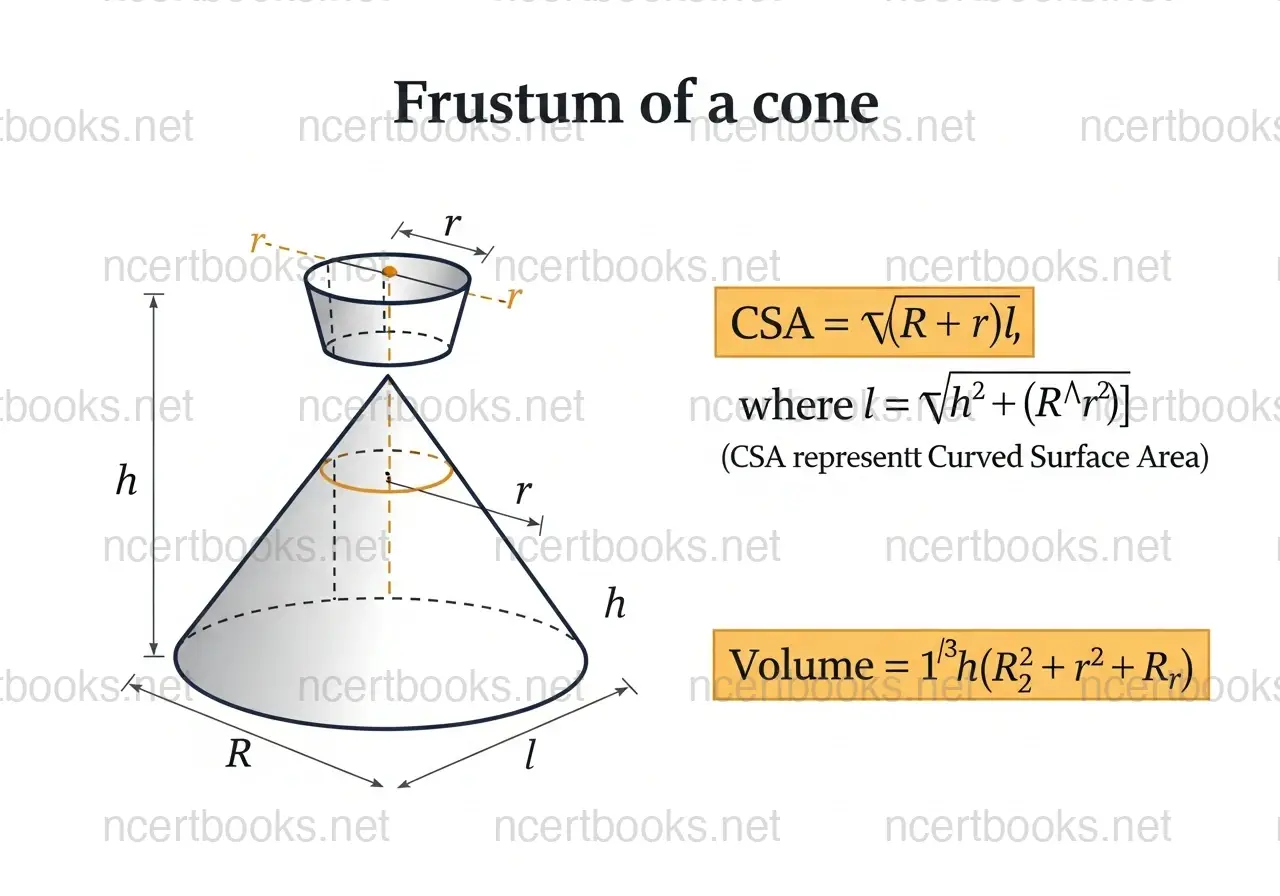
Key Concepts and Formulas for Chapter 13 — Surface Areas and Volumes
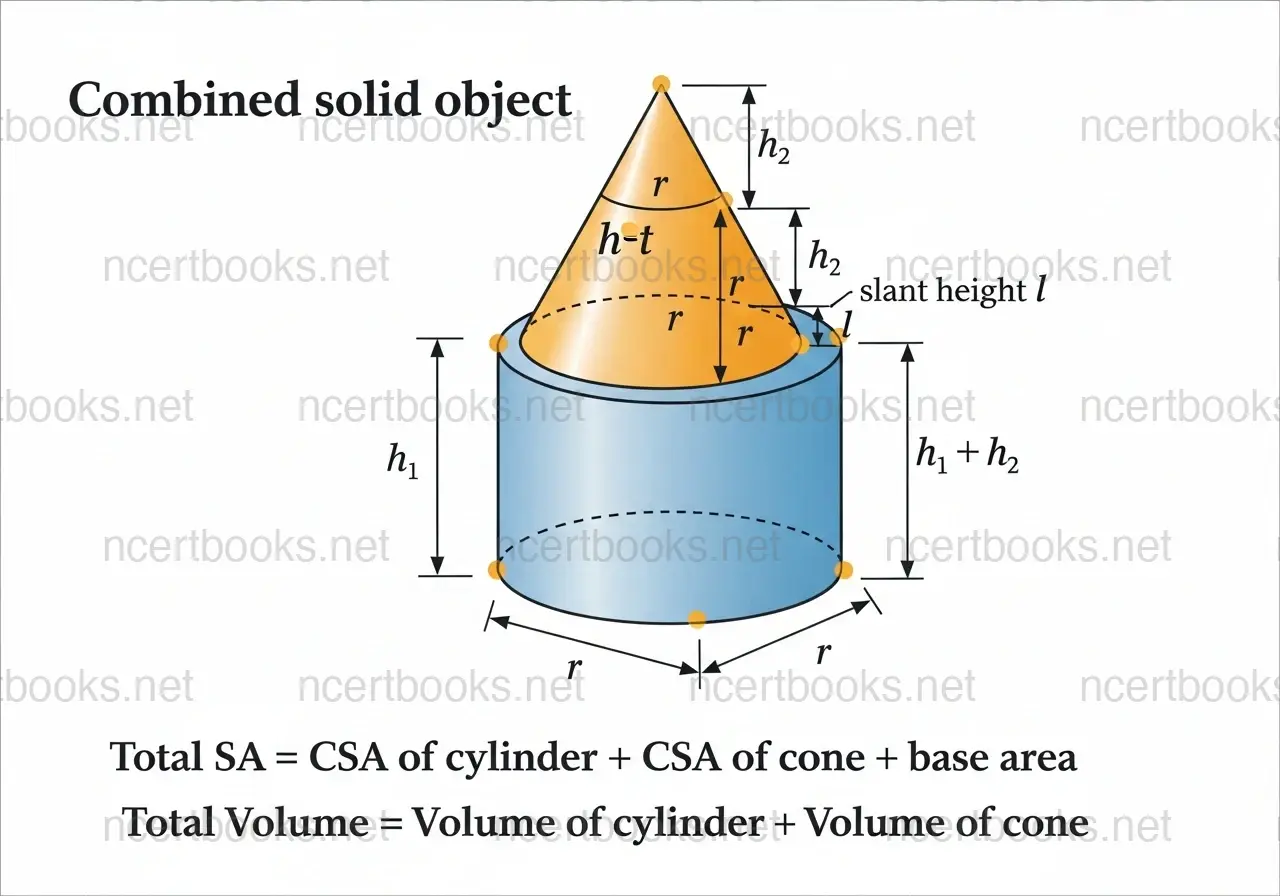
The central idea of Exercise 13.1 is simple: Total Surface Area of a combined solid = Sum of the visible surface areas of individual solids. You must identify which surfaces are exposed (visible) and which are hidden (joined together).
What is a Combination of Solids?
A combination of solids is formed when two or more basic solids are joined together. For example, an ice-cream cone is a cone with a hemisphere on top. A capsule is a cylinder with two hemispheres at each end. In all such cases, the surface area calculation requires care about which parts are visible.
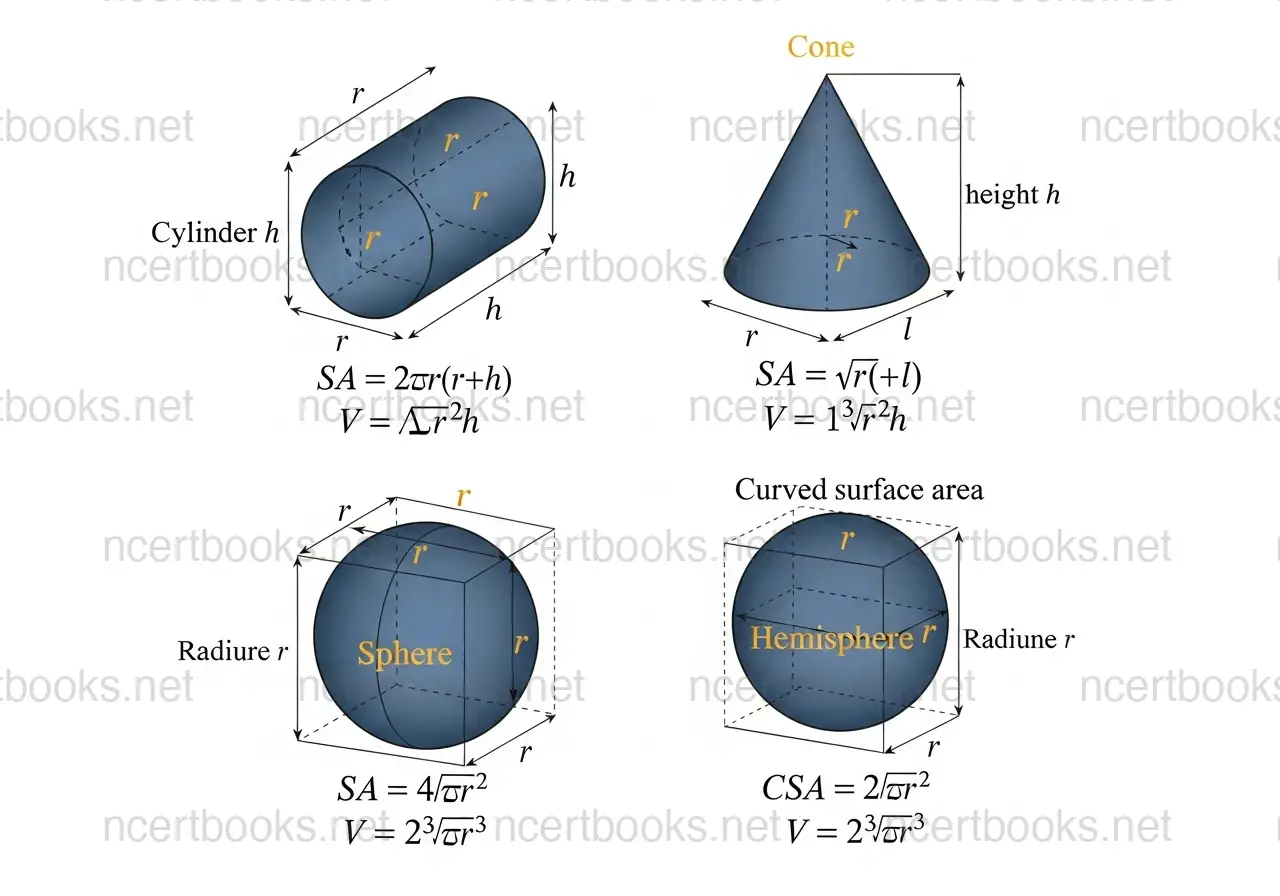
Key Formulas Used in Exercise 13.1
All formulas below use \( \pi = \frac{22}{7} \) unless stated otherwise.
- Curved Surface Area (CSA) of cylinder: \( 2\pi r h \)
- Total Surface Area (TSA) of cylinder: \( 2\pi r(r + h) \)
- CSA of cone: \( \pi r l \) where slant height \( l = \sqrt{r^2 + h^2} \)
- TSA of cone: \( \pi r(r + l) \)
- CSA of hemisphere: \( 2\pi r^2 \)
- TSA of hemisphere: \( 3\pi r^2 \)
- Surface area of sphere: \( 4\pi r^2 \)
- TSA of cuboid: \( 2(lb + bh + hl) \)
- TSA of cube (side a): \( 6a^2 \)
Formula Reference Table — Surface Areas and Volumes Class 10
| Formula Name | Formula (LaTeX) | Variables Defined |
|---|---|---|
| CSA of Cylinder | \( 2\pi r h \) | r = radius, h = height |
| TSA of Cylinder | \( 2\pi r(r+h) \) | r = radius, h = height |
| CSA of Cone | \( \pi r l \) | r = radius, l = slant height |
| Slant Height of Cone | \( l = \sqrt{r^2 + h^2} \) | r = radius, h = vertical height |
| CSA of Hemisphere | \( 2\pi r^2 \) | r = radius |
| TSA of Hemisphere | \( 3\pi r^2 \) | r = radius |
| Surface Area of Sphere | \( 4\pi r^2 \) | r = radius |
| TSA of Cuboid | \( 2(lb + bh + hl) \) | l = length, b = breadth, h = height |
| TSA of Cube | \( 6a^2 \) | a = side length |
NCERT Solutions Exercise 13.1 — NCERT Solutions Class 10th Maths Chapter 13 Surface Areas and Volumes (All 9 Questions)
Below are complete, step-by-step solutions for all 9 questions in Exercise 13.1. These solutions match the official NCERT answer key and are written to help you score full marks in your 2026-27 CBSE board exam. Each solution uses \( \pi = \frac{22}{7} \).
Question 1
Easy
2 cubes each of volume 64 cm³ are joined end to end. Find the surface area of the resulting cuboid.
Step 1: Find the side of each cube. Volume of cube \( = a^3 = 64 \) cm³
\[ a = \sqrt[3]{64} = 4 \text{ cm} \]
Step 2: When two cubes are joined end to end, the resulting cuboid has dimensions:
Length \( l = 4 + 4 = 8 \) cm, Breadth \( b = 4 \) cm, Height \( h = 4 \) cm
Step 3: Apply the TSA formula for a cuboid:
\[ \text{TSA} = 2(lb + bh + hl) \]
\[ = 2(8 \times 4 + 4 \times 4 + 4 \times 8) \]
\[ = 2(32 + 16 + 32) \]
\[ = 2 \times 80 = 160 \text{ cm}^2 \]
Why does this work? When the cubes are joined, two square faces (each of area 4 × 4 = 16 cm²) are hidden inside — they are not part of the outer surface. The formula automatically accounts for this.
\( \therefore \) Surface area of the resulting cuboid = 160 cm²
Question 2
Medium
A vessel is in the form of a hollow hemisphere mounted by a hollow cylinder. The diameter of the hemisphere is 14 cm and the total height of the vessel is 13 cm. Find the inner surface area of the vessel.
Key Concept: The inner surface area = CSA of cylinder + CSA of hemisphere (the circular rim where they join is not a surface).
Step 1: Find the dimensions.
Diameter of hemisphere = 14 cm, so radius \( r = 7 \) cm.
Total height of vessel = 13 cm. Height of hemisphere = radius = 7 cm.
Height of cylinder \( h = 13 – 7 = 6 \) cm.
Step 2: Calculate CSA of the cylinder:
\[ \text{CSA of cylinder} = 2\pi r h = 2 \times \frac{22}{7} \times 7 \times 6 = 264 \text{ cm}^2 \]
Step 3: Calculate CSA of the hemisphere:
\[ \text{CSA of hemisphere} = 2\pi r^2 = 2 \times \frac{22}{7} \times 7 \times 7 = 308 \text{ cm}^2 \]
Step 4: Add both:
\[ \text{Inner Surface Area} = 264 + 308 = 572 \text{ cm}^2 \]
\( \therefore \) Inner surface area of the vessel = 572 cm²
Question 3
Medium
A toy is in the form of a cone of radius 3.5 cm mounted on a hemisphere of the same radius. The total height of the toy is 15.5 cm. Find the total surface area of the toy.
Step 1: Find the height of the cone.
Total height = 15.5 cm. Height of hemisphere = radius = 3.5 cm.
Height of cone \( h = 15.5 – 3.5 = 12 \) cm, radius \( r = 3.5 \) cm.
Step 2: Find the slant height of the cone:
\[ l = \sqrt{r^2 + h^2} = \sqrt{(3.5)^2 + (12)^2} = \sqrt{12.25 + 144} = \sqrt{156.25} = 12.5 \text{ cm} \]
Step 3: Total surface area = CSA of cone + CSA of hemisphere (the base circle of the cone coincides with the flat face of the hemisphere — not visible).
\[ \text{CSA of cone} = \pi r l = \frac{22}{7} \times 3.5 \times 12.5 = 137.5 \text{ cm}^2 \]
\[ \text{CSA of hemisphere} = 2\pi r^2 = 2 \times \frac{22}{7} \times (3.5)^2 = 2 \times \frac{22}{7} \times 12.25 = 77 \text{ cm}^2 \]
Step 4: Add both:
\[ \text{Total Surface Area} = 137.5 + 77 = 214.5 \text{ cm}^2 \]
\( \therefore \) Total surface area of the toy = 214.5 cm²
Question 4
Medium
A cubical block of side 7 cm is surmounted by a hemisphere. What is the greatest diameter the hemisphere can have? Find the surface area of the solid.
Step 1: The greatest diameter of the hemisphere = side of the cube = 7 cm. So radius \( r = 3.5 \) cm.
Step 2: The surface area of the solid = TSA of cube − base circle of hemisphere + CSA of hemisphere.
Why? The hemisphere sits on one face of the cube. The circular base of the hemisphere (area = \( \pi r^2 \)) is no longer exposed. We replace it with the curved surface of the hemisphere.
Step 3: Calculate each part:
\[ \text{TSA of cube} = 6a^2 = 6 \times 7^2 = 6 \times 49 = 294 \text{ cm}^2 \]
\[ \text{Area of base circle of hemisphere} = \pi r^2 = \frac{22}{7} \times (3.5)^2 = \frac{22}{7} \times 12.25 = 38.5 \text{ cm}^2 \]
\[ \text{CSA of hemisphere} = 2\pi r^2 = 2 \times 38.5 = 77 \text{ cm}^2 \]
Step 4: Total surface area:
\[ = 294 – 38.5 + 77 = 332.5 \text{ cm}^2 \]
\( \therefore \) Greatest diameter = 7 cm; Surface area of the solid = 332.5 cm²
Question 5
Hard
A hemispherical depression is cut out from one face of a cubical wooden block such that the diameter d of the hemisphere is equal to the edge of the cube. Determine the surface area of the remaining solid.
Step 1: Let the edge of the cube = d. Then radius of hemisphere \( r = \frac{d}{2} \).
Step 2: The surface area of the remaining solid consists of:
- 5 complete faces of the cube (the 6th face has the hemispherical depression)
- The 6th face minus the circular opening: \( d^2 – \pi r^2 \)
- The curved inner surface of the hemispherical depression: \( 2\pi r^2 \)
Step 3: Calculate:
\[ \text{Area of 5 full faces} = 5d^2 \]
\[ \text{Area of 6th face (with hole)} = d^2 – \pi r^2 = d^2 – \pi \left(\frac{d}{2}\right)^2 = d^2 – \frac{\pi d^2}{4} \]
\[ \text{CSA of hemispherical cavity} = 2\pi r^2 = 2\pi \left(\frac{d}{2}\right)^2 = \frac{\pi d^2}{2} \]
Step 4: Add all parts:
\[ \text{Total Surface Area} = 5d^2 + d^2 – \frac{\pi d^2}{4} + \frac{\pi d^2}{2} \]
\[ = 6d^2 + \frac{\pi d^2}{4}(-1 + 2) \]
\[ = 6d^2 + \frac{\pi d^2}{4} \]
\[ = \frac{1}{4}\left(24d^2 + \pi d^2\right) = \frac{d^2}{4}(24 + \pi) \]
\( \therefore \) Surface area of the remaining solid \( = \dfrac{d^2}{4}(24 + \pi) \)
Question 6
Medium
A medicine capsule is in the shape of a cylinder with two hemispheres stuck to each of its ends. The length of the entire capsule is 14 mm and the diameter of the capsule is 5 mm. Find its surface area.
Step 1: Diameter = 5 mm, so radius \( r = 2.5 \) mm.
Total length of capsule = 14 mm. Each hemisphere has height = radius = 2.5 mm.
Length of cylindrical part \( h = 14 – 2 \times 2.5 = 14 – 5 = 9 \) mm.
Step 2: Surface area = CSA of cylinder + 2 × CSA of hemisphere.
Why? The two flat circular ends of the cylinder are covered by the hemispheres — not visible. The two hemisphere bases are also not visible (joined to cylinder). Only the curved surfaces are exposed.
\[ \text{CSA of cylinder} = 2\pi r h = 2 \times \frac{22}{7} \times 2.5 \times 9 = \frac{990}{7} \approx 141.43 \text{ mm}^2 \]
\[ 2 \times \text{CSA of hemisphere} = 2 \times 2\pi r^2 = 4\pi r^2 = 4 \times \frac{22}{7} \times (2.5)^2 = 4 \times \frac{22}{7} \times 6.25 = \frac{550}{7} \approx 78.57 \text{ mm}^2 \]
Step 3: Total surface area:
\[ = \frac{990}{7} + \frac{550}{7} = \frac{1540}{7} = 220 \text{ mm}^2 \]
\( \therefore \) Surface area of the medicine capsule = 220 mm²
Question 7
Medium
A tent is in the shape of a cylinder surmounted by a conical top. If the height and diameter of the cylindrical part are 2.1 m and 4 m respectively, and the slant height of the top is 2.8 m, find the area of the canvas used for making the tent. Also, find the cost of the canvas of the tent at the rate of Rs 500 per m². (Note that the base of the tent will not be covered with canvas.)
Step 1: Identify dimensions. Diameter = 4 m, so radius \( r = 2 \) m. Height of cylinder \( h = 2.1 \) m. Slant height of cone \( l = 2.8 \) m.
Step 2: Canvas area = CSA of cylinder + CSA of cone. (Base is not covered.)
\[ \text{CSA of cylinder} = 2\pi r h = 2 \times \frac{22}{7} \times 2 \times 2.1 = \frac{2 \times 22 \times 2 \times 2.1}{7} = \frac{184.8}{7} = 26.4 \text{ m}^2 \]
\[ \text{CSA of cone} = \pi r l = \frac{22}{7} \times 2 \times 2.8 = \frac{22 \times 2 \times 2.8}{7} = \frac{123.2}{7} = 17.6 \text{ m}^2 \]
Step 3: Total canvas area:
\[ = 26.4 + 17.6 = 44 \text{ m}^2 \]
Step 4: Cost of canvas:
\[ \text{Cost} = 44 \times 500 = \text{Rs } 22000 \]
\( \therefore \) Area of canvas = 44 m²; Cost of canvas = Rs 22,000
Question 8
Hard
From a solid cylinder whose height is 2.4 cm and diameter 1.4 cm, a conical cavity of the same height and same diameter is hollowed out. Find the total surface area of the remaining solid to the nearest cm².
Step 1: Diameter = 1.4 cm, so radius \( r = 0.7 \) cm. Height \( h = 2.4 \) cm.
Step 2: Find slant height of the cone:
\[ l = \sqrt{r^2 + h^2} = \sqrt{(0.7)^2 + (2.4)^2} = \sqrt{0.49 + 5.76} = \sqrt{6.25} = 2.5 \text{ cm} \]
Step 3: The remaining solid has these visible surfaces:
- Curved surface of the cylinder (outer)
- Top circular face of the cylinder (the cone is hollowed from the bottom, so top remains)
- Base circular ring — wait, the cone is removed from the bottom, so the base circle is gone. Actually the cone is hollowed from inside, so the base of the cylinder is the base of the cone — the base circle is still present as a flat ring… but since the cone has the same base, the base of the cylinder is entirely the base of the cone. The bottom face is not there (it’s the opening of the cone). So the surfaces are: CSA of cylinder + top circle + CSA of cone (inner curved surface).
Clarification: The cone is hollowed out from the bottom. So the bottom flat face of the cylinder is removed (it becomes the open base of the conical cavity). The visible surfaces are: (1) CSA of cylinder, (2) top circular face of cylinder, (3) inner curved surface of cone (the cavity wall).
\[ \text{CSA of cylinder} = 2\pi r h = 2 \times \frac{22}{7} \times 0.7 \times 2.4 = \frac{2 \times 22 \times 0.7 \times 2.4}{7} = \frac{73.92}{7} = 10.56 \text{ cm}^2 \]
\[ \text{Top circle} = \pi r^2 = \frac{22}{7} \times (0.7)^2 = \frac{22}{7} \times 0.49 = \frac{10.78}{7} = 1.54 \text{ cm}^2 \]
\[ \text{CSA of cone} = \pi r l = \frac{22}{7} \times 0.7 \times 2.5 = \frac{38.5}{7} = 5.5 \text{ cm}^2 \]
Step 4: Total surface area:
\[ = 10.56 + 1.54 + 5.5 = 17.60 \text{ cm}^2 \approx 18 \text{ cm}^2 \]
\( \therefore \) Total surface area of the remaining solid ≈ 18 cm²
Question 9
Hard
A wooden article was made by scooping out a hemisphere from each end of a solid cylinder, as shown in figure. If the height of the cylinder is 10 cm, and its base is of radius 3.5 cm, find the total surface area of the article.
Step 1: Radius of cylinder = radius of each hemisphere = \( r = 3.5 \) cm. Height of cylinder \( h = 10 \) cm.
Step 2: Identify the visible surfaces. Two hemispheres are scooped out from each end. The two flat circular ends of the cylinder are completely removed. Instead, the inner curved surfaces of the two hemispheres are visible.
Visible surfaces:
- Curved surface of the cylinder (lateral surface)
- 2 × CSA of hemisphere (inner curved surfaces of the two scooped-out hemispheres)
Note: The flat circular ends of the cylinder are NOT visible — they are replaced by the hemispherical cavities.
Step 3: Calculate each:
\[ \text{CSA of cylinder} = 2\pi r h = 2 \times \frac{22}{7} \times 3.5 \times 10 = \frac{2 \times 22 \times 3.5 \times 10}{7} = \frac{1540}{7} = 220 \text{ cm}^2 \]
\[ 2 \times \text{CSA of hemisphere} = 2 \times 2\pi r^2 = 4\pi r^2 = 4 \times \frac{22}{7} \times (3.5)^2 = 4 \times \frac{22}{7} \times 12.25 = \frac{1078}{7} = 154 \text{ cm}^2 \]
Step 4: Total surface area:
\[ = 220 + 154 = 374 \text{ cm}^2 \]
\( \therefore \) Total surface area of the wooden article = 374 cm²
Solved Examples Beyond NCERT — Extra Practice for CBSE Class 10 Maths
These extra examples go slightly beyond Exercise 13.1 and are ideal for students targeting full marks in the 2026-27 board exam.
Extra Example 1
Medium
A solid is in the form of a cone mounted on a cylinder. The radius of the base of the cone and the cylinder is 5 cm. The height of the cylinder is 8 cm and the slant height of the cone is 13 cm. Find the total surface area of the solid.
Step 1: \( r = 5 \) cm, cylinder height \( h_c = 8 \) cm, cone slant height \( l = 13 \) cm.
Step 2: Visible surfaces = CSA of cylinder + base circle of cylinder + CSA of cone (base of cone is hidden — it sits on top of cylinder).
\[ \text{CSA of cylinder} = 2\pi r h_c = 2 \times \frac{22}{7} \times 5 \times 8 = \frac{1760}{7} \approx 251.43 \text{ cm}^2 \]
\[ \text{Base of cylinder} = \pi r^2 = \frac{22}{7} \times 25 = \frac{550}{7} \approx 78.57 \text{ cm}^2 \]
\[ \text{CSA of cone} = \pi r l = \frac{22}{7} \times 5 \times 13 = \frac{1430}{7} \approx 204.29 \text{ cm}^2 \]
\[ \text{Total} = \frac{1760 + 550 + 1430}{7} = \frac{3740}{7} \approx 534.29 \text{ cm}^2 \]
\( \therefore \) Total surface area ≈ 534.29 cm²
Extra Example 2
Easy
A sphere of radius 7 cm is mounted on a cylinder of radius 7 cm and height 14 cm. Find the total surface area of the solid (excluding the base of the cylinder).
Step 1: \( r = 7 \) cm, cylinder height \( h = 14 \) cm.
Step 2: Visible surfaces = CSA of cylinder + Surface area of sphere − base circle of sphere (where it joins the cylinder).
\[ \text{CSA of cylinder} = 2\pi r h = 2 \times \frac{22}{7} \times 7 \times 14 = 616 \text{ cm}^2 \]
\[ \text{Surface area of sphere} = 4\pi r^2 = 4 \times \frac{22}{7} \times 49 = 616 \text{ cm}^2 \]
\[ \text{Base circle} = \pi r^2 = \frac{22}{7} \times 49 = 154 \text{ cm}^2 \]
\[ \text{Total} = 616 + 616 – 154 = 1078 \text{ cm}^2 \]
\( \therefore \) Total surface area = 1078 cm²
Important Questions for Board Exam 2026-27 — NCERT Class 10 Maths Chapter 13
These questions are selected based on past CBSE board exam patterns. Practise all of them before your 2026-27 exam.
1-Mark Questions (Definition / Recall)
- Write the formula for the curved surface area of a hemisphere of radius r. Answer: \( 2\pi r^2 \)
- What is the slant height of a cone with radius 6 cm and height 8 cm? Answer: \( l = \sqrt{36 + 64} = 10 \) cm
- If two cubes of side 5 cm are joined end to end, what are the dimensions of the resulting cuboid? Answer: 10 cm × 5 cm × 5 cm
3-Mark Questions (Application)
- A solid is made by placing a hemisphere of radius 4 cm on top of a cylinder of the same radius and height 6 cm. Find the total surface area. Answer: CSA of cylinder + base of cylinder + CSA of hemisphere = \( 2\pi(4)(6) + \pi(4)^2 + 2\pi(4)^2 = 48\pi + 16\pi + 32\pi = 96\pi \approx 301.71 \) cm²
- The diameter of a metallic sphere is 6 cm. It is melted and drawn into a wire of diameter 0.2 cm. Find the length of the wire. (This connects Chapter 13 Volume section — good revision.)
5-Mark Questions (Long Answer)
- A tent is in the shape of a right circular cylinder of height 3 m and radius 3 m, surmounted by a right circular cone of the same radius and slant height 5 m. Find the cost of canvas required at Rs 200 per m². Answer: Canvas = CSA of cylinder + CSA of cone = \( 2\pi(3)(3) + \pi(3)(5) = 18\pi + 15\pi = 33\pi \approx 103.71 \) m². Cost = \( 103.71 \times 200 \approx \) Rs 20,742.
Common Mistakes Students Make in Chapter 13 Surface Areas and Volumes
These are the most frequent errors seen in CBSE board answer sheets. Fix these before your 2026-27 exam.
Mistake 1: Students add the total surface area of each solid instead of only the visible parts.
Why it’s wrong: The joined/hidden faces must not be counted — they are inside the solid.
Correct approach: Identify which faces are exposed and add only those.
Mistake 2: Students forget to subtract the circular base of the hemisphere when it sits on a cube or cylinder.
Why it’s wrong: That circle is hidden — it is the junction between the two solids.
Correct approach: TSA of cube − base circle of hemisphere + CSA of hemisphere.
Mistake 3: Students use diameter instead of radius in formulas.
Why it’s wrong: All standard surface area formulas use radius r, not diameter d.
Correct approach: Always divide the given diameter by 2 before substituting.
Mistake 4: Students forget to calculate slant height and use vertical height in the cone CSA formula.
Why it’s wrong: The formula \( \pi r l \) requires slant height l, not vertical height h.
Correct approach: Always compute \( l = \sqrt{r^2 + h^2} \) as a separate step.
Mistake 5: In Question 8, students include the base circle of the cylinder in the total surface area even though the cone is hollowed from the bottom.
Why it’s wrong: The base of the cylinder is removed when the cone is hollowed out.
Correct approach: Include CSA of cylinder + top circle + CSA of cone (inner surface).
Exam Tips for 2026-27 CBSE Board — Chapter 13 Surface Areas and Volumes
Use these tips when preparing for your 2026-27 CBSE Class 10 board exam:
- Show all formula steps: The CBSE 2026-27 marking scheme awards 1 mark for writing the correct formula. Never skip it.
- Use \( \pi = \frac{22}{7} \): Unless the question specifies otherwise, always use \( \frac{22}{7} \). Using 3.14 may give slightly different answers and cost marks.
- Draw a rough diagram: A quick sketch of the combined solid helps you identify visible surfaces. Examiners award marks for correct diagrams.
- Label intermediate answers: Write “CSA of cylinder = …” and “CSA of cone = …” as separate lines. This helps you get partial marks even if the final answer is wrong.
- Round correctly: When the question says “to the nearest cm²”, you must round. Leaving an unrounded decimal answer loses the final mark.
- Chapter weightage: Mensuration (including Chapter 13) typically carries 10–12 marks in the CBSE Class 10 board paper. Mastering Exercise 13.1 can secure you 5–6 marks directly.
Key Points to Remember — NCERT Class 10 Maths Chapter 13
- Surface area of a combination = sum of visible surface areas only
- Always find slant height \( l = \sqrt{r^2 + h^2} \) before using cone CSA formula
- Two hemispheres together = one complete sphere: \( 2 \times 2\pi r^2 = 4\pi r^2 \)
- When a hemisphere is placed on a cube: subtract one \( \pi r^2 \) from cube TSA and add \( 2\pi r^2 \)
- When a hemisphere is scooped out: subtract \( \pi r^2 \) from the face and add \( 2\pi r^2 \) (inner curved surface)
- For the capsule shape (cylinder + 2 hemispheres): cylinder length = total length − 2r
- Use \( \pi = \frac{22}{7} \) for clean calculations in all Exercise 13.1 questions
For more CBSE Class 10 Maths solutions, visit our NCERT Solutions for Class 10 hub. You can also explore all chapters under NCERT Solutions for every class and subject.