⚡ Quick Revision Box
- Chapter Focus: Division of line segments and construction of similar triangles
- Key Tools: Compass, ruler, and protractor for geometric constructions
- Exercise 11.1: Contains 7 construction-based questions worth 4-6 marks each
- Line Division Formula: To divide line AB in ratio m:n, construct (m+n) equal parts
- Similar Triangle Construction: Use scale factor method with ray technique
- Exam Weightage: 8-10 marks from Constructions chapter in CBSE board exam
- Time Required: 15-20 minutes per construction question in exam
- Common Mistakes: Inaccurate measurements and missing construction marks
Chapter Overview — NCERT Solutions Class 10th Maths Chapter 11 Exercise 11.1
The NCERT Solutions Class 10th Maths Chapter 11 Exercise 11.1 focuses on geometric constructions, specifically the division of line segments and construction of similar triangles. This chapter from the NCERT Mathematics textbook for Class 10 is crucial for the 2026-27 CBSE board examination as construction questions carry significant marks.
Chapter 11 Constructions covers fundamental geometric construction techniques using compass and ruler. Students learn to divide line segments in given ratios and construct triangles similar to given triangles with specific scale factors. These skills are essential for solving geometry problems in board exams.
The chapter typically contributes 8-10 marks in the CBSE Class 10 Mathematics board exam. Questions from this chapter appear as 4-mark or 6-mark construction problems. Students must show all construction steps clearly and maintain accuracy in measurements to score full marks.
| Chapter | Textbook | Class | Subject | Marks Weightage | Difficulty Level |
|---|---|---|---|---|---|
| Chapter 11 – Constructions | NCERT Mathematics | Class 10 | Mathematics | 8-10 marks | Medium |
Students can access comprehensive study materials and practice questions from the official NCERT website to strengthen their understanding of geometric constructions.
NCERT Solutions Exercise 11.1 — Division of Line Segments
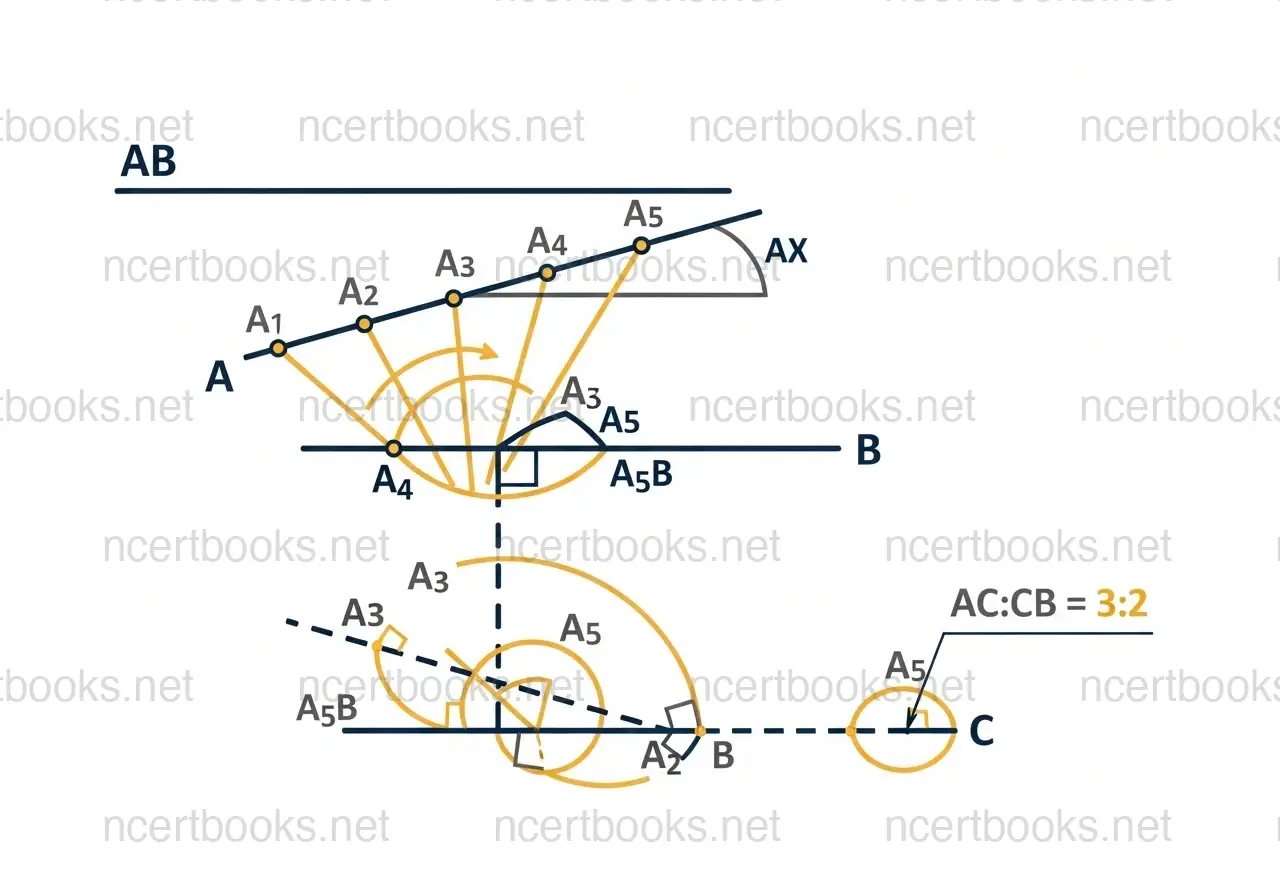
Answer:
Steps of Construction:
- Draw a line segment AB = 7.6 cm using a ruler.
- Draw a ray AX making an acute angle with AB.
- Mark 13 equal divisions (5+8=13) on ray AX: A₁, A₂, A₃, …, A₁₃.
- Join A₁₃ to B.
- From point A₅, draw a line parallel to A₁₃B intersecting AB at point P.
- Point P divides AB in the ratio 5:8.
Measurement:
- AP = 2.9 cm (approximately)
- PB = 4.7 cm (approximately)
- Verification: AP:PB = 2.9:4.7 ≈ 5:8
Answer:
Steps of Construction:
- Draw a line segment BC = 6 cm.
- With B as center and radius 4 cm, draw an arc.
- With C as center and radius 5 cm, draw another arc intersecting the first arc at A.
- Join AB and AC to form triangle ABC.
- Draw a ray BX making an acute angle with BC below BC.
- Mark 3 equal divisions on BX: B₁, B₂, B₃ (since 2/3, denominator is 3).
- Join B₃ to C.
- From B₂, draw a line parallel to B₃C intersecting BC at C’.
- From C’, draw a line parallel to CA intersecting BA at A’.
- Triangle A’BC’ is the required similar triangle.
Verification:
- A’B = (2/3) × 4 = 8/3 cm
- BC’ = (2/3) × 6 = 4 cm
- A’C’ = (2/3) × 5 = 10/3 cm
Answer:
Steps of Construction:
- Draw a line segment BC = 6 cm.
- With B as center and radius 4 cm, draw an arc.
- With C as center and radius 5 cm, draw another arc intersecting the first arc at A.
- Join AB and AC to form triangle ABC.
- Draw a ray BX making an acute angle with BC below BC.
- Mark 5 equal divisions on BX: B₁, B₂, B₃, B₄, B₅ (since 5/3, numerator is 5).
- Join B₃ to C (denominator is 3).
- From B₅, draw a line parallel to B₃C intersecting the extended line BC at C’.
- From C’, draw a line parallel to CA intersecting the extended line BA at A’.
- Triangle A’BC’ is the required similar triangle.
Verification:
- A’B = (5/3) × 4 = 20/3 cm
- BC’ = (5/3) × 6 = 10 cm
- A’C’ = (5/3) × 5 = 25/3 cm
Answer:
Steps of Construction:
- Draw a line segment BC = 8 cm.
- Draw the perpendicular bisector of BC intersecting BC at D.
- From D, mark point A such that AD = 4 cm on the perpendicular bisector.
- Join AB and AC to form isosceles triangle ABC.
- Draw a ray BX making an acute angle with BC below BC.
- Mark 3 equal divisions on BX: B₁, B₂, B₃ (since 1.5 = 3/2, denominator is 2, but we need 3 for numerator).
- Join B₂ to C.
- From B₃, draw a line parallel to B₂C intersecting the extended line BC at C’.
- From C’, draw a line parallel to CA intersecting the extended line BA at A’.
- Triangle A’BC’ is the required similar triangle with sides 1.5 times the original.
Measurements:
- Original triangle: Base = 8 cm, Equal sides = 5 cm each (approximately)
- New triangle: Base = 12 cm, Equal sides = 7.5 cm each
Answer:
Steps of Construction:
- Draw a line segment BC = 6 cm.
- At point B, construct an angle of 60° using compass.
- From B, cut an arc of radius 5 cm on the 60° ray to get point A.
- Join AC to complete triangle ABC.
- Draw a ray BX making an acute angle with BC below BC.
- Mark 4 equal divisions on BX: B₁, B₂, B₃, B₄ (since 3/4, denominator is 4).
- Join B₄ to C.
- From B₃, draw a line parallel to B₄C intersecting BC at C’.
- From C’, draw a line parallel to CA intersecting BA at A’.
- Triangle A’BC’ is the required similar triangle.
Verification:
- A’B = (3/4) × 5 = 3.75 cm
- BC’ = (3/4) × 6 = 4.5 cm
- A’C’ = (3/4) × AC
Answer:
Steps of Construction:
- Draw a line segment BC = 7 cm.
- At point B, construct an angle of 45°.
- At point C, construct an angle of 30° (since ∠C = 180° – 105° – 45° = 30°).
- Let the two rays intersect at point A to form triangle ABC.
- Draw a ray BX making an acute angle with BC below BC.
- Mark 4 equal divisions on BX: B₁, B₂, B₃, B₄ (since 4/3, numerator is 4).
- Join B₃ to C (denominator is 3).
- From B₄, draw a line parallel to B₃C intersecting the extended line BC at C’.
- From C’, draw a line parallel to CA intersecting the extended line BA at A’.
- Triangle A’BC’ is the required similar triangle.
Properties:
- All sides of triangle A’BC’ are 4/3 times the corresponding sides of triangle ABC
- All angles remain the same: ∠A’ = 105°, ∠B’ = 45°, ∠C’ = 30°
Answer:
Steps of Construction:
- Draw a line segment BC = 4 cm.
- At point B, draw a perpendicular line.
- From B, cut an arc of radius 3 cm on the perpendicular to get point A.
- Join AC to complete the right triangle ABC with right angle at B.
- Draw a ray BX making an acute angle with BC below BC.
- Mark 5 equal divisions on BX: B₁, B₂, B₃, B₄, B₅ (since 5/3, numerator is 5).
- Join B₃ to C (denominator is 3).
- From B₅, draw a line parallel to B₃C intersecting the extended line BC at C’.
- From C’, draw a line parallel to CA intersecting the extended line BA at A’.
- Triangle A’BC’ is the required similar triangle.
Measurements:
- Original triangle: BC = 4 cm, AB = 3 cm, AC = 5 cm (hypotenuse)
- New triangle: BC’ = 20/3 cm, A’B = 5 cm, A’C’ = 25/3 cm
- Right angle is maintained at B in both triangles
Important Questions for Exams — Constructions Class 10
Answer: Follow the standard construction method: Draw triangle ABC with given sides, then use ray method with 5 equal divisions. Join the 5th point to C, and from the 4th point draw parallel line to get the scaled triangle. The new triangle will have sides 4 cm, 4.8 cm, and 5.6 cm respectively.
Answer: The basic principle uses the concept of similar triangles and parallel lines. When we construct equal divisions on a ray and draw parallel lines, we create proportional segments. If a line segment needs to be divided in ratio m:n, we create (m+n) equal parts and use the mth division point to draw the parallel line.
Answer: First construct triangle ABC using SSS construction method. Then draw ray BX below BC with acute angle. Mark 7 equal divisions on BX (numerator of 7/5). Join 5th point to C. From 7th point, draw parallel to this line to intersect extended BC at C’. From C’, draw parallel to CA to intersect extended BA at A’. Triangle A’BC’ is the required triangle with sides 5.6 cm, 8.4 cm, and 7 cm.
Answer: We draw the ray from one vertex to maintain the vertex angle unchanged in the similar triangle. This ensures that the new triangle has the same angles as the original triangle while scaling the sides by the required factor.
Answer: Draw line segment AB = 9 cm. Draw ray AX at acute angle. Mark 9 equal divisions (2+7=9). Join 9th point to B. From 2nd point draw parallel line intersecting AB at P. Point P divides AB in ratio 2:7. Measurements: AP = 2 cm and PB = 7 cm (since 9 × 2/9 = 2 cm and 9 × 7/9 = 7 cm).
Common Mistakes Students Make in Constructions
- ❌ Inaccurate measurements → ✅ Use sharp pencil and measure twice before marking
- ❌ Not showing construction arcs → ✅ Keep all construction marks visible for full marks
- ❌ Drawing obtuse angles instead of acute → ✅ Always draw acute angle for ray in constructions
- ❌ Incorrect number of divisions → ✅ For ratio m:n, mark (m+n) equal parts for division, m or n parts for similar triangles
- ❌ Joining wrong points → ✅ For scale factor p/q: mark q divisions, join qth point, draw parallel from pth point
- ❌ Not labeling points clearly → ✅ Label all vertices and construction points with clear letters
Exam Tips for NCERT Solutions Class 10th Maths Chapter 11 Exercise 11.1
- Practice with compass daily: Spend 15 minutes daily practicing basic constructions to improve accuracy and speed for 2026-27 board exam.
- Show all construction steps: CBSE marking scheme awards 1-2 marks for construction arcs and lines, even if final answer is slightly incorrect.
- Use 2H pencil for constructions: Sharp, hard pencil ensures clean construction lines and accurate measurements in exam.
- Double-check measurements: Verify each measurement twice before proceeding to next step – wrong initial measurement affects entire construction.
- Time management strategy: Allocate 15-20 minutes per 4-mark construction question and 25 minutes for 6-mark questions in board exam.
- Learn alternative methods: Know both ray method and parallel line method for similar triangle construction as backup options.