⚡ Quick Revision Box — Chapter 8 Trigonometry
- Chapter: 8 — Introduction to Trigonometry | Class 10 Maths NCERT
- Six Trig Ratios: sin, cos, tan, cosec, sec, cot — all defined from sides of a right triangle
- Key Identity: \( \sin^2 A + \cos^2 A = 1 \) for all values of A
- Pythagoras Link: Always find the missing side using \( \text{Hypotenuse}^2 = \text{Base}^2 + \text{Perpendicular}^2 \) before writing ratios
- Range of sin and cos: Always between 0 and 1 for acute angles (0° to 90°)
- tan A range: Can be any positive value — it is NOT always less than 1
- Exercise 8.1: 11 questions — all based on finding trig ratios from given conditions
- Board Weightage: Trigonometry unit carries ~12 marks in CBSE Class 10 board exam 2026-27
The NCERT Solutions for Class 10 Maths Chapter 8 Introduction to Trigonometry on this page cover all 11 questions of Exercise 8.1 with complete step-by-step working, updated for the CBSE 2026-27 board exam. You can find all NCERT Solutions for Class 10 on our sub-hub, and the full collection of NCERT Solutions for all classes on our main hub. This chapter introduces you to the six trigonometric ratios — sin, cos, tan, cosec, sec, and cot — and shows you how to calculate them from the sides of a right-angled triangle.
NCERT Solutions for Class 10 Maths Chapter 8 Introduction to Trigonometry — Chapter Overview
Chapter 8 of the NCERT Class 10 Maths textbook introduces trigonometry — the branch of mathematics that studies the relationship between the angles and sides of a right-angled triangle. This is one of the most important chapters for CBSE Class 10 because it forms the foundation for Chapter 9 (Some Applications of Trigonometry) and continues into Class 11 and 12 Maths.
For the CBSE 2026-27 board exam, the Trigonometry unit (Chapters 8 and 9 together) carries approximately 12 marks. Questions from Exercise 8.1 typically appear as 1-mark MCQs (true/false type), 2-mark short answers (finding a ratio given another), and 3-mark problems (finding all ratios). You can download the official textbook from the official NCERT website.
Before starting this chapter, make sure you are comfortable with the Pythagoras theorem (from Class 9 Chapter 7 — Triangles) and basic algebraic manipulation. Every solution in Exercise 8.1 uses Pythagoras to find the missing side before writing the trig ratios.
| Detail | Information |
|---|---|
| Chapter | 8 — Introduction to Trigonometry |
| Textbook | NCERT Mathematics — Class 10 (Ganit) |
| Class | 10 |
| Subject | Mathematics |
| Exercise Covered | Exercise 8.1 (11 Questions) |
| Marks Weightage | ~12 marks (Unit: Trigonometry) |
| Difficulty Level | Medium |
| Academic Year | 2026-27 |
Key Concepts and Trigonometric Ratios — Class 10 Chapter 8
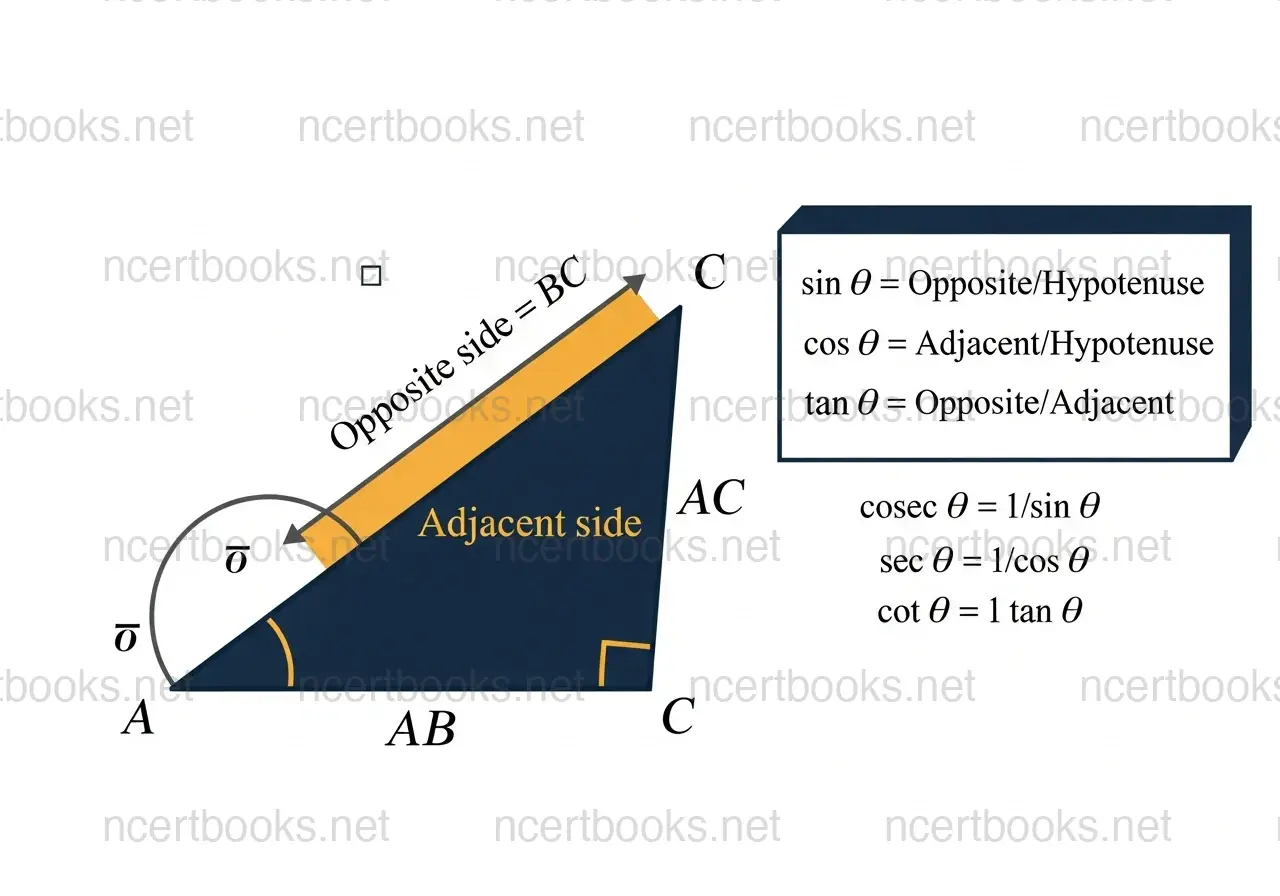
Trigonometry (त्रिकोणमिति) means “measurement of triangles.” In a right-angled triangle ABC, right-angled at B, the three sides are named relative to angle A:
- Opposite side (लम्ब): BC — the side opposite to angle A
- Adjacent side (आधार): AB — the side next to angle A (not the hypotenuse)
- Hypotenuse (कर्ण): AC — the longest side, opposite the right angle
The six trigonometric ratios for angle A are:
\[ \sin A = \frac{\text{Opposite}}{\text{Hypotenuse}} = \frac{BC}{AC} \]
\[ \cos A = \frac{\text{Adjacent}}{\text{Hypotenuse}} = \frac{AB}{AC} \]
\[ \tan A = \frac{\text{Opposite}}{\text{Adjacent}} = \frac{BC}{AB} \]
\[ \text{cosec } A = \frac{1}{\sin A} = \frac{AC}{BC}, \quad \sec A = \frac{1}{\cos A} = \frac{AC}{AB}, \quad \cot A = \frac{1}{\tan A} = \frac{AB}{BC} \]
Key Point: The values of trigonometric ratios depend only on the angle, not on the size of the triangle. Two similar triangles with the same angle A will give the same value of sin A.
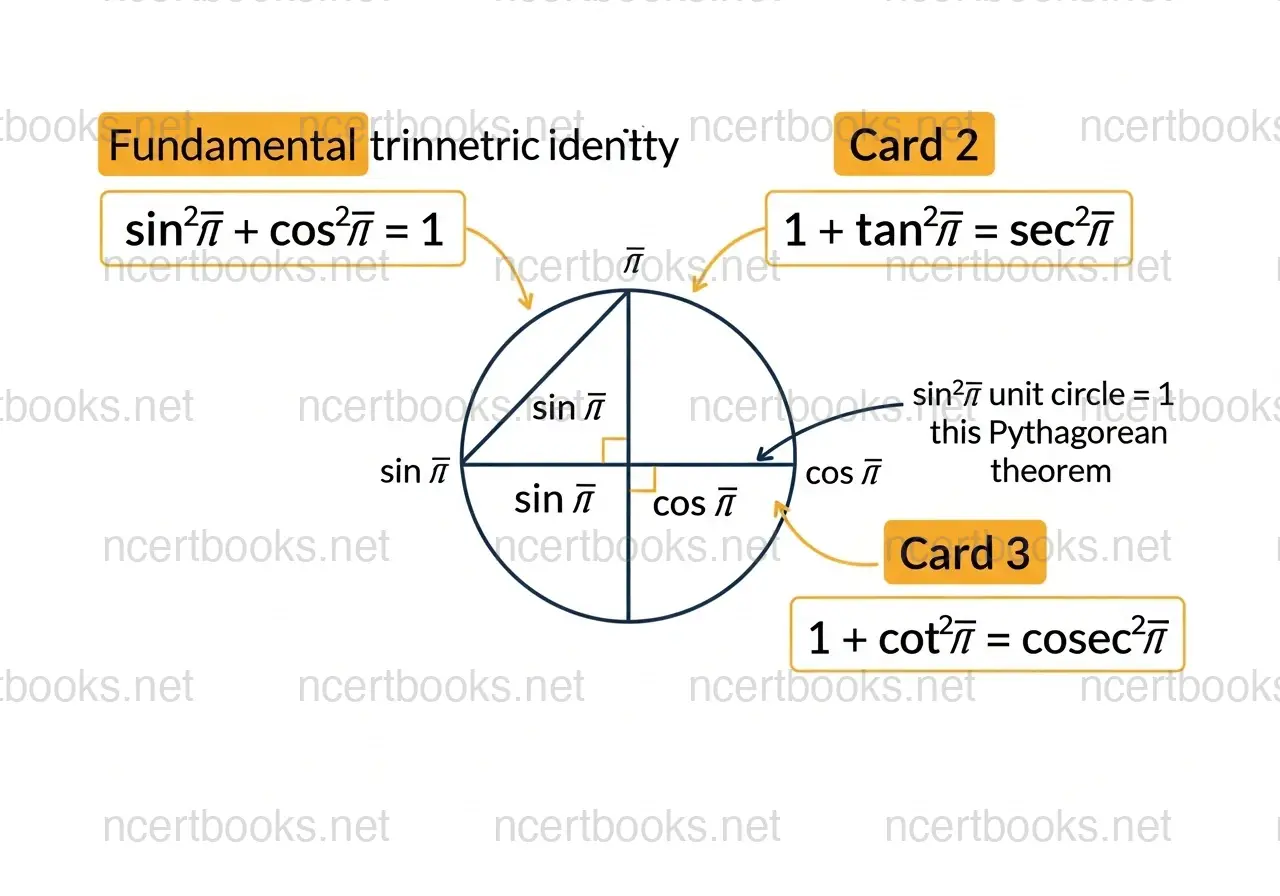
The three fundamental trigonometric identities you must know:
\[ \sin^2 A + \cos^2 A = 1 \]
\[ \sec^2 A – \tan^2 A = 1 \]
\[ \text{cosec}^2 A – \cot^2 A = 1 \]
Formula Reference Table — All Six Trigonometric Ratios
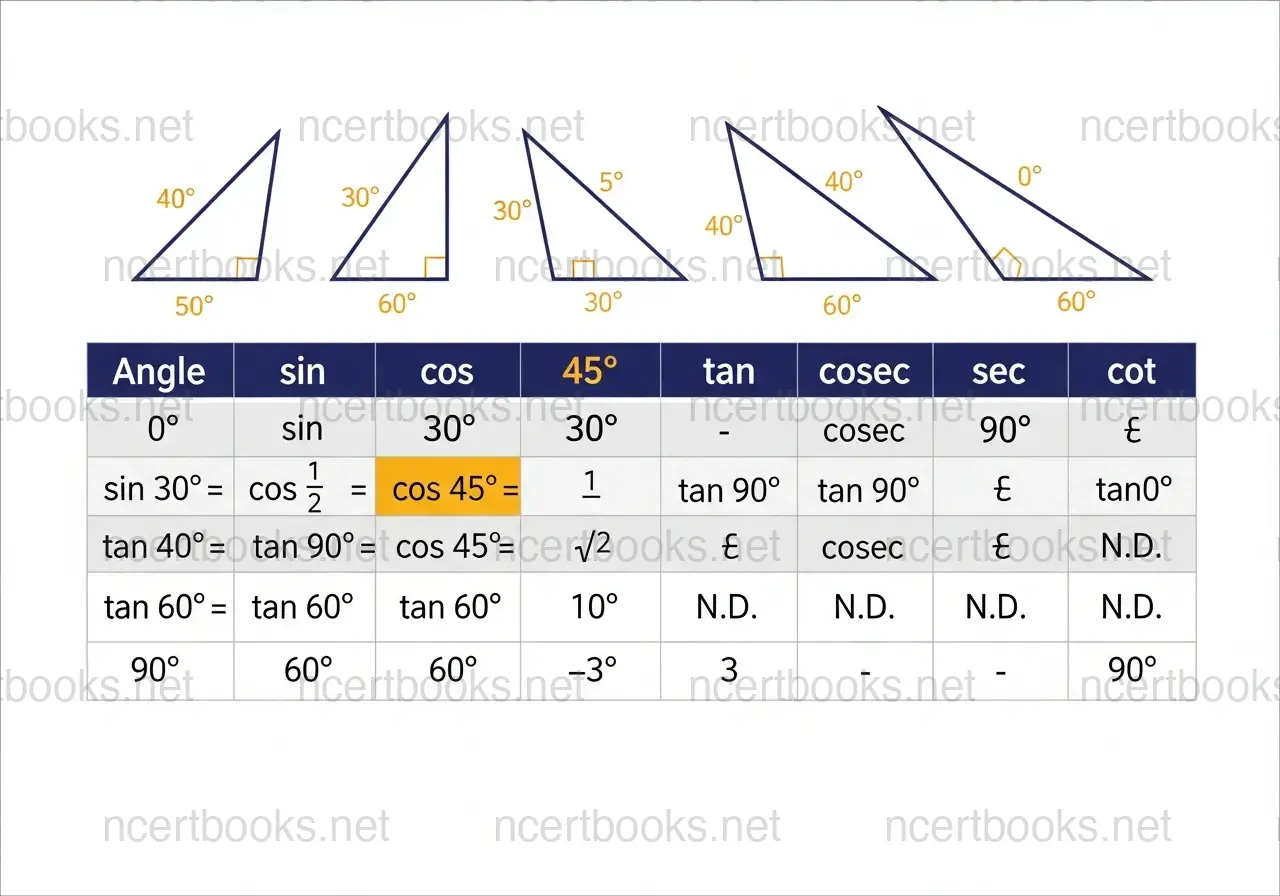
| Ratio Name | Formula | Reciprocal Of | Range (0° to 90°) |
|---|---|---|---|
| sin A | \( \frac{\text{Opposite}}{\text{Hypotenuse}} \) | cosec A | 0 to 1 |
| cos A | \( \frac{\text{Adjacent}}{\text{Hypotenuse}} \) | sec A | 0 to 1 |
| tan A | \( \frac{\text{Opposite}}{\text{Adjacent}} \) | cot A | 0 to ∞ |
| cosec A | \( \frac{\text{Hypotenuse}}{\text{Opposite}} \) | sin A | ≥ 1 |
| sec A | \( \frac{\text{Hypotenuse}}{\text{Adjacent}} \) | cos A | ≥ 1 |
| cot A | \( \frac{\text{Adjacent}}{\text{Opposite}} \) | tan A | 0 to ∞ |
NCERT Solutions for Class 10 Maths Chapter 8 Introduction to Trigonometry — Exercise 8.1 (All 11 Questions)
Below are complete, step-by-step solutions for all 11 questions of Exercise 8.1 from the NCERT Class 10 Maths textbook. Every solution shows the full working so you can follow along and write the same steps in your CBSE board exam 2026-27.
Question 1
Medium
In ∆ABC right angled at B, AB = 24 cm, BC = 7 cm. Determine: (i) sin A, cos A (ii) sin C, cos C
Step 1: Apply the Pythagoras theorem to find AC.
\[ AC^2 = AB^2 + BC^2 = 24^2 + 7^2 = 576 + 49 = 625 \]
\[ AC = \sqrt{625} = 25 \text{ cm} \]
Step 2: For angle A, the opposite side is BC = 7 cm and the adjacent side is AB = 24 cm.
\[ \sin A = \frac{\text{Opposite}}{\text{Hypotenuse}} = \frac{BC}{AC} = \frac{7}{25} \]
\[ \cos A = \frac{\text{Adjacent}}{\text{Hypotenuse}} = \frac{AB}{AC} = \frac{24}{25} \]
\( \therefore \) sin A = 7/25, cos A = 24/25
Step 3: For angle C, the opposite side is AB = 24 cm and the adjacent side is BC = 7 cm.
\[ \sin C = \frac{\text{Opposite}}{\text{Hypotenuse}} = \frac{AB}{AC} = \frac{24}{25} \]
\[ \cos C = \frac{\text{Adjacent}}{\text{Hypotenuse}} = \frac{BC}{AC} = \frac{7}{25} \]
Why does this work? Notice that sin A = cos C and cos A = sin C. This is because A and C are complementary angles in a right triangle (A + C = 90°).
\( \therefore \) sin C = 24/25, cos C = 7/25
Question 2
Medium
In the given figure, find tan P − cot R. (Triangle PQR, right-angled at Q, with PQ = 12 cm, QR = 5 cm, PR = 13 cm)
Step 1: Verify PR using Pythagoras theorem.
\[ PR^2 = PQ^2 + QR^2 = 12^2 + 5^2 = 144 + 25 = 169 \]
\[ PR = \sqrt{169} = 13 \text{ cm} \quad \checkmark \]
Step 2: Find tan P. For angle P, opposite side = QR = 5, adjacent side = PQ = 12.
\[ \tan P = \frac{QR}{PQ} = \frac{5}{12} \]
Step 3: Find cot R. For angle R, adjacent side = QR = 5, opposite side = PQ = 12.
\[ \cot R = \frac{\text{Adjacent}}{\text{Opposite}} = \frac{QR}{PQ} = \frac{5}{12} \]
Step 4: Calculate tan P − cot R.
\[ \tan P – \cot R = \frac{5}{12} – \frac{5}{12} = 0 \]
Why does this work? In a right triangle, tan P and cot R are always equal because P and R are complementary angles, so their trig ratios are reciprocally related in this way.
\( \therefore \) tan P − cot R = 0
Question 3
Medium
If sin A = \( \frac{3}{4} \), calculate cos A and tan A.
Key Concept: If sin A = 3/4, then opposite = 3k and hypotenuse = 4k for some positive value k.
Step 1: Find the adjacent side using Pythagoras.
\[ \text{Adjacent}^2 = \text{Hypotenuse}^2 – \text{Opposite}^2 = (4k)^2 – (3k)^2 = 16k^2 – 9k^2 = 7k^2 \]
\[ \text{Adjacent} = k\sqrt{7} \]
Step 2: Calculate cos A and tan A.
\[ \cos A = \frac{\text{Adjacent}}{\text{Hypotenuse}} = \frac{k\sqrt{7}}{4k} = \frac{\sqrt{7}}{4} \]
\[ \tan A = \frac{\text{Opposite}}{\text{Adjacent}} = \frac{3k}{k\sqrt{7}} = \frac{3}{\sqrt{7}} = \frac{3\sqrt{7}}{7} \]
\( \therefore \) cos A = \( \frac{\sqrt{7}}{4} \), tan A = \( \frac{3}{\sqrt{7}} \) (or \( \frac{3\sqrt{7}}{7} \) after rationalisation)
Question 4
Medium
Given 15 cot A = 8, find sin A and sec A.
Step 1: Find cot A from the given equation.
\[ 15 \cot A = 8 \implies \cot A = \frac{8}{15} \]
Step 2: Since \( \cot A = \frac{\text{Adjacent}}{\text{Opposite}} \), let adjacent = 8k and opposite = 15k.
Step 3: Find the hypotenuse using Pythagoras.
\[ \text{Hypotenuse}^2 = (8k)^2 + (15k)^2 = 64k^2 + 225k^2 = 289k^2 \]
\[ \text{Hypotenuse} = 17k \]
Step 4: Calculate sin A and sec A.
\[ \sin A = \frac{\text{Opposite}}{\text{Hypotenuse}} = \frac{15k}{17k} = \frac{15}{17} \]
\[ \sec A = \frac{\text{Hypotenuse}}{\text{Adjacent}} = \frac{17k}{8k} = \frac{17}{8} \]
\( \therefore \) sin A = 15/17, sec A = 17/8
Question 5
Hard
Given sec θ = \( \frac{13}{12} \), calculate all other trigonometric ratios.
Step 1: Since \( \sec \theta = \frac{\text{Hypotenuse}}{\text{Adjacent}} = \frac{13}{12} \), let hypotenuse = 13k and adjacent = 12k.
Step 2: Find the opposite side using Pythagoras.
\[ \text{Opposite}^2 = \text{Hypotenuse}^2 – \text{Adjacent}^2 = (13k)^2 – (12k)^2 = 169k^2 – 144k^2 = 25k^2 \]
\[ \text{Opposite} = 5k \]
Step 3: Write all six trigonometric ratios.
\[ \sin \theta = \frac{5k}{13k} = \frac{5}{13} \]
\[ \cos \theta = \frac{12k}{13k} = \frac{12}{13} \]
\[ \tan \theta = \frac{5k}{12k} = \frac{5}{12} \]
\[ \text{cosec } \theta = \frac{13}{5} \]
\[ \sec \theta = \frac{13}{12} \text{ (given)} \]
\[ \cot \theta = \frac{12}{5} \]
\( \therefore \) sin θ = 5/13, cos θ = 12/13, tan θ = 5/12, cosec θ = 13/5, sec θ = 13/12, cot θ = 12/5
Question 6
Hard
If ∠A and ∠B are acute angles such that cos A = cos B, then show that ∠A = ∠B.
Key Concept: This is a proof question. We use the definition of cosine in a right triangle.
Step 1: Consider a right triangle ABC right-angled at C. Then:
\[ \cos A = \frac{AC}{AB} \quad \text{and} \quad \cos B = \frac{BC}{AB} \]
Step 2: Given that cos A = cos B:
\[ \frac{AC}{AB} = \frac{BC}{AB} \]
\[ \therefore AC = BC \]
Step 3: Since AC = BC, triangle ABC is an isosceles triangle. In an isosceles triangle, the angles opposite equal sides are equal.
The angle opposite AC is ∠B, and the angle opposite BC is ∠A.
\[ \therefore \angle A = \angle B \]
Why does this work? The cosine ratio equals adjacent/hypotenuse. If two acute angles have the same cosine, their adjacent sides (relative to the same hypotenuse) must be equal, making the triangle isosceles and the angles equal.
\( \therefore \) ∠A = ∠B (Proved)
Question 7
Hard
If cot θ = \( \frac{7}{8} \), evaluate: (i) \( \frac{(1+\sin\theta)(1-\sin\theta)}{(1+\cos\theta)(1-\cos\theta)} \) (ii) cot²θ
Step 1: Since \( \cot \theta = \frac{7}{8} \), let adjacent = 7k and opposite = 8k.
\[ \text{Hypotenuse}^2 = (7k)^2 + (8k)^2 = 49k^2 + 64k^2 = 113k^2 \]
\[ \text{Hypotenuse} = k\sqrt{113} \]
\[ \sin \theta = \frac{8k}{k\sqrt{113}} = \frac{8}{\sqrt{113}}, \quad \cos \theta = \frac{7k}{k\sqrt{113}} = \frac{7}{\sqrt{113}} \]
Step 2: Use the identity \( (1+\sin\theta)(1-\sin\theta) = 1 – \sin^2\theta = \cos^2\theta \) and \( (1+\cos\theta)(1-\cos\theta) = 1 – \cos^2\theta = \sin^2\theta \).
\[ \frac{(1+\sin\theta)(1-\sin\theta)}{(1+\cos\theta)(1-\cos\theta)} = \frac{\cos^2\theta}{\sin^2\theta} = \cot^2\theta \]
\[ = \left(\frac{7}{8}\right)^2 = \frac{49}{64} \]
\( \therefore \) Expression = 49/64
Step 3: Simply square the given cot θ value.
\[ \cot^2\theta = \left(\frac{7}{8}\right)^2 = \frac{49}{64} \]
\( \therefore \) cot²θ = 49/64
Question 8
Hard
If 3 cot A = 4, check whether \( \frac{1-\tan^2 A}{1+\tan^2 A} = \cos^2 A – \sin^2 A \) or not.
Step 1: Find cot A and then the sides of the triangle.
\[ 3 \cot A = 4 \implies \cot A = \frac{4}{3} \implies \tan A = \frac{3}{4} \]
Let adjacent = 4k, opposite = 3k.
\[ \text{Hypotenuse} = \sqrt{(4k)^2 + (3k)^2} = \sqrt{16k^2 + 9k^2} = \sqrt{25k^2} = 5k \]
\[ \sin A = \frac{3k}{5k} = \frac{3}{5}, \quad \cos A = \frac{4k}{5k} = \frac{4}{5}, \quad \tan A = \frac{3}{4} \]
Step 2: Calculate the Left Hand Side (LHS).
\[ \text{LHS} = \frac{1 – \tan^2 A}{1 + \tan^2 A} = \frac{1 – \left(\frac{3}{4}\right)^2}{1 + \left(\frac{3}{4}\right)^2} = \frac{1 – \frac{9}{16}}{1 + \frac{9}{16}} = \frac{\frac{7}{16}}{\frac{25}{16}} = \frac{7}{25} \]
Step 3: Calculate the Right Hand Side (RHS).
\[ \text{RHS} = \cos^2 A – \sin^2 A = \left(\frac{4}{5}\right)^2 – \left(\frac{3}{5}\right)^2 = \frac{16}{25} – \frac{9}{25} = \frac{7}{25} \]
Step 4: Compare LHS and RHS.
\[ \text{LHS} = \frac{7}{25} = \text{RHS} \]
\( \therefore \) Yes, \( \frac{1-\tan^2 A}{1+\tan^2 A} = \cos^2 A – \sin^2 A \) is verified.
Question 9
Hard
In triangle ABC, right angled at B, if tan A = \( \frac{1}{\sqrt{3}} \), find the value of: (i) sin A cos C + cos A sin C (ii) cos A cos C − sin A sin C
Step 1: Since tan A = 1/√3, let opposite = 1k, adjacent = √3 k.
\[ \text{Hypotenuse} = \sqrt{(1k)^2 + (\sqrt{3}k)^2} = \sqrt{k^2 + 3k^2} = \sqrt{4k^2} = 2k \]
\[ \sin A = \frac{1k}{2k} = \frac{1}{2}, \quad \cos A = \frac{\sqrt{3}k}{2k} = \frac{\sqrt{3}}{2} \]
Step 2: Since A + C = 90° (right angle at B), angle C = 90° − A.
\[ \sin C = \sin(90° – A) = \cos A = \frac{\sqrt{3}}{2} \]
\[ \cos C = \cos(90° – A) = \sin A = \frac{1}{2} \]
Step 3: Substitute the values.
\[ \sin A \cos C + \cos A \sin C = \frac{1}{2} \times \frac{1}{2} + \frac{\sqrt{3}}{2} \times \frac{\sqrt{3}}{2} = \frac{1}{4} + \frac{3}{4} = 1 \]
Why does this work? The expression sin A cos C + cos A sin C = sin(A + C) = sin 90° = 1. This is the sine addition formula.
\( \therefore \) sin A cos C + cos A sin C = 1
Step 4: Substitute the values.
\[ \cos A \cos C – \sin A \sin C = \frac{\sqrt{3}}{2} \times \frac{1}{2} – \frac{1}{2} \times \frac{\sqrt{3}}{2} = \frac{\sqrt{3}}{4} – \frac{\sqrt{3}}{4} = 0 \]
Why does this work? The expression cos A cos C − sin A sin C = cos(A + C) = cos 90° = 0.
\( \therefore \) cos A cos C − sin A sin C = 0
Question 10
Hard
In ΔPQR, right-angled at Q, PR + QR = 25 cm and PQ = 5 cm. Determine the values of sin P, cos P and tan P.
Step 1: Let QR = x cm. Then PR = 25 − x cm (since PR + QR = 25).
Step 2: Apply Pythagoras theorem to triangle PQR (right angle at Q).
\[ PR^2 = PQ^2 + QR^2 \]
\[ (25 – x)^2 = 5^2 + x^2 \]
\[ 625 – 50x + x^2 = 25 + x^2 \]
\[ 625 – 50x = 25 \]
\[ 50x = 600 \]
\[ x = 12 \]
Step 3: Therefore QR = 12 cm and PR = 25 − 12 = 13 cm.
Verification: \( 13^2 = 169 \) and \( 5^2 + 12^2 = 25 + 144 = 169 \) ✓
Step 4: Calculate sin P, cos P, and tan P. For angle P: opposite = QR = 12, adjacent = PQ = 5, hypotenuse = PR = 13.
\[ \sin P = \frac{QR}{PR} = \frac{12}{13} \]
\[ \cos P = \frac{PQ}{PR} = \frac{5}{13} \]
\[ \tan P = \frac{QR}{PQ} = \frac{12}{5} \]
\( \therefore \) sin P = 12/13, cos P = 5/13, tan P = 12/5
Question 11
Easy
State whether the following statements are true or false. Justify your answer. (i) The value of tan A is always less than 1. (ii) sec A = 12/5 for some value of angle A. (iii) cos A is the abbreviation used for the cosecant of angle A. (iv) cot A is the product of cot and A. (v) sin θ = 4/3 for some angle θ.
This can take any positive value depending on the lengths of the opposite and adjacent sides. For example, in a 3-4-5 triangle, tan A can be 3/4 (less than 1) or 4/3 (greater than 1).
FALSE. tan A can be greater than 1, equal to 1, or less than 1 depending on the angle.
Since \( \sec A = \frac{\text{Hypotenuse}}{\text{Adjacent}} \) and hypotenuse is always the longest side, sec A ≥ 1 for all acute angles. Since 12/5 = 2.4 > 1, this is possible.
TRUE. sec A = 12/5 is valid since sec A ≥ 1 for all acute angles, and 12/5 > 1.
“cos” stands for cosine, not cosecant. The abbreviation for cosecant is “cosec” or “csc”.
FALSE. cos A stands for cosine of A, not cosecant. Cosecant is written as cosec A.
“cot A” is a single trigonometric ratio — cot of angle A. It is not the multiplication of two separate quantities “cot” and “A”. “cot” has no meaning on its own without an angle.
FALSE. cot A is the cotangent of angle A — it is one combined ratio, not a product of two separate values.
For any acute angle θ, \( \sin \theta = \frac{\text{Opposite}}{\text{Hypotenuse}} \). Since the hypotenuse is always the longest side, opposite < hypotenuse, so sin θ < 1 always. Since 4/3 > 1, this is impossible.
FALSE. sin θ cannot exceed 1 for any acute angle. Since 4/3 > 1, this value is impossible.
Solved Examples Beyond NCERT — Class 10 Maths Chapter 8
These extra examples go slightly beyond the NCERT textbook and are useful for CBSE board exam preparation 2026-27 and for students who want deeper practice.
Extra Example 1
Medium
If tan A = 5/12, find the value of (sin A + cos A) × cosec A.
Step 1: Let opposite = 5, adjacent = 12. Hypotenuse = \( \sqrt{25 + 144} = \sqrt{169} = 13 \).
\[ \sin A = \frac{5}{13}, \quad \cos A = \frac{12}{13}, \quad \text{cosec } A = \frac{13}{5} \]
Step 2: Substitute.
\[ (\sin A + \cos A) \times \text{cosec } A = \left(\frac{5}{13} + \frac{12}{13}\right) \times \frac{13}{5} = \frac{17}{13} \times \frac{13}{5} = \frac{17}{5} \]
\( \therefore \) Answer = 17/5
Extra Example 2
Medium
In a right triangle, if sin A = 5/13, verify that \( \sin^2 A + \cos^2 A = 1 \).
Step 1: Opposite = 5, hypotenuse = 13. Adjacent = \( \sqrt{169 – 25} = \sqrt{144} = 12 \).
\[ \cos A = \frac{12}{13} \]
Step 2: Verify the identity.
\[ \sin^2 A + \cos^2 A = \left(\frac{5}{13}\right)^2 + \left(\frac{12}{13}\right)^2 = \frac{25}{169} + \frac{144}{169} = \frac{169}{169} = 1 \quad \checkmark \]
\( \therefore \) Identity verified: \( \sin^2 A + \cos^2 A = 1 \)
Extra Example 3
Hard
If cosec θ − cot θ = 1/3, find the value of cosec θ + cot θ.
Key Concept: Use the identity \( \text{cosec}^2 \theta – \cot^2 \theta = 1 \), which factors as \( (\text{cosec } \theta + \cot \theta)(\text{cosec } \theta – \cot \theta) = 1 \).
Step 1: Let cosec θ + cot θ = x. Then:
\[ x \times \frac{1}{3} = 1 \implies x = 3 \]
\( \therefore \) cosec θ + cot θ = 3
Important Questions for CBSE Board Exam — Class 10 Maths Chapter 8
These questions are based on the CBSE 2026-27 marking scheme and frequently appear in board papers. Practice these to score full marks in the Trigonometry unit.
1-Mark Questions (Definition / MCQ Type)
- Q: What is the value of sin 0°? A: 0
- Q: If tan A = 1, what is angle A? A: 45°
- Q: What is the range of cos A for acute angles? A: 0 < cos A ≤ 1
3-Mark Questions (Application)
- Q: In a right triangle, if sin A = 3/5, find all other five trigonometric ratios.
A: cos A = 4/5, tan A = 3/4, cosec A = 5/3, sec A = 5/4, cot A = 4/3 (using Pythagoras: opposite = 3, hypotenuse = 5, adjacent = 4). - Q: If 5 tan A = 4, find the value of \( \frac{5\sin A – 3\cos A}{5\sin A + 2\cos A} \).
A: tan A = 4/5, so sin A = 4/√41, cos A = 5/√41. Substituting: \( \frac{5 \cdot \frac{4}{\sqrt{41}} – 3 \cdot \frac{5}{\sqrt{41}}}{5 \cdot \frac{4}{\sqrt{41}} + 2 \cdot \frac{5}{\sqrt{41}}} = \frac{20 – 15}{20 + 10} = \frac{5}{30} = \frac{1}{6} \)
5-Mark Question (Long Answer)
Q: In a right triangle ABC right-angled at C, if tan A = 1/√3 and tan B = √3, verify that sin A cos B + cos A sin B = 1.
A: tan A = 1/√3 gives A = 30°, so sin A = 1/2, cos A = √3/2. tan B = √3 gives B = 60°, so sin B = √3/2, cos B = 1/2. LHS = (1/2)(1/2) + (√3/2)(√3/2) = 1/4 + 3/4 = 1 = RHS. ✓
Common Mistakes Students Make in Trigonometry — Class 10
Mistake 1: Writing sin A = opposite/adjacent instead of opposite/hypotenuse.
Why it’s wrong: sin is always opposite over hypotenuse. Opposite/adjacent is tan.
Correct approach: Remember SOH-CAH-TOA: Sin = Opposite/Hypotenuse, Cos = Adjacent/Hypotenuse, Tan = Opposite/Adjacent.
Mistake 2: Forgetting to find the missing side using Pythagoras before writing ratios.
Why it’s wrong: You cannot write all six ratios without knowing all three sides.
Correct approach: Always use \( \text{Hyp}^2 = \text{Base}^2 + \text{Perp}^2 \) as your first step.
Mistake 3: Claiming tan A is always less than 1.
Why it’s wrong: tan A = opposite/adjacent. If opposite > adjacent, tan A > 1.
Correct approach: tan A can be any positive value — there is no upper bound.
Mistake 4: In verification problems, calculating LHS and RHS together instead of separately.
Why it’s wrong: Examiners want to see LHS and RHS calculated independently, then compared.
Correct approach: Write “LHS = …” and “RHS = …” separately, then conclude “LHS = RHS, hence verified.”
Mistake 5: Confusing cos A (cosine) with cosec A (cosecant).
Why it’s wrong: These are completely different ratios — cos A = adjacent/hypotenuse, cosec A = hypotenuse/opposite.
Correct approach: Always write the full form once in your exam answer to show you know the difference.
Exam Tips for 2026-27 CBSE Board — Class 10 Maths Chapter 8
- Show Pythagoras first: In every problem where you need to find trig ratios from given sides, write the Pythagoras step explicitly. The CBSE 2026-27 marking scheme awards 1 mark specifically for this step.
- Write all six ratios when asked: If a question says “find all trigonometric ratios,” write all six — sin, cos, tan, cosec, sec, cot. Each is worth partial marks.
- Use the identity shortcut: In Q7 type problems, recognise that \( (1+\sin\theta)(1-\sin\theta) = \cos^2\theta \). This saves time in board exams.
- LHS = RHS structure: For all “verify” or “check whether” questions, always compute LHS and RHS separately. Never manipulate both sides simultaneously.
- Justify True/False: In Q11 type questions, a True/False answer without justification may get zero marks. Always write 1-2 lines of reason.
- Chapter 8 weightage: The Trigonometry unit (Chapters 8 + 9) carries approximately 12 marks in the CBSE Class 10 board exam 2026-27. Chapter 8 alone can contribute 6-8 marks — do not skip any exercise.