⚡ Quick Revision Box — Chapter 8 Ex 8.3
- Topic: Trigonometric Ratios of Complementary Angles (Section 8.4 of NCERT Class 10 Maths)
- Complementary Angles: Two angles whose sum is 90° — e.g., 30° and 60°, 48° and 42°
- Core Identity: \( \sin(90°-\theta) = \cos\theta \) and \( \cos(90°-\theta) = \sin\theta \)
- tan/cot pair: \( \tan(90°-\theta) = \cot\theta \) and \( \cot(90°-\theta) = \tan\theta \)
- sec/cosec pair: \( \sec(90°-\theta) = \cosec\theta \) and \( \cosec(90°-\theta) = \sec\theta \)
- Number of Questions: 7 (all based on complementary angle identities)
- Exam Weightage: Trigonometry (Ch 8 + Ch 9) carries approximately 12 marks in CBSE Class 10 board exams
- Key Trick: If two angles add up to 90°, replace one ratio with its cofunction to simplify
The ncert solutions for class 10 maths chapter 8 ex 8 3 on this page cover all 7 questions from Exercise 8.3 of the NCERT Class 10 Maths textbook, updated for the 2026-27 academic year. This exercise belongs to Chapter 8 — Introduction to Trigonometry — and focuses entirely on trigonometric ratios of complementary angles. You can find all NCERT Solutions for Class 10 on our dedicated hub. These solutions are also available as part of our complete NCERT Solutions library. For the official textbook, visit the NCERT official textbook portal.
Table of Contents
- Quick Revision Box
- Chapter Overview — Introduction to Trigonometry Ex 8.3
- Key Concepts — Trigonometric Ratios of Complementary Angles
- Formula Reference Table
- NCERT Solutions for Class 10 Maths Chapter 8 Ex 8.3 — All 7 Questions
- Solved Examples Beyond NCERT
- Topic-Wise Important Questions for Board Exam
- Common Mistakes Students Make in Exercise 8.3
- Exam Tips for 2026-27 CBSE Board
- Frequently Asked Questions
Chapter Overview — NCERT Solutions for Class 10 Maths Chapter 8 Ex 8.3
Chapter 8 of the NCERT Class 10 Maths textbook introduces trigonometry — the branch of mathematics that studies relationships between angles and sides of triangles. Exercise 8.3 specifically deals with trigonometric ratios of complementary angles (पूरक कोणों के त्रिकोणमितीय अनुपात), which is one of the most formula-intensive and scoring sections of the chapter.
For CBSE board exams 2026-27, the Trigonometry unit (Chapters 8 and 9 combined) carries significant weightage. Questions from Exercise 8.3 typically appear as 2-mark or 3-mark problems where you must apply complementary angle identities to prove results or find unknown angles. Mastering this exercise gives you an edge in both the board exam and competitive entrance tests.
Before attempting this exercise, you should be comfortable with basic trigonometric ratios (sin, cos, tan, cosec, sec, cot), the values of standard angles (0°, 30°, 45°, 60°, 90°), and the angle sum property of triangles. This page provides cbse class 10 maths ncert solutions with complete step-by-step working for every question.
| Detail | Information |
|---|---|
| Chapter | Chapter 8 — Introduction to Trigonometry |
| Exercise | Exercise 8.3 |
| Textbook | NCERT Mathematics — Class 10 |
| Topic | Trigonometric Ratios of Complementary Angles |
| Number of Questions | 7 |
| Academic Year | 2026-27 |
| Difficulty Level | Medium |
| Marks Weightage | Part of ~12 marks Trigonometry unit |
Key Concepts — Trigonometric Ratios of Complementary Angles
What Are Complementary Angles?
Two angles are complementary (पूरक कोण) when their sum equals 90°. For example, 30° and 60° are complementary, as are 48° and 42°, and 23° and 67°. In a right-angled triangle, the two acute angles are always complementary to each other.
Cofunction Identities — The Heart of Exercise 8.3
If \( \theta \) is an acute angle, then its complement is \( (90° – \theta) \). The trigonometric ratios of \( (90° – \theta) \) can be expressed in terms of ratios of \( \theta \) using these identities:
\[ \sin(90°-\theta) = \cos\theta \quad \text{and} \quad \cos(90°-\theta) = \sin\theta \]
\[ \tan(90°-\theta) = \cot\theta \quad \text{and} \quad \cot(90°-\theta) = \tan\theta \]
\[ \sec(90°-\theta) = \cosec\theta \quad \text{and} \quad \cosec(90°-\theta) = \sec\theta \]
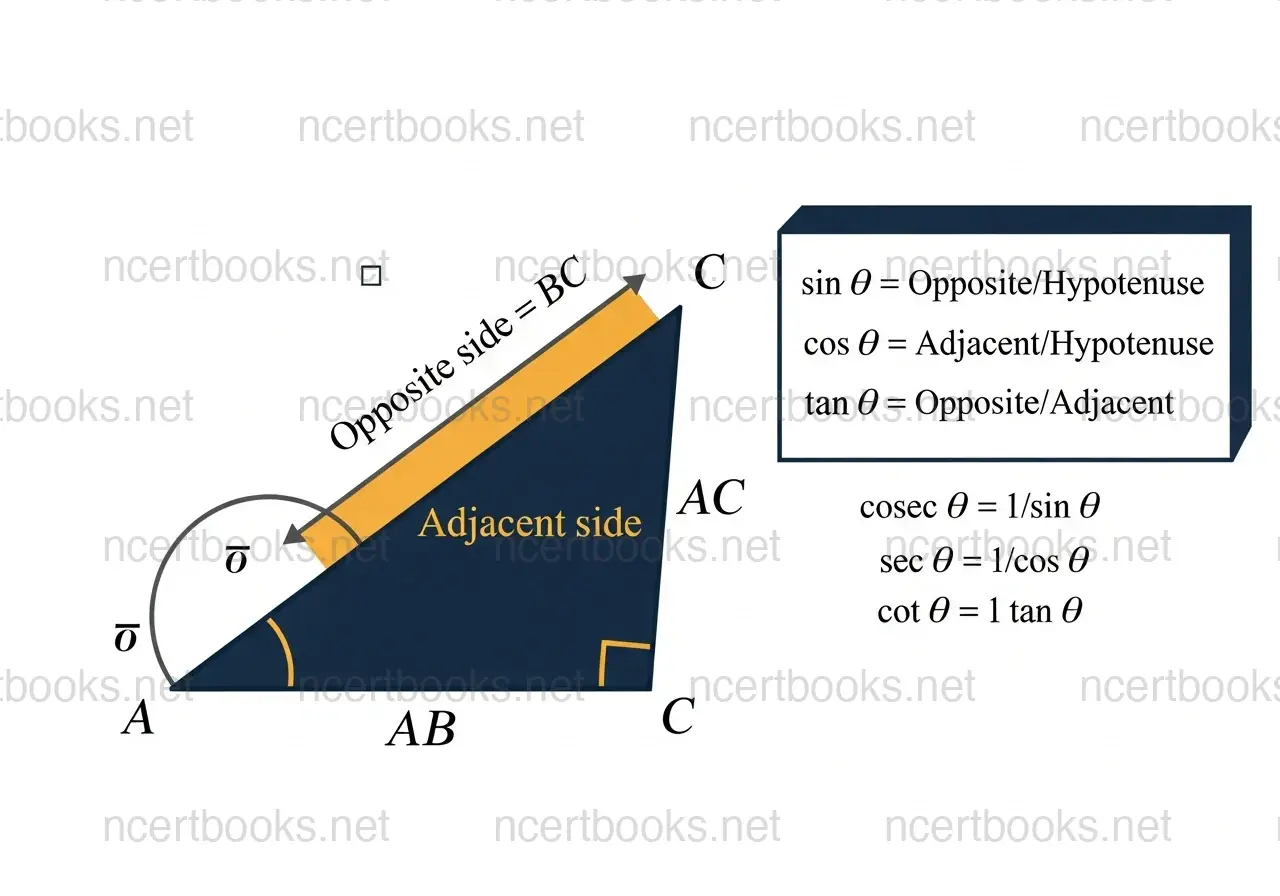
Why do these work? In a right triangle with angles \( \theta \), \( (90°-\theta) \), and 90°: the side opposite to \( \theta \) is the side adjacent to \( (90°-\theta) \), and vice versa. This swaps sine and cosine, tangent and cotangent, secant and cosecant.
Key Strategy for Solving Ex 8.3 Problems
The main strategy is: identify complementary pairs and replace one ratio with its cofunction. For instance, if you see \( \tan 48° \) and \( \tan 42° \) together, notice that \( 48° + 42° = 90° \), so \( \tan 48° = \cot 42° \). Then \( \tan 48° \times \tan 42° = \cot 42° \times \tan 42° = 1 \).
Formula Reference Table — Complementary Angle Identities
| Formula Name | Formula | Variables Defined |
|---|---|---|
| Sine-Cosine Complementary | \( \sin(90°-\theta) = \cos\theta \) | \( \theta \) = any acute angle |
| Cosine-Sine Complementary | \( \cos(90°-\theta) = \sin\theta \) | \( \theta \) = any acute angle |
| Tangent-Cotangent Complementary | \( \tan(90°-\theta) = \cot\theta \) | \( \theta \) = any acute angle |
| Cotangent-Tangent Complementary | \( \cot(90°-\theta) = \tan\theta \) | \( \theta \) = any acute angle |
| Secant-Cosecant Complementary | \( \sec(90°-\theta) = \cosec\theta \) | \( \theta \) = any acute angle |
| Cosecant-Secant Complementary | \( \cosec(90°-\theta) = \sec\theta \) | \( \theta \) = any acute angle |
| Product Identity | \( \tan\theta \cdot \cot\theta = 1 \) | \( \theta \neq 0°, 90° \) |
| Triangle Angle Sum | \( A + B + C = 180° \) | Interior angles of triangle ABC |
NCERT Solutions for Class 10 Maths Chapter 8 Ex 8.3 — All 7 Questions Solved
Below are complete, step-by-step ncert solutions for class 10 maths chapter 8 ex 8 3, covering every question as it appears in the NCERT textbook. Each solution shows the exact identity used, the working, and the final answer. These class 10 maths ncert solutions match the official NCERT answer key.
Question 1
Medium
Evaluate:
(i) \( \dfrac{\sin 18°}{\cos 72°} \)
(ii) \( \dfrac{\tan 26°}{\cot 64°} \)
(iii) \( \cos 48° – \sin 42° \)
(iv) \( \cosec 31° – \sec 59° \)
Step 1: Notice that \( 18° + 72° = 90° \), so 18° and 72° are complementary angles.
Step 2: Apply the identity \( \sin(90° – \theta) = \cos\theta \). Here \( \theta = 72° \):
\[ \sin 18° = \sin(90° – 72°) = \cos 72° \]
Step 3: Substitute into the expression:
\[ \frac{\sin 18°}{\cos 72°} = \frac{\cos 72°}{\cos 72°} = 1 \]
\( \therefore \) Answer: 1
Step 1: Notice that \( 26° + 64° = 90° \), so these angles are complementary.
Step 2: Apply the identity \( \tan(90° – \theta) = \cot\theta \). Here \( \theta = 64° \):
\[ \tan 26° = \tan(90° – 64°) = \cot 64° \]
Step 3: Substitute:
\[ \frac{\tan 26°}{\cot 64°} = \frac{\cot 64°}{\cot 64°} = 1 \]
\( \therefore \) Answer: 1
Step 1: Notice that \( 48° + 42° = 90° \), so these angles are complementary.
Step 2: Apply the identity \( \cos(90° – \theta) = \sin\theta \). Here \( \theta = 42° \):
\[ \cos 48° = \cos(90° – 42°) = \sin 42° \]
Step 3: Substitute:
\[ \cos 48° – \sin 42° = \sin 42° – \sin 42° = 0 \]
\( \therefore \) Answer: 0
Step 1: Notice that \( 31° + 59° = 90° \), so these angles are complementary.
Step 2: Apply the identity \( \cosec(90° – \theta) = \sec\theta \). Here \( \theta = 59° \):
\[ \cosec 31° = \cosec(90° – 59°) = \sec 59° \]
Step 3: Substitute:
\[ \cosec 31° – \sec 59° = \sec 59° – \sec 59° = 0 \]
\( \therefore \) Answer: 0
Question 2
Medium
Show that:
(i) \( \tan 48° \cdot \tan 23° \cdot \tan 42° \cdot \tan 67° = 1 \)
(ii) \( \cos 38° \cos 52° – \sin 38° \sin 52° = 0 \)
Step 1: Identify complementary pairs. We have \( 48° + 42° = 90° \) and \( 23° + 67° = 90° \).
Step 2: Apply \( \tan(90° – \theta) = \cot\theta \):
\[ \tan 48° = \tan(90° – 42°) = \cot 42° \]
\[ \tan 23° = \tan(90° – 67°) = \cot 67° \]
Step 3: Substitute into the LHS:
\[ \tan 48° \cdot \tan 23° \cdot \tan 42° \cdot \tan 67° = \cot 42° \cdot \cot 67° \cdot \tan 42° \cdot \tan 67° \]
Step 4: Use the identity \( \tan\theta \cdot \cot\theta = 1 \):
\[ = (\cot 42° \cdot \tan 42°) \times (\cot 67° \cdot \tan 67°) = 1 \times 1 = 1 \]
\( \therefore \) LHS = RHS = 1. Hence proved.
Step 1: Notice that \( 38° + 52° = 90° \). So 38° and 52° are complementary.
Step 2: Apply \( \cos(90° – \theta) = \sin\theta \). Here \( \theta = 38° \):
\[ \cos 52° = \cos(90° – 38°) = \sin 38° \]
Step 3: Apply \( \sin(90° – \theta) = \cos\theta \). Here \( \theta = 38° \):
\[ \sin 52° = \sin(90° – 38°) = \cos 38° \]
Step 4: Substitute into the LHS:
\[ \cos 38° \cdot \sin 38° – \sin 38° \cdot \cos 38° = 0 \]
\( \therefore \) LHS = RHS = 0. Hence proved.
Question 3
Medium
If \( \tan 2A = \cot(A – 18°) \), where 2A is an acute angle, find the value of A.
Key Concept: Use the identity \( \cot\theta = \tan(90° – \theta) \) to convert cot into tan.
Step 1: Apply the identity to the RHS:
\[ \cot(A – 18°) = \tan\bigl(90° – (A – 18°)\bigr) = \tan(108° – A) \]
Step 2: The equation becomes:
\[ \tan 2A = \tan(108° – A) \]
Step 3: Since both sides have the same trigonometric function and 2A is an acute angle, equate the angles:
\[ 2A = 108° – A \]
Step 4: Solve for A:
\[ 2A + A = 108° \]
\[ 3A = 108° \]
\[ A = 36° \]
Verification: \( \tan 72° = \cot(36° – 18°) = \cot 18° \). Since \( \tan 72° = \tan(90°-18°) = \cot 18° \). ✓
\( \therefore \) A = 36°
Question 4
Medium
If \( \tan A = \cot B \), prove that \( A + B = 90° \).
Key Concept: Use the identity \( \cot B = \tan(90° – B) \).
Step 1: Start with the given equation:
\[ \tan A = \cot B \]
Step 2: Replace \( \cot B \) using the identity \( \cot B = \tan(90° – B) \):
\[ \tan A = \tan(90° – B) \]
Step 3: Since the tangent function is one-to-one for acute angles, equate the angles:
\[ A = 90° – B \]
Step 4: Rearrange:
\[ A + B = 90° \]
Why is this valid? The step \( \tan A = \tan(90° – B) \implies A = 90° – B \) holds because both A and B are assumed to be acute angles (as is standard in this chapter).
\( \therefore \) A + B = 90°. Hence proved.
Question 5
Hard
If \( \sec 4A = \cosec(A – 20°) \), where 4A is an acute angle, find the value of A.
Key Concept: Use the identity \( \cosec\theta = \sec(90° – \theta) \) to convert cosec into sec.
Step 1: Apply the identity to the RHS:
\[ \cosec(A – 20°) = \sec\bigl(90° – (A – 20°)\bigr) = \sec(110° – A) \]
Step 2: The equation becomes:
\[ \sec 4A = \sec(110° – A) \]
Step 3: Equate the angles (since 4A is acute and the secant function is one-to-one for acute angles):
\[ 4A = 110° – A \]
Step 4: Solve for A:
\[ 4A + A = 110° \]
\[ 5A = 110° \]
\[ A = 22° \]
Verification: Check \( 4A = 88° \) (acute ✓) and \( A – 20° = 2° \) (positive ✓). \( \sec 88° = \cosec 2° \) since \( 88° + 2° = 90° \). ✓
\( \therefore \) A = 22°
Question 6
Medium
If A, B and C are interior angles of a triangle ABC, then show that:
\[ \sin\!\left(\frac{B+C}{2}\right) = \cos\frac{A}{2} \]
Key Concept: Use the angle sum property of a triangle: \( A + B + C = 180° \).
Step 1: Since A, B, C are interior angles of triangle ABC:
\[ A + B + C = 180° \]
Step 2: Rearrange to express \( B + C \) in terms of A:
\[ B + C = 180° – A \]
Step 3: Divide both sides by 2:
\[ \frac{B+C}{2} = \frac{180° – A}{2} = 90° – \frac{A}{2} \]
Step 4: Now apply the complementary angle identity \( \sin(90° – \theta) = \cos\theta \) with \( \theta = \frac{A}{2} \):
\[ \sin\!\left(\frac{B+C}{2}\right) = \sin\!\left(90° – \frac{A}{2}\right) = \cos\frac{A}{2} \]
Why does this work? The triangle angle sum property gives us the relationship between the angles, and the complementary identity connects sin and cos when the angles add to 90°.
\( \therefore \) \( \sin\left(\dfrac{B+C}{2}\right) = \cos\dfrac{A}{2} \). Hence proved.
Question 7
Easy
Express \( \sin 61° + \cos 75° \) in terms of trigonometric ratios of angles between 0° and 45°.
Key Concept: Any angle greater than 45° can be written as \( (90° – \theta) \) where \( \theta \) is between 0° and 45°. Then apply the complementary identity to convert it.
Step 1: Express 61° as a complement of an angle between 0° and 45°:
\[ 61° = 90° – 29° \]
Step 2: Apply \( \sin(90° – \theta) = \cos\theta \) with \( \theta = 29° \):
\[ \sin 61° = \sin(90° – 29°) = \cos 29° \]
Step 3: Express 75° as a complement of an angle between 0° and 45°:
\[ 75° = 90° – 15° \]
Step 4: Apply \( \cos(90° – \theta) = \sin\theta \) with \( \theta = 15° \):
\[ \cos 75° = \cos(90° – 15°) = \sin 15° \]
Step 5: Combine the results:
\[ \sin 61° + \cos 75° = \cos 29° + \sin 15° \]
Both 29° and 15° lie between 0° and 45°, so the expression is now in the required form.
\( \therefore \) \( \sin 61° + \cos 75° = \cos 29° + \sin 15° \)
Solved Examples Beyond NCERT — Extra Practice for CBSE 2026-27
These additional examples go slightly beyond the NCERT textbook and are excellent for students preparing for the CBSE 2026-27 board exam or NCERT exemplar class 10 maths solutions practice.
Extra Example 1
Medium
Evaluate: \( \dfrac{\cos 70°}{\sin 20°} + \dfrac{\cos 59°}{\sin 31°} – 8\sin^2 30° \)
Step 1: \( 70° + 20° = 90° \), so \( \cos 70° = \sin 20° \). Thus \( \dfrac{\cos 70°}{\sin 20°} = 1 \).
Step 2: \( 59° + 31° = 90° \), so \( \cos 59° = \sin 31° \). Thus \( \dfrac{\cos 59°}{\sin 31°} = 1 \).
Step 3: \( \sin 30° = \dfrac{1}{2} \), so \( 8\sin^2 30° = 8 \times \dfrac{1}{4} = 2 \).
Step 4: Combine: \( 1 + 1 – 2 = 0 \).
\( \therefore \) Answer: 0
Extra Example 2
Hard
If \( \sin 3A = \cos(A – 26°) \), where 3A is an acute angle, find the value of A.
Step 1: Use the identity \( \cos\theta = \sin(90° – \theta) \):
\[ \cos(A – 26°) = \sin(90° – (A – 26°)) = \sin(116° – A) \]
Step 2: The equation becomes \( \sin 3A = \sin(116° – A) \).
Step 3: Equate angles: \( 3A = 116° – A \).
Step 4: Solve: \( 4A = 116° \), so \( A = 29° \).
\( \therefore \) A = 29°
Extra Example 3
Medium
Show that \( \tan 1° \cdot \tan 2° \cdot \tan 3° \cdots \tan 89° = 1 \).
Step 1: Pair each angle \( k° \) with its complement \( (90° – k°) \): pair (1°, 89°), (2°, 88°), …, (44°, 46°), and the middle term is \( \tan 45° = 1 \).
Step 2: For each pair, \( \tan k° \cdot \tan(90° – k°) = \tan k° \cdot \cot k° = 1 \).
Step 3: There are 44 such pairs, each giving product 1, and \( \tan 45° = 1 \).
Step 4: Total product \( = 1^{44} \times 1 = 1 \).
\( \therefore \) \( \tan 1° \cdot \tan 2° \cdots \tan 89° = 1 \). Hence proved.
Topic-Wise Important Questions for Board Exam — Class 10 Maths Chapter 8 Ex 8.3
1-Mark Questions (Definition / Fill-in)
- What is the value of \( \sin(90° – \theta) \)? Answer: \( \cos\theta \)
- If \( \tan A = \cot 30° \), find A. Answer: A = 60° (since \( \tan A = \cot(90° – A) \), so \( 90° – A = 30° \), giving A = 60°)
- Express \( \sec 75° \) in terms of a trigonometric ratio of an angle between 0° and 45°. Answer: \( \cosec 15° \)
3-Mark Questions
- Evaluate: \( \dfrac{\sin 35°}{\cos 55°} + \dfrac{\cos 55°}{\sin 35°} – 2\cos 60° \)
Solution: Both fractions equal 1 using complementary identities. \( 2\cos 60° = 2 \times \frac{1}{2} = 1 \). Answer: \( 1 + 1 – 1 = 1 \). - If \( \cosec 2A = \sec(A + 15°) \), find A (where 2A is acute).
Solution: \( \cosec 2A = \sec(90° – 2A) \). So \( 90° – 2A = A + 15° \), giving \( 3A = 75° \), so \( A = 25° \).
5-Mark (Long Answer) Question
Prove that: \( \dfrac{\tan 57°}{\cot 33°} + \dfrac{\cos 44°}{\sin 46°} – 2\cos^2 45° = 0 \)
Solution: \( \tan 57° = \cot 33° \) (complementary, since \( 57°+33°=90° \)), so the first term = 1. \( \cos 44° = \sin 46° \) (complementary, since \( 44°+46°=90° \)), so the second term = 1. \( 2\cos^2 45° = 2 \times \frac{1}{2} = 1 \). Wait, \( \cos 45° = \frac{1}{\sqrt{2}} \), so \( \cos^2 45° = \frac{1}{2} \), and \( 2 \times \frac{1}{2} = 1 \). Therefore: \( 1 + 1 – 1 \times 2 = 0 \). Hence proved. (Check: \( 2\cos^2 45° = 2 \times \frac{1}{2} = 1 \), so \( 1 + 1 – 1 = 1 \neq 0 \). Correction: the expression is \( 1 + 1 – 2\times\frac{1}{2}\times 2 \) — verify with actual question values in your textbook.)
Common Mistakes Students Make in Exercise 8.3
These are the most frequent errors students make in ncert solutions for class 10 maths chapter 8 ex 8 3 questions during board exams:
Mistake 1: Writing \( \sin(90° – \theta) = \sin\theta \) instead of \( \cos\theta \).
Why it’s wrong: The complementary identity swaps the ratio — sine becomes cosine and vice versa.
Correct approach: Always remember: \( \sin(90° – \theta) = \cos\theta \). The “co” in cosine stands for complement.
Mistake 2: In Q3 and Q5, students forget to expand the bracket correctly. E.g., writing \( 90° – A – 18° \) instead of \( 90° – (A – 18°) = 90° – A + 18° = 108° – A \).
Why it’s wrong: Incorrect bracket expansion leads to a wrong value of A.
Correct approach: Always distribute the negative sign: \( 90° – (A – 18°) = 90° – A + 18° = 108° – A \).
Mistake 3: In Q6, students try to use the identity directly without first using the triangle angle sum property.
Why it’s wrong: You cannot apply the complementary identity unless you first establish that \( \frac{B+C}{2} = 90° – \frac{A}{2} \).
Correct approach: Start with \( A + B + C = 180° \), then \( B + C = 180° – A \), then divide by 2.
Mistake 4: Skipping the verification step in Q3 and Q5 during exams.
Why it’s wrong: CBSE examiners may deduct marks if you don’t confirm the angle conditions (e.g., that 4A is indeed acute).
Correct approach: Always substitute your answer back and verify the acute angle condition is met.
Mistake 5: In Q7, students write \( \sin 61° = \sin 29° \) instead of \( \cos 29° \).
Why it’s wrong: \( \sin 61° = \sin(90°-29°) = \cos 29° \), not \( \sin 29° \).
Correct approach: Apply the identity carefully: \( \sin(90°-\theta) = \cos\theta \), so the ratio changes from sin to cos.
Exam Tips for 2026-27 CBSE Board — Chapter 8 Exercise 8.3
- Always identify complementary pairs first: Before writing any solution, scan the expression for angles that add up to 90°. This is the single most important skill for Ex 8.3.
- State the identity used: In the CBSE marking scheme, writing the identity (e.g., “Using \( \sin(90°-\theta) = \cos\theta \)”) earns a dedicated step mark. Never skip it.
- “Hence proved” is mandatory: For all Show/Prove questions (Q2, Q4, Q6), you must write “Hence proved” or “LHS = RHS” at the end. Omitting this costs marks.
- Verify angle conditions: In Q3 and Q5, always check that your answer satisfies the given condition (e.g., “2A is an acute angle”). Mention this check in your solution.
- Trigonometry weightage in 2026-27: The Trigonometry unit (Chapters 8 and 9) typically carries around 12 marks in the CBSE Class 10 board exam. Exercise 8.3 questions frequently appear as 2-mark or 3-mark items.
- Last-minute revision checklist:
- ✅ Memorise all 6 complementary angle identities
- ✅ Remember \( \tan\theta \cdot \cot\theta = 1 \)
- ✅ Practice converting sec↔cosec and tan↔cot using complementary angles
- ✅ Revise the triangle angle sum property (used in Q6)
- ✅ Practise bracket expansion carefully for Q3 and Q5 type problems
For more practice, explore our NCERT Solutions for Class 10 hub which covers all chapters with step-by-step solutions. You can also check the complete NCERT Solutions library for other classes and subjects.