- Exercise 8.2 covers trigonometric ratios of specific angles: 0°, 30°, 45°, 60°, and 90°.
- Key values to memorise: sin30° = 1/2, cos60° = 1/2, tan45° = 1, tan60° = √3, tan30° = 1/√3.
- sin θ increases as θ increases from 0° to 90° (0 → 1).
- cos θ decreases as θ increases from 0° to 90° (1 → 0).
- sin(A+B) ≠ sinA + sinB — this is a very common mistake; always remember the compound angle formula.
- cot 0° is undefined because sin0° = 0 and cotA = cosA/sinA (division by zero).
- tan 60° = √3 → A+B = 60°; tan 30° = 1/√3 → A−B = 30° → A = 45°, B = 15°.
- Total questions in Ex 8.2: 4 questions (including sub-parts). Updated for 2026-27 CBSE syllabus.
The NCERT Solutions for Class 10 Maths Chapter 8 Ex 8.2 on this page give you complete, step-by-step answers to all 4 questions in Exercise 8.2 of Introduction to Trigonometry — updated for the 2026-27 CBSE board exam. You can find all NCERT Solutions for Class 10 on our hub page. This exercise focuses on evaluating trigonometric expressions using standard angle values and verifying key properties of trigonometric functions. The solutions are written by experienced CBSE teachers and match the official NCERT official textbook answer key exactly.
For the complete set of NCERT Solutions across all classes and subjects, visit our main solutions page. Students preparing for the 2026-27 board exams will find this exercise particularly important as it tests your ability to substitute standard angle values and reason about the behaviour of trigonometric functions.
Table of Contents
- Quick Revision Box
- Chapter Overview — Introduction to Trigonometry Class 10
- Key Concepts: Trigonometric Ratios of Specific Angles
- Formula Reference Table — Standard Angle Values
- NCERT Solutions for Class 10 Maths Chapter 8 Ex 8.2 — All Questions
- Question 1 — Evaluate the Following
- Question 2 — Choose the Correct Option
- Question 3 — Find A and B
- Question 4 — True or False Statements
- Solved Examples Beyond NCERT — Extra Practice
- Topic-Wise Important Questions for Board Exam
- Common Mistakes Students Make in Exercise 8.2
- Exam Tips for 2026-27 — Chapter 8 Trigonometry
- Frequently Asked Questions
Chapter Overview — Introduction to Trigonometry Class 10 (CBSE 2026-27)
Chapter 8 of the Class 10 NCERT Maths textbook is Introduction to Trigonometry. It introduces trigonometric ratios for acute angles, explores the values of these ratios at specific angles, and establishes fundamental identities. This chapter is part of the Unit 5: Trigonometry section of the CBSE Class 10 Maths syllabus and carries significant weightage in board exams.
Exercise 8.2 specifically deals with Trigonometric Ratios of Some Specific Angles — namely 0°, 30°, 45°, 60°, and 90°. Questions in this exercise require you to evaluate expressions using these standard values, choose correct answers with justification, and verify whether given statements about trigonometric functions are true or false. CBSE board papers regularly include 2–3 mark questions directly based on this exercise.
Before attempting Ex 8.2, you should be comfortable with the basic trigonometric ratios (sin, cos, tan, cosec, sec, cot) from Exercise 8.1 and the concept of right-angled triangles. The cbse class 10 maths ncert solutions for this chapter are essential for board exam preparation in 2026-27.
| Detail | Information |
|---|---|
| Chapter | Chapter 8 — Introduction to Trigonometry |
| Exercise | Exercise 8.2 |
| Textbook | NCERT Mathematics — Class 10 |
| Class | Class 10 (Secondary) |
| Subject | Mathematics |
| Number of Questions | 4 (with sub-parts) |
| Topic Covered | Trigonometric Ratios of Specific Angles (0°, 30°, 45°, 60°, 90°) |
| Difficulty Level | Easy to Medium |
| Academic Year | 2026-27 |
Key Concepts: Trigonometric Ratios of Specific Angles
The central idea of Exercise 8.2 is that for certain specific angles, the values of trigonometric ratios can be calculated exactly using geometry. These are called standard angles (मानक कोण). You must memorise these values to solve problems quickly in exams.
Key Concept: The values are derived from equilateral triangles (for 30° and 60°) and isosceles right-angled triangles (for 45°). At 0° and 90°, the values are limiting cases.
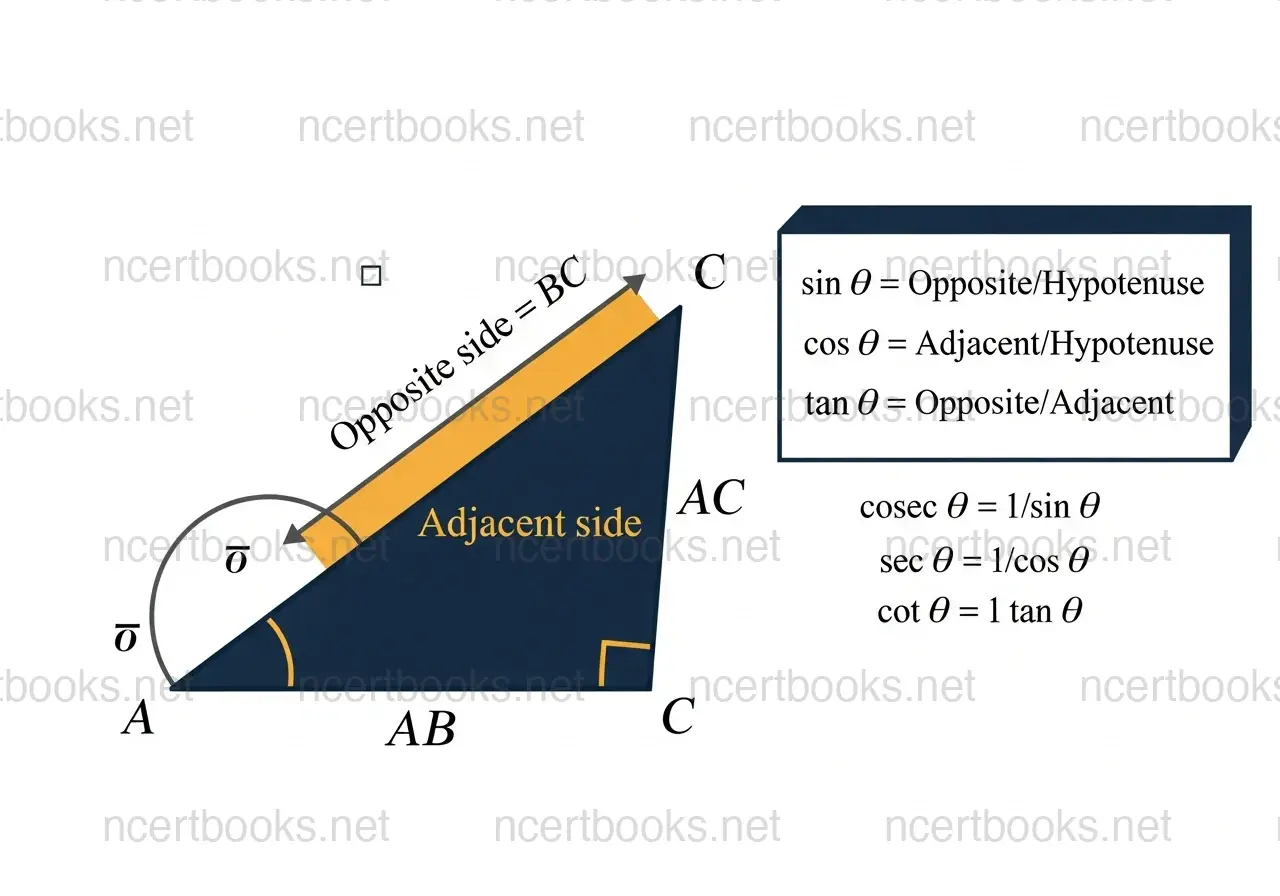
- sin θ (sine — ज्या): Ratio of perpendicular to hypotenuse in a right triangle.
- cos θ (cosine — कोज्या): Ratio of base to hypotenuse.
- tan θ (tangent — स्पर्शज्या): Ratio of perpendicular to base; equals sinθ/cosθ.
- cosec θ: Reciprocal of sinθ — undefined when sinθ = 0 (i.e., at θ = 0°).
- sec θ: Reciprocal of cosθ — undefined when cosθ = 0 (i.e., at θ = 90°).
- cot θ: Reciprocal of tanθ — undefined when tanθ = 0 (i.e., at θ = 0°).
Understanding why certain ratios are undefined at 0° and 90° is a common exam question. The answer always comes back to division by zero.
Formula Reference Table — Standard Angle Values (Trigonometric Ratios of Specific Angles)
This table is your most important revision tool for ncert solutions for class 10 maths Chapter 8. Memorise every cell before your exam.
| Ratio | 0° | 30° | 45° | 60° | 90° |
|---|---|---|---|---|---|
| sin θ | 0 | \( \frac{1}{2} \) | \( \frac{1}{\sqrt{2}} \) | \( \frac{\sqrt{3}}{2} \) | 1 |
| cos θ | 1 | \( \frac{\sqrt{3}}{2} \) | \( \frac{1}{\sqrt{2}} \) | \( \frac{1}{2} \) | 0 |
| tan θ | 0 | \( \frac{1}{\sqrt{3}} \) | 1 | \( \sqrt{3} \) | Not defined |
| cosec θ | Not defined | 2 | \( \sqrt{2} \) | \( \frac{2}{\sqrt{3}} \) | 1 |
| sec θ | 1 | \( \frac{2}{\sqrt{3}} \) | \( \sqrt{2} \) | 2 | Not defined |
| cot θ | Not defined | \( \sqrt{3} \) | 1 | \( \frac{1}{\sqrt{3}} \) | 0 |
Memory trick: For sin values at 0°, 30°, 45°, 60°, 90°, remember the sequence \( 0, \frac{1}{2}, \frac{1}{\sqrt{2}}, \frac{\sqrt{3}}{2}, 1 \). Cos values are the reverse of this sequence.
NCERT Solutions for Class 10 Maths Chapter 8 Ex 8.2 — All Questions (2026-27)
Below are complete, step-by-step solutions for all 4 questions in Exercise 8.2. Every solution follows the CBSE marking scheme and shows the working your examiner expects to see. These ncert solutions for class 10 maths chapter 8 ex 8 2 are verified against the official NCERT answer key.
Question 1 — Evaluate the Following
Question 1
Medium
Evaluate the following:
Step 1: Write down the standard values needed.
\( \sin 60° = \frac{\sqrt{3}}{2}, \quad \cos 30° = \frac{\sqrt{3}}{2}, \quad \sin 30° = \frac{1}{2}, \quad \cos 60° = \frac{1}{2} \)
Step 2: Substitute into the expression.
\[ \sin 60° \cos 30° + \sin 30° \cos 60° = \frac{\sqrt{3}}{2} \times \frac{\sqrt{3}}{2} + \frac{1}{2} \times \frac{1}{2} \]
\[ = \frac{3}{4} + \frac{1}{4} \]
\[ = \frac{4}{4} = 1 \]
Why does this work? Notice that this expression equals \( \sin(60° + 30°) = \sin 90° = 1 \) — this is the compound angle formula for sine in action.
\( \therefore \) \( \sin 60° \cos 30° + \sin 30° \cos 60° = 1 \)
Step 1: Recall the standard values.
\( \tan 45° = 1, \quad \cos 30° = \frac{\sqrt{3}}{2}, \quad \sin 60° = \frac{\sqrt{3}}{2} \)
Step 2: Compute each term separately.
\[ 2\tan^2 45° = 2 \times (1)^2 = 2 \]
\[ \cos^2 30° = \left(\frac{\sqrt{3}}{2}\right)^2 = \frac{3}{4} \]
\[ \sin^2 60° = \left(\frac{\sqrt{3}}{2}\right)^2 = \frac{3}{4} \]
Step 3: Substitute and simplify.
\[ 2\tan^2 45° + \cos^2 30° – \sin^2 60° = 2 + \frac{3}{4} – \frac{3}{4} = 2 \]
Why does this work? \( \cos^2 30° \) and \( \sin^2 60° \) are equal (both = 3/4), so they cancel out, leaving just \( 2\tan^2 45° = 2 \).
\( \therefore \) \( 2\tan^2 45° + \cos^2 30° – \sin^2 60° = 2 \)
Step 1: Write standard values.
\( \cos 45° = \frac{1}{\sqrt{2}}, \quad \sec 30° = \frac{2}{\sqrt{3}}, \quad \text{cosec} 30° = 2 \)
Step 2: Find the denominator.
\[ \sec 30° + \text{cosec} 30° = \frac{2}{\sqrt{3}} + 2 = \frac{2 + 2\sqrt{3}}{\sqrt{3}} = \frac{2(1 + \sqrt{3})}{\sqrt{3}} \]
Step 3: Divide numerator by denominator.
\[ \frac{\cos 45°}{\sec 30° + \text{cosec} 30°} = \frac{\frac{1}{\sqrt{2}}}{\frac{2(1+\sqrt{3})}{\sqrt{3}}} = \frac{1}{\sqrt{2}} \times \frac{\sqrt{3}}{2(1+\sqrt{3})} = \frac{\sqrt{3}}{2\sqrt{2}(1+\sqrt{3})} \]
Step 4: Rationalise by multiplying numerator and denominator by \( (\sqrt{3}-1) \).
\[ = \frac{\sqrt{3}(\sqrt{3}-1)}{2\sqrt{2}(\sqrt{3}+1)(\sqrt{3}-1)} = \frac{\sqrt{3}(\sqrt{3}-1)}{2\sqrt{2}(3-1)} = \frac{\sqrt{3}(\sqrt{3}-1)}{4\sqrt{2}} \]
\[ = \frac{3 – \sqrt{3}}{4\sqrt{2}} = \frac{\sqrt{3}(\sqrt{3}-1)}{4\sqrt{2}} \times \frac{\sqrt{2}}{\sqrt{2}} = \frac{\sqrt{6}(\sqrt{3}-1)}{8} = \frac{\sqrt{18}-\sqrt{6}}{8} = \frac{3\sqrt{2}-\sqrt{6}}{8} \]
\( \therefore \) \( \dfrac{\cos 45°}{\sec 30° + \text{cosec} 30°} = \dfrac{3\sqrt{2}-\sqrt{6}}{8} \)
Step 1: List all values needed.
\( \sin 30° = \frac{1}{2},\ \tan 45° = 1,\ \text{cosec} 60° = \frac{2}{\sqrt{3}},\ \sec 30° = \frac{2}{\sqrt{3}},\ \cos 60° = \frac{1}{2},\ \cot 45° = 1 \)
Step 2: Compute the numerator.
\[ \sin 30° + \tan 45° – \text{cosec} 60° = \frac{1}{2} + 1 – \frac{2}{\sqrt{3}} = \frac{3}{2} – \frac{2}{\sqrt{3}} \]
\[ = \frac{3\sqrt{3} – 4}{2\sqrt{3}} \]
Step 3: Compute the denominator.
\[ \sec 30° + \cos 60° + \cot 45° = \frac{2}{\sqrt{3}} + \frac{1}{2} + 1 = \frac{2}{\sqrt{3}} + \frac{3}{2} \]
\[ = \frac{4 + 3\sqrt{3}}{2\sqrt{3}} \]
Step 4: Divide numerator by denominator (the \( 2\sqrt{3} \) cancels).
\[ \frac{3\sqrt{3}-4}{2\sqrt{3}} \div \frac{4+3\sqrt{3}}{2\sqrt{3}} = \frac{3\sqrt{3}-4}{4+3\sqrt{3}} \]
Step 5: Rationalise by multiplying by \( \frac{4-3\sqrt{3}}{4-3\sqrt{3}} \).
\[ = \frac{(3\sqrt{3}-4)(4-3\sqrt{3})}{(4+3\sqrt{3})(4-3\sqrt{3})} = \frac{12\sqrt{3}-27-16+12\sqrt{3}}{16-27} = \frac{24\sqrt{3}-43}{-11} = \frac{43-24\sqrt{3}}{11} \]
\( \therefore \) \( \dfrac{\sin 30° + \tan 45° – \text{cosec} 60°}{\sec 30° + \cos 60° + \cot 45°} = \dfrac{43 – 24\sqrt{3}}{11} \)
Step 1: Note the denominator immediately — by the Pythagorean identity, \( \sin^2 30° + \cos^2 30° = 1 \).
Step 2: Compute each term in the numerator.
\[ 5\cos^2 60° = 5 \times \left(\frac{1}{2}\right)^2 = 5 \times \frac{1}{4} = \frac{5}{4} \]
\[ 4\sec^2 30° = 4 \times \left(\frac{2}{\sqrt{3}}\right)^2 = 4 \times \frac{4}{3} = \frac{16}{3} \]
\[ \tan^2 45° = (1)^2 = 1 \]
Step 3: Add and subtract in the numerator.
\[ \frac{5}{4} + \frac{16}{3} – 1 = \frac{15}{12} + \frac{64}{12} – \frac{12}{12} = \frac{67}{12} \]
Step 4: Divide by denominator (which equals 1).
\[ \frac{\frac{67}{12}}{1} = \frac{67}{12} \]
\( \therefore \) \( \dfrac{5\cos^2 60° + 4\sec^2 30° – \tan^2 45°}{\sin^2 30° + \cos^2 30°} = \dfrac{67}{12} \)
Question 2 — Choose the Correct Option and Justify Your Choice
Question 2
Easy
Choose the correct option and justify your choice:
Options: (A) sin 60°, (B) cos 60°, (C) tan 60°, (D) sin 30°
Step 1: Substitute \( \tan 30° = \frac{1}{\sqrt{3}} \).
\[ \frac{2 \times \frac{1}{\sqrt{3}}}{1 + \left(\frac{1}{\sqrt{3}}\right)^2} = \frac{\frac{2}{\sqrt{3}}}{1 + \frac{1}{3}} = \frac{\frac{2}{\sqrt{3}}}{\frac{4}{3}} \]
Step 2: Simplify.
\[ = \frac{2}{\sqrt{3}} \times \frac{3}{4} = \frac{6}{4\sqrt{3}} = \frac{3}{2\sqrt{3}} = \frac{3}{2\sqrt{3}} \times \frac{\sqrt{3}}{\sqrt{3}} = \frac{3\sqrt{3}}{6} = \frac{\sqrt{3}}{2} \]
Step 3: Identify the value. \( \frac{\sqrt{3}}{2} = \sin 60° \).
Why does this work? The formula \( \frac{2\tan\theta}{1+\tan^2\theta} = \sin 2\theta \) is the double angle formula. Here \( \theta = 30° \), so the result is \( \sin 60° \).
\( \therefore \) Answer: (A) sin 60°
Options: (A) tan 90°, (B) 1, (C) sin 45°, (D) 0
Step 1: Substitute \( \tan 45° = 1 \).
\[ \frac{1 – (1)^2}{1 + (1)^2} = \frac{1 – 1}{1 + 1} = \frac{0}{2} = 0 \]
Why does this work? The formula \( \frac{1-\tan^2\theta}{1+\tan^2\theta} = \cos 2\theta \). Here \( \theta = 45° \), so the result is \( \cos 90° = 0 \).
\( \therefore \) Answer: (D) 0
Options: (A) 0°, (B) 30°, (C) 45°, (D) 60°
Step 1: We know \( \sin 2A = 2\sin A \cos A \). So the equation becomes:
\[ 2\sin A \cos A = 2\sin A \]
\[ 2\sin A \cos A – 2\sin A = 0 \]
\[ 2\sin A (\cos A – 1) = 0 \]
Step 2: This holds when \( \sin A = 0 \) or \( \cos A = 1 \). Both conditions are satisfied at \( A = 0° \).
Verification: At A = 0°: LHS = \( \sin 0° = 0 \); RHS = \( 2\sin 0° = 0 \). ✓
\( \therefore \) Answer: (A) 0°
Options: (A) cos 60°, (B) sin 60°, (C) tan 60°, (D) sin 30°
\[ \frac{2 \times \frac{1}{\sqrt{3}}}{1 – \left(\frac{1}{\sqrt{3}}\right)^2} = \frac{\frac{2}{\sqrt{3}}}{1 – \frac{1}{3}} = \frac{\frac{2}{\sqrt{3}}}{\frac{2}{3}} \]
Step 2: Simplify.
\[ = \frac{2}{\sqrt{3}} \times \frac{3}{2} = \frac{3}{\sqrt{3}} = \frac{3}{\sqrt{3}} \times \frac{\sqrt{3}}{\sqrt{3}} = \frac{3\sqrt{3}}{3} = \sqrt{3} \]
Step 3: Identify: \( \sqrt{3} = \tan 60° \).
Why does this work? This is the double angle formula: \( \frac{2\tan\theta}{1-\tan^2\theta} = \tan 2\theta \). Here \( \theta = 30° \), so the result is \( \tan 60° = \sqrt{3} \).
\( \therefore \) Answer: (C) tan 60°
Question 3 — Find A and B Given Trigonometric Conditions
Question 3
Medium
If \( \tan(A + B) = \sqrt{3} \) and \( \tan(A – B) = \dfrac{1}{\sqrt{3}} \); \( 0° < A + B \leq 90° \); \( A > B \), find A and B.
Key Concept: Use the standard angle table to identify angles from their tan values.
Step 1: From the table, \( \tan 60° = \sqrt{3} \).
\[ \tan(A + B) = \sqrt{3} = \tan 60° \]
\[ \therefore A + B = 60° \quad \text{…(1)} \]
Step 2: From the table, \( \tan 30° = \dfrac{1}{\sqrt{3}} \).
\[ \tan(A – B) = \frac{1}{\sqrt{3}} = \tan 30° \]
\[ \therefore A – B = 30° \quad \text{…(2)} \]
Step 3: Add equations (1) and (2).
\[ (A + B) + (A – B) = 60° + 30° \]
\[ 2A = 90° \]
\[ A = 45° \]
Step 4: Substitute \( A = 45° \) into equation (1).
\[ 45° + B = 60° \]
\[ B = 60° – 45° = 15° \]
Verification: \( A + B = 45° + 15° = 60° \leq 90° \) ✓ and \( A = 45° > B = 15° \) ✓. Both conditions from the problem are satisfied.
\( \therefore \) A = 45° and B = 15°
Question 4 — True or False Statements About Trigonometric Functions
Question 4
Medium
State whether the following statements are true or false. Justify your answer.
Statement: FALSE
Justification: The correct formula is \( \sin(A+B) = \sin A \cos B + \cos A \sin B \), which is not equal to \( \sin A + \sin B \) in general.
Counterexample: Let A = 30°, B = 60°.
\[ \text{LHS} = \sin(30° + 60°) = \sin 90° = 1 \]
\[ \text{RHS} = \sin 30° + \sin 60° = \frac{1}{2} + \frac{\sqrt{3}}{2} = \frac{1+\sqrt{3}}{2} \approx 1.366 \]
\[ \text{LHS} \neq \text{RHS} \]
\( \therefore \) FALSE — \( \sin(A+B) \neq \sin A + \sin B \) in general.
Statement: TRUE
Justification: As θ increases from 0° to 90°, the value of sin θ increases from 0 to 1.
\[ \sin 0° = 0 < \sin 30° = \frac{1}{2} < \sin 45° = \frac{1}{\sqrt{2}} < \sin 60° = \frac{\sqrt{3}}{2} < \sin 90° = 1 \]
The sequence \( 0, 0.5, 0.707, 0.866, 1 \) is strictly increasing, confirming the statement.
\( \therefore \) TRUE — sin θ is an increasing function for \( 0° \leq \theta \leq 90° \).
Statement: FALSE
Justification: As θ increases from 0° to 90°, the value of cos θ actually decreases from 1 to 0.
\[ \cos 0° = 1 > \cos 30° = \frac{\sqrt{3}}{2} > \cos 45° = \frac{1}{\sqrt{2}} > \cos 60° = \frac{1}{2} > \cos 90° = 0 \]
The sequence \( 1, 0.866, 0.707, 0.5, 0 \) is strictly decreasing, so cos θ decreases as θ increases.
\( \therefore \) FALSE — cos θ is a decreasing function for \( 0° \leq \theta \leq 90° \).
Statement: FALSE
Justification: \( \sin \theta = \cos \theta \) only when \( \theta = 45° \) (within the range 0° to 90°). It is not true for all values of θ.
Counterexample: At \( \theta = 30° \): \( \sin 30° = \frac{1}{2} \) but \( \cos 30° = \frac{\sqrt{3}}{2} \). These are not equal.
\[ \sin 30° = 0.5 \neq 0.866 = \cos 30° \]
\( \therefore \) FALSE — \( \sin \theta = \cos \theta \) only at \( \theta = 45° \), not for all θ.
Statement: TRUE
Justification: By definition, \( \cot A = \dfrac{\cos A}{\sin A} \). At A = 0°:
\[ \cot 0° = \frac{\cos 0°}{\sin 0°} = \frac{1}{0} \]
Division by zero is undefined in mathematics. Therefore, cot A is not defined when A = 0°.
\( \therefore \) TRUE — cot 0° is undefined because \( \sin 0° = 0 \), making the denominator zero.
Solved Examples Beyond NCERT — Extra Practice for Class 10 Maths Trigonometry
These extra examples go slightly beyond Exercise 8.2 to help you score in CBSE board exams and ncert exemplar class 10 maths solutions questions.
Extra Example 1
Easy
Evaluate: \( \cos^2 30° – \sin^2 30° \)
Step 1: \( \cos 30° = \frac{\sqrt{3}}{2} \), so \( \cos^2 30° = \frac{3}{4} \).
Step 2: \( \sin 30° = \frac{1}{2} \), so \( \sin^2 30° = \frac{1}{4} \).
\[ \cos^2 30° – \sin^2 30° = \frac{3}{4} – \frac{1}{4} = \frac{2}{4} = \frac{1}{2} \]
Why does this work? This equals \( \cos(2 \times 30°) = \cos 60° = \frac{1}{2} \) — the double angle formula for cosine.
\( \therefore \) Answer = \( \frac{1}{2} \)
Extra Example 2
Medium
If \( \sin(A – B) = \frac{1}{2} \) and \( \cos(A + B) = \frac{1}{2} \), where \( 0° < A+B \leq 90° \) and \( A > B \), find A and B.
Step 1: \( \sin 30° = \frac{1}{2} \), so \( A – B = 30° \) …(1)
Step 2: \( \cos 60° = \frac{1}{2} \), so \( A + B = 60° \) …(2)
Step 3: Adding: \( 2A = 90° \Rightarrow A = 45° \). Then \( B = 60° – 45° = 15° \).
\( \therefore \) A = 45°, B = 15°
Extra Example 3
Hard
Prove that: \( \frac{\tan 60° – \tan 30°}{1 + \tan 60° \cdot \tan 30°} = \tan 30° \)
Step 1: Substitute \( \tan 60° = \sqrt{3} \) and \( \tan 30° = \frac{1}{\sqrt{3}} \).
\[ \text{LHS} = \frac{\sqrt{3} – \frac{1}{\sqrt{3}}}{1 + \sqrt{3} \cdot \frac{1}{\sqrt{3}}} = \frac{\frac{3-1}{\sqrt{3}}}{1+1} = \frac{\frac{2}{\sqrt{3}}}{2} = \frac{1}{\sqrt{3}} \]
Step 2: \( \frac{1}{\sqrt{3}} = \tan 30° = \text{RHS} \). ✓
Why does this work? This is the tan subtraction formula: \( \tan(A-B) = \frac{\tan A – \tan B}{1+\tan A \tan B} \). Here \( A-B = 60°-30° = 30° \).
\( \therefore \) LHS = RHS = tan 30°. Proved.
Topic-Wise Important Questions for Board Exam — Class 10 Maths Chapter 8
These questions are based on the CBSE board exam pattern for 2026-27. Practice them to score full marks in the cbse class 10 maths ncert solutions chapter on trigonometry.
1-Mark Questions (Definition/Fill-in)
- What is the value of \( \tan 45° \)? Answer: 1
- What is the value of \( \sin 90° + \cos 0° \)? Answer: 1 + 1 = 2
- Is cot 90° defined? Give reason. Answer: Yes. \( \cot 90° = \cos 90° / \sin 90° = 0/1 = 0 \). It is defined and equals 0.
3-Mark Questions
- Evaluate: \( \frac{\sin 30°}{\cos 45°} + \frac{\cot 45°}{\sec 60°} – \frac{\sin 60°}{\tan 45°} \)
Solution: \( = \frac{\frac{1}{2}}{\frac{1}{\sqrt{2}}} + \frac{1}{2} – \frac{\frac{\sqrt{3}}{2}}{1} = \frac{\sqrt{2}}{2} + \frac{1}{2} – \frac{\sqrt{3}}{2} = \frac{\sqrt{2}+1-\sqrt{3}}{2} \) - If \( \cos(A+B) = 0 \) and \( \sin(A-B) = \frac{\sqrt{3}}{2} \), find A and B (where A, B are acute angles).
Solution: \( \cos 90° = 0 \Rightarrow A+B = 90° \); \( \sin 60° = \frac{\sqrt{3}}{2} \Rightarrow A-B = 60° \). Adding: \( 2A = 150° \Rightarrow A = 75° \), \( B = 15° \).
5-Mark (Long Answer) Question
Evaluate the following, showing all steps: \( \frac{5\sin^2 30° + \cos^2 45° – 4\tan^2 30°}{2\sin 30°\cos 30° + \tan 45°} \)
Solution:
\[ \text{Numerator} = 5 \times \frac{1}{4} + \frac{1}{2} – 4 \times \frac{1}{3} = \frac{5}{4} + \frac{1}{2} – \frac{4}{3} = \frac{15+6-16}{12} = \frac{5}{12} \]
\[ \text{Denominator} = 2 \times \frac{1}{2} \times \frac{\sqrt{3}}{2} + 1 = \frac{\sqrt{3}}{2} + 1 = \frac{\sqrt{3}+2}{2} \]
\[ \text{Result} = \frac{5}{12} \div \frac{\sqrt{3}+2}{2} = \frac{5}{12} \times \frac{2}{\sqrt{3}+2} = \frac{10}{12(\sqrt{3}+2)} = \frac{5}{6(\sqrt{3}+2)} \times \frac{(2-\sqrt{3})}{(2-\sqrt{3})} = \frac{5(2-\sqrt{3})}{6(4-3)} = \frac{5(2-\sqrt{3})}{6} \]
Common Mistakes Students Make in Exercise 8.2 — Class 10 Maths Trigonometry
Mistake 1: Writing \( \sin(A+B) = \sin A + \sin B \).
Why it’s wrong: Trigonometric functions do not distribute over addition. This is one of the most common errors in Class 10 board exams.
Correct approach: Use the compound angle formula: \( \sin(A+B) = \sin A \cos B + \cos A \sin B \). Or use a counterexample to prove it false.
Mistake 2: Confusing \( \tan 30° \) and \( \tan 60° \) values.
Why it’s wrong: Students often swap \( \frac{1}{\sqrt{3}} \) and \( \sqrt{3} \), leading to completely wrong answers.
Correct approach: Remember — \( \tan \) increases with angle. \( \tan 30° = \frac{1}{\sqrt{3}} \approx 0.577 \) (smaller) and \( \tan 60° = \sqrt{3} \approx 1.732 \) (larger).
Mistake 3: Not writing the justification in Question 2 (MCQ) and Question 4 (True/False).
Why it’s wrong: The question explicitly says “justify your choice” / “justify your answer”. Without justification, you lose 1–2 marks.
Correct approach: Always substitute numerical values and show the calculation that confirms your answer.
Mistake 4: Saying cos θ increases as θ increases.
Why it’s wrong: cos is a decreasing function from 0° to 90°. Students confuse it with sin.
Correct approach: Write the values: cos 0° = 1, cos 90° = 0. The sequence goes down, not up.
Mistake 5: Not verifying conditions in Question 3 (checking A > B and A+B ≤ 90°).
Why it’s wrong: The problem gives constraints. Not checking them means your answer may be incomplete.
Correct approach: After finding A = 45° and B = 15°, always write: A+B = 60° ≤ 90° ✓ and A = 45° > B = 15° ✓.
Exam Tips for 2026-27 — CBSE Class 10 Maths Chapter 8 Trigonometry
- Memorise the standard angle table completely. At least 2–3 questions in the board exam directly require substituting sin, cos, tan values at 0°, 30°, 45°, 60°, 90°. A small error here cascades through your entire solution.
- Show every substitution step. The CBSE 2026-27 marking scheme awards marks for method (writing the standard value) separately from the final answer. Even if your arithmetic is wrong, you can score method marks.
- For True/False questions, always give a counterexample for FALSE. Saying “it is false” without proof earns zero marks. Use specific angle values (30° and 60° work well as counterexamples).
- In MCQ-style questions, write your working. Even if the final question is multiple choice, CBSE expects you to show how you arrived at the answer when justification is asked.
- Chapter 8 typically carries 6–8 marks in the CBSE Class 10 board exam as part of the Trigonometry unit. Exercise 8.2 questions are among the most frequently asked.
- Last-minute revision checklist:
- ✅ Standard angle values table (all 6 ratios × 5 angles)
- ✅ sin θ increases, cos θ decreases as θ goes from 0° to 90°
- ✅ sin(A+B) ≠ sinA + sinB
- ✅ cot 0° and cosec 0° are undefined; tan 90° and sec 90° are undefined
- ✅ Practice Q3-type problems: given tan(A±B), find A and B
For additional practice, check our related pages: NCERT Solutions Class 10 Maths Chapter 8 Ex 8.1, NCERT Solutions Class 10 Maths Chapter 8 Ex 8.3, and NCERT Solutions Class 10 Maths Chapter 8 Ex 8.4.