- Area of Triangle Formula: \( \text{Area} = \frac{1}{2} |x_1(y_2 – y_3) + x_2(y_3 – y_1) + x_3(y_1 – y_2)| \)
- Collinear Points: Three points are collinear if the area of the triangle they form = 0
- Midpoint Formula: Midpoint of \((x_1, y_1)\) and \((x_2, y_2)\) is \( \left(\frac{x_1+x_2}{2}, \frac{y_1+y_2}{2}\right) \)
- Quadrilateral Area: Divide into two triangles using a diagonal; add both areas
- Median Property: A median divides a triangle into two triangles of equal area
- Midpoint Triangle Ratio: Area of medial triangle : Area of original triangle = 1 : 4
- Chapter: Class 10 Maths Chapter 7 — Coordinate Geometry, Exercise 7.3 (5 questions)
- CBSE Weightage: Coordinate Geometry carries 6 marks in the Class 10 board exam
This page reflects the latest NCERT syllabus for 2026-27. Exercise 7.3 on Area of a Triangle is part of the current CBSE syllabus. Any exercises removed from the current syllabus are clearly labelled “Extra Reference / State Boards” and are not required for CBSE board exams.
The NCERT Solutions for Class 10 Maths Chapter 7 Ex 7.3 cover the topic of Area of a Triangle using coordinate geometry — one of the most important and frequently tested topics in the CBSE Class 10 board exam 2026-27. You can find all five questions solved step-by-step on this page, as part of our complete NCERT Solutions for Class 10. These solutions are based on the official NCERT official textbook and are fully updated for the 2026-27 academic year. Whether you are preparing for your board exam or doing homework, this page gives you everything you need.
Table of Contents
- Quick Revision Box
- Chapter 7 Coordinate Geometry — Exercise 7.3 Overview
- Key Concepts and Formulas — Area of a Triangle
- NCERT Solutions for Class 10 Maths Chapter 7 Ex 7.3 — All Questions
- Formula Reference Table — Coordinate Geometry
- Solved Examples Beyond NCERT
- Topic-Wise Important Questions for Board Exam
- Common Mistakes Students Make in Ex 7.3
- Exam Tips for 2026-27 CBSE Board
- Frequently Asked Questions
Chapter 7 Coordinate Geometry — Exercise 7.3 Overview (2026-27)
Chapter 7 of the NCERT Class 10 Maths textbook is Coordinate Geometry. It teaches you how to use algebraic methods to study geometric figures on the Cartesian plane. Exercise 7.3 specifically deals with the Area of a Triangle when the coordinates of its vertices are known. This is a direct application of the shoelace (surveyor’s) formula and is part of the NCERT Solutions curriculum for Class 10.
For the CBSE board exam 2026-27, Coordinate Geometry carries 6 marks in the standard paper. Questions from Exercise 7.3 typically appear as 2-mark or 3-mark problems. You need to know the Distance Formula (Ex 7.1), the Section Formula (Ex 7.2), and the Area Formula (Ex 7.3) to score full marks in this chapter.
| Detail | Information |
|---|---|
| Class | 10 |
| Subject | Mathematics |
| Chapter | Chapter 7 — Coordinate Geometry |
| Exercise | Exercise 7.3 |
| Textbook | NCERT Mathematics (Ganita) — Class 10 |
| Number of Questions | 5 |
| Topic | Area of a Triangle |
| CBSE Marks Weightage | 6 marks (full chapter) |
| Difficulty Level | Medium |
| Academic Year | 2026-27 |
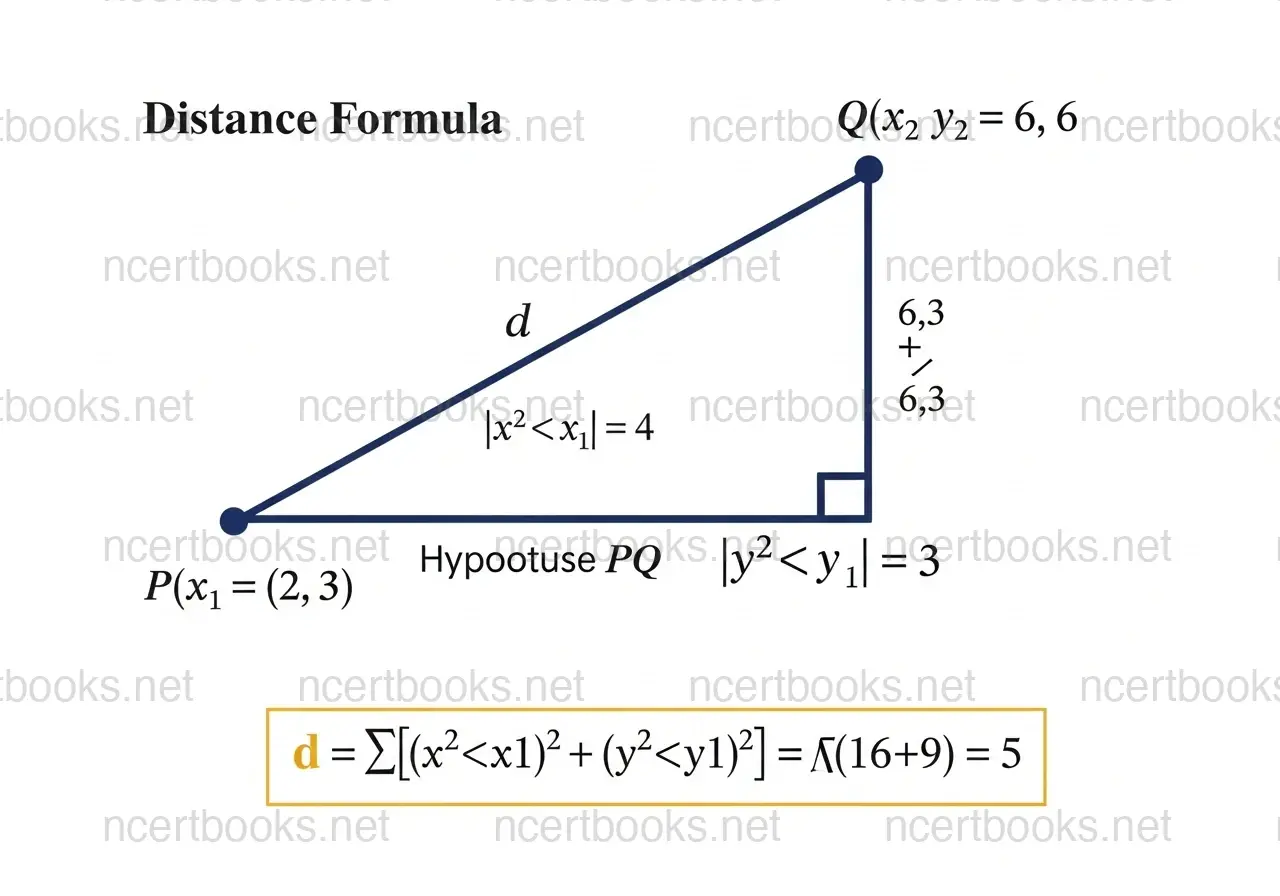
Key Concepts and Formulas — Area of a Triangle in Coordinate Geometry
Before solving the questions, make sure you understand these core ideas. These concepts appear directly in CBSE board exam questions.
Area of a Triangle Formula
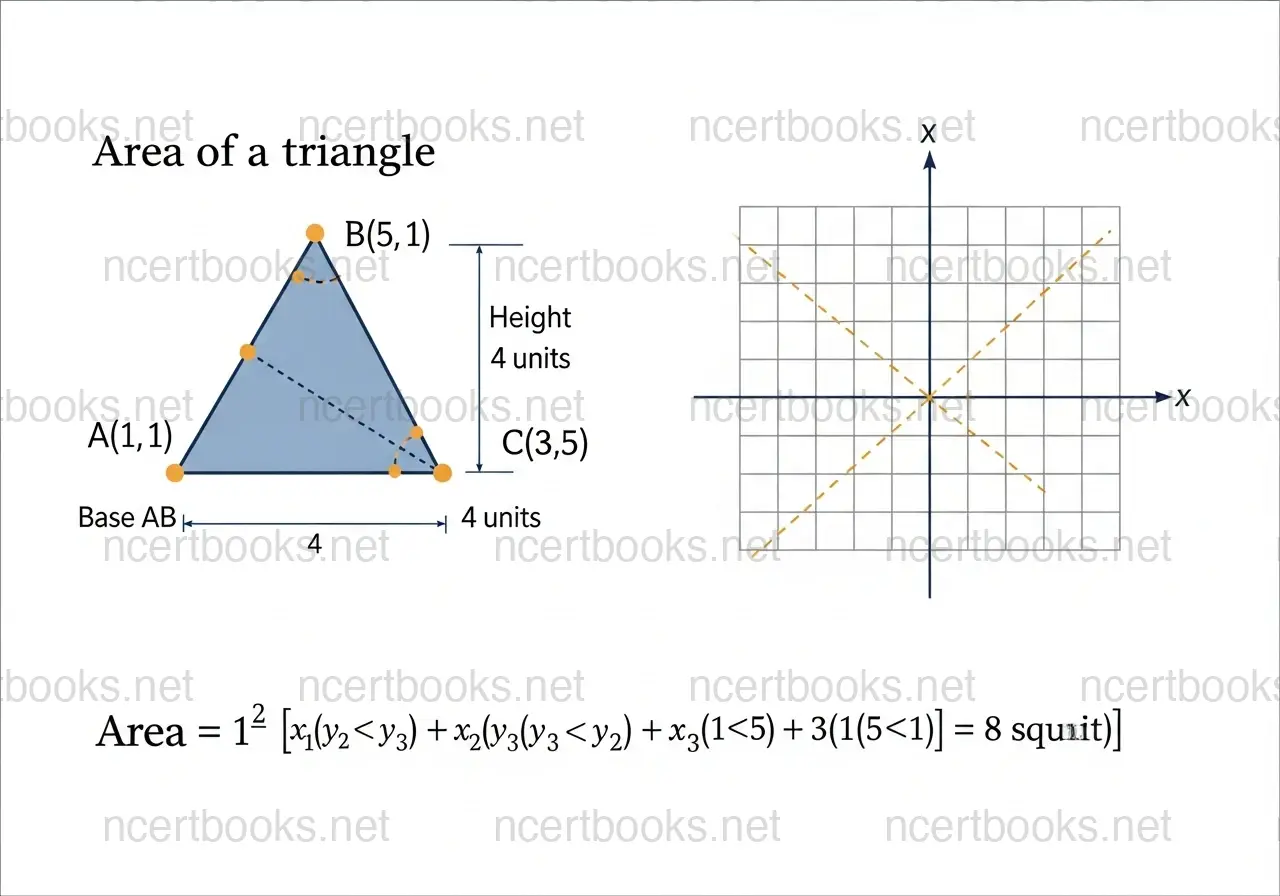
If the three vertices of a triangle are \( A(x_1, y_1) \), \( B(x_2, y_2) \), and \( C(x_3, y_3) \), then:
\[ \text{Area of } \triangle ABC = \frac{1}{2} |x_1(y_2 – y_3) + x_2(y_3 – y_1) + x_3(y_1 – y_2)| \]
The absolute value (modulus) is used because area is always positive. This formula is derived from the shoelace (Gauss area) formula for polygons.
Condition for Collinearity of Three Points
Three points \( P(x_1, y_1) \), \( Q(x_2, y_2) \), \( R(x_3, y_3) \) are collinear (lie on the same straight line) if and only if the area of the triangle formed by them is zero:
\[ x_1(y_2 – y_3) + x_2(y_3 – y_1) + x_3(y_1 – y_2) = 0 \]
This is the key tool for solving Question 2 of Exercise 7.3.
Midpoint Formula
The midpoint \( M \) of the segment joining \( A(x_1, y_1) \) and \( B(x_2, y_2) \) is:
\[ M = \left( \frac{x_1 + x_2}{2},\ \frac{y_1 + y_2}{2} \right) \]
You need this formula for Questions 3 and 5, where midpoints of sides are required.
Area of a Quadrilateral by Triangulation
To find the area of a quadrilateral with vertices \( A, B, C, D \) (in order), divide it into two triangles using diagonal \( AC \):
\[ \text{Area of Quadrilateral} = \text{Area of } \triangle ABC + \text{Area of } \triangle ACD \]
NCERT Solutions for Class 10 Maths Chapter 7 Ex 7.3 — All 5 Questions Solved
Below are complete, step-by-step solutions for all 5 questions in Exercise 7.3. These solutions follow the CBSE marking scheme for 2026-27. Each solution shows every working step so you can write the same in your board exam.
Question 1
Medium
Find the area of the triangle whose vertices are:
(i) (2, 3), (−1, 0), (2, −4)
(ii) (−5, −1), (3, −5), (5, 2)
Key Concept: Use the area formula with \( (x_1, y_1) = (2, 3) \), \( (x_2, y_2) = (-1, 0) \), \( (x_3, y_3) = (2, -4) \).
Step 1: Write the area formula:
\[ \text{Area} = \frac{1}{2} |x_1(y_2 – y_3) + x_2(y_3 – y_1) + x_3(y_1 – y_2)| \]
Step 2: Substitute the values:
\[ = \frac{1}{2} |2(0 – (-4)) + (-1)((-4) – 3) + 2(3 – 0)| \]
\[ = \frac{1}{2} |2(4) + (-1)(-7) + 2(3)| \]
\[ = \frac{1}{2} |8 + 7 + 6| \]
\[ = \frac{1}{2} \times 21 \]
Why take the absolute value? The formula can give a negative value depending on the order of vertices, but area is always a positive quantity.
\( \therefore \) Area of triangle = \( \frac{21}{2} \) = 10.5 square units
Step 1: Let \( (x_1, y_1) = (-5, -1) \), \( (x_2, y_2) = (3, -5) \), \( (x_3, y_3) = (5, 2) \).
Step 2: Apply the area formula:
\[ \text{Area} = \frac{1}{2} |x_1(y_2 – y_3) + x_2(y_3 – y_1) + x_3(y_1 – y_2)| \]
\[ = \frac{1}{2} |(-5)((-5) – 2) + 3(2 – (-1)) + 5((-1) – (-5))| \]
\[ = \frac{1}{2} |(-5)(-7) + 3(3) + 5(4)| \]
\[ = \frac{1}{2} |35 + 9 + 20| \]
\[ = \frac{1}{2} \times 64 \]
\( \therefore \) Area of triangle = 32 square units
Question 2
Medium
In each of the following find the value of ‘k’ for which the points are collinear.
(i) (7, −2), (5, 1), (3, k)
(ii) (8, 1), (k, −4), (2, −5)
Key Concept: Three points are collinear when the area of the triangle they form equals zero. Set the area expression equal to zero and solve for \( k \).
Step 1: Let \( (x_1, y_1) = (7, -2) \), \( (x_2, y_2) = (5, 1) \), \( (x_3, y_3) = (3, k) \).
Step 2: Apply the collinearity condition:
\[ x_1(y_2 – y_3) + x_2(y_3 – y_1) + x_3(y_1 – y_2) = 0 \]
\[ 7(1 – k) + 5(k – (-2)) + 3((-2) – 1) = 0 \]
\[ 7(1 – k) + 5(k + 2) + 3(-3) = 0 \]
Step 3: Expand the brackets:
\[ 7 – 7k + 5k + 10 – 9 = 0 \]
\[ (7 + 10 – 9) + (-7k + 5k) = 0 \]
\[ 8 – 2k = 0 \]
Step 4: Solve for \( k \):
\[ 2k = 8 \implies k = 4 \]
\( \therefore \) k = 4
Step 1: Let \( (x_1, y_1) = (8, 1) \), \( (x_2, y_2) = (k, -4) \), \( (x_3, y_3) = (2, -5) \).
\[ 8((-4) – (-5)) + k((-5) – 1) + 2(1 – (-4)) = 0 \]
\[ 8(-4 + 5) + k(-6) + 2(5) = 0 \]
\[ 8(1) – 6k + 10 = 0 \]
Step 3: Simplify:
\[ 8 – 6k + 10 = 0 \]
\[ 18 – 6k = 0 \]
Step 4: Solve for \( k \):
\[ 6k = 18 \implies k = 3 \]
\( \therefore \) k = 3
Question 3
Hard
Find the area of the triangle formed by joining the mid-points of the sides of the triangle whose vertices are (0, −1), (2, 1) and (0, 3). Find the ratio of this area to the area of the given triangle.
Key Concept: The triangle formed by joining the midpoints of the sides of a triangle is called the medial triangle. Its area is always one-fourth of the original triangle.
Step 1: Find the midpoints of each side. Let \( A = (0, -1) \), \( B = (2, 1) \), \( C = (0, 3) \).
Midpoint of AB:
\[ D = \left( \frac{0+2}{2}, \frac{-1+1}{2} \right) = (1, 0) \]
Midpoint of BC:
\[ E = \left( \frac{2+0}{2}, \frac{1+3}{2} \right) = (1, 2) \]
Midpoint of CA:
\[ F = \left( \frac{0+0}{2}, \frac{3+(-1)}{2} \right) = (0, 1) \]
Step 2: Find the area of the original triangle ABC with vertices (0, −1), (2, 1), (0, 3):
\[ \text{Area of } \triangle ABC = \frac{1}{2} |0(1 – 3) + 2(3 – (-1)) + 0((-1) – 1)| \]
\[ = \frac{1}{2} |0(−2) + 2(4) + 0(−2)| \]
\[ = \frac{1}{2} |0 + 8 + 0| = \frac{1}{2} \times 8 = 4 \text{ sq. units} \]
Step 3: Find the area of the medial triangle DEF with vertices D(1, 0), E(1, 2), F(0, 1):
\[ \text{Area of } \triangle DEF = \frac{1}{2} |1(2 – 1) + 1(1 – 0) + 0(0 – 2)| \]
\[ = \frac{1}{2} |1(1) + 1(1) + 0(-2)| \]
\[ = \frac{1}{2} |1 + 1 + 0| = \frac{1}{2} \times 2 = 1 \text{ sq. unit} \]
Step 4: Find the ratio:
\[ \text{Ratio} = \frac{\text{Area of } \triangle DEF}{\text{Area of } \triangle ABC} = \frac{1}{4} \]
Why is the ratio always 1:4? Each side of the medial triangle is parallel to and half the length of the corresponding side of the original triangle (by the Midpoint Theorem). Since area scales as the square of linear dimensions, the area ratio is \( \left(\frac{1}{2}\right)^2 = \frac{1}{4} \).
\( \therefore \) Area of medial triangle DEF = 1 sq. unit
Ratio of area of medial triangle to original triangle = 1 : 4
Question 4
Hard
Find the area of the quadrilateral whose vertices, taken in order, are (−4, −2), (−3, −5), (3, −2) and (2, 3).
Key Concept: A quadrilateral can be split into two triangles using one of its diagonals. Calculate the area of each triangle separately, then add them.
Step 1: Label the vertices. Let \( A = (-4, -2) \), \( B = (-3, -5) \), \( C = (3, -2) \), \( D = (2, 3) \).
Step 2: Draw diagonal AC to split quadrilateral ABCD into triangles ABC and ACD.
Step 3: Find the area of \( \triangle ABC \) with vertices A(−4, −2), B(−3, −5), C(3, −2):
\[ \text{Area of } \triangle ABC = \frac{1}{2} |(-4)((-5) – (-2)) + (-3)((-2) – (-2)) + 3((-2) – (-5))| \]
\[ = \frac{1}{2} |(-4)(-3) + (-3)(0) + 3(3)| \]
\[ = \frac{1}{2} |12 + 0 + 9| \]
\[ = \frac{1}{2} \times 21 = \frac{21}{2} \text{ sq. units} \]
Step 4: Find the area of \( \triangle ACD \) with vertices A(−4, −2), C(3, −2), D(2, 3):
\[ \text{Area of } \triangle ACD = \frac{1}{2} |(-4)((-2) – 3) + 3(3 – (-2)) + 2((-2) – (-2))| \]
\[ = \frac{1}{2} |(-4)(-5) + 3(5) + 2(0)| \]
\[ = \frac{1}{2} |20 + 15 + 0| \]
\[ = \frac{1}{2} \times 35 = \frac{35}{2} \text{ sq. units} \]
Step 5: Add both areas:
\[ \text{Area of Quadrilateral ABCD} = \frac{21}{2} + \frac{35}{2} = \frac{56}{2} = 28 \text{ sq. units} \]
\( \therefore \) Area of quadrilateral ABCD = 28 square units
Question 5
Hard
You have studied in Class IX, that a median of a triangle divides it into two triangles of equal areas. Verify this result for ∆ABC whose vertices are A(4, −6), B(3, −2) and C(5, 2).
Key Concept: A median connects a vertex to the midpoint of the opposite side. To verify that it divides the triangle into two equal areas, find the midpoint of one side, then calculate the area of each of the two resulting triangles.
Step 1: Find the midpoint D of BC, where B = (3, −2) and C = (5, 2).
\[ D = \left( \frac{3 + 5}{2},\ \frac{-2 + 2}{2} \right) = \left( 4, 0 \right) \]
So AD is the median from vertex A to side BC.
Step 2: Find the area of \( \triangle ABD \) with vertices A(4, −6), B(3, −2), D(4, 0):
\[ \text{Area of } \triangle ABD = \frac{1}{2} |4((-2) – 0) + 3(0 – (-6)) + 4((-6) – (-2))| \]
\[ = \frac{1}{2} |4(-2) + 3(6) + 4(-4)| \]
\[ = \frac{1}{2} |-8 + 18 – 16| \]
\[ = \frac{1}{2} |-6| = \frac{1}{2} \times 6 = 3 \text{ sq. units} \]
Step 3: Find the area of \( \triangle ACD \) with vertices A(4, −6), C(5, 2), D(4, 0):
\[ \text{Area of } \triangle ACD = \frac{1}{2} |4(2 – 0) + 5(0 – (-6)) + 4((-6) – 2)| \]
\[ = \frac{1}{2} |4(2) + 5(6) + 4(-8)| \]
\[ = \frac{1}{2} |8 + 30 – 32| \]
\[ = \frac{1}{2} |6| = \frac{1}{2} \times 6 = 3 \text{ sq. units} \]
Step 4: Compare the two areas:
\[ \text{Area of } \triangle ABD = 3 \text{ sq. units} = \text{Area of } \triangle ACD \]
Why are they equal? Both triangles share the same vertex A and their bases BD and DC are equal (D is the midpoint of BC). Equal base and equal height means equal area.
\( \therefore \) Area of ∆ABD = Area of ∆ACD = 3 sq. units
This verifies that the median AD divides ∆ABC into two triangles of equal area. ✓
Formula Reference Table — Coordinate Geometry Class 10
Use this table as a quick reference when solving CBSE Class 10 Maths NCERT solutions for Coordinate Geometry. All formulas below are from the 2026-27 syllabus.
| Formula Name | Formula | Variables |
|---|---|---|
| Distance Formula | \( d = \sqrt{(x_2 – x_1)^2 + (y_2 – y_1)^2} \) | Two points \((x_1,y_1)\) and \((x_2,y_2)\) |
| Section Formula (Internal) | \( \left( \frac{mx_2 + nx_1}{m+n},\ \frac{my_2 + ny_1}{m+n} \right) \) | Point dividing in ratio m:n |
| Midpoint Formula | \( \left( \frac{x_1+x_2}{2},\ \frac{y_1+y_2}{2} \right) \) | Midpoint of segment |
| Area of Triangle | \( \frac{1}{2}|x_1(y_2-y_3)+x_2(y_3-y_1)+x_3(y_1-y_2)| \) | Vertices \((x_1,y_1), (x_2,y_2), (x_3,y_3)\) |
| Collinearity Condition | \( x_1(y_2-y_3)+x_2(y_3-y_1)+x_3(y_1-y_2) = 0 \) | Area of triangle = 0 |
Solved Examples Beyond NCERT — Coordinate Geometry Area Problems
These extra examples are slightly harder than the NCERT questions and are useful for CBSE board exam 2026-27 preparation and NCERT Exemplar Class 10 Maths practice.
Extra Example 1
Easy
Show that the points A(1, 1), B(4, 4), and C(7, 7) are collinear.
Step 1: Apply the collinearity condition:
\[ 1(4 – 7) + 4(7 – 1) + 7(1 – 4) \]
\[ = 1(-3) + 4(6) + 7(-3) \]
\[ = -3 + 24 – 21 = 0 \]
\( \therefore \) Area = 0, so A, B, C are collinear.
Extra Example 2
Medium
If the area of the triangle with vertices (x, 0), (4, 3), and (−2, 3) is 12 sq. units, find x.
Step 1: Apply the area formula:
\[ \frac{1}{2}|x(3 – 3) + 4(3 – 0) + (-2)(0 – 3)| = 12 \]
\[ \frac{1}{2}|0 + 12 + 6| = 12 \]
\[ \frac{1}{2} \times 18 = 9 \neq 12 \]
Step 2: Re-apply with the full expression:
\[ \frac{1}{2}|x(3-3) + 4(3-0) + (-2)(0-3)| = 12 \]
\[ \frac{1}{2}|0 + 12 + 6| = 12 \implies 9 \neq 12 \]
This means x does not affect the area here since the coefficient of x is 0. If the problem is modified so that one vertex is (x, 1) instead of (x, 0), then x can be determined. This example illustrates that when two y-coordinates are equal, the base is horizontal and x only shifts position, not area.
Note: With vertices (x, 0), (4, 3), (−2, 3): area = 9 sq. units regardless of x, since the two points (4,3) and (−2,3) define a horizontal base of length 6 and height 3.
Extra Example 3
Hard
The vertices of a triangle are A(−2, 4), B(−1, −3), C(3, 2). Find the area. Also find the length of the median from A.
Step 1: Find area of \(\triangle ABC\):
\[ \text{Area} = \frac{1}{2}|(-2)(-3-2)+(-1)(2-4)+3(4-(-3))| \]
\[ = \frac{1}{2}|(-2)(-5)+(-1)(-2)+3(7)| \]
\[ = \frac{1}{2}|10+2+21| = \frac{33}{2} = 16.5 \text{ sq. units} \]
Step 2: Midpoint of BC: \( M = \left(\frac{-1+3}{2}, \frac{-3+2}{2}\right) = \left(1, -\frac{1}{2}\right) \)
Step 3: Length of median AM:
\[ AM = \sqrt{(1-(-2))^2 + \left(-\frac{1}{2}-4\right)^2} = \sqrt{9 + \frac{81}{4}} = \sqrt{\frac{117}{4}} = \frac{3\sqrt{13}}{2} \]
\( \therefore \) Area = 16.5 sq. units; Length of median from A = \( \frac{3\sqrt{13}}{2} \) units
Topic-Wise Important Questions for Board Exam — Coordinate Geometry Ex 7.3
These questions are based on the CBSE Class 10 Maths question pattern for 2026-27. Practise all of them before your board exam.
1-Mark Questions (Definition / Recall)
- Write the formula for the area of a triangle with vertices \((x_1,y_1)\), \((x_2,y_2)\), \((x_3,y_3)\).
- What is the condition for three points to be collinear using the area formula?
- The area of a triangle with vertices (1, 1), (4, 1), (1, 4) is ________ sq. units.
3-Mark Questions (Application)
- Find the value of k if points (2, 3), (4, k), and (6, −3) are collinear. [Answer: k = 0]
- Find the area of the triangle formed by the points (0, 0), (5, 0), and (3, 4). [Answer: 10 sq. units]
5-Mark Questions (Long Answer)
- The vertices of a quadrilateral ABCD are A(1, 1), B(7, −3), C(12, 2), D(7, 21). Find the area of the quadrilateral by dividing it into two triangles. Show all working. [Hint: Use diagonal AC; Area = 132 sq. units]
Common Mistakes Students Make in Ex 7.3 — NCERT Class 10 Maths
Mistake 1: Forgetting the absolute value (modulus) sign in the area formula.
Why it’s wrong: The expression inside the formula can be negative depending on the order of vertices. Area is always positive.
Correct approach: Always write \( \frac{1}{2}|\ldots| \) and take the positive value as the final answer.
Mistake 2: Not setting the area equal to zero when finding k for collinear points.
Why it’s wrong: Students sometimes set \( \frac{1}{2}|\ldots| = 0 \) and then incorrectly solve. The modulus must be removed before solving the linear equation.
Correct approach: Remove the \( \frac{1}{2} \) and the modulus, set the expression = 0, then solve the linear equation in k.
Mistake 3: Using the wrong diagonal to split a quadrilateral into triangles.
Why it’s wrong: If you use the wrong diagonal, you may split the quadrilateral into a triangle and a region outside it, giving a wrong answer.
Correct approach: Always use the diagonal that lies inside the quadrilateral. For a convex quadrilateral, either diagonal works. Sketch the figure first.
Mistake 4: Computing the midpoint incorrectly in Q3 and Q5.
Why it’s wrong: Students sometimes add the coordinates without dividing by 2, or divide only one coordinate.
Correct approach: \( M = \left(\frac{x_1+x_2}{2}, \frac{y_1+y_2}{2}\right) \) — divide both x and y coordinates by 2.
Mistake 5: Not writing a concluding statement in verification questions (Q5).
Why it’s wrong: CBSE examiners deduct marks if you do not explicitly state that the two areas are equal and the median divides the triangle into two equal-area triangles.
Correct approach: Always end with: “Since Area of ∆ABD = Area of ∆ACD = 3 sq. units, the median AD divides ∆ABC into two triangles of equal area. Verified.”
Exam Tips for 2026-27 CBSE Board — Class 10 Maths Chapter 7 Ex 7.3
- Write the formula first: In the CBSE 2026-27 marking scheme, 1 mark is awarded for writing the correct formula before substituting values. Never skip this step.
- Show every substitution: Write out the substitution step in full. Examiners award marks for correct substitution even if the final answer has an arithmetic error.
- Use the absolute value: If you forget the modulus sign and get a negative area, you will lose marks. Always check your final answer is positive.
- Collinearity questions: Set up the equation clearly as “Area = 0” and then solve. Do not try to solve directly in your head — show all steps.
- Quadrilateral questions: Mention which diagonal you are using to split the quadrilateral. This shows the examiner you understand the method.
- Verification questions: Always write a final concluding sentence. CBSE awards 1 mark specifically for the conclusion in verification problems.
- Chapter weightage: Coordinate Geometry carries 6 marks in the CBSE Class 10 board exam 2026-27. Exercise 7.3 questions are the most likely to appear — practise all 5 questions until you can solve them without looking at notes.
Frequently Asked Questions — NCERT Solutions Class 10 Maths Chapter 7 Ex 7.3
How do you find the area of a triangle using coordinates in Class 10?
Use the formula: \( \text{Area} = \frac{1}{2}|x_1(y_2-y_3)+x_2(y_3-y_1)+x_3(y_1-y_2)| \). Identify the three vertices and substitute their coordinates. The absolute value ensures the area is always positive. This formula is directly used in all 5 questions of Exercise 7.3 and is a must-know for the CBSE Class 10 board exam 2026-27.
What is the condition for three points to be collinear in coordinate geometry?
Three points are collinear if the area of the triangle they form equals zero. Set \( x_1(y_2-y_3)+x_2(y_3-y_1)+x_3(y_1-y_2) = 0 \) and solve for the unknown variable. This is used in Question 2 of Exercise 7.3 to find the value of k. It is a standard 2-3 mark question in CBSE board papers.
What is the ratio of the area of the triangle formed by midpoints to the original triangle?
The triangle formed by joining the midpoints of the sides of any triangle (called the medial triangle) has an area exactly one-fourth of the original triangle. So the ratio is 1:4. This is proved in Question 3 of Exercise 7.3 using coordinates. The result follows from the Midpoint Theorem — each side of the medial triangle is half the corresponding side of the original.
How do you find the area of a quadrilateral using coordinate geometry?
Split the quadrilateral into two triangles using one of its diagonals. Calculate the area of each triangle using the coordinate area formula, then add the two areas. For Question 4 of Exercise 7.3, the quadrilateral with vertices (−4,−2), (−3,−5), (3,−2), (2,3) is split using diagonal AC, giving a total area of 28 square units. Always take the vertices in order.
How does a median divide a triangle into two equal areas — Class 10 verification?
A median connects a vertex to the midpoint of the opposite side, creating two triangles with equal bases (each half of the original side) and the same height (distance from the vertex to the opposite side). Equal base and equal height means equal area. In Question 5 of Exercise 7.3, this is verified for ∆ABC with A(4,−6), B(3,−2), C(5,2) — both triangles ABD and ACD have area 3 sq. units.