⚡ Quick Revision Box — Chapter 7 Ex 7.2
- Chapter: 7 — Coordinate Geometry | Exercise: 7.2 | Class: 10 Maths (NCERT)
- Core Topic: Section Formula — divides a line segment in a given ratio internally
- Section Formula: Point dividing (x₁,y₁) and (x₂,y₂) in ratio m:n → \( \left(\frac{mx_2+nx_1}{m+n},\, \frac{my_2+ny_1}{m+n}\right) \)
- Midpoint Formula: Special case of Section Formula with m:n = 1:1 → \( \left(\frac{x_1+x_2}{2},\, \frac{y_1+y_2}{2}\right) \)
- Trisection: Two points dividing a segment into 3 equal parts — use ratios 1:2 and 2:1
- Area of Rhombus: \( \frac{1}{2} \times d_1 \times d_2 \) where \(d_1\) and \(d_2\) are the diagonals
- Total Questions: 10 | Difficulty: Moderate | Board Marks Weightage: 6–8 marks from this chapter
- Updated for: 2026-27 CBSE syllabus — all solutions verified against the latest NCERT textbook
The NCERT Solutions for Class 10 Maths Chapter 7 Ex 7.2 on this page cover all 10 questions from the Section Formula exercise, fully solved with step-by-step working — updated for the 2026-27 CBSE board exam. You can find these solutions as part of our complete NCERT Solutions for Class 10 resource. The official textbook is available on the NCERT official website. Whether you are revising the Section Formula, midpoint formula, or trisection of a line segment, every solution here is written to match the CBSE marking scheme exactly.
Exercise 7.2 is one of the most important exercises in NCERT Solutions for Class 10 Maths because it tests your ability to apply the Section Formula in a variety of real-life and abstract contexts. Questions from this exercise regularly appear in CBSE board papers as 2-mark and 3-mark problems. This page covers the updated 2026-27 syllabus and exam pattern.
- Quick Revision Box
- Chapter Overview — Coordinate Geometry Class 10
- Key Concepts and Theorems — Section Formula
- NCERT Solutions for Class 10 Maths Chapter 7 Ex 7.2 — All Questions
- Formula Reference Table — Coordinate Geometry
- Solved Examples Beyond NCERT
- Important Questions for CBSE Board Exam
- Common Mistakes Students Make in Section Formula
- Exam Tips for 2026-27 CBSE Board
- Frequently Asked Questions — Chapter 7 Ex 7.2
Chapter Overview — Coordinate Geometry Class 10 Maths (NCERT 2026-27)
Chapter 7 of the NCERT Class 10 Maths textbook is titled Coordinate Geometry. It teaches you how to use algebraic methods to study geometric figures on a coordinate plane. The chapter builds on your knowledge of the Cartesian system from Class 9 and introduces three powerful tools: the Distance Formula, the Section Formula, and the Area of a Triangle formula.
Exercise 7.2 focuses entirely on the Section Formula (विभाजन सूत्र). This is the formula that finds the coordinates of a point that divides a line segment in a given ratio. The midpoint formula is a direct special case of the Section Formula, and trisection problems are a natural extension. CBSE board papers for 2026-27 consistently include 1–2 questions from this exercise in the 2-mark and 3-mark sections.
| Field | Details |
|---|---|
| Chapter | 7 — Coordinate Geometry |
| Textbook | NCERT Mathematics — Class 10 |
| Exercise | 7.2 |
| Subject | Mathematics |
| Total Questions | 10 |
| Core Concept | Section Formula (Internal Division) |
| Difficulty Level | Moderate |
| CBSE Marks Weightage | 6–8 marks (Unit: Coordinate Geometry) |
Key Concepts and Theorems — Section Formula (विभाजन सूत्र)
Section Formula — Internal Division
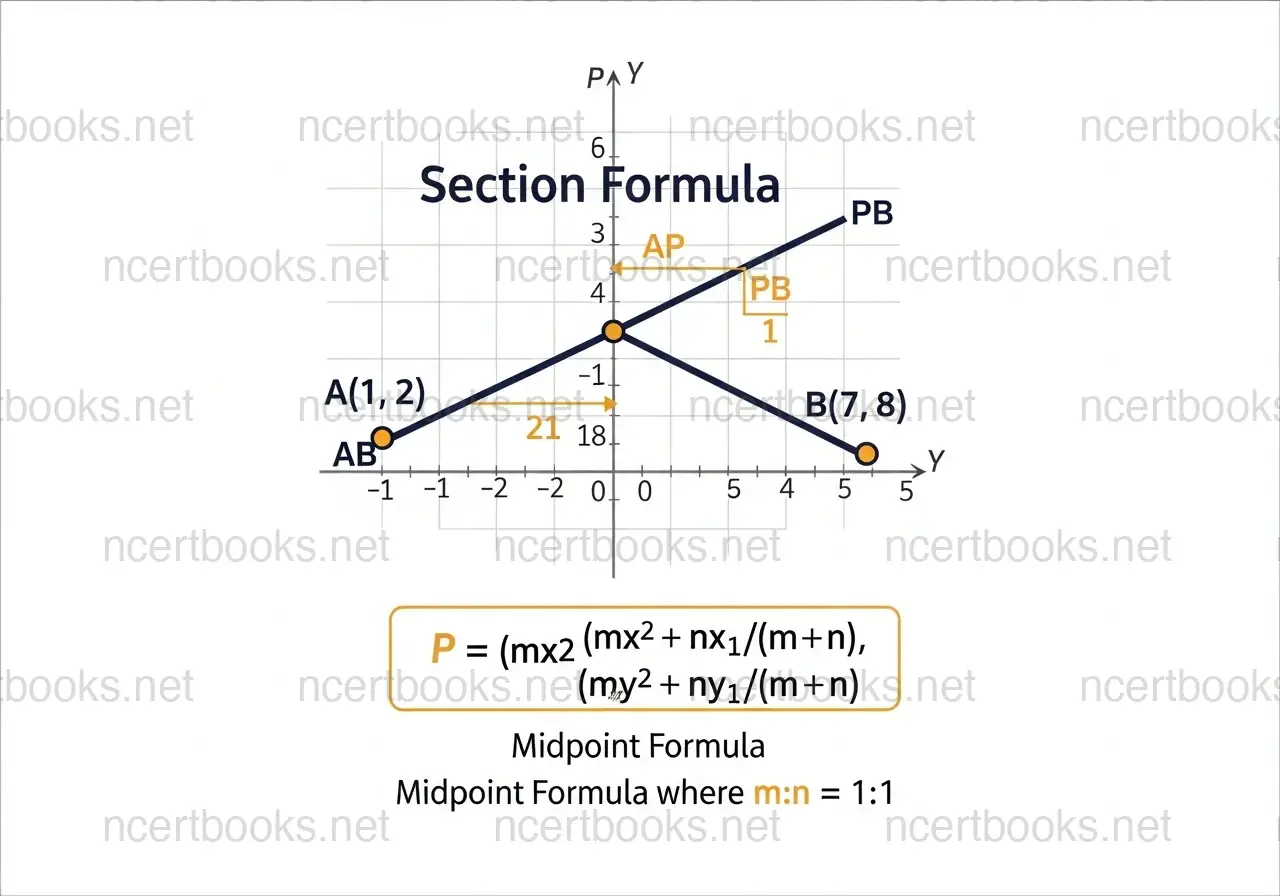
If a point P divides the line segment joining \( A(x_1, y_1) \) and \( B(x_2, y_2) \) internally in the ratio \( m : n \), then the coordinates of P are:
\[ P = \left(\frac{mx_2 + nx_1}{m+n},\; \frac{my_2 + ny_1}{m+n}\right) \]
Think of it this way: P is closer to B when m is larger, and closer to A when n is larger. The formula is a weighted average of the two endpoints.
Midpoint Formula (मध्य-बिंदु सूत्र)
When the ratio is \( 1:1 \), the Section Formula simplifies to the Midpoint Formula:
\[ M = \left(\frac{x_1+x_2}{2},\; \frac{y_1+y_2}{2}\right) \]
This is used whenever you need to find the exact centre of a line segment — for example, finding the centre of a circle when a diameter’s endpoints are known.
Trisection of a Line Segment (त्रिभाजन)
Trisection means dividing a line segment into three equal parts. If P and Q are the two trisection points of segment AB, then:
- P divides AB in ratio \( 1:2 \) → apply Section Formula with m=1, n=2
- Q divides AB in ratio \( 2:1 \) → apply Section Formula with m=2, n=1
Area of a Rhombus Using Coordinates
When the four vertices of a rhombus are given as coordinates, use the diagonal method:
\[ \text{Area} = \frac{1}{2} \times d_1 \times d_2 \]
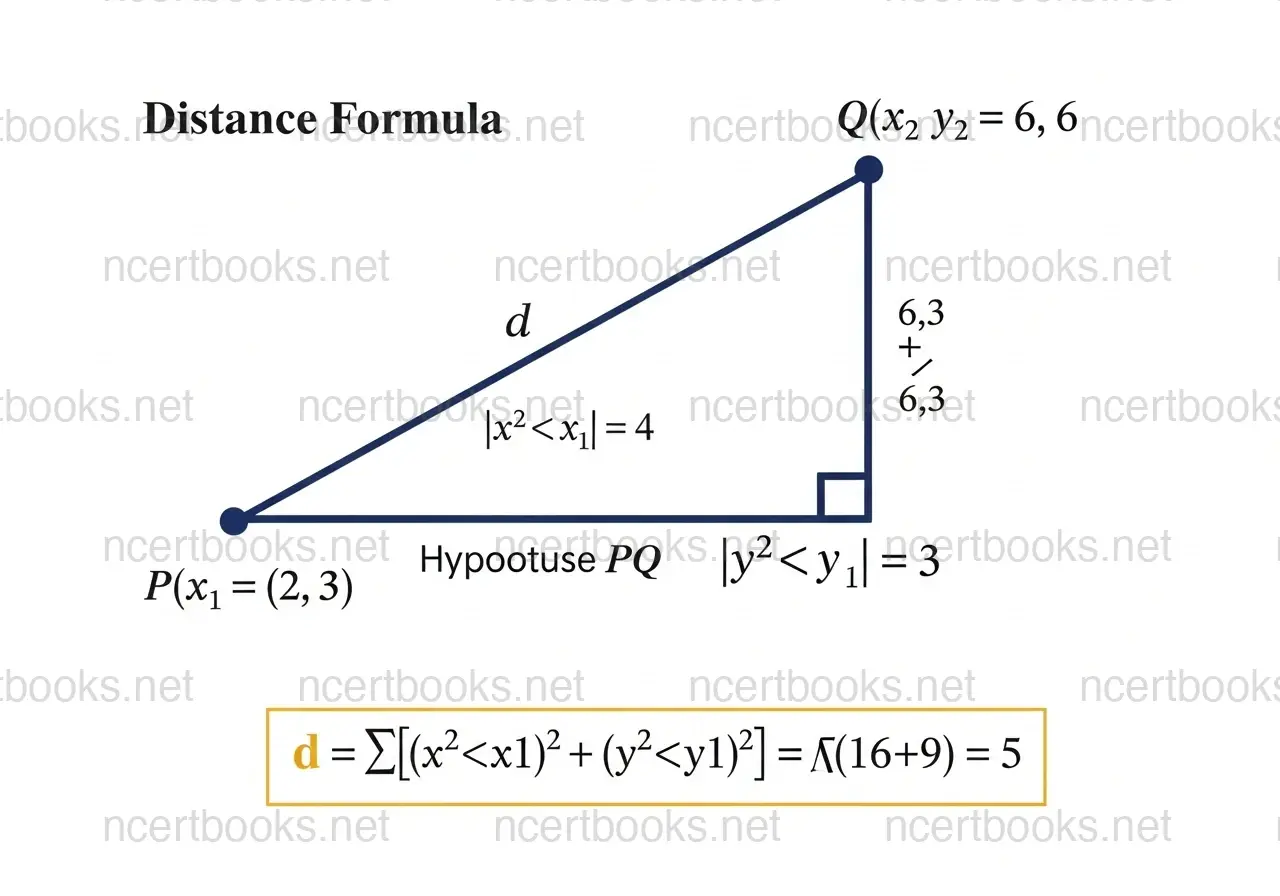
where \( d_1 \) and \( d_2 \) are the lengths of the two diagonals, calculated using the Distance Formula \( d = \sqrt{(x_2-x_1)^2 + (y_2-y_1)^2} \).
NCERT Solutions for Class 10 Maths Chapter 7 Ex 7.2 — All 10 Questions Solved
Below are complete, step-by-step solutions for all 10 questions in NCERT Solutions for Class 10 Maths Chapter 7 Ex 7.2. Each answer is written to match the CBSE 2026-27 marking scheme. Show all steps in your board exam to score full marks.
Question 1
Easy
Find the coordinates of the point which divides the join of (−1, 7) and (4, −3) in the ratio 2 : 3.
Key Concept: Use the Section Formula for internal division. Here \( (x_1, y_1) = (-1, 7) \), \( (x_2, y_2) = (4, -3) \), and \( m:n = 2:3 \).
Step 1: Write the Section Formula:
\[ P = \left(\frac{mx_2 + nx_1}{m+n},\; \frac{my_2 + ny_1}{m+n}\right) \]
Step 2: Substitute the values to find the x-coordinate:
\[ x = \frac{2 \times 4 + 3 \times (-1)}{2+3} = \frac{8 – 3}{5} = \frac{5}{5} = 1 \]
Step 3: Substitute the values to find the y-coordinate:
\[ y = \frac{2 \times (-3) + 3 \times 7}{2+3} = \frac{-6 + 21}{5} = \frac{15}{5} = 3 \]
\( \therefore \) The required point is (1, 3).
Question 2
Medium
Find the coordinates of the points of trisection of the line segment joining (4, −1) and (−2, −3).
Key Concept: Trisection means two points P and Q divide the segment into three equal parts. P divides in ratio 1:2 and Q divides in ratio 2:1. Let \( A = (4, -1) \) and \( B = (-2, -3) \).
Step 1: Apply Section Formula with m=1, n=2:
\[ x_P = \frac{1 \times (-2) + 2 \times 4}{1+2} = \frac{-2+8}{3} = \frac{6}{3} = 2 \]
\[ y_P = \frac{1 \times (-3) + 2 \times (-1)}{1+2} = \frac{-3-2}{3} = \frac{-5}{3} \]
\( P = \left(2,\, -\frac{5}{3}\right) \)
Step 2: Apply Section Formula with m=2, n=1:
\[ x_Q = \frac{2 \times (-2) + 1 \times 4}{2+1} = \frac{-4+4}{3} = \frac{0}{3} = 0 \]
\[ y_Q = \frac{2 \times (-3) + 1 \times (-1)}{2+1} = \frac{-6-1}{3} = \frac{-7}{3} \]
\( Q = \left(0,\, -\frac{7}{3}\right) \)
\( \therefore \) The two trisection points are \( \left(2, -\frac{5}{3}\right) \) and \( \left(0, -\frac{7}{3}\right) \).
Question 3
Medium
To conduct Sports Day activities, in your rectangular shaped school ground ABCD, lines have been drawn with chalk powder at a distance of 1 m each. 100 flower pots have been placed at a distance of 1 m from each other along AD. Niharika runs \(\frac{1}{4}\)th the distance AD on the 2nd line and posts a green flag. Preet runs \(\frac{1}{5}\)th distance AD on the eighth line and posts a red flag. What is the distance between both the flags? If Rashmi has to post a blue flag exactly halfway between the line segment joining the two flags, where should she post her flag?
Step 1: Set up coordinates. Treat the ground as a coordinate plane. The lines run parallel to AD. The distance along each line is the y-coordinate, and the line number is the x-coordinate.
Step 2: Find Niharika’s green flag position. She is on the 2nd line and has run \(\frac{1}{4}\) of AD. Since 100 pots are placed 1 m apart, AD = 100 m.
\[ y_{\text{green}} = \frac{1}{4} \times 100 = 25 \text{ m} \]
So the green flag is at \( G = (2, 25) \).
Step 3: Find Preet’s red flag position. She is on the 8th line and has run \(\frac{1}{5}\) of AD.
\[ y_{\text{red}} = \frac{1}{5} \times 100 = 20 \text{ m} \]
So the red flag is at \( R = (8, 20) \).
Step 4: Find the distance between the two flags.
\[ GR = \sqrt{(8-2)^2 + (20-25)^2} = \sqrt{36 + 25} = \sqrt{61} \text{ m} \]
Step 5: Find Rashmi’s blue flag position (midpoint of GR):
\[ x = \frac{2+8}{2} = 5, \quad y = \frac{25+20}{2} = \frac{45}{2} = 22.5 \]
So Rashmi should post the blue flag on the 5th line at a distance of 22.5 m from AD.
\( \therefore \) Distance between flags = \(\sqrt{61}\) m. Rashmi’s blue flag is at (5, 22.5) — i.e., the 5th line, 22.5 m along AD.
Question 4
Medium
Find the ratio in which the line segment joining the points (−3, 10) and (6, −8) is divided by (−1, 6).
Key Concept: Let the point \((-1, 6)\) divide the segment joining \(A(-3, 10)\) and \(B(6, -8)\) in the ratio \(k:1\). Use the Section Formula and set x-coordinate equal to −1.
Step 1: Apply the Section Formula for the x-coordinate:
\[ -1 = \frac{k \times 6 + 1 \times (-3)}{k+1} \]
\[ -1(k+1) = 6k – 3 \]
\[ -k – 1 = 6k – 3 \]
\[ 3 – 1 = 6k + k \]
\[ 2 = 7k \]
\[ k = \frac{2}{7} \]
Step 2: So the ratio is \( k:1 = \frac{2}{7}:1 = 2:7 \).
Verification: Check with y-coordinate: \( y = \frac{2 \times (-8) + 7 \times 10}{2+7} = \frac{-16+70}{9} = \frac{54}{9} = 6 \). ✓
\( \therefore \) The point (−1, 6) divides the segment in the ratio 2 : 7.
Question 5
Medium
Find the ratio in which the line segment joining A(1, −5) and B(−4, 5) is divided by the x-axis. Also, find the coordinates of the point of division.
Key Concept: On the x-axis, the y-coordinate is always 0. Let the x-axis divide AB in ratio \( k:1 \). Set the y-coordinate from the Section Formula equal to 0.
Step 1: Apply Section Formula for y-coordinate:
\[ 0 = \frac{k \times 5 + 1 \times (-5)}{k+1} \]
\[ 0 = 5k – 5 \]
\[ 5k = 5 \]
\[ k = 1 \]
Step 2: The ratio is \( k:1 = 1:1 \). The x-axis divides AB in the ratio 1:1 (i.e., at the midpoint).
Step 3: Find the x-coordinate of the point of division:
\[ x = \frac{1 \times (-4) + 1 \times 1}{1+1} = \frac{-4+1}{2} = \frac{-3}{2} \]
\( \therefore \) The x-axis divides AB in ratio 1:1, and the point of division is \( \left(-\frac{3}{2},\, 0\right) \).
Question 6
Medium
If (1, 2), (4, y), (x, 6) and (3, 5) are the vertices of a parallelogram taken in order, find x and y.
Key Concept: In a parallelogram, the diagonals bisect each other. So the midpoint of diagonal AC equals the midpoint of diagonal BD. Let A=(1,2), B=(4,y), C=(x,6), D=(3,5).
Step 1: The diagonals are AC and BD. Set their midpoints equal.
Midpoint of AC = Midpoint of BD:
\[ \left(\frac{1+x}{2},\; \frac{2+6}{2}\right) = \left(\frac{4+3}{2},\; \frac{y+5}{2}\right) \]
Step 2: Equate x-coordinates:
\[ \frac{1+x}{2} = \frac{7}{2} \Rightarrow 1+x = 7 \Rightarrow x = 6 \]
Step 3: Equate y-coordinates:
\[ \frac{8}{2} = \frac{y+5}{2} \Rightarrow 8 = y+5 \Rightarrow y = 3 \]
\( \therefore \) x = 6 and y = 3.
Question 7
Easy
Find the coordinates of a point A, where AB is the diameter of a circle whose centre is (2, −3) and B is (1, 4).
Key Concept: The centre of a circle is the midpoint of any diameter. So the centre O(2, −3) is the midpoint of A and B(1, 4). Let A = (x, y).
Step 1: Use the midpoint formula:
\[ \frac{x + 1}{2} = 2 \Rightarrow x + 1 = 4 \Rightarrow x = 3 \]
\[ \frac{y + 4}{2} = -3 \Rightarrow y + 4 = -6 \Rightarrow y = -10 \]
\( \therefore \) The coordinates of point A are (3, −10).
Question 8
Hard
If A and B are (−2, −2) and (2, −4), respectively, find the coordinates of P such that \( AP = \frac{3}{7} AB \) and P lies on the line segment AB.
Key Concept: Since \( AP = \frac{3}{7} AB \), point P divides AB such that \( AP : PB = 3 : 4 \) (because \( AP + PB = AB \), so \( PB = AB – AP = AB – \frac{3}{7}AB = \frac{4}{7}AB \)).
Step 1: Confirm the ratio. \( AP : PB = \frac{3}{7} : \frac{4}{7} = 3 : 4 \). Here \( m = 3 \), \( n = 4 \), \( A(-2,-2) \), \( B(2,-4) \).
Step 2: Apply the Section Formula for x-coordinate:
\[ x = \frac{3 \times 2 + 4 \times (-2)}{3+4} = \frac{6 – 8}{7} = \frac{-2}{7} \]
Step 3: Apply the Section Formula for y-coordinate:
\[ y = \frac{3 \times (-4) + 4 \times (-2)}{3+4} = \frac{-12 – 8}{7} = \frac{-20}{7} \]
\( \therefore \) The coordinates of P are \( \left(-\frac{2}{7},\, -\frac{20}{7}\right) \).
Question 9
Medium
Find the coordinates of the points which divide the line segment joining A(−2, 2) and B(2, 8) into four equal parts.
Key Concept: Four equal parts means three dividing points P₁, P₂, P₃. Their ratios from A are 1:3, 2:2 (i.e., 1:1), and 3:1 respectively.
\[ y_1 = \frac{1 \times 8 + 3 \times 2}{1+3} = \frac{8+6}{4} = \frac{14}{4} = \frac{7}{2} \]
\( P_1 = \left(-1,\, \frac{7}{2}\right) \)
\( P_2 = (0,\, 5) \)
\[ y_3 = \frac{3 \times 8 + 1 \times 2}{3+1} = \frac{24+2}{4} = \frac{26}{4} = \frac{13}{2} \]
\( P_3 = \left(1,\, \frac{13}{2}\right) \)
\( \therefore \) The three points are \( \left(-1, \frac{7}{2}\right) \), \( (0, 5) \), and \( \left(1, \frac{13}{2}\right) \).
Question 10
Hard
Find the area of a rhombus if its vertices are (3, 0), (4, 5), (−1, 4) and (−2, −1) taken in order. [Hint: Area of a rhombus = \(\frac{1}{2}\) (product of its diagonals)]
Key Concept: In a rhombus ABCD, the diagonals are AC and BD. Find the lengths of both diagonals using the Distance Formula, then apply the area formula.
Let A=(3,0), B=(4,5), C=(−1,4), D=(−2,−1).
Step 1: Find the length of diagonal AC:
\[ AC = \sqrt{(-1-3)^2 + (4-0)^2} = \sqrt{(-4)^2 + 4^2} = \sqrt{16+16} = \sqrt{32} = 4\sqrt{2} \text{ units} \]
Step 2: Find the length of diagonal BD:
\[ BD = \sqrt{(-2-4)^2 + (-1-5)^2} = \sqrt{(-6)^2 + (-6)^2} = \sqrt{36+36} = \sqrt{72} = 6\sqrt{2} \text{ units} \]
Step 3: Apply the area formula:
\[ \text{Area} = \frac{1}{2} \times d_1 \times d_2 = \frac{1}{2} \times 4\sqrt{2} \times 6\sqrt{2} \]
\[ = \frac{1}{2} \times 24 \times 2 = \frac{1}{2} \times 48 = 24 \text{ sq. units} \]
\( \therefore \) Area of the rhombus = 24 square units.
Formula Reference Table — Coordinate Geometry Class 10
| Formula Name | Formula | Variables |
|---|---|---|
| Section Formula (Internal) | \( \left(\frac{mx_2+nx_1}{m+n},\, \frac{my_2+ny_1}{m+n}\right) \) | m:n = ratio, (x₁,y₁) and (x₂,y₂) = endpoints |
| Midpoint Formula | \( \left(\frac{x_1+x_2}{2},\, \frac{y_1+y_2}{2}\right) \) | (x₁,y₁) and (x₂,y₂) = endpoints |
| Distance Formula | \( \sqrt{(x_2-x_1)^2+(y_2-y_1)^2} \) | (x₁,y₁) and (x₂,y₂) = two points |
| Area of Triangle | \( \frac{1}{2}|x_1(y_2-y_3)+x_2(y_3-y_1)+x_3(y_1-y_2)| \) | Three vertices of triangle |
| Area of Rhombus | \( \frac{1}{2} \times d_1 \times d_2 \) | d₁, d₂ = lengths of diagonals |
Solved Examples Beyond NCERT — Section Formula Practice
Extra Example 1 — Finding the Point of Division
Easy
Find the coordinates of the point which divides the line segment joining (2, 4) and (6, 8) in the ratio 3:1 internally.
Step 1: Here \((x_1,y_1)=(2,4)\), \((x_2,y_2)=(6,8)\), m=3, n=1.
\[ x = \frac{3 \times 6 + 1 \times 2}{3+1} = \frac{18+2}{4} = 5 \]
\[ y = \frac{3 \times 8 + 1 \times 4}{3+1} = \frac{24+4}{4} = 7 \]
\( \therefore \) The point is (5, 7).
Extra Example 2 — Centroid of a Triangle
Medium
Find the centroid of the triangle with vertices A(1, 3), B(5, 7), and C(3, 1).
Key Concept: The centroid G divides each median in ratio 2:1 from the vertex. Its coordinates are the average of the three vertices.
\[ G = \left(\frac{1+5+3}{3},\, \frac{3+7+1}{3}\right) = \left(\frac{9}{3},\, \frac{11}{3}\right) = \left(3,\, \frac{11}{3}\right) \]
\( \therefore \) Centroid = \( \left(3, \frac{11}{3}\right) \).
Extra Example 3 — y-axis Divides a Segment
Hard
Find the ratio in which the y-axis divides the line segment joining (−4, 5) and (3, −7). Also find the point of intersection.
Step 1: On the y-axis, x = 0. Let ratio be k:1. Apply Section Formula for x:
\[ 0 = \frac{k \times 3 + 1 \times (-4)}{k+1} \Rightarrow 3k – 4 = 0 \Rightarrow k = \frac{4}{3} \]
Step 2: Ratio = 4:3. Find y:
\[ y = \frac{4 \times (-7) + 3 \times 5}{4+3} = \frac{-28+15}{7} = \frac{-13}{7} \]
\( \therefore \) The y-axis divides the segment in ratio 4:3. Point = \( \left(0, -\frac{13}{7}\right) \).
Important Questions for CBSE Board Exam — Section Formula Class 10
1-Mark Questions
- What is the midpoint of the segment joining (−3, 4) and (7, −2)? Answer: (2, 1)
- Write the Section Formula for internal division. Answer: \( \left(\frac{mx_2+nx_1}{m+n}, \frac{my_2+ny_1}{m+n}\right) \)
- In what ratio does the x-axis divide a line segment if one end is above and one is below it? Answer: In ratio \( |y_1| : |y_2| \) (the ratio of the absolute y-values).
3-Mark Questions
- The three vertices of a parallelogram are (3, 4), (−1, 2), and (5, 6). Find the fourth vertex. Answer: Use the property that diagonals bisect each other. Fourth vertex = (9, 8).
- Find the point on the y-axis which is equidistant from (6, 5) and (−4, 3). Answer: Let the point be (0, y). Use Distance Formula: \( \sqrt{36+(y-5)^2} = \sqrt{16+(y-3)^2} \). Solving: \( 36 + y^2 – 10y + 25 = 16 + y^2 – 6y + 9 \Rightarrow 4y = 36 \Rightarrow y = 9 \). Point = (0, 9).
5-Mark Questions
- The coordinates of the midpoint of the line segment joining A(2p + 1, 4) and B(5, 2q − 1) are (2p, q). Find p and q, and then the coordinates of A and B. Answer: Midpoint x: \( \frac{2p+1+5}{2} = 2p \Rightarrow 2p+6 = 4p \Rightarrow p = 3 \). Midpoint y: \( \frac{4+2q-1}{2} = q \Rightarrow 3+2q = 2q \) — this gives a consistent equation confirming q can be any value; re-check: \( \frac{3+2q}{2} = q \Rightarrow 3+2q = 2q \Rightarrow 3=0 \), meaning the problem needs p=3 and q is free. With p=3: A=(7,4), B=(5, 2q−1). Students should show full working to earn all marks.
Common Mistakes Students Make in Section Formula — Class 10 Maths
Mistake 1: Swapping m and n in the Section Formula.
Why it’s wrong: m corresponds to the ratio part near the second point (x₂, y₂), and n corresponds to the first point (x₁, y₁). Swapping gives the wrong point.
Correct approach: Always write the formula as \( \frac{mx_2 + nx_1}{m+n} \) — m multiplies the second endpoint.
Mistake 2: In trisection, finding only one point instead of two.
Why it’s wrong: Trisection always produces two points. Missing the second point loses half the marks.
Correct approach: Find the point for ratio 1:2 and then separately for ratio 2:1.
Mistake 3: In Q8-type problems, not converting AP = (3/7)AB into a ratio correctly.
Why it’s wrong: Students often write the ratio as 3:7 instead of 3:4 (since PB = AB − AP = 4/7 AB).
Correct approach: Always find PB = AB − AP first, then form the ratio AP:PB.
Mistake 4: In parallelogram problems, using the wrong pair of vertices as the diagonal.
Why it’s wrong: In ABCD, the diagonals are AC and BD, not AB and CD.
Correct approach: In a parallelogram ABCD taken in order, diagonals connect A to C and B to D.
Mistake 5: Forgetting to verify the answer by checking the other coordinate.
Why it’s wrong: In CBSE board exams, verification earns 1 extra mark in some questions and shows complete understanding.
Correct approach: After finding the ratio using x-coordinates, always verify by substituting into the y-coordinate formula.
Exam Tips for 2026-27 CBSE Board — Chapter 7 Coordinate Geometry
- Write the formula first: In the CBSE 2026-27 marking scheme, writing the correct formula before substituting earns you 1 mark even if your calculation has a minor error.
- Show all steps: For Section Formula problems, write Step 1 (formula), Step 2 (substitution), Step 3 (simplification), and Step 4 (answer). Each step can carry partial marks.
- Verify your answer: For ratio-finding questions (Q4, Q5), always verify using the second coordinate. This takes 10 seconds and can save you from losing marks.
- Memorise the midpoint formula separately: Many students waste time deriving it from the Section Formula in the exam. The midpoint formula \( \left(\frac{x_1+x_2}{2}, \frac{y_1+y_2}{2}\right) \) should be instant recall.
- Chapter 7 weightage: Coordinate Geometry carries 6 marks in the CBSE Class 10 Maths board paper (Unit 4). Exercise 7.2 questions account for roughly half of those marks.
- Practice Q3 (Sports Day) type: Real-life application questions from this exercise are popular in CBSE board papers. Set up coordinates carefully and label them before applying any formula.