⚡ Quick Revision Box — Chapter 7 Coordinate Geometry
- Distance Formula: Distance between P(x₁, y₁) and Q(x₂, y₂) = \( \sqrt{(x_2 – x_1)^2 + (y_2 – y_1)^2} \)
- Distance from Origin: Distance of P(x, y) from O(0,0) = \( \sqrt{x^2 + y^2} \)
- Collinear Points: Three points are collinear if AB + BC = AC (sum of two distances equals the third)
- Isosceles Triangle: A triangle is isosceles if any two of its three sides are equal in length
- Equidistant Point on x-axis: Any point on x-axis has form (x, 0); set distances equal and solve for x
- Square Check: All four sides equal AND both diagonals equal → Square; all sides equal but diagonals unequal → Rhombus
- Exercise 7.1: Contains 10 questions, all based on the Distance Formula — most important exercise of Chapter 7
- CBSE Weightage: Coordinate Geometry carries 6 marks in the Class 10 board exam 2026-27
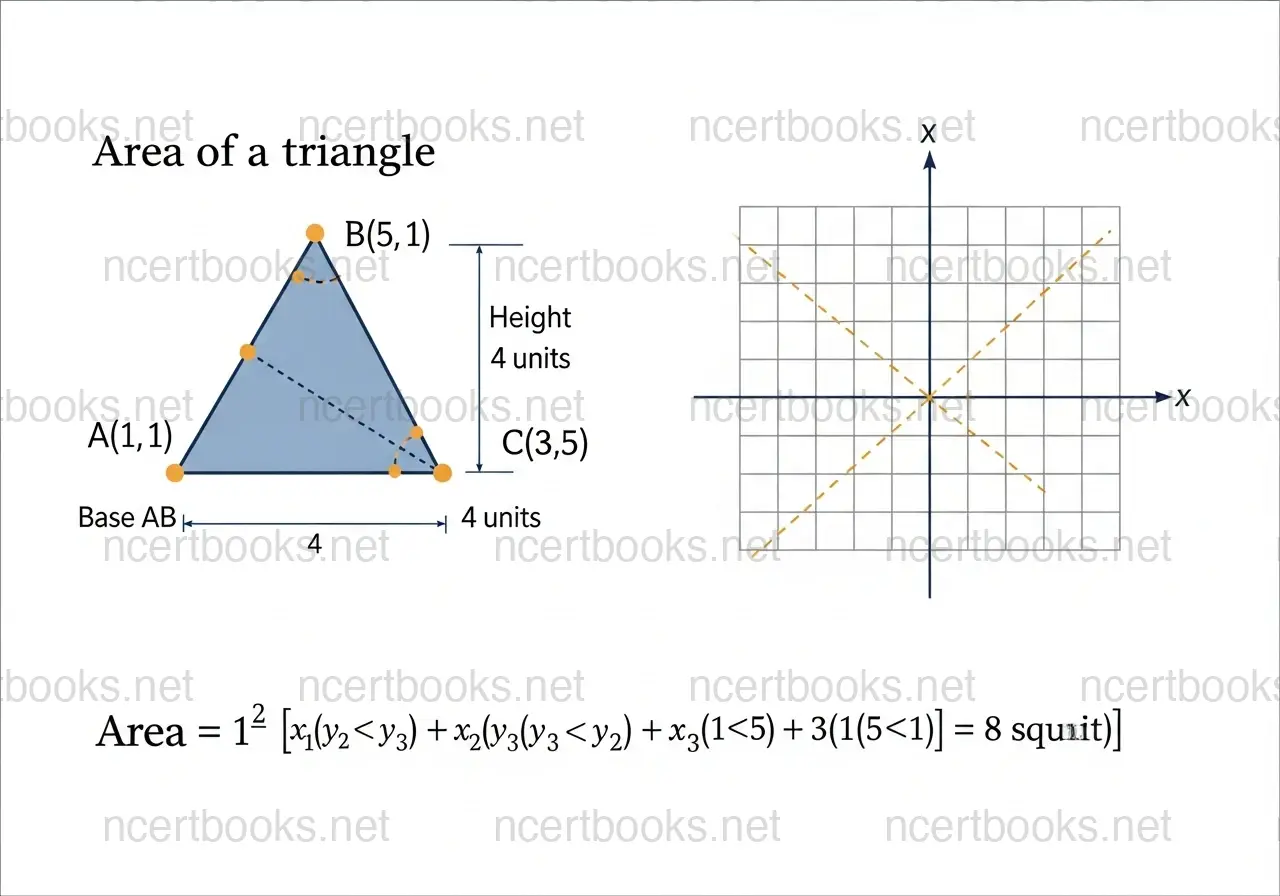
📘 Updated for 2026-27 Rationalised Syllabus: This page reflects the latest NCERT syllabus. Exercise 7.4 (Area of Triangle) has been removed from the current CBSE rationalised syllabus. It is labelled “Extra Reference / State Boards” and is not required for CBSE board exams 2026-27.
The NCERT Solutions for Class 10 Maths Chapter 7 Coordinate Geometry on this page cover all questions from Exercise 7.1 with complete step-by-step working, updated for the 2026-27 CBSE board exam. You can find these solutions as part of our complete NCERT Solutions for Class 10 resource hub. Chapter 7 introduces the Distance Formula and Section Formula — two of the most frequently tested topics in CBSE Class 10 Maths. This page is your one-stop guide to mastering Exercise 7.1 and scoring full marks on these questions. All solutions are verified against the official NCERT official textbook.
Whether you need cbse class 10 maths ncert solutions in English or want to understand the logic behind each step, this page explains every question clearly. You can also explore the full NCERT Solutions library for all classes and subjects on ncertbooks.net.
Table of Contents
- Quick Revision Box
- Chapter Overview — Coordinate Geometry Class 10
- Key Concepts and Theorems — Distance Formula
- Formula Reference Table
- NCERT Solutions Exercise 7.1 — All 10 Questions Solved
- Solved Examples Beyond NCERT
- Important Questions for Board Exam 2026-27
- Common Mistakes Students Make
- Exam Tips for 2026-27 CBSE Board
- Frequently Asked Questions
Chapter Overview — NCERT Solutions for Class 10 Maths Chapter 7 Coordinate Geometry
Chapter 7 Coordinate Geometry is part of the Class 10 NCERT Mathematics textbook (published by NCERT, New Delhi). This chapter builds on your knowledge of the Cartesian plane from earlier classes and introduces powerful algebraic tools — the Distance Formula and Section Formula — to solve geometric problems analytically.
For the 2026-27 CBSE board exam, Coordinate Geometry carries 6 marks in the standard question paper. Questions from this chapter appear as 2-mark and 3-mark problems, making Exercise 7.1 (Distance Formula) the most scoring section. You need strong command of Class 9 Chapter 3 (Coordinate Geometry basics) before starting this chapter.
| Detail | Information |
|---|---|
| Chapter | Chapter 7 — Coordinate Geometry |
| Textbook | NCERT Mathematics Class 10 |
| Class | Class 10 |
| Subject | Mathematics |
| Exercise Covered | Exercise 7.1 (Distance Formula) — 10 Questions |
| CBSE Marks Weightage | 6 marks (2026-27 board exam) |
| Difficulty Level | Medium |
| Prerequisites | Cartesian Plane (Class 9 Ch. 3), Pythagoras Theorem |
Key Concepts and Theorems — Distance Formula in Coordinate Geometry
Cartesian Plane Basics (निर्देशांक तल)
The Cartesian plane is divided into four quadrants by the x-axis and y-axis. Every point is represented as an ordered pair (x, y) where x is the abscissa (x-coordinate / भुज) and y is the ordinate (y-coordinate / कोटि). The origin is at (0, 0). Points on the x-axis have y = 0; points on the y-axis have x = 0.
Distance Formula — Derivation and Application
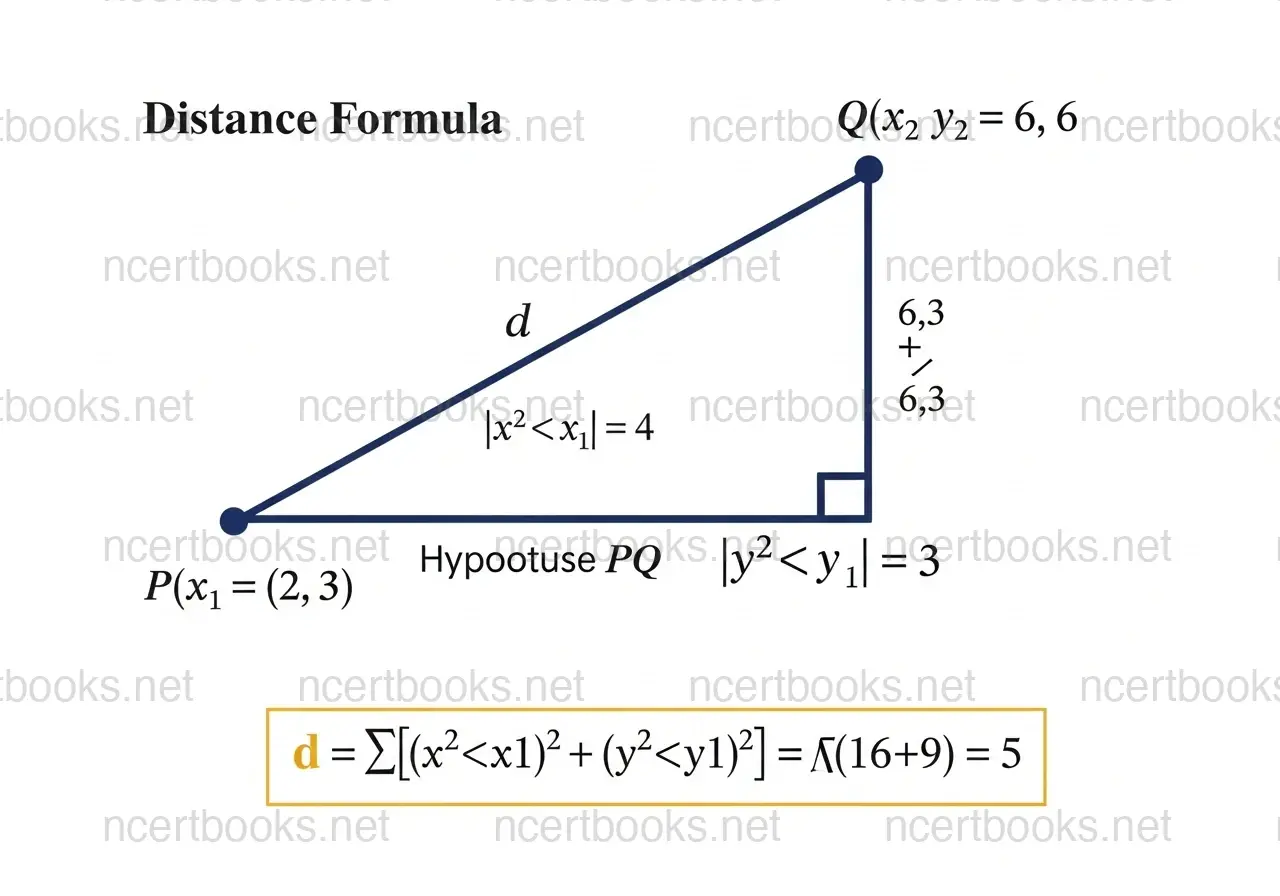
The distance formula is derived from the Pythagoras theorem. If you draw a right triangle with P(x₁, y₁) and Q(x₂, y₂) as the hypotenuse endpoints, the horizontal leg has length |x₂ − x₁| and the vertical leg has length |y₂ − y₁|. By Pythagoras:
\[ PQ = \sqrt{(x_2 – x_1)^2 + (y_2 – y_1)^2} \]
This works for any two points in any quadrant because squaring removes the sign.
Collinearity Condition (संरेखता)
Three points A, B, C are collinear (lie on the same line) if and only if:
\[ AB + BC = AC \]
Alternatively, if none of the three combinations of distances satisfy this, the points form a triangle (non-collinear).
Identifying Triangle Types Using Distance Formula
- Equilateral Triangle (समबाहु त्रिभुज): All three sides equal
- Isosceles Triangle (समद्विबाहु त्रिभुज): Any two sides equal
- Scalene Triangle (विषमबाहु त्रिभुज): All three sides different
- Right Triangle (समकोण त्रिभुज): Satisfies Pythagoras theorem (a² + b² = c²)
Identifying Quadrilateral Types
To identify a quadrilateral from four vertices, calculate all four sides AND both diagonals:
- Square: All 4 sides equal + both diagonals equal
- Rhombus: All 4 sides equal + diagonals unequal
- Rectangle: Opposite sides equal + both diagonals equal
- Parallelogram: Opposite sides equal + diagonals unequal
Formula Reference Table — Class 10 Maths Chapter 7
| Formula Name | Formula | Variables |
|---|---|---|
| Distance Formula | \( d = \sqrt{(x_2 – x_1)^2 + (y_2 – y_1)^2} \) | P(x₁,y₁), Q(x₂,y₂) |
| Distance from Origin | \( d = \sqrt{x^2 + y^2} \) | Point P(x, y) |
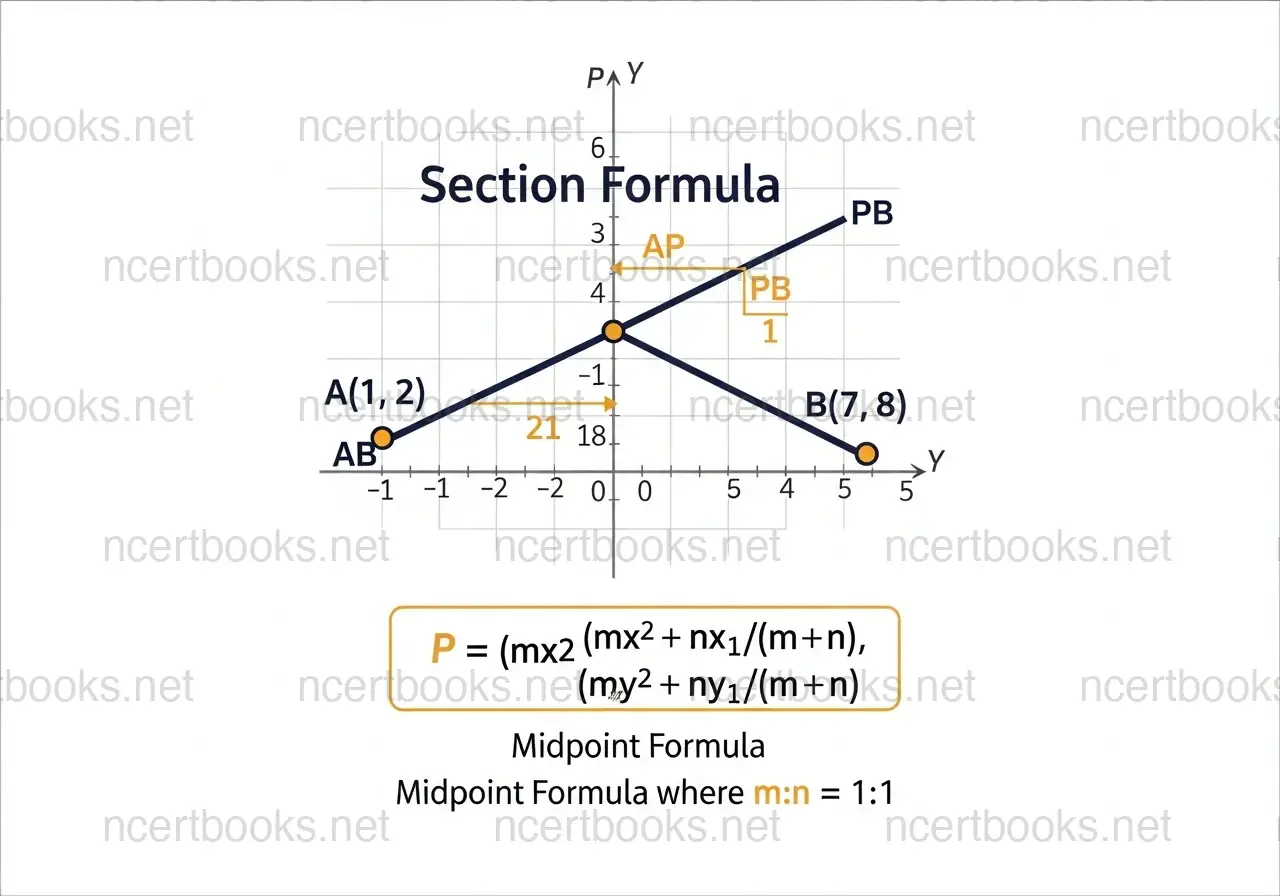
| Section Formula (Internal) | \( P = \left(\frac{m_1 x_2 + m_2 x_1}{m_1 + m_2},\ \frac{m_1 y_2 + m_2 y_1}{m_1 + m_2}\right) \) | Ratio m₁:m₂ |
| Mid-Point Formula | \( M = \left(\frac{x_1 + x_2}{2},\ \frac{y_1 + y_2}{2}\right) \) | Endpoints A(x₁,y₁), B(x₂,y₂) |
| Collinearity Condition | \( AB + BC = AC \) | Three points A, B, C |
NCERT Solutions for Class 10 Maths Chapter 7 Exercise 7.1 — All 10 Questions Solved
Below are complete, step-by-step solutions for all 10 questions in Exercise 7.1. These solutions match the official NCERT answer key and are formatted for the 2026-27 CBSE board exam marking scheme. Show all working in your exam to earn full marks.
Question 1
Easy
Find the distance between the following pairs of points:
(i) (2, 3), (4, 1) (ii) (−5, 7), (−1, 3) (iii) (a, b), (−a, −b)
Step 1: Identify the coordinates: \( x_1 = 2,\ y_1 = 3,\ x_2 = 4,\ y_2 = 1 \)
Step 2: Apply the distance formula:
\[ d = \sqrt{(x_2 – x_1)^2 + (y_2 – y_1)^2} \]
\[ d = \sqrt{(4 – 2)^2 + (1 – 3)^2} \]
\[ d = \sqrt{(2)^2 + (-2)^2} \]
\[ d = \sqrt{4 + 4} = \sqrt{8} = 2\sqrt{2} \]
\( \therefore \) Distance = \( 2\sqrt{2} \) units
Step 1: Identify: \( x_1 = -5,\ y_1 = 7,\ x_2 = -1,\ y_2 = 3 \)
Step 2: Apply the distance formula:
\[ d = \sqrt{(-1 – (-5))^2 + (3 – 7)^2} \]
\[ d = \sqrt{(4)^2 + (-4)^2} \]
\[ d = \sqrt{16 + 16} = \sqrt{32} = 4\sqrt{2} \]
\( \therefore \) Distance = \( 4\sqrt{2} \) units
Step 1: Identify: \( x_1 = a,\ y_1 = b,\ x_2 = -a,\ y_2 = -b \)
Step 2: Apply the distance formula:
\[ d = \sqrt{(-a – a)^2 + (-b – b)^2} \]
\[ d = \sqrt{(-2a)^2 + (-2b)^2} \]
\[ d = \sqrt{4a^2 + 4b^2} = 2\sqrt{a^2 + b^2} \]
Why does this work? The two points are symmetric about the origin, so the distance is twice the distance from either point to the origin.
\( \therefore \) Distance = \( 2\sqrt{a^2 + b^2} \) units
Question 2
Easy
Find the distance between the points (0, 0) and (36, 15).
Key Concept: When one point is the origin (0, 0), use the simplified formula \( d = \sqrt{x^2 + y^2} \).
Step 1: Let A = (0, 0) and B = (36, 15). Apply the distance formula:
\[ d = \sqrt{(36 – 0)^2 + (15 – 0)^2} \]
\[ d = \sqrt{36^2 + 15^2} \]
\[ d = \sqrt{1296 + 225} \]
\[ d = \sqrt{1521} \]
Step 2: Simplify \( \sqrt{1521} \). Check: \( 39^2 = 1521 \). Yes!
\[ d = 39 \]
Verification: \( 39^2 = 1521 \) and \( 1296 + 225 = 1521 \). ✓
\( \therefore \) Distance between (0, 0) and (36, 15) = 39 units
Question 3
Medium
Determine if the points (1, 5), (2, 3) and (−2, −11) are collinear.
Key Concept: Three points are collinear if the sum of two of the distances equals the third. Let A = (1, 5), B = (2, 3), C = (−2, −11).
Step 1: Find AB:
\[ AB = \sqrt{(2-1)^2 + (3-5)^2} = \sqrt{1 + 4} = \sqrt{5} \]
Step 2: Find BC:
\[ BC = \sqrt{(-2-2)^2 + (-11-3)^2} = \sqrt{16 + 196} = \sqrt{212} = 2\sqrt{53} \]
Step 3: Find AC:
\[ AC = \sqrt{(-2-1)^2 + (-11-5)^2} = \sqrt{9 + 256} = \sqrt{265} \]
Step 4: Check collinearity: Is AB + BC = AC?
\[ \sqrt{5} + 2\sqrt{53} \approx 2.236 + 14.56 = 16.796 \]
\[ \sqrt{265} \approx 16.279 \]
Since \( AB + BC \neq AC \), the points are not collinear.
\( \therefore \) The points (1, 5), (2, 3) and (−2, −11) are NOT collinear.
Question 4
Medium
Check whether (5, −2), (6, 4) and (7, −2) are the vertices of an isosceles triangle.
Let A = (5, −2), B = (6, 4), C = (7, −2).
Step 1: Find AB:
\[ AB = \sqrt{(6-5)^2 + (4-(-2))^2} = \sqrt{1 + 36} = \sqrt{37} \]
Step 2: Find BC:
\[ BC = \sqrt{(7-6)^2 + (-2-4)^2} = \sqrt{1 + 36} = \sqrt{37} \]
Step 3: Find AC:
\[ AC = \sqrt{(7-5)^2 + (-2-(-2))^2} = \sqrt{4 + 0} = 2 \]
Step 4: Compare: \( AB = BC = \sqrt{37} \) and \( AC = 2 \). Two sides are equal.
Why is this isosceles? An isosceles triangle has exactly two equal sides. Here AB = BC, confirming it is isosceles.
\( \therefore \) Yes, (5, −2), (6, 4) and (7, −2) are vertices of an isosceles triangle since AB = BC = \( \sqrt{37} \) units.
Question 5
Medium
In a classroom, 4 friends are seated at the points A, B, C and D as shown in the given figure. Champa and Chameli walk into the class and after observing for a few minutes Champa asks Chameli, “Don’t you think ABCD is a square?” Chameli disagrees. Using distance formula, find which of them is correct.
Key Concept: From the figure, the coordinates are A(3, 4), B(6, 7), C(9, 4), D(6, 1).
Step 1: Find all four sides:
\[ AB = \sqrt{(6-3)^2 + (7-4)^2} = \sqrt{9 + 9} = \sqrt{18} = 3\sqrt{2} \]
\[ BC = \sqrt{(9-6)^2 + (4-7)^2} = \sqrt{9 + 9} = \sqrt{18} = 3\sqrt{2} \]
\[ CD = \sqrt{(6-9)^2 + (1-4)^2} = \sqrt{9 + 9} = \sqrt{18} = 3\sqrt{2} \]
\[ DA = \sqrt{(3-6)^2 + (4-1)^2} = \sqrt{9 + 9} = \sqrt{18} = 3\sqrt{2} \]
Step 2: All four sides are equal: \( AB = BC = CD = DA = 3\sqrt{2} \)
Step 3: Find both diagonals:
\[ AC = \sqrt{(9-3)^2 + (4-4)^2} = \sqrt{36 + 0} = 6 \]
\[ BD = \sqrt{(6-6)^2 + (1-7)^2} = \sqrt{0 + 36} = 6 \]
Step 4: Both diagonals are equal: \( AC = BD = 6 \). All sides equal AND diagonals equal → Square.
\( \therefore \) Champa is correct — ABCD is a square with side \( 3\sqrt{2} \) units and diagonals of 6 units each.
Question 6
Hard
Name the type of quadrilateral formed, if any, by the following points, and give reasons for your answer.
(i) (−1, −2), (1, 0), (−1, 2), (−3, 0)
(ii) (−3, 5), (3, 1), (0, 3), (−1, −4)
(iii) (4, 5), (7, 6), (4, 3), (1, 2)
Step 1: Calculate all sides:
\[ AB = \sqrt{(1-(-1))^2 + (0-(-2))^2} = \sqrt{4+4} = 2\sqrt{2} \]
\[ BC = \sqrt{(-1-1)^2 + (2-0)^2} = \sqrt{4+4} = 2\sqrt{2} \]
\[ CD = \sqrt{(-3-(-1))^2 + (0-2)^2} = \sqrt{4+4} = 2\sqrt{2} \]
\[ DA = \sqrt{(-1-(-3))^2 + (-2-0)^2} = \sqrt{4+4} = 2\sqrt{2} \]
Step 2: Calculate diagonals:
\[ AC = \sqrt{(-1-(-1))^2 + (2-(-2))^2} = \sqrt{0+16} = 4 \]
\[ BD = \sqrt{(-3-1)^2 + (0-0)^2} = \sqrt{16+0} = 4 \]
All four sides equal \( 2\sqrt{2} \) and both diagonals equal 4.
\( \therefore \) ABCD is a Square.
Step 1: Calculate all sides:
\[ AB = \sqrt{(3-(-3))^2 + (1-5)^2} = \sqrt{36+16} = \sqrt{52} = 2\sqrt{13} \]
\[ BC = \sqrt{(0-3)^2 + (3-1)^2} = \sqrt{9+4} = \sqrt{13} \]
\[ CD = \sqrt{(-1-0)^2 + (-4-3)^2} = \sqrt{1+49} = \sqrt{50} = 5\sqrt{2} \]
\[ DA = \sqrt{(-3-(-1))^2 + (5-(-4))^2} = \sqrt{4+81} = \sqrt{85} \]
All four sides are different. Check if A, B, C are collinear:
\[ AB = 2\sqrt{13},\ BC = \sqrt{13},\ AC = \sqrt{(0-(-3))^2+(3-5)^2} = \sqrt{9+4} = \sqrt{13} \]
Since \( BC + AC = \sqrt{13} + \sqrt{13} = 2\sqrt{13} = AB \), points A, B, C are collinear. Therefore, these four points do not form a quadrilateral.
\( \therefore \) No quadrilateral is formed — points A, B, C are collinear.
Step 1: Calculate all sides:
\[ AB = \sqrt{(7-4)^2 + (6-5)^2} = \sqrt{9+1} = \sqrt{10} \]
\[ BC = \sqrt{(4-7)^2 + (3-6)^2} = \sqrt{9+9} = \sqrt{18} = 3\sqrt{2} \]
\[ CD = \sqrt{(1-4)^2 + (2-3)^2} = \sqrt{9+1} = \sqrt{10} \]
\[ DA = \sqrt{(4-1)^2 + (5-2)^2} = \sqrt{9+9} = \sqrt{18} = 3\sqrt{2} \]
Step 2: Opposite sides are equal: AB = CD = \( \sqrt{10} \) and BC = DA = \( 3\sqrt{2} \).
Step 3: Calculate diagonals:
\[ AC = \sqrt{(4-4)^2 + (3-5)^2} = \sqrt{0+4} = 2 \]
\[ BD = \sqrt{(1-7)^2 + (2-6)^2} = \sqrt{36+16} = \sqrt{52} = 2\sqrt{13} \]
Opposite sides equal but diagonals are unequal → Parallelogram.
\( \therefore \) ABCD is a Parallelogram.
Question 7
Medium
Find the point on the x-axis which is equidistant from (2, −5) and (−2, 9).
Key Concept: Any point on the x-axis has coordinates (x, 0). Set the two distances equal and solve for x.
Step 1: Let the required point be P(x, 0). Given points: A(2, −5) and B(−2, 9).
Step 2: Set PA = PB:
\[ \sqrt{(x-2)^2 + (0-(-5))^2} = \sqrt{(x-(-2))^2 + (0-9)^2} \]
\[ \sqrt{(x-2)^2 + 25} = \sqrt{(x+2)^2 + 81} \]
Step 3: Square both sides:
\[ (x-2)^2 + 25 = (x+2)^2 + 81 \]
\[ x^2 – 4x + 4 + 25 = x^2 + 4x + 4 + 81 \]
\[ x^2 – 4x + 29 = x^2 + 4x + 85 \]
Step 4: Simplify:
\[ -4x – 4x = 85 – 29 \]
\[ -8x = 56 \]
\[ x = -7 \]
\( \therefore \) The required point on the x-axis is (−7, 0).
Question 8
Medium
Find the values of y for which the distance between the points P(2, −3) and Q(10, y) is 10 units.
Step 1: Apply the distance formula and set equal to 10:
\[ PQ = \sqrt{(10-2)^2 + (y-(-3))^2} = 10 \]
\[ \sqrt{64 + (y+3)^2} = 10 \]
Step 2: Square both sides:
\[ 64 + (y+3)^2 = 100 \]
\[ (y+3)^2 = 100 – 64 = 36 \]
Step 3: Take square root of both sides:
\[ y + 3 = \pm 6 \]
Step 4: Solve both cases:
Case 1: \( y + 3 = 6 \Rightarrow y = 3 \)
Case 2: \( y + 3 = -6 \Rightarrow y = -9 \)
Verification: For y = 3: \( PQ = \sqrt{64 + 36} = \sqrt{100} = 10 \) ✓ For y = −9: \( PQ = \sqrt{64 + 36} = 10 \) ✓
\( \therefore \) y = 3 or y = −9
Question 9
Hard
If Q(0, 1) is equidistant from P(5, −3) and R(x, 6), find the values of x. Also, find the distances QR and PR.
Step 1: Since Q is equidistant from P and R, set QP = QR:
\[ QP = \sqrt{(5-0)^2 + (-3-1)^2} = \sqrt{25 + 16} = \sqrt{41} \]
\[ QR = \sqrt{(x-0)^2 + (6-1)^2} = \sqrt{x^2 + 25} \]
Step 2: Set QP = QR:
\[ \sqrt{x^2 + 25} = \sqrt{41} \]
\[ x^2 + 25 = 41 \]
\[ x^2 = 16 \]
\[ x = \pm 4 \]
Step 3: Find QR: \( QR = \sqrt{41} \) units (same as QP).
Step 4: Find PR for both values of x.
When \( x = 4 \): R = (4, 6)
\[ PR = \sqrt{(4-5)^2 + (6-(-3))^2} = \sqrt{1 + 81} = \sqrt{82} \]
When \( x = -4 \): R = (−4, 6)
\[ PR = \sqrt{(-4-5)^2 + (6-(-3))^2} = \sqrt{81 + 81} = \sqrt{162} = 9\sqrt{2} \]
\( \therefore \) x = 4 or x = −4
QR = \( \sqrt{41} \) units
When x = 4: PR = \( \sqrt{82} \) units
When x = −4: PR = \( 9\sqrt{2} \) units
Question 10
Medium
Find a relation between x and y such that the point (x, y) is equidistant from the points (3, 6) and (−3, 4).
Step 1: Let A = (3, 6) and B = (−3, 4). Let P = (x, y) be equidistant from A and B, so PA = PB.
Step 2: Write the distance equations:
\[ PA = \sqrt{(x-3)^2 + (y-6)^2} \]
\[ PB = \sqrt{(x+3)^2 + (y-4)^2} \]
Step 3: Set PA = PB and square both sides:
\[ (x-3)^2 + (y-6)^2 = (x+3)^2 + (y-4)^2 \]
Step 4: Expand:
\[ x^2 – 6x + 9 + y^2 – 12y + 36 = x^2 + 6x + 9 + y^2 – 8y + 16 \]
Step 5: Cancel \( x^2 \) and \( y^2 \) from both sides:
\[ -6x + 9 – 12y + 36 = 6x + 9 – 8y + 16 \]
\[ -6x – 12y + 45 = 6x – 8y + 25 \]
Step 6: Rearrange:
\[ -6x – 6x – 12y + 8y + 45 – 25 = 0 \]
\[ -12x – 4y + 20 = 0 \]
\[ 3x + y = 5 \]
\( \therefore \) The required relation is \( 3x + y = 5 \)
Solved Examples Beyond NCERT — Class 10 Maths Chapter 7
Extra Example 1
Medium
Show that the points A(1, 2), B(5, 4), C(3, 8) and D(−1, 6) form a square.
Step 1: Find all sides:
\[ AB = \sqrt{16+4} = \sqrt{20},\ BC = \sqrt{4+16} = \sqrt{20},\ CD = \sqrt{16+4} = \sqrt{20},\ DA = \sqrt{4+16} = \sqrt{20} \]
Step 2: Find diagonals:
\[ AC = \sqrt{4+36} = \sqrt{40},\ BD = \sqrt{36+4} = \sqrt{40} \]
All sides equal and diagonals equal → Square.
\( \therefore \) ABCD is a Square.
Extra Example 2
Medium
Find the point on the y-axis equidistant from (6, 5) and (−4, 3).
Step 1: Let the point be P(0, y). Set distances equal:
\[ \sqrt{36 + (y-5)^2} = \sqrt{16 + (y-3)^2} \]
Step 2: Square and simplify:
\[ 36 + y^2 – 10y + 25 = 16 + y^2 – 6y + 9 \]
\[ 61 – 10y = 25 – 6y \]
\[ -4y = -36 \Rightarrow y = 9 \]
\( \therefore \) Required point = (0, 9)
Extra Example 3
Hard
Prove that the points (0, 0), (5, 5) and (−5, 5) form a right isosceles triangle.
Step 1: Let A = (0,0), B = (5,5), C = (−5,5).
\[ AB = \sqrt{25+25} = 5\sqrt{2},\ AC = \sqrt{25+25} = 5\sqrt{2},\ BC = \sqrt{100+0} = 10 \]
Step 2: AB = AC → Isosceles. Check Pythagoras: \( AB^2 + AC^2 = 50 + 50 = 100 = BC^2 \) → Right angle at A.
\( \therefore \) Right Isosceles Triangle with right angle at A(0,0).
Important Questions for Board Exam 2026-27 — NCERT Class 10 Maths Chapter 7
1-Mark Questions (Definition / Recall)
- Q1. State the distance formula for two points P(x₁, y₁) and Q(x₂, y₂).
Answer: \( d = \sqrt{(x_2-x_1)^2 + (y_2-y_1)^2} \) - Q2. What are the coordinates of a point on the x-axis?
Answer: (x, 0) — the y-coordinate is always 0 for any point on the x-axis. - Q3. When are three points said to be collinear?
Answer: Three points A, B, C are collinear if AB + BC = AC (the sum of two distances equals the third).
3-Mark Questions (Application)
- Q4. Show that the points (1, 7), (4, 2), (−1, −1) and (−4, 4) form a square.
Hint: Calculate all four sides and both diagonals using the distance formula. - Q5. Find the values of k if the distance between (k, 3) and (2, 7) is 5 units.
Answer: \( (k-2)^2 + 16 = 25 \Rightarrow (k-2)^2 = 9 \Rightarrow k = 5 \text{ or } k = -1 \)
5-Mark Questions (Long Answer)
Q6. Name the type of quadrilateral formed by the points A(4, 5), B(7, 6), C(4, 3), D(1, 2). Also verify your answer by computing all sides and diagonals.
Answer: Parallelogram (opposite sides equal, diagonals unequal — full working as in Q6 above).
Common Mistakes Students Make — Class 10 Maths Chapter 7
Mistake 1: Students forget to square the differences before adding under the square root.
Why it’s wrong: \( \sqrt{(x_2-x_1) + (y_2-y_1)} \) is not the distance formula. You must square each difference.
Correct approach: Always write \( \sqrt{(x_2-x_1)^2 + (y_2-y_1)^2} \) — both terms are squared.
Mistake 2: Students conclude a quadrilateral is a square just because all four sides are equal.
Why it’s wrong: Equal sides only prove a rhombus. You must also check that both diagonals are equal to confirm a square.
Correct approach: Always calculate all four sides AND both diagonals for quadrilateral identification.
Mistake 3: In Question 8 type problems, students write only one value of y instead of both.
Why it’s wrong: When you take the square root of both sides, \( \pm \) gives two solutions. Both are valid.
Correct approach: Always write \( y + 3 = +6 \) and \( y + 3 = -6 \) separately and solve both.
Mistake 4: Students assume collinear points form a degenerate triangle and say “area = 0” without checking distances.
Why it’s wrong: In Exercise 7.1, collinearity must be checked using the distance formula (AB + BC = AC), not area.
Correct approach: Compute all three pairwise distances and check if the sum of any two equals the third.
Mistake 5: Students write the point on x-axis as (0, x) instead of (x, 0).
Why it’s wrong: On the x-axis, the y-coordinate is always 0, not the x-coordinate.
Correct approach: Points on x-axis → (x, 0); Points on y-axis → (0, y).
Exam Tips for 2026-27 CBSE Board — Class 10 Maths Chapter 7
- Show all steps: The 2026-27 CBSE marking scheme awards step marks. Even if your final answer is wrong, you earn marks for correct working. Never skip steps.
- Memorise the distance formula: Write it at the top of your answer before substituting values. This signals to the examiner you know the formula and earns the first mark.
- Always compute diagonals for quadrilateral questions: The most common reason students lose marks in Q5 and Q6 type questions is skipping the diagonal calculation.
- Check your arithmetic with perfect squares: Numbers like 1521, 1296, 225 are perfect squares. Recognising \( 39^2 = 1521 \) quickly saves time in the exam hall.
- State the conclusion clearly: After all calculations, write “Therefore, ABCD is a square” or “The points are collinear” in a separate line. Examiners look for this final statement.
- Chapter 7 carries 6 marks in the 2026-27 CBSE board exam. Distance Formula questions (Ex 7.1) and Section Formula questions (Ex 7.2) are the most frequently tested. Practise at least 5 questions from each exercise before your exam.
For more practice on ncert solutions for class 10 maths, visit our sibling pages:
NCERT Solutions Class 10 Maths Chapter 6 Triangles,
NCERT Solutions Class 10 Maths Chapter 8 Trigonometry, and
NCERT Solutions Class 10 Maths Chapter 5 Arithmetic Progressions.