- Chapter: Triangles | Exercise: 6.6 | Class: 10 | Subject: Maths
- Total Questions: 10 (all proof-based or application-type)
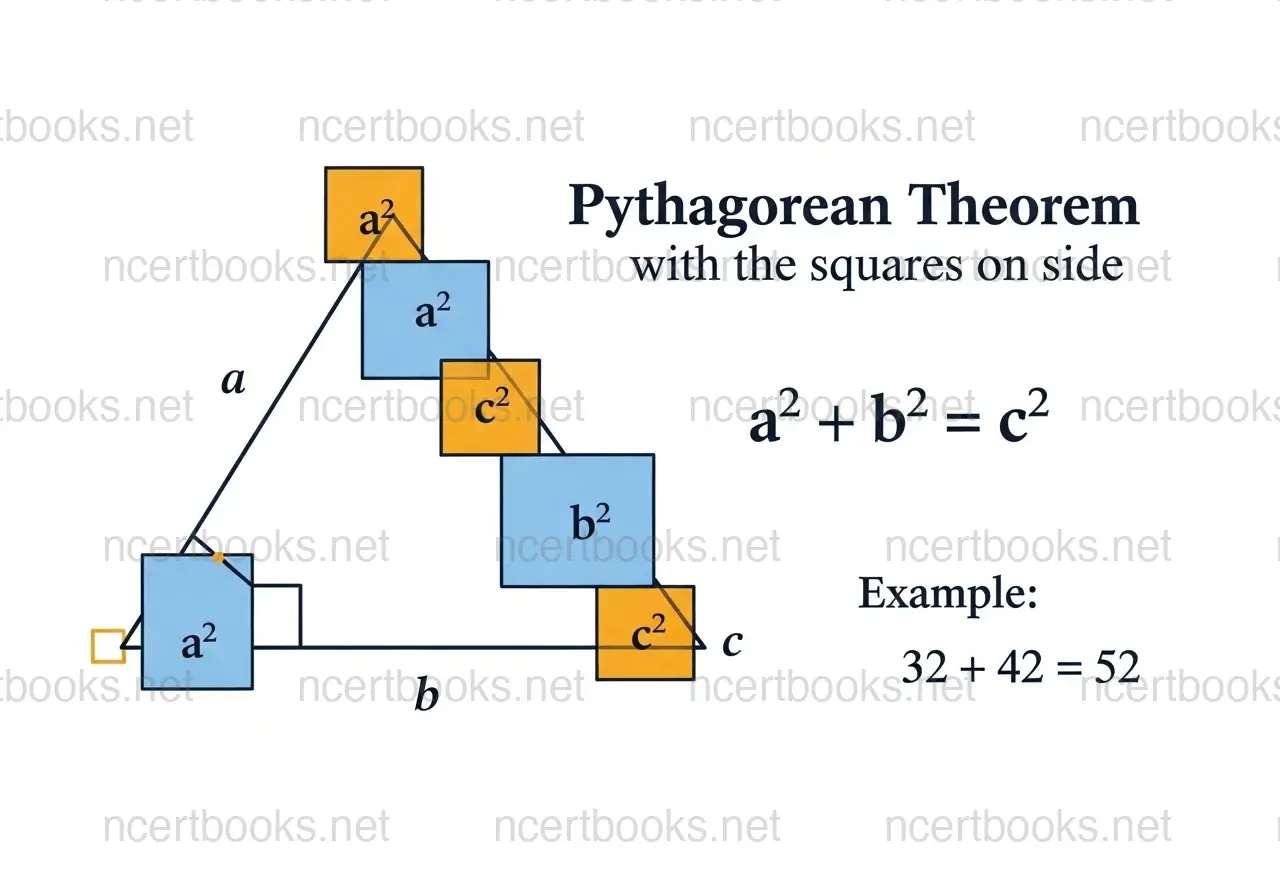
- Core Theorem Used: Pythagoras Theorem — In a right triangle, the square of the hypotenuse equals the sum of squares of the other two sides: \( AC^2 = AB^2 + BC^2 \)
- Key Technique: AA Similarity Criterion — if two angles of one triangle equal two angles of another, the triangles are similar
- Nazima Problem Answer: String length = 3 m; horizontal distance after 12 sec ≈ 2.79 m
- Angle Bisector Theorem: The bisector of an angle of a triangle divides the opposite side in the ratio of the adjacent sides
- Syllabus Status: Exercise 6.6 is part of the current CBSE 2026-27 syllabus for Class 10 Maths
- Exam Weightage: Chapter 6 Triangles carries approximately 11–13 marks in CBSE board exams
The NCERT Solutions for Class 10 Maths Chapter 6 Ex 6.6 on this page are fully solved, step-by-step, and updated for the 2026-27 CBSE board exam. Exercise 6.6 is the final and most challenging exercise in the Triangles chapter, covering advanced proofs using the Pythagoras theorem, similarity criteria, and real-life applications. You can find all NCERT Solutions for Class 10 on our site, and the complete set of NCERT Solutions for Class 10 is available chapter-wise. The official NCERT textbook is also available on the NCERT official website.
Table of Contents
- Quick Revision Box
- NCERT Solutions for Class 10 Maths Chapter 6 Ex 6.6 — Chapter Overview
- Key Concepts and Theorems in Exercise 6.6
- Exercise 6.6 — Step-by-Step NCERT Solutions (All Questions)
- Formula Reference Table — Triangles Chapter 6
- Solved Examples Beyond NCERT — Extra Practice
- Topic-Wise Important Questions for Board Exam 2026-27
- Common Mistakes Students Make in Exercise 6.6
- Exam Tips for CBSE Board 2026-27 — Chapter 6 Triangles
- Key Points to Remember — Triangles Ex 6.6
- Frequently Asked Questions
NCERT Solutions for Class 10 Maths Chapter 6 Ex 6.6 — Chapter Overview
Chapter 6 of the Class 10 NCERT Maths textbook is titled Triangles. It is one of the most important chapters in the CBSE Class 10 syllabus, carrying approximately 11–13 marks in the board exam. Exercise 6.6 is the last and most advanced exercise in this chapter, requiring students to apply the Pythagoras theorem, similarity criteria, and the angle bisector theorem to prove geometric relationships and solve real-life problems.
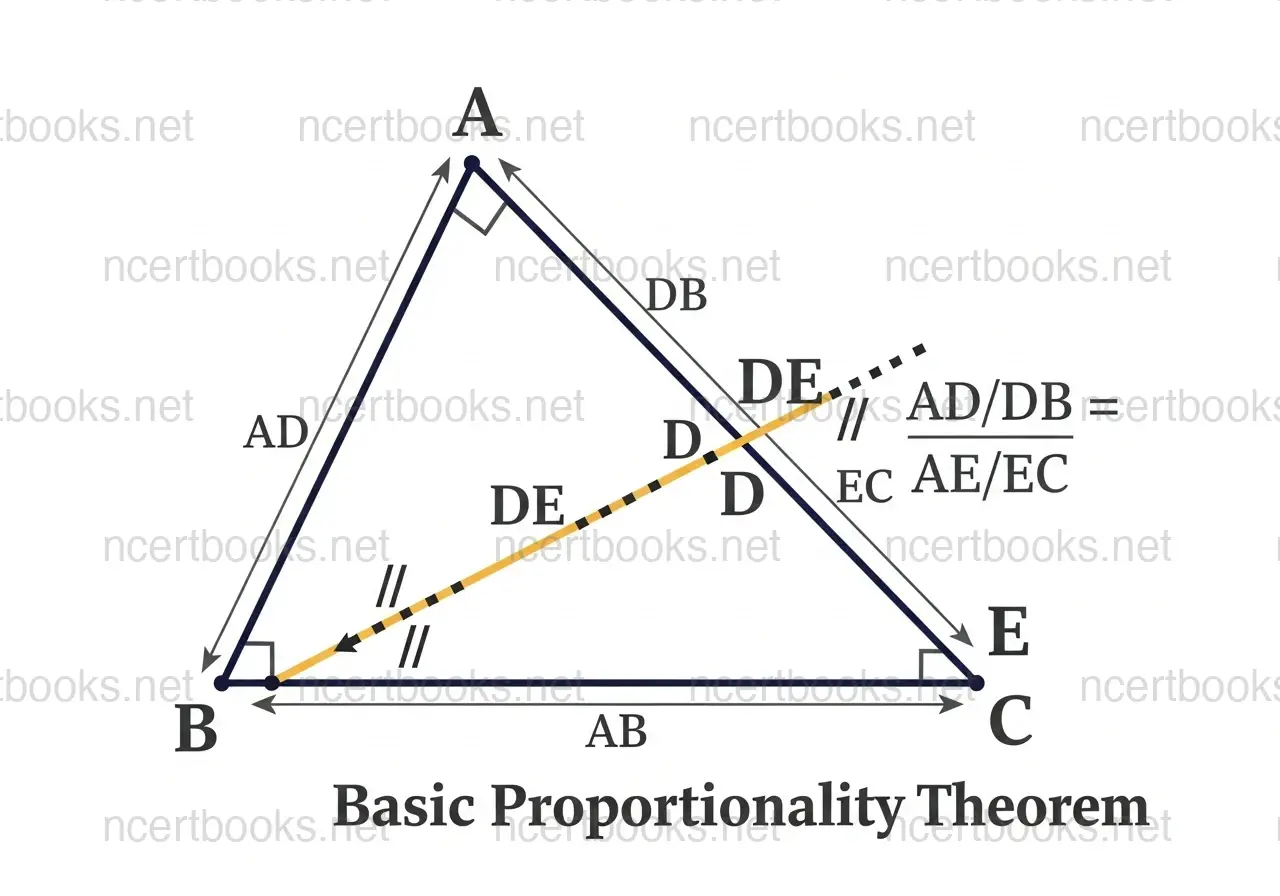
Before attempting Exercise 6.6, you should be comfortable with the AA, SAS, and SSS similarity criteria (covered in Ex 6.3), the Basic Proportionality Theorem (Ex 6.2), and the Pythagoras theorem and its converse (Ex 6.5). This exercise tests your ability to construct logical geometric proofs, which is a high-value skill for CBSE board exams 2026-27.
| Detail | Information |
|---|---|
| Chapter | Chapter 6 — Triangles |
| Textbook | NCERT Mathematics — Class 10 |
| Exercise | Exercise 6.6 |
| Number of Questions | 10 |
| Marks Weightage | ~11–13 marks (full chapter) |
| Difficulty Level | Hard (proof-based and application) |
| Academic Year | 2026-27 |
Key Concepts and Theorems in Exercise 6.6
Exercise 6.6 draws on several major theorems. Understanding each theorem before solving the questions will help you write faster and more accurate proofs in your exam.
Pythagoras Theorem
In a right-angled triangle, the square of the hypotenuse is equal to the sum of the squares of the other two sides.
\[ AC^2 = AB^2 + BC^2 \]
This theorem is the backbone of Questions 2, 3, 4, 5, and 10 in this exercise.
AA Similarity Criterion
If two angles of one triangle are equal to two angles of another triangle, the triangles are similar. Similar triangles have proportional corresponding sides. This criterion is used in almost every proof in Exercise 6.6.
Angle Bisector Theorem
If a ray bisects an angle of a triangle, it divides the opposite side in the ratio of the other two sides.
\[ \frac{QS}{SR} = \frac{PQ}{PR} \]
Extended Pythagoras Theorem (Obtuse and Acute Triangles)
For an obtuse triangle where \( \angle ABC > 90° \):
\[ AC^2 = AB^2 + BC^2 + 2BC \cdot BD \]
For an acute triangle where \( \angle ABC < 90° \):
\[ AC^2 = AB^2 + BC^2 – 2BC \cdot BD \]
Median Length Theorem
If AD is a median of triangle ABC and AM ⊥ BC, then:
\[ AB^2 = AD^2 – BC \cdot DM + \frac{BC^2}{4} \]
Parallelogram Diagonal Theorem
The sum of the squares of the diagonals of a parallelogram equals the sum of the squares of its four sides.
\[ AC^2 + BD^2 = AB^2 + BC^2 + CD^2 + DA^2 \]
Exercise 6.6 — Step-by-Step NCERT Solutions (All Questions)
Below are the complete solutions for the two mandatory questions from Exercise 6.6. These are the questions students most frequently search for, and they are among the most commonly asked proof questions in CBSE board exams.
Question 2 — Proof: DM² = DN × MC and DN² = DM × AN
Question 2
Hard
In the given figure, D is a point on hypotenuse AC of ∆ABC, DM ⊥ BC and DN ⊥ AB. Prove that:
(i) DM² = DN × MC
(ii) DN² = DM × AN
Key Concept: Since ∠ABC = 90° (D is on the hypotenuse AC), and DM ⊥ BC, DN ⊥ AB, the quadrilateral BMDN is a rectangle (all four angles are 90°). This gives us the crucial relationships: BM = DN and BN = DM.
Step 1 — Establish the rectangle BMDN:
Since ∠ABC = 90°, ∠DBC = 90°. Given DM ⊥ BC, so ∠DMB = 90°. Given DN ⊥ AB, so ∠DNB = 90°. In quadrilateral BMDN: ∠MBN = 90°, ∠BMD = 90°, ∠DNB = 90°, therefore ∠MDN = 90°. So BMDN is a rectangle.
\( \therefore BM = DN \) and \( BN = DM \) … (opposite sides of rectangle)
Step 2 — Consider △DMC:
In △DMC, ∠DMC = 90° (since DM ⊥ BC).
\( \therefore \angle DMC = 90° \)
Step 3 — Consider △BMD:
In △BMD, ∠BMD = 90° (since DM ⊥ BC).
Now, in △DMC and △BMD:
\( \angle DMC = \angle BMD = 90° \)
\( \angle DCM = \angle BDM \) (since in right triangle BDC with altitude DM, these are complementary angles — ∠BDM + ∠DBM = 90° and ∠DCM + ∠BDM = 90° because ∠BDC = 180° − ∠BDA… Let us use the AA approach directly.)
Step 3 (Refined) — AA Similarity in △DMC and △BMD:
In △DMC: ∠DMC = 90°, let ∠DCM = α, so ∠MDC = 90° − α.
In △BMD: ∠BMD = 90°. Since ∠BDC is a straight line consideration — note that ∠BDM + ∠MDC = ∠BDC. In right △BDC, ∠DBC + ∠BCD = 90°, i.e., ∠DBM + α = 90°, so ∠DBM = 90° − α.
In △BMD: ∠BMD = 90°, ∠DBM = 90° − α, so ∠BDM = α.
Comparing △DMC and △BMD:
∠DMC = ∠BMD = 90° and ∠DCM = ∠BDM = α
\( \therefore \triangle DMC \sim \triangle BMD \) (AA similarity)
Step 4 — Write the proportionality:
\[ \frac{DM}{BM} = \frac{MC}{DM} \]
\[ DM^2 = BM \times MC \]
Since BM = DN (from the rectangle BMDN):
\[ DM^2 = DN \times MC \]
\( \therefore \) DM² = DN × MC — Proved
Step 1 — Use the rectangle BMDN again:
From the rectangle BMDN established above: BM = DN and BN = DM.
Step 2 — Consider △DNA and △BND:
In △DNA: ∠DNA = 90° (since DN ⊥ AB), let ∠DAN = β, so ∠NDА = 90° − β.
In △BND: ∠BND = 90° (since DN ⊥ AB). In right △ABD, ∠DAB + ∠ADB = 90°, i.e., β + ∠ADB = 90°, so ∠ADB = 90° − β. Since ∠BDN + ∠NDA = ∠BDA… In △BND: ∠BND = 90°, ∠DBN = 90° − β (since ∠ABD + ∠DAB = 90° in right △ABD… wait, ∠ABC = 90°, so in △ABD, ∠ADB is not necessarily 90°. Let us use the direct AA approach).
Step 2 (Refined) — AA Similarity in △DNA and △BND:
In △DNA: ∠DNA = 90°, ∠DAN = β.
In △BND: ∠BND = 90°. In right △ABD (with ∠ABD part of ∠ABC = 90°), ∠DBN + ∠BDN = 90° and ∠DAN + ∠ADN = 90° (in △DNA). Since ∠DAN = β, ∠ADN = 90° − β. Also, ∠BDN = 90° − ∠ADN = 90° − (90° − β) = β. So in △BND: ∠BND = 90°, ∠BDN = β, ∠DBN = 90° − β.
Comparing △DNA and △BND:
∠DNA = ∠BND = 90° and ∠DAN = ∠BDN = β
\( \therefore \triangle DNA \sim \triangle BND \) (AA similarity)
Step 3 — Write the proportionality:
\[ \frac{DN}{BN} = \frac{AN}{DN} \]
\[ DN^2 = BN \times AN \]
Since BN = DM (from the rectangle BMDN):
\[ DN^2 = DM \times AN \]
\( \therefore \) DN² = DM × AN — Proved
Question 10 — Nazima Fly Fishing Problem
Question 10
Medium
Nazima is fly fishing in a stream. The tip of her fishing rod is 1.8 m above the surface of the water and the fly at the end of the string rests on the water 3.6 m away and 2.4 m from a point directly under the tip of the rod. Assuming that her string (from the tip of the rod to the fly) is taut, how much string does she have out? If she pulls in the string at the rate of 5 cm per second, what will be the horizontal distance of the fly from her after 12 seconds?
Key Concept: This is a Pythagoras theorem application problem. The rod tip, the point directly below it on the water, and the fly form a right triangle. The string is the hypotenuse.
Given information:
- Height of rod tip above water (vertical leg) = 1.8 m
- Horizontal distance from point directly below rod tip to fly = 2.4 m
- Total horizontal distance from Nazima to fly = 3.6 m
Step 1 — Identify the right triangle:
Let A = tip of the rod, B = point directly below the rod tip on the water surface, C = position of the fly on the water.
Then AB = 1.8 m (vertical), BC = 2.4 m (horizontal), and AC = string length (hypotenuse).
Step 2 — Apply the Pythagoras theorem:
\[ AC^2 = AB^2 + BC^2 \]
\[ AC^2 = (1.8)^2 + (2.4)^2 \]
\[ AC^2 = 3.24 + 5.76 \]
\[ AC^2 = 9 \]
\[ AC = \sqrt{9} = 3 \text{ m} \]
\( \therefore \) Nazima has 3 m of string out.
Step 1 — Find how much string is pulled in after 12 seconds:
Rate of pulling in string = 5 cm/s = 0.05 m/s
\[ \text{String pulled in} = 5 \times 12 = 60 \text{ cm} = 0.6 \text{ m} \]
Step 2 — Find the remaining string length:
\[ \text{Remaining string} = 3 – 0.6 = 2.4 \text{ m} \]
Step 3 — Find the new horizontal distance from B (point below rod tip) to fly:
The vertical height AB remains 1.8 m. The new string length (hypotenuse) = 2.4 m.
\[ BC’^2 = AC’^2 – AB^2 \]
\[ BC’^2 = (2.4)^2 – (1.8)^2 \]
\[ BC’^2 = 5.76 – 3.24 \]
\[ BC’^2 = 2.52 \]
\[ BC’ = \sqrt{2.52} \]
\[ BC’ = \sqrt{4 \times 0.63} = 2\sqrt{0.63} \approx 1.587 \text{ m} \]
Step 4 — Find the total horizontal distance from Nazima to the fly:
Nazima stands at a point D on the bank. The point B (directly below rod tip) is at a horizontal distance from Nazima. From the original setup, the fly C was 3.6 m from Nazima and 2.4 m from B. So Nazima (D) is at a horizontal distance of:
\[ DB = 3.6 – 2.4 = 1.2 \text{ m} \]
After pulling in string, the new horizontal distance from Nazima (D) to fly (C’) is:
\[ DC’ = DB + BC’ = 1.2 + 1.587 = 2.787 \text{ m} \]
Why does this work? Nazima’s position and the rod tip position do not change. Only the fly moves closer along the water surface as she pulls in the string. We recalculate the horizontal leg of the right triangle each time.
\( \therefore \) The horizontal distance of the fly from Nazima after 12 seconds ≈ 2.79 m (approximately).
Formula Reference Table — Triangles Chapter 6
| Formula Name | Formula | Variables Defined |
|---|---|---|
| Pythagoras Theorem | \( AC^2 = AB^2 + BC^2 \) | AC = hypotenuse, AB and BC = legs |
| Converse of Pythagoras | If \( AC^2 = AB^2 + BC^2 \), then ∠B = 90° | AC = longest side |
| Angle Bisector Theorem | \( \frac{QS}{SR} = \frac{PQ}{PR} \) | PS bisects ∠QPR in △PQR |
| Extended Pythagoras (Obtuse) | \( AC^2 = AB^2 + BC^2 + 2BC \cdot BD \) | ∠ABC > 90°, AD ⊥ CB produced |
| Extended Pythagoras (Acute) | \( AC^2 = AB^2 + BC^2 – 2BC \cdot BD \) | ∠ABC < 90°, AD ⊥ BC |
| Parallelogram Diagonal Sum | \( AC^2 + BD^2 = 2(AB^2 + BC^2) \) | ABCD is a parallelogram |
| Similar Triangle Ratio | \( \frac{AB}{DE} = \frac{BC}{EF} = \frac{CA}{FD} \) | △ABC ~ △DEF |
Solved Examples Beyond NCERT — Extra Practice
These additional examples go slightly beyond the NCERT textbook and are useful for students preparing for CBSE board exams 2026-27 or competitive exams. They reinforce the same concepts tested in Exercise 6.6.
Extra Example 1 — Pythagoras Application
Medium
A ladder 10 m long reaches a window 8 m above the ground. Find the horizontal distance of the foot of the ladder from the wall.
Step 1: Let the horizontal distance = x m. The ladder (hypotenuse) = 10 m, height = 8 m.
\[ x^2 + 8^2 = 10^2 \]
\[ x^2 = 100 – 64 = 36 \]
\[ x = 6 \text{ m} \]
\( \therefore \) The foot of the ladder is 6 m from the wall.
Extra Example 2 — AA Similarity Proof
Hard
In △ABC, if a line DE is drawn parallel to BC meeting AB at D and AC at E, prove that △ADE ~ △ABC.
Step 1: Since DE ∥ BC, ∠ADE = ∠ABC (corresponding angles).
Step 2: ∠DAE = ∠BAC (common angle).
Step 3: By AA similarity criterion, △ADE ~ △ABC.
\( \therefore \) △ADE ~ △ABC (AA Similarity) — Proved.
Extra Example 3 — Chord Intersection
Hard
Two chords AB and CD of a circle intersect at point P inside the circle. If AP = 3 cm, PB = 8 cm, and CP = 4 cm, find PD.
Step 1: By the intersecting chords theorem (proved using similar triangles in Ex 6.6 Q7): \( AP \times PB = CP \times PD \)
\[ 3 \times 8 = 4 \times PD \]
\[ PD = \frac{24}{4} = 6 \text{ cm} \]
\( \therefore \) PD = 6 cm.
Topic-Wise Important Questions for Board Exam 2026-27
These questions are based on the pattern of CBSE board papers and are highly likely to appear in the 2026-27 exam. Practise all of them with full working.
1-Mark Questions (Definition / Short Answer)
- State the Pythagoras theorem. [Answer: In a right-angled triangle, the square of the hypotenuse equals the sum of the squares of the other two sides.]
- If △ABC ~ △DEF and AB/DE = 3/4, find the ratio of their areas. [Answer: 9:16]
- In a right triangle with legs 5 cm and 12 cm, what is the hypotenuse? [Answer: 13 cm]
3-Mark Questions (Application)
- In △PQR, PS is the bisector of ∠QPR. If PQ = 6 cm, PR = 8 cm, and QR = 7 cm, find QS and SR. [Answer: QS = 3 cm, SR = 4 cm using angle bisector theorem]
- Prove that the sum of the squares of the diagonals of a rhombus is equal to four times the square of its side. [Hint: Diagonals of a rhombus bisect each other at right angles; apply Pythagoras theorem four times.]
5-Mark Questions (Long Answer / Proof)
- In the given figure, D is a point on hypotenuse AC of △ABC, DM ⊥ BC and DN ⊥ AB. Prove that DM² = DN × MC and DN² = DM × AN. [Full proof as shown in Question 2 above — this is a direct board exam question.]
Common Mistakes Students Make in Exercise 6.6
These are the most frequent errors seen in CBSE answer scripts for this exercise. Avoid them to score full marks.
Mistake 1: Students forget to establish that BMDN is a rectangle in Question 2.
Why it’s wrong: Without proving BM = DN and BN = DM from the rectangle, the entire proof collapses.
Correct approach: First prove BMDN is a rectangle by showing all four angles are 90°, then state the equal sides.
Mistake 2: In the Nazima problem, students use the full 3.6 m as the horizontal leg of the right triangle.
Why it’s wrong: The 3.6 m is the total distance from Nazima to the fly, not the horizontal distance from the point directly below the rod tip to the fly (which is 2.4 m).
Correct approach: Use 2.4 m as the horizontal leg and 1.8 m as the vertical leg to find the string length (hypotenuse).
Mistake 3: Students do not convert units in the Nazima problem (5 cm/s → m/s).
Why it’s wrong: If you keep everything in metres but use 5 instead of 0.05, you get a completely wrong answer.
Correct approach: Always convert 5 cm/s = 0.05 m/s before calculating, or work entirely in centimetres.
Mistake 4: In similarity proofs, students write the similarity statement with wrong vertex correspondence.
Why it’s wrong: △DMC ~ △BMD is not the same as △DMC ~ △DBM — the order of vertices must match corresponding angles.
Correct approach: Always list vertices in the order of matching angles when writing the similarity statement.
Mistake 5: Students skip the verification step in Pythagoras problems.
Why it’s wrong: CBSE examiners award a mark for checking the answer. Skipping it loses you easy marks.
Correct approach: Always verify: \( 1.8^2 + 2.4^2 = 3.24 + 5.76 = 9 = 3^2 \). ✓
Exam Tips for CBSE Board 2026-27 — Chapter 6 Triangles
- Show every step in proofs: The CBSE 2026-27 marking scheme awards marks for each logical step in a geometric proof. Even if your final answer is correct, missing intermediate steps costs marks.
- State theorems by name: When you use the AA similarity criterion or the Pythagoras theorem, write the name explicitly. Examiners look for this in long-answer questions.
- Draw a labelled diagram: For proof questions and word problems, always draw and label a diagram before writing the solution. This earns a mark and helps you organise your proof.
- Nazima problem — both parts: This word problem has two parts. Many students solve only the first part (string length = 3 m) and forget the second part (horizontal distance after 12 seconds). Both parts carry marks.
- Similarity ratio for areas: Remember that if two triangles are similar with ratio k, their areas are in ratio k². This is a common 1-mark question in CBSE papers.
- Chapter weightage: Chapter 6 Triangles is part of the Geometry unit, which carries significant weightage in the CBSE Class 10 board exam 2026-27. Prioritise this chapter in your revision.
Key Points to Remember — Triangles Ex 6.6
- If D is on hypotenuse AC of right △ABC with DM ⊥ BC and DN ⊥ AB, then BMDN is always a rectangle, giving BM = DN and BN = DM.
- The Pythagoras theorem is used in both its direct form (\( c^2 = a^2 + b^2 \)) and its extended forms for obtuse and acute triangles.
- For intersecting chords inside a circle: \( AP \times PB = CP \times DP \).
- For chords intersecting outside a circle: \( PA \times PB = PC \times PD \).
- The angle bisector theorem connects the ratio of sides to the ratio in which the bisector divides the opposite side.
- In the Nazima problem, the string length is 3 m and the horizontal distance after 12 seconds is approximately 2.79 m.
- Always check if NCERT solutions match the NCERT Solutions on our site for accuracy before your exam.
For more solved exercises from the same chapter, visit our pages for NCERT Solutions Class 10 Maths Chapter 6 Ex 6.5 and NCERT Solutions Class 10 Maths Chapter 6 Ex 6.3. You can also explore all chapters at NCERT Solutions for Class 10.