- Pythagoras Theorem: In a right triangle, \( \text{Hypotenuse}^2 = \text{Base}^2 + \text{Perpendicular}^2 \)
- Converse of Pythagoras: If \( c^2 = a^2 + b^2 \), the triangle is right-angled opposite side \( c \)
- Altitude-on-Hypotenuse Result: If PM ⊥ QR in right △PQR (right angle at P), then \( PM^2 = QM \times MR \)
- Key Similarity Used: △QPM ~ △QPR ~ △PMR (AA criterion)
- Q17 Answer: In △ABC with AB = 6√3, AC = 12, BC = 6 — angle B = 90°
- Total Questions in Ex 6.5: 17 (including 1 MCQ)
- Board Exam Weightage: Triangles chapter carries 6–7 marks in CBSE Class 10 board exam 2026-27
- Most Asked Proof: PM² = QM × MR (Q2) and 9AD² = 7AB² (Q15) appear frequently in board papers
Table of Contents
- Quick Revision Box
- Chapter Overview — Triangles Class 10 Maths Chapter 6
- Key Concepts and Theorems in Exercise 6.5
- NCERT Solutions for Class 10 Maths Chapter 6 Ex 6.5 — All Questions
- Formula Reference Table — Pythagoras Theorem
- Solved Examples Beyond NCERT
- Important Questions for CBSE Board Exam 2026-27
- Common Mistakes Students Make in Exercise 6.5
- Exam Tips for 2026-27 CBSE Board Exam
- Frequently Asked Questions
The ncert solutions for class 10 maths chapter 6 ex 6 5 on this page cover all 17 questions from Exercise 6.5 of the NCERT Maths textbook, updated for the 2026-27 CBSE board exam. Exercise 6.5 is based on the Pythagoras Theorem and its converse — two of the most important results in the Triangles chapter. You can find the complete NCERT Solutions for Class 10 on our hub page. These solutions are written in a clear, step-by-step format so you can follow every proof and calculation easily. Download the NCERT official textbook for reference alongside these solutions.
This exercise is part of Chapter 6 — Triangles in the NCERT Solutions series for Class 10 Maths. It tests your ability to apply the Pythagoras theorem to right triangles, prove geometric results using similar triangles, and solve real-life distance problems. Mastering this exercise will directly help you score in the 2026-27 CBSE board exam.
Chapter Overview — Triangles Class 10 Maths Chapter 6
Chapter 6 of Class 10 NCERT Maths is titled Triangles. It covers similar triangles, criteria for similarity (AA, SSS, SAS), areas of similar triangles, and the Pythagoras theorem with its converse. Exercise 6.5 specifically focuses on the Pythagoras Theorem and its converse, along with the altitude-on-hypotenuse theorem derived using similar triangles.
For the CBSE board exam 2026-27, the Triangles chapter carries approximately 6–7 marks. Questions from Exercise 6.5 typically appear as 2-mark short answers (identify right triangles), 3-mark proofs, and occasionally as part of a 5-mark long answer. The converse of Pythagoras and altitude-on-hypotenuse results are the most frequently tested topics.
| Detail | Information |
|---|---|
| Class | 10 |
| Subject | Mathematics |
| Chapter | Chapter 6 — Triangles |
| Exercise | Exercise 6.5 |
| Number of Questions | 17 |
| Key Topics | Pythagoras Theorem, Converse, Altitude on Hypotenuse |
| Marks Weightage | 6–7 marks (Triangles chapter, CBSE 2026-27) |
| Difficulty Level | Medium to Hard |
Key Concepts and Theorems in Exercise 6.5
Pythagoras Theorem (पाइथागोरस प्रमेय)
Statement: In a right-angled triangle, the square of the hypotenuse is equal to the sum of the squares of the other two sides.
\[ \text{Hypotenuse}^2 = \text{Base}^2 + \text{Perpendicular}^2 \]
If △ABC is right-angled at B, then \( AC^2 = AB^2 + BC^2 \). This theorem is the backbone of all 17 questions in Exercise 6.5.
Converse of Pythagoras Theorem
Statement: If in a triangle, the square of one side equals the sum of the squares of the other two sides, then the angle opposite to the first side is a right angle.
You use this converse in Q1 (identifying right triangles) and Q17 (MCQ justification). Always check: is the largest side the one whose square you are comparing?
Altitude-on-Hypotenuse Theorem
When an altitude is drawn from the right-angle vertex to the hypotenuse of a right triangle, three similar triangles are formed. This gives the key result used in Q2 and Q3:
\[ PM^2 = QM \times MR \]
This follows from the AA similarity criterion applied to the sub-triangles formed by the altitude.
AA Similarity Criterion
Two triangles are similar if two angles of one triangle are equal to two angles of the other. In Exercise 6.5, most proofs rely on AA similarity to establish proportional sides, which then leads to Pythagoras-type results.
NCERT Solutions for Class 10 Maths Chapter 6 Ex 6.5 — All Questions
Below are the complete solutions for the two mandatory questions from Exercise 6.5. These are the most proof-intensive questions in the exercise and are highly important for the CBSE board exam 2026-27.
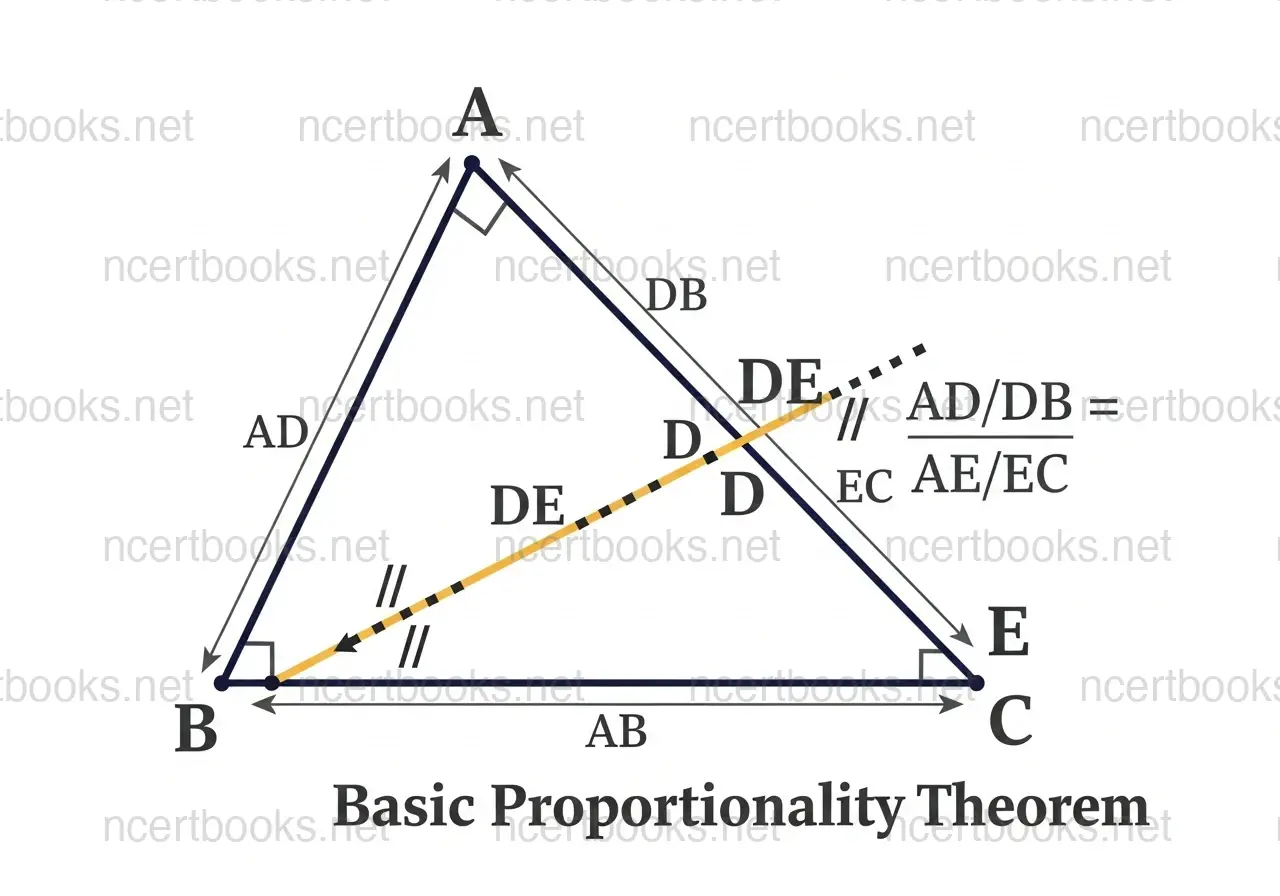
Question 2 — PM² = QM × MR Proof
Question 2
Medium
PQR is a triangle right angled at P and M is a point on QR such that PM ⊥ QR. Show that \( PM^2 = QM \times MR \).
△PQR is right-angled at P. M is a point on QR such that PM ⊥ QR.
To Prove: \( PM^2 = QM \times MR \)
Key Concept: When an altitude is drawn from the right-angle vertex to the hypotenuse, the altitude is the geometric mean of the two segments it creates on the hypotenuse. We prove this using AA similarity.
Step 1: Consider △QPM and △QPR.
In △QPM: ∠QMP = 90° (PM ⊥ QR) and ∠Q is common to both triangles.
In △QPR: ∠QPR = 90° (given, right angle at P).
By AA similarity criterion:
\[ \triangle QPM \sim \triangle QPR \]
From this similarity, corresponding sides are proportional:
\[ \frac{QP}{QR} = \frac{QM}{QP} \]
\[ QP^2 = QM \times QR \quad \text{…(i)} \]
Step 2: Consider △RPM and △RQP.
In △RPM: ∠RMP = 90° (PM ⊥ QR) and ∠R is common to both triangles.
In △RQP: ∠QPR = 90°.
By AA similarity criterion:
\[ \triangle RPM \sim \triangle RQP \]
From this similarity:
\[ \frac{RP}{RQ} = \frac{RM}{RP} \]
\[ RP^2 = RM \times RQ \quad \text{…(ii)} \]
Step 3: Now consider △QPM and △RPM.
From △QPM ~ △QPR (Step 1): \( \angle QPM = \angle QRP \) (corresponding angles of similar triangles).
From △RPM ~ △RQP (Step 2): \( \angle RPM = \angle RQP \) (corresponding angles of similar triangles).
In △QPM and △RPM:
- ∠PMQ = ∠PMR = 90° (PM ⊥ QR)
- ∠QPM = ∠MRP (shown above)
Therefore by AA criterion:
\[ \triangle QPM \sim \triangle RPM \]
Wait — let us use a cleaner direct approach. In △PQM and △MPR:
- ∠PMQ = ∠PMR = 90°
- ∠QPM = ∠PRM (since in △PQR, ∠QPR = 90°, so ∠QPM + ∠MPR = 90° and ∠PQM + ∠QPM = 90°, giving ∠QPM = ∠PRM)
By AA similarity:
\[ \triangle PQM \sim \triangle MPR \]
From corresponding sides:
\[ \frac{PM}{QM} = \frac{MR}{PM} \]
Step 4: Cross-multiply to get the required result:
\[ PM \times PM = QM \times MR \]
\[ PM^2 = QM \times MR \]
\( \therefore \) \( PM^2 = QM \times MR \) — Hence Proved.
Question 17 — MCQ with Justification
Question 17
Easy
Tick the correct answer and justify: In △ABC, AB = \( 6\sqrt{3} \) cm, AC = 12 cm and BC = 6 cm. The angle B is:
(a) 120° (b) 60° (c) 90° (d) 45°
Key Concept: We use the Converse of the Pythagoras Theorem. If the square of the largest side equals the sum of the squares of the other two sides, the triangle is right-angled, and the right angle is opposite the largest side.
Step 1: Identify the largest side.
Given: AB = \( 6\sqrt{3} \) cm, AC = 12 cm, BC = 6 cm.
\[ AB = 6\sqrt{3} \approx 10.39 \text{ cm}, \quad AC = 12 \text{ cm}, \quad BC = 6 \text{ cm} \]
The largest side is AC = 12 cm.
Step 2: Check whether \( AC^2 = AB^2 + BC^2 \).
\[ AC^2 = 12^2 = 144 \]
\[ AB^2 = (6\sqrt{3})^2 = 36 \times 3 = 108 \]
\[ BC^2 = 6^2 = 36 \]
\[ AB^2 + BC^2 = 108 + 36 = 144 \]
Step 3: Compare the two values.
\[ AC^2 = 144 = AB^2 + BC^2 \]
Since \( AC^2 = AB^2 + BC^2 \), by the Converse of the Pythagoras Theorem, △ABC is right-angled.
Step 4: Identify the right angle.
The right angle is opposite the largest side AC. The side AC is opposite to angle B (∠ABC). Therefore, ∠B = 90°.
Why is this option (c) and not (b)? Some students confuse 60° with 90° because \( 6\sqrt{3} \) and 6 are associated with a 30-60-90 triangle. But here we are asked for ∠B, not ∠A or ∠C. The Pythagoras check confirms ∠B = 90° without ambiguity.
\( \therefore \) The correct answer is (c) 90°.
Justification: \( AB^2 + BC^2 = 108 + 36 = 144 = AC^2 \). By the converse of Pythagoras theorem, ∠B = 90°.
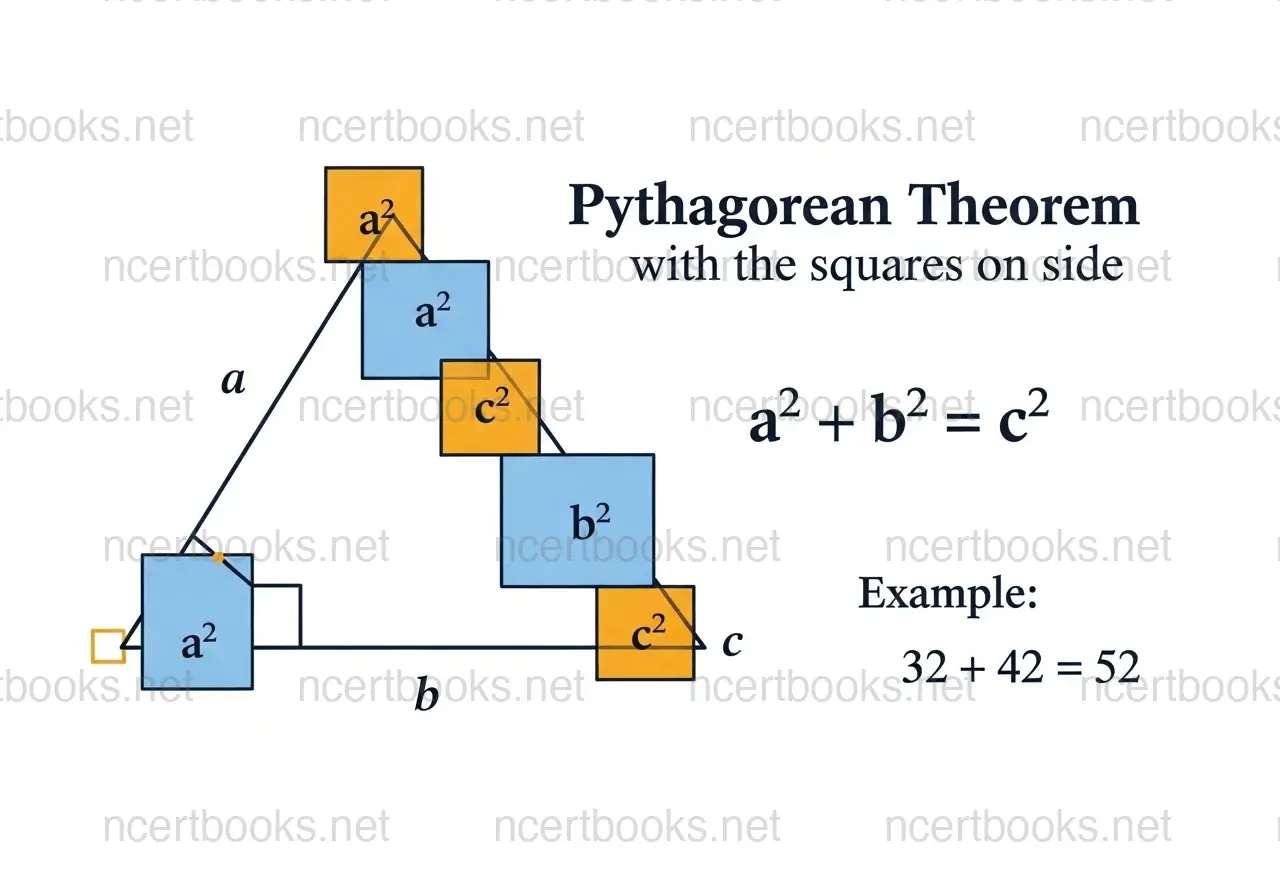
Formula Reference Table — Pythagoras Theorem and Triangles Ex 6.5
| Formula Name | Formula | Variables | Used In |
|---|---|---|---|
| Pythagoras Theorem | \( c^2 = a^2 + b^2 \) | c = hypotenuse, a and b = other sides | Q1, Q4, Q5, Q9, Q10, Q11, Q12 |
| Converse of Pythagoras | If \( c^2 = a^2 + b^2 \), then ∠C = 90° | c = side opposite to angle C | Q1, Q5, Q17 |
| Altitude-on-Hypotenuse | \( PM^2 = QM \times MR \) | PM = altitude, QM and MR = segments | Q2, Q3 |
| Altitude of Equilateral Triangle | \( h = \frac{\sqrt{3}}{2} a \) | h = altitude, a = side length | Q6, Q16 |
| Rhombus Diagonal Property | \( AB^2 + BC^2 + CD^2 + DA^2 = AC^2 + BD^2 \) | Diagonals AC and BD bisect each other at right angles | Q7 |
| Distance Formula (applied) | \( d = \sqrt{x^2 + y^2} \) | x, y = perpendicular distances | Q11 |
Solved Examples Beyond NCERT — Pythagoras Theorem Class 10
Extra Example 1 — Verify a Right Triangle
Example 1
Easy
Sides of a triangle are 9 cm, 40 cm, and 41 cm. Is it a right triangle?
Step 1: Identify the largest side: 41 cm.
Step 2: Check \( 41^2 = 9^2 + 40^2 \).
\[ 41^2 = 1681 \]
\[ 9^2 + 40^2 = 81 + 1600 = 1681 \]
\( \therefore \) Yes, it is a right triangle with hypotenuse 41 cm.
Extra Example 2 — Altitude in a Right Triangle
Example 2
Medium
In a right triangle with legs 6 cm and 8 cm, find the length of the altitude drawn to the hypotenuse.
Step 1: Find the hypotenuse.
\[ c = \sqrt{6^2 + 8^2} = \sqrt{36 + 64} = \sqrt{100} = 10 \text{ cm} \]
Step 2: Use the area method. Area = \( \frac{1}{2} \times 6 \times 8 = 24 \text{ cm}^2 \).
Step 3: Area also = \( \frac{1}{2} \times \text{hypotenuse} \times \text{altitude} \).
\[ 24 = \frac{1}{2} \times 10 \times h \implies h = \frac{48}{10} = 4.8 \text{ cm} \]
\( \therefore \) Altitude to hypotenuse = 4.8 cm
Extra Example 3 — Real-Life Distance Problem
Example 3
Medium
A tree breaks due to a storm. The broken part bends so that the top touches the ground at a distance of 8 m from the base. If the broken part makes an angle of 30° with the ground, find the total height of the tree. (Use: tan 30° = 1/√3)
Step 1: Let the broken part have length \( l \). The base distance is 8 m.
Step 2: Using trigonometry: \( \tan 30° = \frac{\text{standing part}}{8} \), so standing part \( = 8 \times \frac{1}{\sqrt{3}} = \frac{8}{\sqrt{3}} \) m.
Step 3: Broken part \( l = \frac{8}{\cos 30°} = \frac{8}{\frac{\sqrt{3}}{2}} = \frac{16}{\sqrt{3}} \) m.
Step 4: Total height = standing part + broken part = \( \frac{8}{\sqrt{3}} + \frac{16}{\sqrt{3}} = \frac{24}{\sqrt{3}} = 8\sqrt{3} \) m.
\( \therefore \) Total height of tree = \( 8\sqrt{3} \) m ≈ 13.86 m
Important Questions for CBSE Board Exam 2026-27 — Triangles Ex 6.5
1-Mark Questions
- State the Pythagoras theorem. [Answer: In a right triangle, hypotenuse² = sum of squares of other two sides.]
- In a right triangle with legs 5 cm and 12 cm, what is the hypotenuse? [Answer: 13 cm, since 5² + 12² = 169 = 13².]
- If PM ⊥ QR in right △PQR (right angle at P), write the relation between PM, QM, and MR. [Answer: PM² = QM × MR.]
3-Mark Questions
Board Question 1 — [3 Marks]
ABC is an isosceles triangle right-angled at C. Prove that AB² = 2AC².
Given: △ABC is isosceles right-angled at C, so AC = BC.
Step 1: Apply Pythagoras theorem to △ABC right-angled at C:
\[ AB^2 = AC^2 + BC^2 \]
Step 2: Since AC = BC (isosceles):
\[ AB^2 = AC^2 + AC^2 = 2AC^2 \]
\( \therefore \) AB² = 2AC² — Hence Proved.
Board Question 2 — [3 Marks]
A ladder 10 m long reaches a window 8 m above the ground. Find the distance of the foot of the ladder from the base of the wall.
Step 1: Let the foot of the ladder be at distance \( d \) from the wall. The ladder is the hypotenuse.
\[ 10^2 = 8^2 + d^2 \]
\[ 100 = 64 + d^2 \]
\[ d^2 = 36 \implies d = 6 \text{ m} \]
\( \therefore \) The foot of the ladder is 6 m from the base of the wall.
5-Mark Question
Board Question 3 — [5 Marks]
In an equilateral triangle ABC, D is a point on BC such that BD = (1/3)BC. Prove that 9AD² = 7AB².
Given: △ABC is equilateral with side \( a \). D is on BC with \( BD = \frac{a}{3} \).
Step 1: Draw AE ⊥ BC. Since △ABC is equilateral, E is the midpoint of BC, so \( BE = \frac{a}{2} \).
Step 2: In right △AEB:
\[ AE^2 = AB^2 – BE^2 = a^2 – \frac{a^2}{4} = \frac{3a^2}{4} \]
Step 3: Now \( DE = BE – BD = \frac{a}{2} – \frac{a}{3} = \frac{a}{6} \).
Step 4: In right △AED:
\[ AD^2 = AE^2 + DE^2 = \frac{3a^2}{4} + \frac{a^2}{36} = \frac{27a^2}{36} + \frac{a^2}{36} = \frac{28a^2}{36} = \frac{7a^2}{9} \]
Step 5: Multiply both sides by 9:
\[ 9AD^2 = 7a^2 = 7AB^2 \]
\( \therefore \) 9AD² = 7AB² — Hence Proved.
Common Mistakes Students Make in Exercise 6.5
Mistake 1: Students apply the Pythagoras theorem without checking which is the largest side.
Why it’s wrong: The theorem states that the square of the hypotenuse (largest side) equals the sum of squares of the other two. If you pick the wrong side, your check will fail even for a right triangle.
Correct approach: Always identify the largest side first, then verify \( c^2 = a^2 + b^2 \) where \( c \) is the largest side.
Mistake 2: In Q2 (PM² = QM × MR), students write the similarity as △PMQ ~ △PMR without justifying the angle equality.
Why it’s wrong: You must prove that the angles match before claiming similarity. Use the fact that ∠QPR = 90° to show ∠QPM = ∠PRM.
Correct approach: Explicitly state: “In △PQM and △MPR, ∠PMQ = ∠PMR = 90° and ∠QPM = ∠PRM (since ∠QPR = 90°, angles of a triangle sum to 180°). Therefore by AA, △PQM ~ △MPR.”
Mistake 3: In Q17, students mark option (b) 60° because they recognise 6, 6√3, 12 as a 30-60-90 pattern.
Why it’s wrong: The question asks for ∠B, not ∠A or ∠C. ∠B is opposite the largest side AC = 12, and the Pythagoras check confirms ∠B = 90°.
Correct approach: Always do the numerical Pythagoras check and identify which angle is opposite the largest side.
Mistake 4: Students forget to write the verification step when identifying right triangles in Q1.
Why it’s wrong: CBSE marking schemes award a mark for the verification. Simply stating “it is a right triangle” without showing \( c^2 = a^2 + b^2 \) will lose you marks.
Correct approach: Always write: “Since \( c^2 = a^2 + b^2 \), by the converse of Pythagoras theorem, this is a right triangle.”
Mistake 5: In proof questions, students write “LHS = RHS” without showing the intermediate steps.
Why it’s wrong: CBSE examiners award marks for each logical step. Jumping to the conclusion without showing the similarity, the proportionality, and the cross-multiplication will lose you 1–2 marks per proof.
Correct approach: Write every step: state the triangles, state the criterion (AA/SSS/SAS), write the proportion, then cross-multiply.
Exam Tips for 2026-27 CBSE Board Exam — Triangles Chapter 6
- Always state the theorem name: Write “By the Pythagoras Theorem” or “By the Converse of the Pythagoras Theorem” — examiners look for this phrase and award a dedicated mark for it.
- For similarity proofs: The CBSE marking scheme awards separate marks for (a) stating the similar triangles, (b) the criterion (AA/SSS/SAS), and (c) the proportion. Do not merge these into one line.
- MCQ justification is mandatory: Q17-type MCQs in board papers require written justification. Show the numerical check even if you can identify the answer by inspection.
- Draw a clear diagram: For Q2, Q3, Q8, and Q13-type questions, a labelled diagram earns 1 mark in the CBSE 2026-27 marking scheme. Spend 30 seconds drawing it.
- Last-minute revision checklist:
- ✅ Pythagoras theorem statement and converse
- ✅ PM² = QM × MR result and its proof method
- ✅ Altitude of equilateral triangle formula: \( h = \frac{\sqrt{3}}{2}a \)
- ✅ 9AD² = 7AB² proof steps
- ✅ Q17 verification: AB² + BC² = AC² when AB = 6√3, BC = 6, AC = 12
- Chapter weightage: The Triangles chapter (Chapter 6) is part of the Geometry unit, which carries approximately 15 marks in the CBSE Class 10 board exam 2026-27. Exercise 6.5 alone can contribute 3–5 marks.