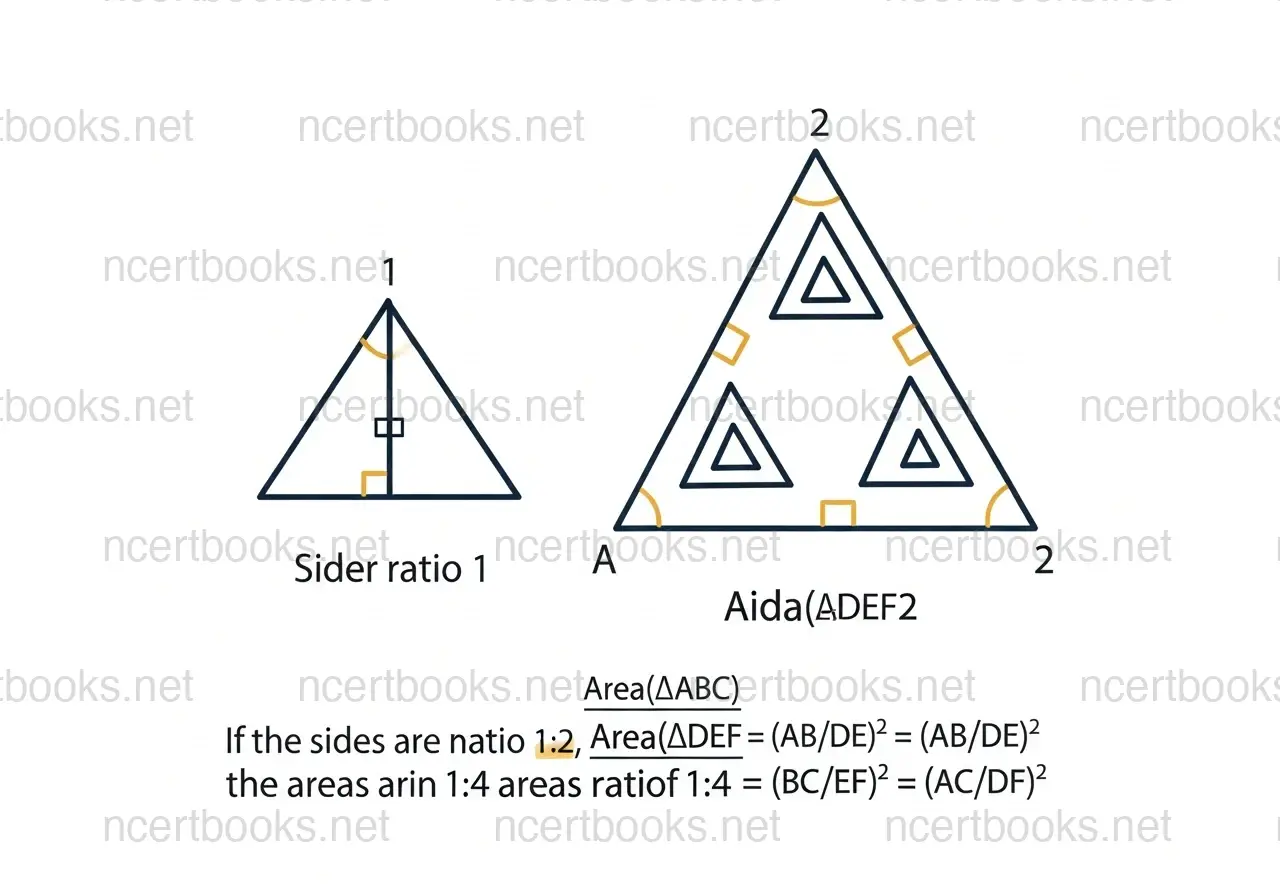
- Core Theorem: Ratio of areas of two similar triangles = square of ratio of their corresponding sides: \( \frac{ar(\triangle ABC)}{ar(\triangle DEF)} = \frac{AB^2}{DE^2} = \frac{BC^2}{EF^2} = \frac{CA^2}{FD^2} \)
- Trapezium Diagonals: If AB ∥ DC in trapezium ABCD, triangles AOB and COD are similar by AA criterion.
- Midpoint Triangle: When D, E, F are midpoints of sides of △ABC, then ar(△DEF) : ar(△ABC) = 1 : 4.
- Equal Areas → Congruent: If two similar triangles have equal areas, they are congruent (ratio of sides = 1).
- Medians Ratio: Ratio of areas of two similar triangles = square of ratio of their corresponding medians.
- Equilateral Triangles: All equilateral triangles are similar to each other (AAA criterion).
- Square Diagonal: Area of equilateral triangle on side of square = half the area of equilateral triangle on its diagonal.
- Exam Weightage: Chapter 6 Triangles carries approximately 11–12 marks in CBSE Class 10 board exams.
Table of Contents
- Quick Revision Box
- Chapter Overview — Triangles Class 10 Exercise 6.4
- Key Concepts and Theorems for Exercise 6.4
- NCERT Solutions for Class 10 Maths Chapter 6 Ex 6.4 — All Questions
- Formula Reference Table — Similar Triangles
- Solved Examples Beyond NCERT
- Important Questions for Board Exam 2026-27
- Common Mistakes Students Make in Exercise 6.4
- Exam Tips for 2026-27 CBSE Board Exam
- Frequently Asked Questions — Triangles Ex 6.4
The ncert solutions for class 10 maths chapter 6 ex 6 4 on this page cover all 8 questions from Exercise 6.4 of the NCERT Maths textbook, fully updated for the 2026-27 CBSE board exam. You can find these solutions as part of our complete NCERT Solutions for Class 10 collection. Exercise 6.4 is built around one powerful theorem: the ratio of the areas of two similar triangles equals the square of the ratio of their corresponding sides. Every question in this exercise applies this theorem in a different context — from trapeziums and midpoints to equilateral triangles and proofs. Download the free PDF above or read through the step-by-step solutions below. You can also explore all subjects in our NCERT Solutions hub.
Chapter Overview — Triangles Class 10 Exercise 6.4
Chapter 6 of the Class 10 NCERT Maths textbook is titled Triangles. It covers similarity of triangles, criteria for similarity (AA, SAS, SSS), the Basic Proportionality Theorem (BPT), and the relationship between areas and sides of similar triangles. Exercise 6.4 specifically focuses on the Areas of Similar Triangles theorem, which is one of the most frequently tested concepts in CBSE board exams. You can download the official textbook from the NCERT official website.
This exercise has 8 questions — 6 problems (including proofs and ratio-finding) and 2 MCQ-based questions with justification. In CBSE board exams, questions from this chapter appear in the 2-mark, 3-mark, and 5-mark categories. The chapter carries approximately 11–12 marks in the board paper, making it one of the highest-weightage chapters in Class 10 Maths.
| Detail | Information |
|---|---|
| Class | 10 |
| Subject | Mathematics |
| Chapter | Chapter 6 — Triangles |
| Exercise | Exercise 6.4 |
| Topic | Areas of Similar Triangles |
| Number of Questions | 8 |
| Marks Weightage | ~11–12 marks (full chapter) |
| Difficulty Level | Medium to Hard |
| Academic Year | 2026-27 |
Key Concepts and Theorems for Exercise 6.4
Theorem: Ratio of Areas of Similar Triangles
Statement: If two triangles are similar, then the ratio of their areas is equal to the square of the ratio of their corresponding sides.
If \( \triangle ABC \sim \triangle DEF \), then:
\[ \frac{ar(\triangle ABC)}{ar(\triangle DEF)} = \frac{AB^2}{DE^2} = \frac{BC^2}{EF^2} = \frac{CA^2}{FD^2} \]
Why does this work? The area of a triangle is \( \frac{1}{2} \times base \times height \). When two triangles are similar, both the base and the corresponding altitude scale by the same ratio \( k \). So the area scales by \( k^2 \).
AA Similarity Criterion
If two angles of one triangle are equal to two angles of another triangle, the triangles are similar. This is used in the trapezium question (Q2) where alternate interior angles and vertically opposite angles establish similarity.
Midpoint Theorem and Triangle Similarity
The line segment joining the midpoints of two sides of a triangle is parallel to the third side and half its length. This makes the medial triangle (formed by joining midpoints) similar to the original triangle with ratio 1:2, giving an area ratio of 1:4.
All Equilateral Triangles Are Similar
Every equilateral triangle has all angles equal to 60°. By the AAA criterion, all equilateral triangles are similar to each other. This fact is used in Q7 and Q8 of this exercise.
NCERT Solutions for Class 10 Maths Chapter 6 Ex 6.4 — All Questions
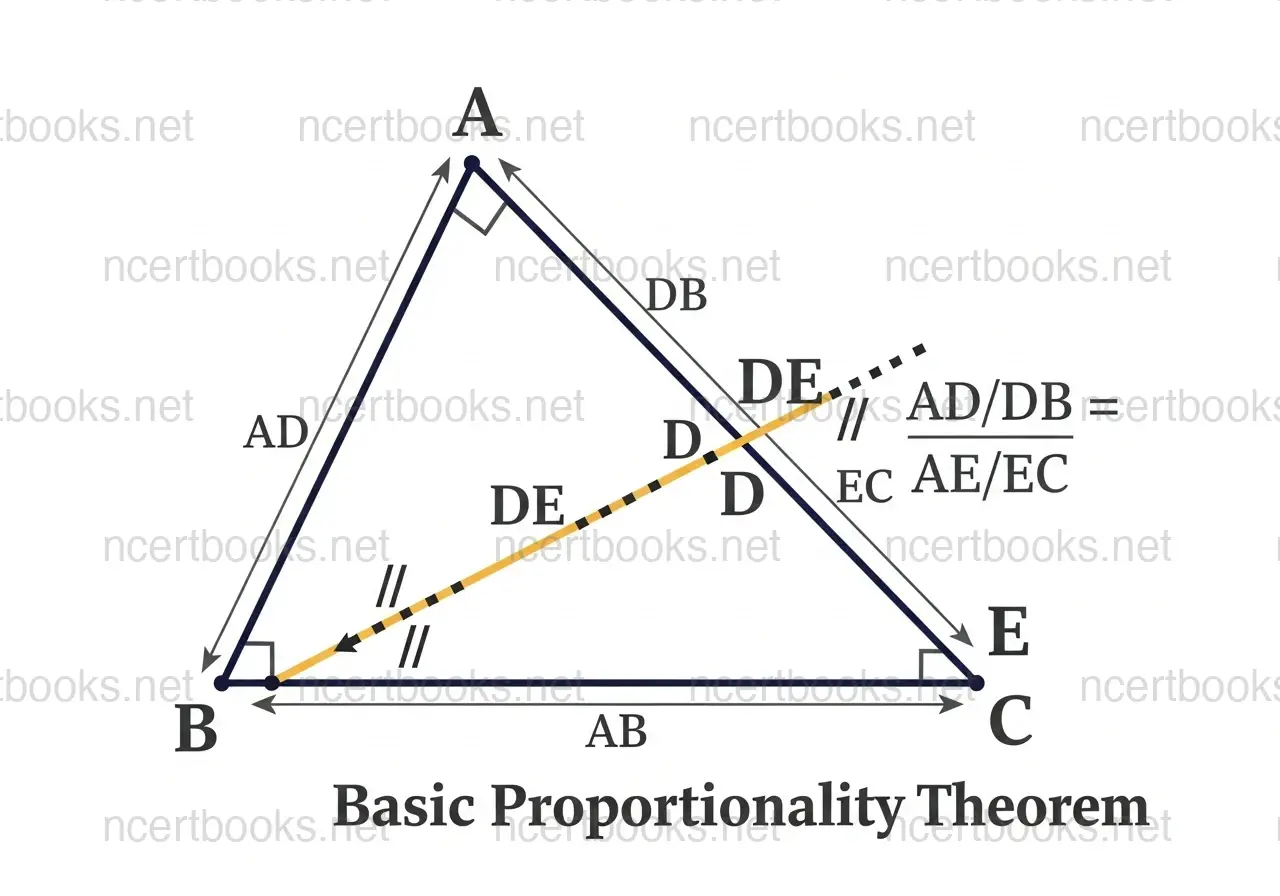
Question 1
Medium
Let △ABC ~ △DEF and their areas be, respectively, 64 cm² and 121 cm². If EF = 15.4 cm, find BC.
Key Concept: Since △ABC ~ △DEF, the ratio of their areas equals the square of the ratio of corresponding sides.
Step 1: Write the area ratio using the theorem:
\[ \frac{ar(\triangle ABC)}{ar(\triangle DEF)} = \frac{BC^2}{EF^2} \]
Step 2: Substitute the known values:
\[ \frac{64}{121} = \frac{BC^2}{(15.4)^2} \]
Step 3: Take square roots on both sides:
\[ \frac{BC}{EF} = \sqrt{\frac{64}{121}} = \frac{8}{11} \]
Step 4: Solve for BC:
\[ BC = \frac{8}{11} \times 15.4 = \frac{8 \times 15.4}{11} = \frac{123.2}{11} = 11.2 \text{ cm} \]
\( \therefore \) BC = 11.2 cm
Question 2
Medium
Diagonals of a trapezium ABCD with AB ∥ DC intersect each other at the point O. If AB = 2 CD, find the ratio of the areas of triangles AOB and COD.
Key Concept: When two parallel lines are cut by transversals, alternate interior angles are equal. Vertically opposite angles are always equal. These two facts together establish AA similarity between triangles formed at the intersection of diagonals.
Step 1: Identify the two triangles. The diagonals AC and BD of trapezium ABCD intersect at point O. We need to compare △AOB and △COD.
Step 2: Establish similarity using AA criterion.
In △AOB and △COD:
- \( \angle AOB = \angle COD \) — vertically opposite angles (शीर्षभिमुख कोण)
- \( \angle OAB = \angle OCD \) — alternate interior angles, since AB ∥ DC and AC is a transversal (एकान्तर कोण)
By the AA similarity criterion:
\[ \triangle AOB \sim \triangle COD \]
Step 3: Apply the Areas of Similar Triangles theorem.
\[ \frac{ar(\triangle AOB)}{ar(\triangle COD)} = \frac{AB^2}{CD^2} \]
Step 4: Substitute AB = 2CD.
\[ \frac{ar(\triangle AOB)}{ar(\triangle COD)} = \frac{(2CD)^2}{CD^2} = \frac{4 \cdot CD^2}{CD^2} = \frac{4}{1} \]
Why does this work? Because the ratio of areas of similar triangles is the square of the ratio of their corresponding sides. Here the corresponding sides are AB and CD, and their ratio is 2:1, so the area ratio is 2² : 1² = 4 : 1.
\( \therefore \) ar(△AOB) : ar(△COD) = 4 : 1
Question 3
Hard
In the given figure, ABC and DBC are two triangles on the same base BC. If AD intersects BC at O, show that: \( \frac{ar(ABC)}{ar(DBC)} = \frac{AO}{DO} \)
Key Concept: The area of a triangle = ½ × base × height. When two triangles share the same base, their areas are in the ratio of their heights.
Step 1: Draw perpendiculars AM ⊥ BC from A and DN ⊥ BC from D.
Step 2: Express the areas:
\[ ar(\triangle ABC) = \frac{1}{2} \times BC \times AM \]
\[ ar(\triangle DBC) = \frac{1}{2} \times BC \times DN \]
Step 3: Take the ratio:
\[ \frac{ar(\triangle ABC)}{ar(\triangle DBC)} = \frac{\frac{1}{2} \times BC \times AM}{\frac{1}{2} \times BC \times DN} = \frac{AM}{DN} \]
Step 4: In △AOM and △DON:
- \( \angle AOM = \angle DON \) (vertically opposite angles)
- \( \angle AMO = \angle DNO = 90° \) (by construction)
By AA similarity: \( \triangle AOM \sim \triangle DON \)
Step 5: Therefore \( \frac{AM}{DN} = \frac{AO}{DO} \)
Step 6: Combining Steps 3 and 5:
\[ \frac{ar(\triangle ABC)}{ar(\triangle DBC)} = \frac{AO}{DO} \]
\( \therefore \) Proved: \( \frac{ar(ABC)}{ar(DBC)} = \frac{AO}{DO} \)
Question 4
Medium
If the areas of two similar triangles are equal, prove that they are congruent.
Key Concept: If two similar triangles have equal areas, the ratio of their areas is 1:1, which means the ratio of their corresponding sides is also 1:1, making them congruent.
Given: △ABC ~ △DEF and ar(△ABC) = ar(△DEF)
To Prove: △ABC ≅ △DEF
Step 1: Since △ABC ~ △DEF, by the areas theorem:
\[ \frac{ar(\triangle ABC)}{ar(\triangle DEF)} = \frac{AB^2}{DE^2} = \frac{BC^2}{EF^2} = \frac{CA^2}{FD^2} \]
Step 2: Since ar(△ABC) = ar(△DEF):
\[ \frac{ar(\triangle ABC)}{ar(\triangle DEF)} = 1 \]
Step 3: Therefore:
\[ \frac{AB^2}{DE^2} = 1 \Rightarrow AB = DE \]
\[ \frac{BC^2}{EF^2} = 1 \Rightarrow BC = EF \]
\[ \frac{CA^2}{FD^2} = 1 \Rightarrow CA = FD \]
Step 4: Since all three pairs of corresponding sides are equal, by SSS congruence criterion:
\[ \triangle ABC \cong \triangle DEF \]
\( \therefore \) Proved: If two similar triangles have equal areas, they are congruent.
Question 5
Medium
D, E and F are respectively the mid-points of sides AB, BC and CA of △ABC. Find the ratio of the areas of △DEF and △ABC.
Key Concept: By the Midpoint Theorem, the line joining the midpoints of two sides of a triangle is parallel to the third side and half its length. Using this, △DEF ~ △ABC.
Step 1: D is the midpoint of AB and F is the midpoint of AC. By the Midpoint Theorem:
\[ DF \parallel BC \text{ and } DF = \frac{1}{2} BC \]
Step 2: Similarly, DE ∥ AC and DE = ½ AC; EF ∥ AB and EF = ½ AB.
Step 3: Since DF ∥ BC, BDEF is a parallelogram. Therefore ∠BFD = ∠DEF (opposite angles). Also ∠ABC = ∠DEF. By SSS similarity (or using the ratio of sides):
\[ \frac{DE}{AB} = \frac{EF}{BC} = \frac{DF}{CA} = \frac{1}{2} \]
Therefore \( \triangle DEF \sim \triangle ABC \) with ratio of corresponding sides = 1 : 2.
Step 4: Apply the areas theorem:
\[ \frac{ar(\triangle DEF)}{ar(\triangle ABC)} = \left(\frac{1}{2}\right)^2 = \frac{1}{4} \]
\( \therefore \) ar(△DEF) : ar(△ABC) = 1 : 4
Question 6
Hard
Prove that the ratio of the areas of two similar triangles is equal to the square of the ratio of their corresponding medians.
Given: △ABC ~ △DEF; AM and DN are medians to sides BC and EF respectively.
To Prove: \( \frac{ar(\triangle ABC)}{ar(\triangle DEF)} = \frac{AM^2}{DN^2} \)
Step 1: Since △ABC ~ △DEF:
\[ \frac{AB}{DE} = \frac{BC}{EF} = \frac{CA}{FD} = k \text{ (say)} \]
Step 2: M is the midpoint of BC, so BM = BC/2. N is the midpoint of EF, so EN = EF/2.
\[ \frac{BM}{EN} = \frac{BC/2}{EF/2} = \frac{BC}{EF} = k \]
Step 3: In △ABM and △DEN:
\[ \frac{AB}{DE} = k \text{ and } \frac{BM}{EN} = k, \text{ and } \angle B = \angle E \text{ (since △ABC ~ △DEF)} \]
By SAS similarity: \( \triangle ABM \sim \triangle DEN \)
Step 4: Therefore \( \frac{AM}{DN} = \frac{AB}{DE} = k \)
Step 5: From the areas theorem applied to △ABC ~ △DEF:
\[ \frac{ar(\triangle ABC)}{ar(\triangle DEF)} = \frac{AB^2}{DE^2} = k^2 = \frac{AM^2}{DN^2} \]
\( \therefore \) Proved: \( \frac{ar(\triangle ABC)}{ar(\triangle DEF)} = \frac{AM^2}{DN^2} \)
Question 7
Hard
Prove that the area of an equilateral triangle described on one side of a square is equal to half the area of the equilateral triangle described on one of its diagonals.
Given: Square ABCD with side = a. Equilateral △BQC is drawn on side BC. Equilateral △APC is drawn on diagonal AC.
Key Concept: All equilateral triangles are similar (AAA). The diagonal of a square with side a = \( a\sqrt{2} \).
Step 1: Since all equilateral triangles are similar:
\[ \triangle BQC \sim \triangle APC \]
Step 2: The ratio of corresponding sides:
\[ \frac{BC}{AC} = \frac{a}{a\sqrt{2}} = \frac{1}{\sqrt{2}} \]
Step 3: Apply the areas theorem:
\[ \frac{ar(\triangle BQC)}{ar(\triangle APC)} = \left(\frac{BC}{AC}\right)^2 = \left(\frac{1}{\sqrt{2}}\right)^2 = \frac{1}{2} \]
Step 4: Therefore:
\[ ar(\triangle BQC) = \frac{1}{2} \times ar(\triangle APC) \]
\( \therefore \) Proved: Area of equilateral △ on side = ½ × Area of equilateral △ on diagonal.
Question 8
Medium
Tick the correct answer and justify:
(i) ABC and BDE are two equilateral triangles such that D is the mid-point of BC. Ratio of the areas of triangles ABC and BDE is:
(a) 2:1 (b) 1:2 (c) 4:1 (d) 1:4
(ii) Sides of two similar triangles are in the ratio 4:9. Areas of these triangles are in the ratio:
(a) 2:3 (b) 4:9 (c) 81:16 (d) 16:81
Step 1: Let the side of equilateral △ABC = a. Then BC = a.
Step 2: D is the midpoint of BC, so BD = a/2. Since △BDE is equilateral, its side = a/2.
Step 3: All equilateral triangles are similar, so △ABC ~ △BDE.
Step 4: Apply the areas theorem:
\[ \frac{ar(\triangle ABC)}{ar(\triangle BDE)} = \left(\frac{BC}{BD}\right)^2 = \left(\frac{a}{a/2}\right)^2 = (2)^2 = 4 \]
\( \therefore \) Answer: (c) 4:1
Step 1: Given two similar triangles with sides in ratio 4:9.
Step 2: By the areas theorem, ratio of areas = square of ratio of sides:
\[ \frac{ar(\triangle_1)}{ar(\triangle_2)} = \left(\frac{4}{9}\right)^2 = \frac{16}{81} \]
\( \therefore \) Answer: (d) 16:81
Formula Reference Table — Similar Triangles
| Formula Name | Formula | Variables Defined |
|---|---|---|
| Area Ratio Theorem | \( \frac{ar(\triangle ABC)}{ar(\triangle DEF)} = \frac{AB^2}{DE^2} = \frac{BC^2}{EF^2} = \frac{CA^2}{FD^2} \) | AB, DE etc. = corresponding sides |
| Area of Triangle | \( ar = \frac{1}{2} \times base \times height \) | base, height in same units |
| Equilateral Triangle Area | \( ar = \frac{\sqrt{3}}{4} a^2 \) | a = side length |
| Square Diagonal | \( d = a\sqrt{2} \) | a = side of square, d = diagonal |
| Medians Area Ratio | \( \frac{ar(\triangle ABC)}{ar(\triangle DEF)} = \frac{AM^2}{DN^2} \) | AM, DN = corresponding medians |
| Midpoint Theorem | \( DE = \frac{1}{2} BC \) when D, E are midpoints of AB, AC | DE ∥ BC |
Solved Examples Beyond NCERT — Class 10 Maths Triangles Ex 6.4
Extra Example 1
Easy
Two similar triangles have areas 25 cm² and 100 cm². If a side of the smaller triangle is 3 cm, find the corresponding side of the larger triangle.
Step 1: Use the area ratio theorem:
\[ \frac{25}{100} = \frac{3^2}{x^2} \]
Step 2: Simplify and solve:
\[ \frac{1}{4} = \frac{9}{x^2} \Rightarrow x^2 = 36 \Rightarrow x = 6 \text{ cm} \]
\( \therefore \) The corresponding side = 6 cm
Extra Example 2
Medium
In trapezium PQRS, PQ ∥ SR and the diagonals intersect at O. If PQ = 3SR, find ar(△POQ) : ar(△SOR).
Step 1: △POQ ~ △SOR by AA (vertically opposite angles + alternate interior angles with PQ ∥ SR).
Step 2: Ratio of corresponding sides = PQ : SR = 3 : 1.
Step 3: Area ratio = \( 3^2 : 1^2 = 9 : 1 \)
\( \therefore \) ar(△POQ) : ar(△SOR) = 9 : 1
Extra Example 3
Hard
△ABC ~ △PQR. The perimeters of △ABC and △PQR are 36 cm and 24 cm respectively. If PQ = 10 cm, find AB. Also find the ratio of their areas.
Step 1: For similar triangles, ratio of perimeters = ratio of corresponding sides.
\[ \frac{AB}{PQ} = \frac{\text{Perimeter of }\triangle ABC}{\text{Perimeter of }\triangle PQR} = \frac{36}{24} = \frac{3}{2} \]
Step 2: Find AB:
\[ AB = \frac{3}{2} \times PQ = \frac{3}{2} \times 10 = 15 \text{ cm} \]
Step 3: Ratio of areas = square of ratio of sides:
\[ \frac{ar(\triangle ABC)}{ar(\triangle PQR)} = \left(\frac{3}{2}\right)^2 = \frac{9}{4} \]
\( \therefore \) AB = 15 cm; ar(△ABC) : ar(△PQR) = 9 : 4
Important Questions for Board Exam 2026-27 — Triangles Exercise 6.4
1-Mark Questions (Definition / Short Answer)
- State the theorem relating areas of two similar triangles to their corresponding sides.
- All equilateral triangles are ________ (similar / congruent).
- If △ABC ~ △DEF and BC : EF = 3 : 5, find ar(△ABC) : ar(△DEF).
Answers: 1. Ratio of areas = square of ratio of corresponding sides. 2. Similar. 3. 9 : 25.
3-Mark Questions (Application)
Q1. △ABC ~ △DEF, ar(△ABC) = 36 cm², ar(△DEF) = 81 cm², DE = 6 cm. Find AB.
Answer: \( \frac{AB^2}{36} = \frac{36}{81} \Rightarrow AB^2 = 16 \Rightarrow AB = 4 \) cm.
Q2. In trapezium ABCD, AB ∥ DC. Diagonals meet at O. If ar(△AOB) = 16 cm² and ar(△COD) = 4 cm², find AB : CD.
Answer: \( \frac{ar(\triangle AOB)}{ar(\triangle COD)} = \frac{AB^2}{CD^2} \Rightarrow \frac{16}{4} = \frac{AB^2}{CD^2} \Rightarrow \frac{AB}{CD} = 2 \). So AB : CD = 2 : 1.
5-Mark Questions (Proof / Long Answer)
Q1. Prove that the ratio of areas of two similar triangles is equal to the square of the ratio of their corresponding medians. (This is Q6 from the exercise — a full proof is required.)
Common Mistakes Students Make in Exercise 6.4
Mistake 1: Students write the area ratio equal to the ratio of sides (not the square).
Why it’s wrong: The theorem states area ratio = square of side ratio.
Correct approach: Always write \( \frac{ar_1}{ar_2} = \left(\frac{s_1}{s_2}\right)^2 \), not \( \frac{s_1}{s_2} \).
Mistake 2: In Q2 (trapezium), students skip the AA similarity proof and directly write the ratio.
Why it’s wrong: You must establish similarity before applying the theorem. Examiners deduct marks for missing the AA proof step.
Correct approach: Name both angles (∠AOB = ∠COD and ∠OAB = ∠OCD) with their reasons before writing △AOB ~ △COD.
Mistake 3: In Q7 (square and diagonal), students forget that the diagonal of a square with side a is \( a\sqrt{2} \).
Why it’s wrong: Using the wrong diagonal length gives the wrong area ratio.
Correct approach: Recall \( d = a\sqrt{2} \) and then \( (a/a\sqrt{2})^2 = 1/2 \).
Mistake 4: In Q8 MCQ, students select the answer without showing justification.
Why it’s wrong: CBSE awards marks specifically for the working, not just the option letter.
Correct approach: Always write the ratio of sides, square it, and state the answer with the calculation.
Mistake 5: In Q3 (triangles on same base), students confuse the heights and use the base instead.
Why it’s wrong: The triangles share the same base BC, so the ratio of areas depends on the ratio of their heights, not the base.
Correct approach: Draw perpendiculars from A and D to BC, then use AA similarity in the small triangles formed.
Exam Tips for 2026-27 CBSE Board Exam — Chapter 6 Triangles
- Always state the theorem before applying it. The CBSE marking scheme awards 1 mark specifically for writing “by the theorem, ratio of areas = square of ratio of sides” before the calculation.
- For proof questions (Q3, Q4, Q6, Q7): Write “Given”, “To Prove”, “Proof” as separate headings. The marking scheme follows this structure.
- Construction marks: In Q3, drawing the perpendiculars AM and DN earns a dedicated mark. Never skip constructions.
- For MCQ with justification (Q8): Write the full calculation — the justification carries more marks than the option itself.
- Chapter 6 weightage: Triangles typically contributes 11–12 marks to the CBSE Class 10 Maths paper in 2026-27. Exercise 6.4 questions appear most often in the 3-mark and 5-mark categories.
- Last-minute checklist: Know the area-ratio theorem, AA/SAS/SSS similarity criteria, midpoint theorem, diagonal of square = a√2, and that all equilateral triangles are similar.
For more chapter-wise solutions, visit our NCERT Solutions for Class 10 page. You can also explore related exercises: NCERT Solutions for all classes are available on ncertbooks.net.