- Exercise: 6.3 | Chapter 6 — Triangles | Class 10 Maths (NCERT)
- Total Questions: 16 (mix of state-which, show-that, prove-that, and calculation types)
- Main Similarity Criteria: AA (Angle-Angle), SAS (Side-Angle-Side), SSS (Side-Side-Side)
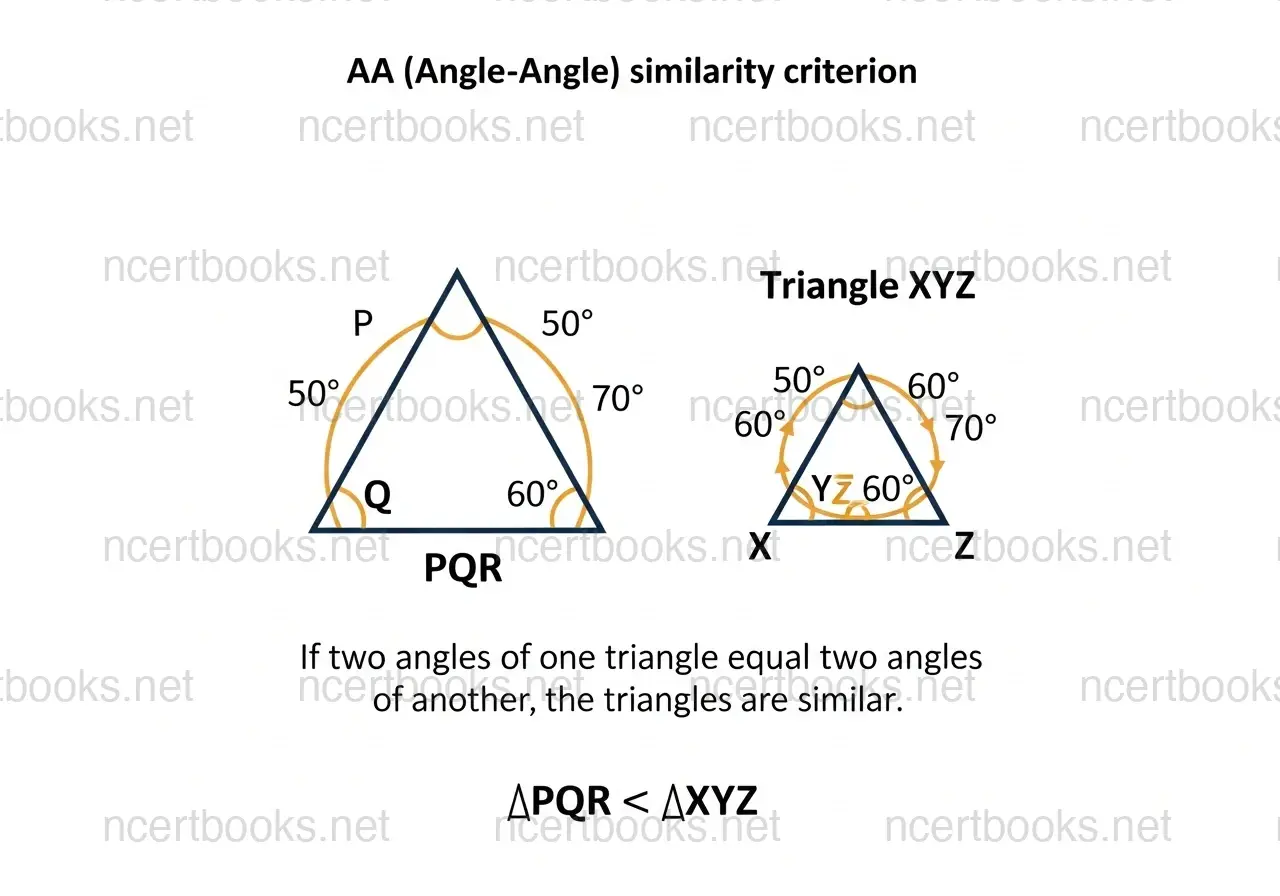
- AA Criterion: If two angles of one triangle equal two angles of another, the triangles are similar
- Key Theorem Used: Corresponding sides of similar triangles are proportional; corresponding angles are equal
- Median Proportionality: If \( \triangle ABC \sim \triangle PQR \), then \( \frac{AB}{PQ} = \frac{AD}{PM} \) where AD, PM are medians
- Linear Pair: Angles on a straight line add up to 180° — critical for Q2
- Syllabus Status: Fully included in 2026-27 CBSE syllabus
The NCERT Solutions for Class 10 Maths Chapter 6 Ex 6.3 on this page cover all 16 questions from the Triangles chapter, updated for the 2026-27 CBSE academic year. Whether you need to identify similarity criteria, calculate unknown angles, or write formal proofs, every answer here is explained step by step. These solutions are part of our complete NCERT Solutions for Class 10 series. You can also access the full range of NCERT Solutions for all classes on our site. The official textbook is available on the NCERT official website.
Table of Contents
- Quick Revision Box
- Chapter Overview — Triangles Class 10 Maths
- Key Concepts and Theorems for Exercise 6.3
- NCERT Solutions for Class 10 Maths Chapter 6 Ex 6.3 — All Questions
- Formula Reference Table — Similarity of Triangles
- Solved Examples Beyond NCERT
- Important Questions for Board Exam
- Common Mistakes Students Make
- Exam Tips for 2026-27 CBSE Board
- Frequently Asked Questions
Chapter Overview — Triangles Class 10 Maths (NCERT 2026-27)
Chapter 6 of Class 10 NCERT Maths is Triangles. It builds on the congruence of triangles studied in earlier classes and introduces the concept of similarity of triangles — a more general relationship where shapes have the same form but not necessarily the same size. Exercise 6.3 specifically deals with criteria for similarity (AA, SAS, SSS) and their application in proofs and calculations.
This chapter carries significant weightage in CBSE board exams. Questions from Triangles appear in the 2-mark, 3-mark, and 5-mark sections. Proof-based questions (show that / prove that) are especially common from Exercise 6.3. Students who have studied Basic Proportionality Theorem (Exercise 6.2) will find this exercise a natural extension.
| Field | Details |
|---|---|
| Chapter | Chapter 6 — Triangles |
| Exercise | Exercise 6.3 |
| Textbook | NCERT Mathematics Class 10 |
| Class | Class 10 |
| Subject | Mathematics |
| Number of Questions | 16 |
| Difficulty Level | Medium to Hard |
| Syllabus Status | Included in 2026-27 CBSE Syllabus |
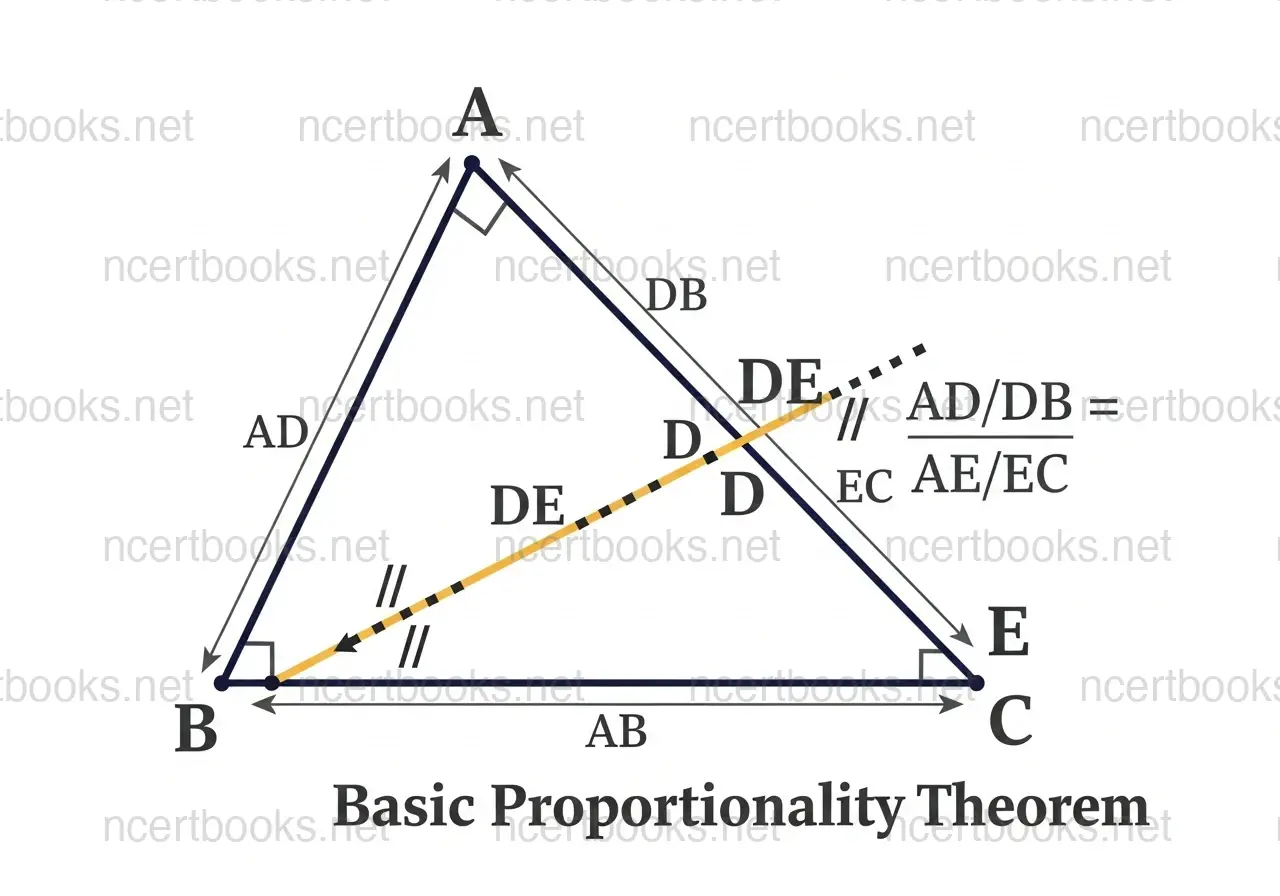
Key Concepts and Theorems for Exercise 6.3
AA Similarity Criterion (Angle-Angle)
If two angles of one triangle are equal to two angles of another triangle, the two triangles are similar. Since the angle sum in any triangle is 180°, proving two pairs of angles equal automatically proves the third pair equal as well.
\[ \text{If } \angle A = \angle P \text{ and } \angle B = \angle Q, \text{ then } \triangle ABC \sim \triangle PQR \]
SAS Similarity Criterion (Side-Angle-Side)
If one angle of a triangle equals one angle of another triangle and the sides including those angles are proportional, the triangles are similar.
\[ \text{If } \angle A = \angle P \text{ and } \frac{AB}{PQ} = \frac{AC}{PR}, \text{ then } \triangle ABC \sim \triangle PQR \]
SSS Similarity Criterion (Side-Side-Side)
If all three pairs of corresponding sides of two triangles are proportional, the triangles are similar.
\[ \frac{AB}{PQ} = \frac{BC}{QR} = \frac{CA}{RP} \implies \triangle ABC \sim \triangle PQR \]
Properties of Similar Triangles
- Corresponding angles of similar triangles are equal.
- Corresponding sides of similar triangles are proportional.
- The order of vertices in the similarity statement matters: \( \triangle ABC \sim \triangle PQR \) means A↔P, B↔Q, C↔R.
NCERT Solutions for Class 10 Maths Chapter 6 Ex 6.3 — All Questions (2026-27)
Below are complete, step-by-step solutions for the mandatory questions from Exercise 6.3. These solutions match the official NCERT answer key and are written to help you score full marks in CBSE board exams.
Question 2
Medium
In the given figure, \( \triangle ODC \sim \triangle OBA \), \( \angle BOC = 125° \) and \( \angle CDO = 70° \). Find \( \angle DOC \), \( \angle DCO \) and \( \angle OAB \).
Key Concept: \( \angle DOC \) and \( \angle BOC \) form a linear pair (they lie on a straight line). The sum of a linear pair is always 180°.
Step 1: Apply the linear pair property:
\[ \angle DOC + \angle BOC = 180° \]
\[ \angle DOC + 125° = 180° \]
\[ \angle DOC = 180° – 125° = 55° \]
\( \therefore \angle DOC = 55° \)
Step 2: In \( \triangle DOC \), the sum of all three angles equals 180°:
\[ \angle DOC + \angle CDO + \angle DCO = 180° \]
\[ 55° + 70° + \angle DCO = 180° \]
\[ 125° + \angle DCO = 180° \]
\[ \angle DCO = 180° – 125° = 55° \]
\( \therefore \angle DCO = 55° \)
Step 3: We are given that \( \triangle ODC \sim \triangle OBA \). In similar triangles, corresponding angles are equal.
Why does this work? The order of vertices tells us which angles correspond: O↔O, D↔B, C↔A. So \( \angle DCO \) (angle at C in \( \triangle ODC \)) corresponds to \( \angle OAB \) (angle at A in \( \triangle OBA \)).
\[ \angle OAB = \angle DCO = 55° \]
\( \therefore \angle OAB = 55° \)
Question 16
Hard
If AD and PM are medians of triangles ABC and PQR respectively, where \( \triangle ABC \sim \triangle PQR \), prove that \( \dfrac{AB}{PQ} = \dfrac{AD}{PM} \).
Key Concept: A median (मध्यिका) of a triangle is the line segment joining a vertex to the midpoint of the opposite side. Since AD is a median of \( \triangle ABC \), D is the midpoint of BC, so \( BD = \frac{BC}{2} \). Similarly, since PM is a median of \( \triangle PQR \), M is the midpoint of QR, so \( QM = \frac{QR}{2} \).
Step 1: Write the proportionality from the given similarity \( \triangle ABC \sim \triangle PQR \):
\[ \frac{AB}{PQ} = \frac{BC}{QR} = \frac{CA}{RP} \]
Also, corresponding angles are equal:
\[ \angle B = \angle Q \]
Step 2: Express BC and QR in terms of the half-segments (using the median definition):
\[ BC = 2 \cdot BD \quad \text{and} \quad QR = 2 \cdot QM \]
Substituting into the ratio:
\[ \frac{AB}{PQ} = \frac{BC}{QR} = \frac{2 \cdot BD}{2 \cdot QM} = \frac{BD}{QM} \]
Step 3: We now have \( \frac{AB}{PQ} = \frac{BD}{QM} \) and \( \angle B = \angle Q \). These are the conditions for the SAS Similarity Criterion in triangles ABD and PQM.
Why does this work? SAS similarity requires two sides in proportion AND the included angle equal. Here the included angle between AB, BD is \( \angle B \), and the included angle between PQ, QM is \( \angle Q \), and \( \angle B = \angle Q \).
Step 4: Apply SAS Similarity Criterion:
\[ \triangle ABD \sim \triangle PQM \quad (\text{SAS Similarity}) \]
Step 5: Since \( \triangle ABD \sim \triangle PQM \), their corresponding sides are proportional:
\[ \frac{AB}{PQ} = \frac{BD}{QM} = \frac{AD}{PM} \]
Conclusion: From the above,
\[ \frac{AB}{PQ} = \frac{AD}{PM} \]
\( \therefore \dfrac{AB}{PQ} = \dfrac{AD}{PM} \) — Proved.
For complete solutions to all 16 questions in Exercise 6.3 — including Questions 1, 3–15 — refer to our detailed NCERT Solutions for Class 10 Maths page. Each question is solved with the same rigour shown above.
Formula Reference Table — Similarity of Triangles
| Criterion / Property | Formula / Statement | When to Use |
|---|---|---|
| AA Similarity | \( \angle A = \angle P, \angle B = \angle Q \implies \triangle ABC \sim \triangle PQR \) | When two pairs of angles are known |
| SAS Similarity | \( \angle A = \angle P, \frac{AB}{PQ} = \frac{AC}{PR} \implies \triangle ABC \sim \triangle PQR \) | When two sides and included angle are known |
| SSS Similarity | \( \frac{AB}{PQ} = \frac{BC}{QR} = \frac{CA}{RP} \implies \triangle ABC \sim \triangle PQR \) | When all three side ratios are given |
| Corresponding Sides | \( \frac{AB}{PQ} = \frac{BC}{QR} = \frac{CA}{RP} \) | After establishing similarity |
| Angle Sum in Triangle | \( \angle A + \angle B + \angle C = 180° \) | Finding unknown angles |
| Linear Pair | \( \angle 1 + \angle 2 = 180° \) | Angles on a straight line (Q2) |
| Median Definition | \( BD = \frac{BC}{2} \) (D is midpoint of BC) | Median proportionality proofs (Q16) |
Solved Examples Beyond NCERT — Triangles Similarity
Extra Example 1 — Identifying Similarity
Easy
In \( \triangle ABC \) and \( \triangle DEF \), \( \angle A = 50° \), \( \angle B = 70° \), \( \angle D = 50° \), \( \angle F = 60° \). Are the triangles similar?
Step 1: Find \( \angle C \) in \( \triangle ABC \): \( \angle C = 180° – 50° – 70° = 60° \).
Step 2: Find \( \angle E \) in \( \triangle DEF \): \( \angle E = 180° – 50° – 60° = 70° \).
Step 3: Compare: \( \angle A = \angle D = 50° \), \( \angle B = \angle E = 70° \), \( \angle C = \angle F = 60° \).
\( \therefore \triangle ABC \sim \triangle DEF \) by AA Similarity Criterion.
Extra Example 2 — Shadow and Height Problem
Medium
A tree of height 8 m casts a shadow 6 m long. At the same time, a building casts a shadow 30 m long. Find the height of the building.
Step 1: The sun’s rays are parallel, so the triangles formed by the tree and its shadow and the building and its shadow are similar by the AA criterion.
Step 2: Set up the proportion:
\[ \frac{\text{Height of tree}}{\text{Shadow of tree}} = \frac{\text{Height of building}}{\text{Shadow of building}} \]
\[ \frac{8}{6} = \frac{h}{30} \]
Step 3: Solve for \( h \):
\[ h = \frac{8 \times 30}{6} = \frac{240}{6} = 40 \text{ m} \]
\( \therefore \) The height of the building is 40 m.
Extra Example 3 — Median Ratio
Hard
In \( \triangle ABC \sim \triangle PQR \), if \( AB = 6 \) cm, \( PQ = 9 \) cm, and median \( AD = 4 \) cm, find median PM.
Step 1: By the result proved in Q16 (median proportionality theorem):
\[ \frac{AB}{PQ} = \frac{AD}{PM} \]
Step 2: Substitute known values:
\[ \frac{6}{9} = \frac{4}{PM} \]
Step 3: Cross-multiply and solve:
\[ PM = \frac{4 \times 9}{6} = \frac{36}{6} = 6 \text{ cm} \]
\( \therefore \) Median \( PM = 6 \) cm.
Important Questions for Board Exam — Triangles Exercise 6.3
1-Mark Questions (Definition / State the criterion)
- Q1. State the AA similarity criterion.
Answer: If two angles of one triangle are equal to two angles of another triangle, the triangles are similar. - Q2. What is a median of a triangle?
Answer: A median is a line segment joining a vertex to the midpoint of the opposite side. Every triangle has three medians. - Q3. If \( \triangle ABC \sim \triangle PQR \) and \( \angle A = 60° \), \( \angle B = 80° \), find \( \angle R \).
Answer: \( \angle C = 180° – 60° – 80° = 40° \). Since \( \angle C = \angle R \), \( \angle R = 40° \).
3-Mark Questions (Application)
Q4. In \( \triangle ABC \), \( \angle ABC = \angle DAC \). Prove that \( \triangle ABC \sim \triangle DAC \).
Answer: In \( \triangle ABC \) and \( \triangle DAC \): \( \angle ABC = \angle DAC \) (given) and \( \angle ACB = \angle DCA \) (common angle). By AA similarity criterion, \( \triangle ABC \sim \triangle DAC \).
Q5. A vertical pole of length 6 m casts a shadow 4 m long on the ground and at the same time a tower casts a shadow 28 m long. Find the height of the tower.
Answer: The triangles formed are similar by AA criterion (same sun angle, both vertical). \( \frac{6}{4} = \frac{h}{28} \implies h = \frac{6 \times 28}{4} = 42 \) m. The height of the tower is 42 m.
5-Mark Question (Proof)
Q6. If AD and PM are medians of triangles ABC and PQR respectively, where \( \triangle ABC \sim \triangle PQR \), prove that \( \frac{AB}{PQ} = \frac{AD}{PM} \).
Answer: See Question 16 solution above — full proof with all steps and reasons.
Common Mistakes Students Make in Exercise 6.3
Mistake 1: Writing the similarity statement in the wrong order.
Why it’s wrong: \( \triangle ABC \sim \triangle PQR \) means A↔P, B↔Q, C↔R. If you write \( \triangle ABC \sim \triangle QPR \), all your angle and side correspondences become wrong.
Correct approach: Always match vertices so that equal angles correspond. Double-check by verifying all three angle pairs match.
Mistake 2: Confusing congruence (≅) with similarity (~).
Why it’s wrong: Congruent triangles are identical in size and shape. Similar triangles have the same shape but can be different sizes. Exercise 6.3 is entirely about similarity, not congruence.
Correct approach: Use the ~ symbol for similarity and state the criterion (AA, SAS, or SSS) explicitly.
Mistake 3: Forgetting to state the reason for each step in a proof.
Why it’s wrong: CBSE marking schemes award marks for both the step and the reason. Writing \( \angle DOC = 55° \) without writing “linear pair” loses a mark.
Correct approach: After every angle calculation or proportionality statement, write the property or theorem used in brackets.
Mistake 4: In the median proof (Q16), not using the half-segment substitution correctly.
Why it’s wrong: Some students write \( BD = BC \) instead of \( BD = \frac{BC}{2} \), which breaks the proportionality argument.
Correct approach: Clearly state “D is the midpoint of BC (since AD is a median), therefore \( BD = \frac{BC}{2} \)”.
Mistake 5: Applying SAS similarity without checking that the angle is the included angle.
Why it’s wrong: SAS similarity requires the equal angle to be between the two proportional sides. If the angle is not included, SAS similarity does not apply.
Correct approach: Draw a rough diagram and verify that the equal angle lies between the two sides you are comparing.
Exam Tips for 2026-27 CBSE Board — Triangles Chapter 6
- State the criterion explicitly: Every proof in Exercise 6.3 requires you to name the similarity criterion used (AA, SAS, or SSS). The 2026-27 CBSE marking scheme awards a dedicated mark for this.
- Write corresponding vertices carefully: In the similarity statement, the order of vertices encodes all angle and side relationships. Spend 10 seconds checking vertex order before writing your answer.
- Proof questions carry 3–5 marks: For “show that” and “prove that” questions, every step with its reason is a potential mark. Never skip a step even if it seems obvious.
- Shadow/height problems are calculation-based: For Q15-type problems, set up a clear proportion, show the cross-multiplication, and state the final answer with units (metres).
- Median proportionality is a favourite board question: The result \( \frac{AB}{PQ} = \frac{AD}{PM} \) has appeared in CBSE board papers multiple times. Memorise the proof structure: given similarity → proportional sides → half-segment substitution → SAS similarity of sub-triangles → corresponding sides.
- Revise angle sum and linear pair: Q2-type angle calculation questions are quick marks if you remember that linear pair = 180° and triangle angle sum = 180°. These are guaranteed 2-3 mark questions in the 2026-27 pattern.
Frequently Asked Questions — Triangles Exercise 6.3
How many questions are there in NCERT Class 10 Maths Chapter 6 Exercise 6.3?
Exercise 6.3 of Class 10 Maths Chapter 6 (Triangles) has 16 questions. These questions cover identifying similarity criteria, calculating unknown angles in similar triangles, formal proofs involving medians and altitudes, and real-world application problems like finding the height of a tower using shadows. The exercise tests both conceptual understanding and proof-writing skills.
What similarity criteria are tested in Exercise 6.3 of Class 10 Maths?
Exercise 6.3 tests three main similarity criteria: AA (Angle-Angle), SAS (Side-Angle-Side), and SSS (Side-Side-Side). The AA criterion is the most frequently used across the 16 questions. Students must correctly identify which criterion applies to each pair of triangles and state it explicitly for full marks in CBSE board exams.
How do you find ∠DOC, ∠DCO and ∠OAB in Question 2 of Exercise 6.3?
Since \( \angle BOC = 125° \) and \( \angle DOC \) forms a linear pair with \( \angle BOC \), we get \( \angle DOC = 180° – 125° = 55° \). In triangle DOC, the angle sum gives \( \angle DCO = 180° – 55° – 70° = 55° \). Since \( \triangle ODC \sim \triangle OBA \), corresponding angles are equal, so \( \angle OAB = \angle DCO = 55° \).
How to prove AB/PQ = AD/PM when AD and PM are medians of similar triangles?
Since \( \triangle ABC \sim \triangle PQR \), we have \( \frac{AB}{PQ} = \frac{BC}{QR} \) and \( \angle B = \angle Q \). Since AD and PM are medians, \( BD = \frac{BC}{2} \) and \( QM = \frac{QR}{2} \), giving \( \frac{AB}{PQ} = \frac{BD}{QM} \). With \( \angle B = \angle Q \), by SAS similarity \( \triangle ABD \sim \triangle PQM \), which gives \( \frac{AB}{PQ} = \frac{AD}{PM} \).
Is Exercise 6.3 of Class 10 Maths Chapter 6 in the current 2026-27 CBSE syllabus?
Yes, Exercise 6.3 on similarity of triangles is fully included in the 2026-27 CBSE syllabus for Class 10 Maths. The Triangles chapter carries significant weightage in board exams, and Exercise 6.3 specifically tests the similarity criteria that appear in both 3-mark and 5-mark board questions. Students must practise all 16 questions for complete exam preparation.