⚡ Quick Revision Box — NCERT Class 10 Maths Chapter 6 Ex 6.2
- Chapter: Triangles | Exercise 6.2 | Class 10 Maths NCERT
- Core Theorem: Basic Proportionality Theorem (BPT) / Thales’ Theorem — a line parallel to one side of a triangle divides the other two sides proportionally.
- Converse of BPT: If a line divides two sides of a triangle in the same ratio, it is parallel to the third side.
- Total Questions: 10 questions covering BPT application, converse, mid-point theorem, and trapezium properties.
- Key Check Method: To verify EF ∥ QR, check if \( \frac{PE}{EQ} = \frac{PF}{FR} \). If equal → parallel; if not equal → not parallel.
- Trapezium Proof (Q10): Uses converse of BPT by constructing an auxiliary line to show one pair of opposite sides is parallel.
- Board Exam Weightage: Triangles chapter carries 6–8 marks in CBSE Class 10 board exams 2026-27.
- Updated For: 2026-27 CBSE rationalised syllabus — all questions in this exercise are part of the current syllabus.
The NCERT Solutions for Class 10 Maths Chapter 6 Ex 6.2 on this page cover all 10 questions from the Triangles exercise, updated for the 2026-27 CBSE board exam. Exercise 6.2 is built entirely around the Basic Proportionality Theorem (BPT) and its converse — two of the most frequently tested concepts in CBSE Class 10 geometry. You can find all NCERT Solutions for other subjects and classes on our main hub, and all Class 10 solutions are available at NCERT Solutions for Class 10. The official NCERT textbook for this chapter is also available on the NCERT official website.
Table of Contents
- Quick Revision Box
- Chapter Overview — Triangles Exercise 6.2
- Key Concepts and Theorems — BPT and Converse
- NCERT Solutions for Class 10 Maths Chapter 6 Ex 6.2 — All Questions
- Formula Reference Table — Triangles Chapter 6
- Solved Examples Beyond NCERT — Extra Practice
- Topic-Wise Important Questions for Board Exam
- Common Mistakes Students Make in Exercise 6.2
- Exam Tips for 2026-27 CBSE Board Exam
- Key Points to Remember — Triangles Chapter 6
- Frequently Asked Questions — Exercise 6.2 Triangles
Chapter Overview — Triangles Exercise 6.2 | NCERT Class 10 Maths 2026-27
Chapter 6 of the NCERT Class 10 Maths textbook is titled Triangles. It is one of the most important chapters in the CBSE Class 10 syllabus, covering similarity of triangles, the Basic Proportionality Theorem, and criteria for similar triangles. Exercise 6.2 specifically focuses on the Basic Proportionality Theorem (BPT) — also called Thales’ Theorem — and its converse.
In your CBSE board exam 2026-27, the Geometry unit (which includes Triangles) carries significant marks. Questions from this exercise appear as 3-mark proofs and 5-mark long-answer questions. You must show complete reasoning and every step to earn full marks. Students who skip steps in proofs lose marks even when the final answer is correct.
Before attempting Exercise 6.2, make sure you are comfortable with ratios and proportions from earlier classes, and that you have studied Exercise 6.1 which introduces the concept of similar figures. The prerequisite knowledge includes basic properties of triangles, the concept of parallel lines, and ratio comparison.
| Detail | Information |
|---|---|
| Chapter | Chapter 6 — Triangles |
| Exercise | Exercise 6.2 |
| Textbook | NCERT Mathematics — Class 10 |
| Subject | Mathematics |
| Total Questions | 10 |
| Core Concept | Basic Proportionality Theorem (BPT) and its Converse |
| Marks Weightage | Geometry unit: 15 marks in CBSE 2026-27 board exam |
| Difficulty Level | Medium to Hard (proof-based) |
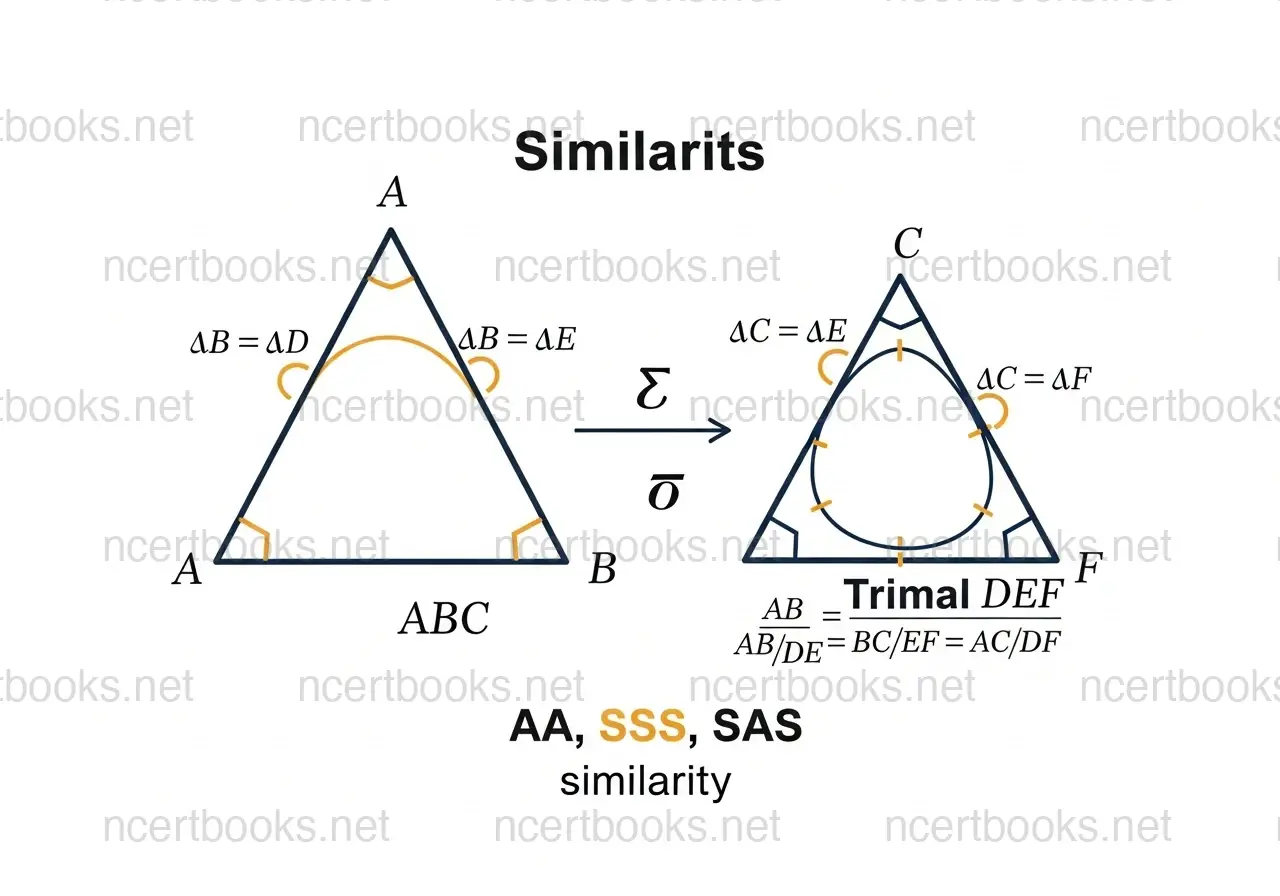
Key Concepts and Theorems — BPT and Converse of BPT
Basic Proportionality Theorem (Thales’ Theorem)
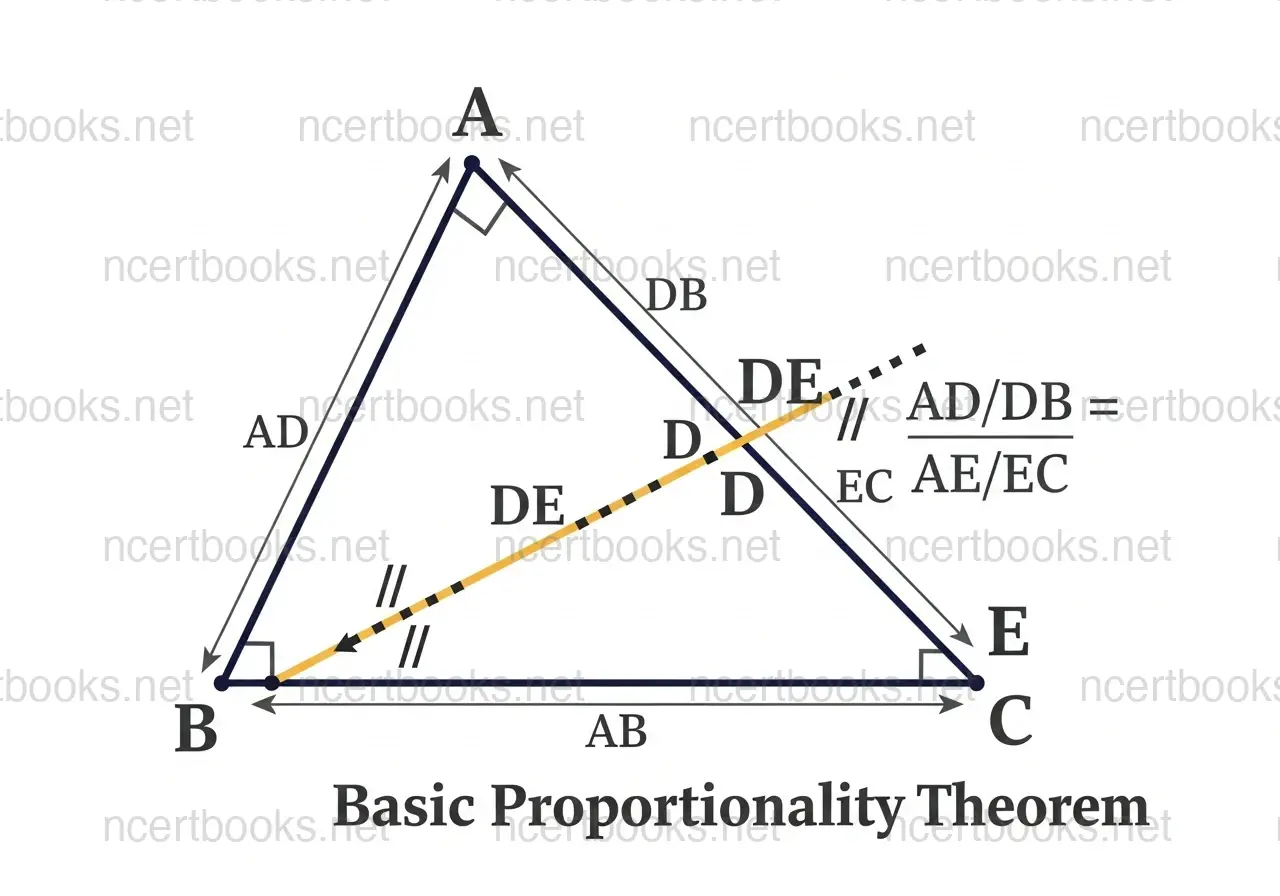
Statement: If a line is drawn parallel to one side of a triangle to intersect the other two sides in distinct points, the other two sides are divided in the same ratio.
In triangle ABC, if DE ∥ BC where D is on AB and E is on AC, then:
\[ \frac{AD}{DB} = \frac{AE}{EC} \]
Real-world analogy: Think of a ladder leaning against a wall. A horizontal rung parallel to the ground divides both sides of the ladder in equal proportion — that is BPT in action.
Converse of Basic Proportionality Theorem
Statement: If a line divides any two sides of a triangle in the same ratio, then the line is parallel to the third side.
In triangle PQR, if E is on PQ and F is on PR such that:
\[ \frac{PE}{EQ} = \frac{PF}{FR} \]
then EF ∥ QR. This converse is the main tool used in Exercise 6.2 Questions 1–6.
Mid-Point Theorem — Connection to BPT
The Mid-Point Theorem is a special case of BPT. It states that the line segment joining the mid-points of two sides of a triangle is parallel to the third side and equal to half of it. Questions 7 and 8 of Exercise 6.2 ask you to prove this using BPT and its converse respectively.
Trapezium and Diagonal Ratio Property
In a trapezium ABCD where AB ∥ DC, the diagonals intersect at O such that \( \frac{AO}{BO} = \frac{CO}{DO} \). Question 9 proves this property, and Question 10 uses it in reverse — given the ratio condition, prove the quadrilateral is a trapezium.
NCERT Solutions for Class 10 Maths Chapter 6 Ex 6.2 — All Questions Solved
Below are complete, step-by-step solutions for all mandatory questions from Exercise 6.2. These solutions follow the CBSE marking scheme for 2026-27 — every step is shown so you can write the same in your board exam and score full marks. For the complete set of cbse class 10 maths ncert solutions, visit our Class 10 hub.
Question 2 — Checking Whether EF is Parallel to QR Using Converse of BPT
Question 2
Medium
E and F are points on the sides PQ and PR respectively of a △PQR. For each of the following cases, state whether EF ∥ QR:
(i) PE = 3.9 cm, EQ = 3 cm, PF = 3.6 cm and FR = 2.4 cm
(ii) PE = 4 cm, QE = 4.5 cm, PF = 8 cm and RF = 9 cm
(iii) PQ = 1.28 cm, PR = 2.56 cm, PE = 0.18 cm and PF = 0.36 cm
Key Concept: By the Converse of BPT, EF ∥ QR if and only if \( \frac{PE}{EQ} = \frac{PF}{FR} \). We compute both ratios for each case and compare.
Step 1: Calculate the ratio \( \frac{PE}{EQ} \):
\[ \frac{PE}{EQ} = \frac{3.9}{3} = \frac{39}{30} = \frac{13}{10} = 1.3 \]
Step 2: Calculate the ratio \( \frac{PF}{FR} \):
\[ \frac{PF}{FR} = \frac{3.6}{2.4} = \frac{36}{24} = \frac{3}{2} = 1.5 \]
Step 3: Compare the two ratios:
\[ \frac{PE}{EQ} = 1.3 \neq 1.5 = \frac{PF}{FR} \]
Why does this matter? Since the two ratios are not equal, the converse of BPT does not apply, so EF cannot be parallel to QR.
\( \therefore \) EF is NOT parallel to QR.
\[ \frac{PE}{EQ} = \frac{4}{4.5} = \frac{40}{45} = \frac{8}{9} \]
\[ \frac{PF}{FR} = \frac{8}{9} \]
Step 3: Compare the two ratios:
\[ \frac{PE}{EQ} = \frac{8}{9} = \frac{PF}{FR} \]
Why does this work? Both ratios are equal, so by the Converse of BPT, EF is parallel to QR.
\( \therefore \) EF is parallel to QR (EF ∥ QR).
Step 1: Find EQ and FR from the given data.
\[ EQ = PQ – PE = 1.28 – 0.18 = 1.10 \text{ cm} \]
\[ FR = PR – PF = 2.56 – 0.36 = 2.20 \text{ cm} \]
Step 2: Calculate the ratio \( \frac{PE}{EQ} \):
\[ \frac{PE}{EQ} = \frac{0.18}{1.10} = \frac{18}{110} = \frac{9}{55} \]
Step 3: Calculate the ratio \( \frac{PF}{FR} \):
\[ \frac{PF}{FR} = \frac{0.36}{2.20} = \frac{36}{220} = \frac{9}{55} \]
Step 4: Compare the two ratios:
\[ \frac{PE}{EQ} = \frac{9}{55} = \frac{PF}{FR} \]
Why does this work? Even though the numbers look different at first, simplifying both fractions gives the same value. Equal ratios confirm EF ∥ QR by the Converse of BPT.
Alternative Check: You can also verify using \( \frac{PE}{PQ} = \frac{PF}{PR} \):
\[ \frac{PE}{PQ} = \frac{0.18}{1.28} = \frac{18}{128} = \frac{9}{64} \]
\[ \frac{PF}{PR} = \frac{0.36}{2.56} = \frac{36}{256} = \frac{9}{64} \]
Both ratios equal \( \frac{9}{64} \), confirming the result.
Question 10 — Prove that ABCD is a Trapezium
Question 10
Hard
The diagonals of a quadrilateral ABCD intersect each other at the point O such that \( \frac{AO}{BO} = \frac{CO}{DO} \). Show that ABCD is a trapezium.
Key Concept: A trapezium is a quadrilateral with exactly one pair of parallel sides. To prove ABCD is a trapezium, we need to show that AB ∥ DC (or AD ∥ BC). We will use the converse of BPT after constructing an auxiliary line.
[Diagram: Quadrilateral ABCD with diagonals AC and BD intersecting at O. A line EO is drawn through O parallel to AB, meeting AD at E.]
Given: Quadrilateral ABCD whose diagonals AC and BD intersect at O, and \( \frac{AO}{BO} = \frac{CO}{DO} \).
To Prove: ABCD is a trapezium, i.e., AB ∥ DC.
Construction: Draw EO ∥ AB through O, where E is a point on AD.
Step 1: In triangle ABD, EO ∥ AB (by construction).
By BPT applied to triangle ABD with EO ∥ AB:
\[ \frac{DE}{EA} = \frac{DO}{OB} \quad \text{…(1)} \]
Step 2: We are given that:
\[ \frac{AO}{BO} = \frac{CO}{DO} \]
Rearranging (taking reciprocals and swapping):
\[ \frac{DO}{BO} = \frac{CO}{AO} \]
This can also be written as:
\[ \frac{AO}{CO} = \frac{BO}{DO} \]
Or equivalently:
\[ \frac{DO}{OB} = \frac{CO}{OA} \quad \text{…(2)} \]
Step 3: From equations (1) and (2):
\[ \frac{DE}{EA} = \frac{CO}{OA} \]
Step 4: Now consider triangle DAC. We have point E on DA and point O on CA such that:
\[ \frac{DE}{EA} = \frac{CO}{OA} \]
This means EO divides DA and CA in the same ratio.
By the Converse of BPT applied to triangle DAC:
\[ EO \parallel DC \]
Step 5: But we constructed EO ∥ AB (by construction).
Therefore:
\[ AB \parallel EO \parallel DC \]
\[ \therefore AB \parallel DC \]
Step 6: Since ABCD is a quadrilateral with AB ∥ DC, by definition ABCD is a trapezium.
Why does this work? We used the construction of an auxiliary parallel line to create a triangle where BPT applies. This is a standard technique in CBSE proofs — when you cannot directly apply a theorem, construct a helper line to create the right configuration.
\( \therefore \) ABCD is a trapezium. (Proved)
Formula Reference Table — Triangles Chapter 6 NCERT Class 10
| Theorem / Formula Name | Mathematical Statement | Variables Defined |
|---|---|---|
| Basic Proportionality Theorem (BPT) | \( \frac{AD}{DB} = \frac{AE}{EC} \) when DE ∥ BC in △ABC | D on AB, E on AC, DE ∥ BC |
| Converse of BPT | If \( \frac{AD}{DB} = \frac{AE}{EC} \) then DE ∥ BC | D on AB, E on AC in △ABC |
| BPT (alternate form) | \( \frac{AD}{AB} = \frac{AE}{AC} \) | D on AB, E on AC, DE ∥ BC |
| Mid-Point Theorem | Line joining mid-points of two sides ∥ third side and = \( \frac{1}{2} \) of third side | Special case of BPT when ratio = 1:1 |
| Trapezium Diagonal Property | \( \frac{AO}{BO} = \frac{CO}{DO} \) when AB ∥ DC | O = intersection of diagonals AC and BD |
Solved Examples Beyond NCERT — Extra Practice for Class 10 Maths
Extra Example 1 — BPT Application
Medium
In △ABC, D is a point on AB and E is a point on AC such that DE ∥ BC. If AD = 2x, DB = x + 1, AE = 2x − 1, and EC = x − 1, find the value of x.
Step 1: Apply BPT. Since DE ∥ BC:
\[ \frac{AD}{DB} = \frac{AE}{EC} \]
Step 2: Substitute the given values:
\[ \frac{2x}{x+1} = \frac{2x-1}{x-1} \]
Step 3: Cross-multiply:
\[ 2x(x-1) = (2x-1)(x+1) \]
\[ 2x^{2} – 2x = 2x^{2} + 2x – x – 1 \]
\[ 2x^{2} – 2x = 2x^{2} + x – 1 \]
Step 4: Simplify:
\[ -2x = x – 1 \]
\[ -3x = -1 \]
\[ x = \frac{1}{3} \]
\( \therefore \) x = 1/3
Extra Example 2 — Converse of BPT
Medium
In △PQR, S is a point on PQ and T is a point on PR. PS = 3 cm, SQ = 6 cm, PT = 2 cm, TR = 4 cm. Is ST ∥ QR?
Step 1: Calculate \( \frac{PS}{SQ} \):
\[ \frac{PS}{SQ} = \frac{3}{6} = \frac{1}{2} \]
Step 2: Calculate \( \frac{PT}{TR} \):
\[ \frac{PT}{TR} = \frac{2}{4} = \frac{1}{2} \]
Step 3: Since \( \frac{PS}{SQ} = \frac{PT}{TR} = \frac{1}{2} \), by the Converse of BPT, ST ∥ QR.
\( \therefore \) ST ∥ QR
Extra Example 3 — Mid-Point Theorem
Easy
D and E are mid-points of sides AB and AC of △ABC. If DE = 4 cm, find BC.
Step 1: By the Mid-Point Theorem, the line joining the mid-points of two sides of a triangle is parallel to the third side and equal to half of it.
Step 2: Since D and E are mid-points of AB and AC:
\[ DE = \frac{1}{2} \times BC \]
Step 3: Substituting DE = 4 cm:
\[ 4 = \frac{1}{2} \times BC \]
\[ BC = 8 \text{ cm} \]
\( \therefore \) BC = 8 cm
Topic-Wise Important Questions for Board Exam — NCERT Class 10 Maths Chapter 6
1-Mark Questions — Definition and Recall
- State the Basic Proportionality Theorem. [Answer: If a line is drawn parallel to one side of a triangle, it divides the other two sides in the same ratio.]
- State the Converse of BPT. [Answer: If a line divides two sides of a triangle in the same ratio, it is parallel to the third side.]
- In △ABC, DE ∥ BC. If AD/DB = 3/5, find AE/EC. [Answer: AE/EC = 3/5 by BPT.]
3-Mark Questions — Application
- In △PQR, E and F are on PQ and PR. PE = 4 cm, EQ = 4.5 cm, PF = 8 cm, RF = 9 cm. Show EF ∥ QR. [Answer: PE/EQ = 4/4.5 = 8/9 and PF/RF = 8/9. Since ratios are equal, EF ∥ QR by Converse of BPT.]
- Prove that the line joining the mid-points of two sides of a triangle is parallel to the third side using the Converse of BPT.
5-Mark Questions — Long Answer Proof
- The diagonals of a quadrilateral ABCD intersect at O such that AO/BO = CO/DO. Prove that ABCD is a trapezium. [This is Question 10 of Exercise 6.2 — see full solution above.]
Common Mistakes Students Make in Exercise 6.2 — Triangles
Mistake 1: Comparing the wrong ratios
Why it’s wrong: Some students calculate PE/PQ and PF/PR instead of PE/EQ and PF/FR when checking EF ∥ QR.
Correct approach: Both forms are valid — \( \frac{PE}{EQ} = \frac{PF}{FR} \) and \( \frac{PE}{PQ} = \frac{PF}{PR} \) both work. But you must use the same form for both sides of the equation consistently.
Mistake 2: Skipping the Construction step in Q10-type proofs
Why it’s wrong: Without drawing EO ∥ AB, you cannot apply BPT to get the required ratio. The construction is essential to the logic of the proof.
Correct approach: Always write “Construction:” as a separate step before writing the proof. CBSE examiners specifically look for this.
Mistake 3: Not simplifying fractions before comparing
Why it’s wrong: In Q2(iii), students see 0.18/1.10 and 0.36/2.20 and think they are different without simplifying.
Correct approach: Always simplify both ratios to their lowest form or convert to decimals before concluding whether they are equal.
Mistake 4: Confusing BPT with the Converse of BPT
Why it’s wrong: BPT starts with a parallel line and concludes equal ratios. The Converse starts with equal ratios and concludes parallel lines. Using the wrong theorem invalidates your proof.
Correct approach: In Exercise 6.2, Questions 1–6 use the Converse of BPT. Questions 7–8 use both. Always state which theorem you are applying.
Mistake 5: Forgetting to write the conclusion
Why it’s wrong: Writing all the steps but not writing “Therefore EF ∥ QR” or “Therefore ABCD is a trapezium” means you have not answered the question.
Correct approach: Every proof must end with a “Therefore” (∴) statement that directly answers what was asked.
Exam Tips for 2026-27 CBSE Board Exam — Class 10 Maths Chapter 6
- Format every proof correctly: The CBSE 2026-27 marking scheme awards marks for Given, To Prove, Construction, and Proof as separate components. Missing any section costs you marks.
- Show ratio calculations clearly: In questions like Q2, write out the full fraction and simplification. Do not just write the answer — the working carries marks.
- Learn both forms of BPT: \( \frac{AD}{DB} = \frac{AE}{EC} \) and \( \frac{AD}{AB} = \frac{AE}{AC} \). In different problems, one form may be easier to use than the other.
- Practice Q10-type proofs: Trapezium proofs using diagonal ratios are a favourite in CBSE board papers. The auxiliary line construction technique is tested regularly.
- Revise Q7 and Q8: Mid-point theorem proofs using BPT are asked in 3-mark sections. They are short but require the correct theorem citation.
- Avoid unit errors: In Q2(iii), all measurements are in cm. Do not mix up PQ with PE or PR with PF — label your working clearly.
Last-Minute Revision Checklist:
- ✅ Can you state BPT and its converse from memory?
- ✅ Can you identify which theorem to apply from the given information?
- ✅ Do you know the construction required for Q9 and Q10?
- ✅ Can you prove the mid-point theorem using BPT?
- ✅ Have you practised writing proofs with all four components: Given, To Prove, Construction, Proof?
Key Points to Remember — NCERT Class 10 Maths Chapter 6 Triangles
- BPT (Thales’ Theorem) is the foundation of Exercise 6.2 — understand it deeply, not just as a formula.
- The converse of BPT is used to prove lines are parallel when ratios are equal.
- The Mid-Point Theorem is a special case of BPT where the ratio is 1:1.
- For trapezium problems, always draw the auxiliary line and clearly state the construction.
- In the ncert maths book class 10, Exercise 6.2 is on pages 128–131 of the standard edition.
- The diagonal ratio property \( \frac{AO}{BO} = \frac{CO}{DO} \) holds if and only if AB ∥ DC in quadrilateral ABCD.
- This chapter connects to coordinate geometry (Chapter 7) where similar triangle concepts are used in section formula derivations.
For more practice, explore our sibling pages: NCERT Solutions Class 10 Maths Chapter 6 Ex 6.1, NCERT Solutions Class 10 Maths Chapter 6 Ex 6.3, and NCERT Solutions Class 10 Maths Chapter 6 Ex 6.5.