⚡ Quick Revision Box — Exercise 5.4 Arithmetic Progressions
- General term (nth term): \( a_n = a + (n-1)d \)
- Sum of first n terms: \( S_n = \frac{n}{2}[2a + (n-1)d] \) or \( S_n = \frac{n}{2}(a + l) \)
- First negative term: Set \( a_n < 0 \) and find the smallest integer n satisfying it
- Middle-term substitution trick: For a 10-term AP, write a₃ = a − 2d and a₇ = a + 2d to simplify sum/product equations
- Ladder rungs problem: 11 rungs, AP from 45 cm to 25 cm → total wood = 385 cm
- House numbering problem: x = 35 satisfies the condition among houses 1 to 49
- Terrace volume problem: Volumes of 15 steps form an AP; total concrete = 1500 m³
- Exercise 5.4 is the hardest exercise in Chapter 5 — all questions are word problems requiring AP application
The ncert solutions for class 10 maths chapter 5 ex 5 4 cover the most challenging application-based questions in the Arithmetic Progressions chapter, and this page gives you complete, step-by-step solutions updated for the 2026-27 CBSE board exam. Exercise 5.4 tests your ability to apply AP formulas to real-world situations — from ladder rungs to house numbering to concrete terraces. You can find all NCERT Solutions for Class 10 on our hub page, and the full set of NCERT Solutions for all classes is also available. The official textbook is available on the NCERT official website.
Table of Contents
- Quick Revision Box
- Chapter Overview — Arithmetic Progressions Ex 5.4
- Key Concepts and Formulas for Exercise 5.4
- Formula Reference Table
- NCERT Solutions Class 10 Maths Chapter 5 Ex 5.4 — All Questions
- Solved Examples Beyond NCERT
- Important Questions for CBSE Board Exam 2026-27
- Common Mistakes Students Make
- Exam Tips for CBSE 2026-27
- Key Points to Remember
- Frequently Asked Questions
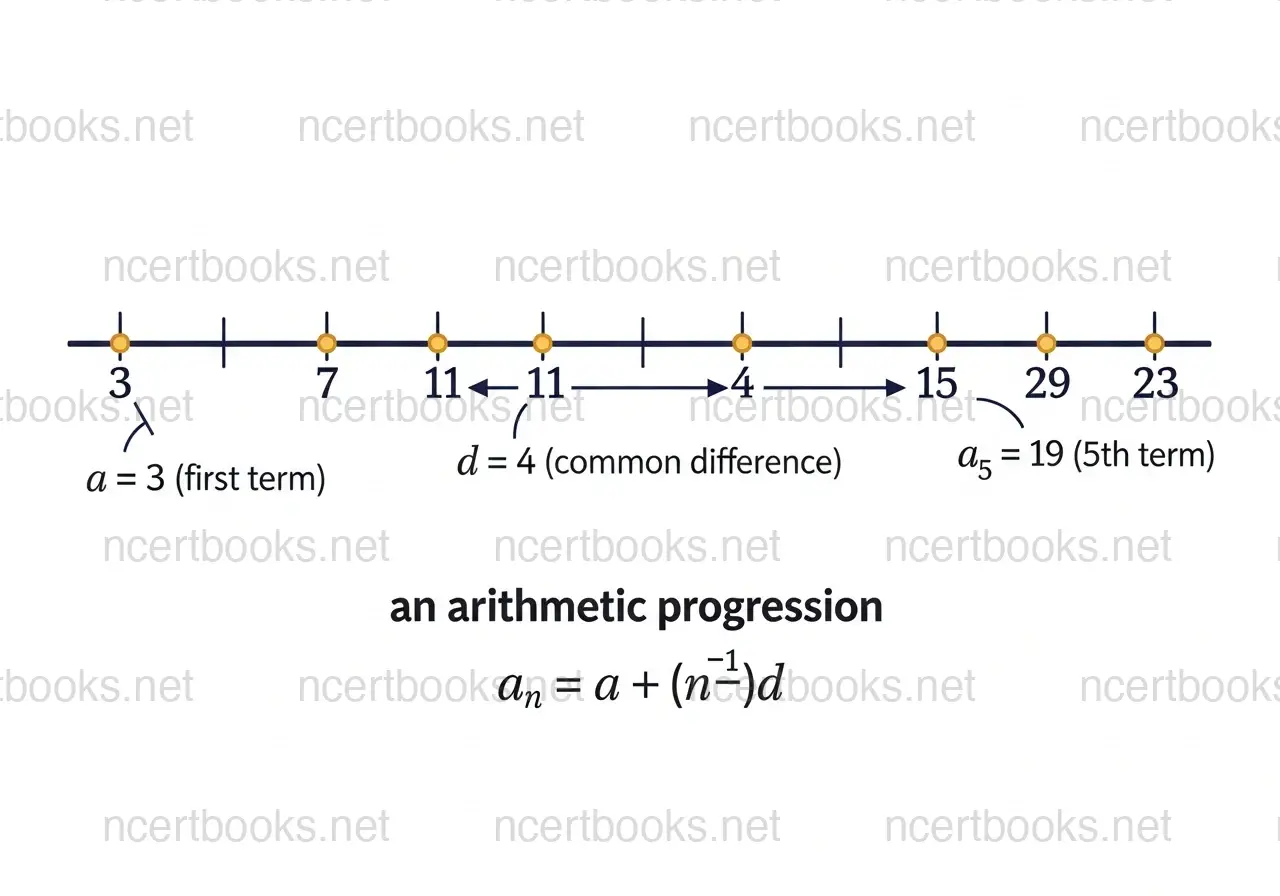
Chapter Overview — NCERT Solutions for Class 10 Maths Chapter 5 Ex 5.4
Chapter 5 of the NCERT Class 10 Maths textbook is Arithmetic Progressions (AP). It is one of the most important chapters for CBSE board exams, carrying approximately 5–6 marks in the standard paper. Exercise 5.4 is the final and most application-heavy exercise in this chapter — every question here is a word problem that connects AP to real life.
Before attempting Exercise 5.4, you should be comfortable with the nth term formula \( a_n = a + (n-1)d \) and the sum formula \( S_n = \frac{n}{2}[2a + (n-1)d] \) from Exercises 5.2 and 5.3. This exercise builds on those foundations and adds an extra layer of problem-solving. Questions from this exercise have appeared in CBSE board papers as 3-mark and 5-mark questions.
| Detail | Information |
|---|---|
| Chapter | 5 — Arithmetic Progressions |
| Exercise | 5.4 |
| Textbook | NCERT Mathematics — Class 10 |
| Number of Questions | 5 |
| Difficulty Level | High (all word problems) |
| Marks Weightage | 5–6 marks in CBSE board (Chapter 5 overall) |
| Academic Year | 2026-27 |
| Syllabus Status | Active — included in CBSE 2026-27 syllabus |
Key Concepts and Formulas for Exercise 5.4
What is an Arithmetic Progression?
An Arithmetic Progression (AP) is a sequence of numbers where the difference between any two consecutive terms is constant. This constant difference is called the common difference (d). For example, 121, 117, 113, … is an AP with \( a = 121 \) and \( d = -4 \).
Finding the nth Term — First Negative Term Problems
To find the first negative term of an AP, set \( a_n < 0 \) and solve for n. Since n must be a positive integer, round up to the next whole number. This technique is tested directly in Question 1 of Exercise 5.4.
Sum of First n Terms — Application Problems
The sum formula \( S_n = \frac{n}{2}[2a + (n-1)d] \) is the backbone of Questions 2, 3, 4, and 5 in this exercise. For Questions 3 and 5, you identify the AP from the physical setup, then apply the sum formula to get a real-world answer (length of wood, volume of concrete).
Middle-Term Substitution Trick
In Question 2, the 3rd and 7th terms are given. Instead of writing \( a_3 = a + 2d \) and \( a_7 = a + 6d \), substitute \( b = a + 4d \) (the middle term). Then \( a_3 = b – 2d \) and \( a_7 = b + 2d \). Their sum \( = 2b \), making the algebra much cleaner. This trick saves time in board exams.
Formula Reference Table — Arithmetic Progressions
| Formula Name | Formula | Variables |
|---|---|---|
| nth term of AP | \( a_n = a + (n-1)d \) | a = first term, d = common difference, n = term number |
| Sum of first n terms (form 1) | \( S_n = \frac{n}{2}[2a + (n-1)d] \) | a = first term, d = common difference |
| Sum of first n terms (form 2) | \( S_n = \frac{n}{2}(a + l) \) | a = first term, l = last term |
| Common difference | \( d = a_2 – a_1 = a_3 – a_2 \) | Any two consecutive terms |
| Sum of first n natural numbers | \( S = \frac{n(n+1)}{2} \) | Special case of AP with a=1, d=1 |
NCERT Solutions for Class 10 Maths Chapter 5 Ex 5.4 — All 5 Questions Solved
Below are complete, step-by-step solutions for all 5 questions in Exercise 5.4. These solutions match the official NCERT answer key and are written to help you score full marks in your CBSE 2026-27 board exam. Each solution shows all working steps — never skip steps in your board answer sheet.
Question 1
Medium
Which term of the AP: 121, 117, 113, ….., is its first negative term?
Key Concept: To find the first negative term, set \( a_n < 0 \) and find the smallest integer n satisfying this inequality.
Step 1: Identify the first term and common difference.
\[ a = 121, \quad d = 117 – 121 = -4 \]
Step 2: Write the general term formula.
\[ a_n = a + (n-1)d = 121 + (n-1)(-4) \]
\[ a_n = 121 – 4n + 4 = 125 – 4n \]
Step 3: For the first negative term, set \( a_n < 0 \).
\[ 125 – 4n < 0 \]
\[ 4n > 125 \]
\[ n > 31.25 \]
Step 4: Since n must be a positive integer, the smallest value of n satisfying \( n > 31.25 \) is \( n = 32 \).
Verification: \( a_{32} = 125 – 4(32) = 125 – 128 = -3 \) (negative ✓) and \( a_{31} = 125 – 4(31) = 125 – 124 = 1 \) (positive ✓).
\( \therefore \) The 32nd term is the first negative term of the AP.
Question 2
Hard
The sum of the third term and the seventh term of an AP is 6 and their product is 8. Find the sum of first sixteen terms of the AP.
Key Concept: Use the middle-term substitution. Let the AP have first term \( a \) and common difference \( d \). The 3rd term is \( a + 2d \) and the 7th term is \( a + 6d \). Notice that the average of these two terms is \( a + 4d \), the 5th term.
Step 1: Write expressions for the 3rd and 7th terms.
\[ a_3 = a + 2d, \quad a_7 = a + 6d \]
Step 2: Use the given sum condition.
\[ a_3 + a_7 = 6 \]
\[ (a + 2d) + (a + 6d) = 6 \]
\[ 2a + 8d = 6 \]
\[ a + 4d = 3 \quad \text{…(i)} \]
Step 3: Use the given product condition.
\[ a_3 \times a_7 = 8 \]
\[ (a + 2d)(a + 6d) = 8 \quad \text{…(ii)} \]
Step 4: From (i), \( a = 3 – 4d \). Substitute into (ii).
\[ (3 – 4d + 2d)(3 – 4d + 6d) = 8 \]
\[ (3 – 2d)(3 + 2d) = 8 \]
\[ 9 – 4d^2 = 8 \]
\[ 4d^2 = 1 \]
\[ d^2 = \frac{1}{4} \]
\[ d = \frac{1}{2} \text{ or } d = -\frac{1}{2} \]
Step 5: Find corresponding values of \( a \).
When \( d = \frac{1}{2} \): \( a = 3 – 4 \times \frac{1}{2} = 3 – 2 = 1 \)
When \( d = -\frac{1}{2} \): \( a = 3 – 4 \times (-\frac{1}{2}) = 3 + 2 = 5 \)
Step 6: Calculate the sum of the first 16 terms using \( S_{16} = \frac{16}{2}[2a + 15d] = 8[2a + 15d] \).
Case 1: \( a = 1, d = \frac{1}{2} \)
\[ S_{16} = 8\left[2(1) + 15 \times \frac{1}{2}\right] = 8\left[2 + \frac{15}{2}\right] = 8 \times \frac{19}{2} = 76 \]
Case 2: \( a = 5, d = -\frac{1}{2} \)
\[ S_{16} = 8\left[2(5) + 15 \times \left(-\frac{1}{2}\right)\right] = 8\left[10 – \frac{15}{2}\right] = 8 \times \frac{5}{2} = 20 \]
\( \therefore \) The sum of the first 16 terms of the AP is either 76 or 20.
Question 3
Medium
A ladder has rungs 25 cm apart. The rungs decrease uniformly in length from 45 cm at the bottom to 25 cm at the top. If the top and the bottom rungs are \( 2\frac{1}{2} \) m apart, what is the length of the wood required for the rungs?
Key Concept: The rungs decrease uniformly in length, so they form an AP. The total distance between top and bottom rungs is \( 2\frac{1}{2} \text{ m} = 250 \text{ cm} \). The rungs are 25 cm apart.
Step 1: Find the number of rungs.
\[ \text{Number of rungs} = \frac{250}{25} + 1 = 10 + 1 = 11 \]
Why +1? If the distance between top and bottom rungs is 250 cm and rungs are 25 cm apart, there are 10 gaps, giving 11 rungs (including both the top and bottom rungs).
Step 2: Identify the AP for rung lengths.
Bottom rung (1st rung): \( a = 45 \) cm
Top rung (11th rung): \( l = 25 \) cm
Number of terms: \( n = 11 \)
Step 3: Calculate total length of wood using the sum formula \( S_n = \frac{n}{2}(a + l) \).
\[ S_{11} = \frac{11}{2}(45 + 25) = \frac{11}{2} \times 70 = 11 \times 35 = 385 \text{ cm} \]
Verification: Common difference \( d = \frac{l – a}{n – 1} = \frac{25 – 45}{10} = -2 \) cm. So rungs are 45, 43, 41, … 25 cm — a valid AP ✓.
\( \therefore \) The total length of wood required for the rungs is 385 cm.
Question 4
Hard
The houses of a row are numbered consecutively from 1 to 49. Show that there is a value of x such that the sum of the numbers of the houses preceding the house numbered x is equal to the sum of the numbers of the houses following it. Find this value of x.
Key Concept: The house numbers 1, 2, 3, …, 49 form an AP with \( a = 1 \), \( d = 1 \). The sum of the first \( n \) natural numbers is \( S_n = \frac{n(n+1)}{2} \).
Step 1: Write the condition mathematically.
Sum of houses preceding house x = sum of houses 1 to \( (x-1) \)
\[ S_{x-1} = \frac{(x-1)x}{2} \]
Sum of houses following house x = sum of houses \( (x+1) \) to 49
\[ = S_{49} – S_x = \frac{49 \times 50}{2} – \frac{x(x+1)}{2} \]
Step 2: Set the two sums equal.
\[ \frac{(x-1)x}{2} = \frac{49 \times 50}{2} – \frac{x(x+1)}{2} \]
Step 3: Multiply throughout by 2 to clear fractions.
\[ x(x-1) = 49 \times 50 – x(x+1) \]
\[ x^2 – x = 2450 – x^2 – x \]
\[ x^2 – x + x^2 + x = 2450 \]
\[ 2x^2 = 2450 \]
\[ x^2 = 1225 \]
\[ x = 35 \quad (\text{since } x > 0) \]
Step 4: Verify that \( x = 35 \) lies between 1 and 49, i.e., \( 1 < 35 < 49 \). ✓
Verification:
Sum of houses 1 to 34: \( \frac{34 \times 35}{2} = 595 \)
Sum of houses 36 to 49: \( S_{49} – S_{35} = \frac{49 \times 50}{2} – \frac{35 \times 36}{2} = 1225 – 630 = 595 \) ✓
Why does this work? Since \( x^2 = 1225 \) has a perfect integer solution \( x = 35 \) that lies strictly between 1 and 49, the required value of x exists.
\( \therefore \) The value of x is 35. The sum of house numbers preceding house 35 equals the sum of house numbers following it (both equal 595).
Question 5
Hard
A small terrace at a football ground comprises of 15 steps each of which is 50 m long and built of solid concrete. Each step has a rise of \( \frac{1}{2} \) m and a tread of \( \frac{1}{2} \) m. Calculate the total volume of concrete required to build the terrace.
Key Concept: Each step is a rectangular block (cuboid). The volume of each step = length × width × height. As you go higher, each successive step is taller because it sits on all the steps below it. The heights of the steps form an AP.
Step 1: Understand the structure. Each step has a tread (horizontal depth) of \( \frac{1}{2} \) m and a rise of \( \frac{1}{2} \) m. The 1st step (bottom) has height \( \frac{1}{2} \) m. The 2nd step has height \( 2 \times \frac{1}{2} = 1 \) m (it includes the height of step 1 plus its own rise). The kth step has height \( k \times \frac{1}{2} \) m.
Step 2: Write the volume of the kth step.
\[ V_k = \text{length} \times \text{tread} \times \text{height of step k} \]
\[ V_k = 50 \times \frac{1}{2} \times \frac{k}{2} = \frac{50k}{4} = \frac{25k}{2} \text{ m}^3 \]
Step 3: List the volumes of the 15 steps to confirm they form an AP.
\[ V_1 = \frac{25}{2} = 12.5 \text{ m}^3, \quad V_2 = 25 \text{ m}^3, \quad V_3 = 37.5 \text{ m}^3, \quad \ldots \]
This is an AP with \( a = 12.5 \), \( d = 12.5 \), \( n = 15 \).
Step 4: Find the last term (volume of 15th step).
\[ V_{15} = \frac{25 \times 15}{2} = \frac{375}{2} = 187.5 \text{ m}^3 \]
Step 5: Calculate the total volume using \( S_n = \frac{n}{2}(a + l) \).
\[ S_{15} = \frac{15}{2}(12.5 + 187.5) = \frac{15}{2} \times 200 = 15 \times 100 = 1500 \text{ m}^3 \]
Verification using the other sum formula:
\[ S_{15} = \frac{15}{2}[2(12.5) + (15-1)(12.5)] = \frac{15}{2}[25 + 175] = \frac{15}{2} \times 200 = 1500 \text{ m}^3 \checkmark \]
\( \therefore \) The total volume of concrete required to build the terrace is 1500 m³.
Solved Examples Beyond NCERT — Extra Practice for CBSE Class 10 Maths
These extra examples go slightly beyond the NCERT textbook and are useful for students preparing for the CBSE 2026-27 board exam or competitive exams. They use the same AP concepts from Exercise 5.4.
Extra Example 1
Medium
The sum of the first n terms of an AP is \( 4n – n^2 \). Find the AP and the 10th term.
Step 1: Find \( S_1 \) and \( S_2 \).
\[ S_1 = 4(1) – 1^2 = 3 = a_1 \]
\[ S_2 = 4(2) – 4 = 4, \text{ so } a_2 = S_2 – S_1 = 4 – 3 = 1 \]
Step 2: Common difference \( d = a_2 – a_1 = 1 – 3 = -2 \).
Step 3: AP is 3, 1, −1, −3, …
Step 4: \( a_{10} = 3 + 9(-2) = 3 – 18 = -15 \).
\( \therefore \) The AP is 3, 1, −1, −3, … and the 10th term is −15.
Extra Example 2
Hard
Find the sum of all three-digit numbers which are divisible by 7.
Step 1: The smallest 3-digit number divisible by 7 is 105. The largest is 994.
Step 2: AP: 105, 112, 119, …, 994. Here \( a = 105 \), \( d = 7 \), \( l = 994 \).
Step 3: Find number of terms: \( 994 = 105 + (n-1) \times 7 \Rightarrow n = 128 \).
Step 4: \( S_{128} = \frac{128}{2}(105 + 994) = 64 \times 1099 = 70336 \).
\( \therefore \) Sum of all 3-digit numbers divisible by 7 is 70,336.
Important Questions for CBSE Board Exam 2026-27 — Arithmetic Progressions
1-Mark Questions
- Write the formula for the sum of first n terms of an AP. Answer: \( S_n = \frac{n}{2}[2a + (n-1)d] \)
- What is the common difference of the AP: 3, 1, −1, −3, …? Answer: \( d = -2 \)
- If \( S_n = 3n^2 + 5n \), what is the first term? Answer: \( a_1 = S_1 = 8 \)
3-Mark Questions
- The 7th term of an AP is 32 and its 13th term is 62. Find the AP. Answer: \( a_7 = a + 6d = 32 \), \( a_{13} = a + 12d = 62 \). Subtracting: \( 6d = 30 \Rightarrow d = 5 \), \( a = 2 \). AP: 2, 7, 12, 17, …
- Find the sum of all two-digit odd numbers. Answer: AP: 11, 13, …, 99. \( n = 45 \), \( S_{45} = \frac{45}{2}(11 + 99) = 2475 \).
5-Mark Questions
- A manufacturer of TV sets produced 600 sets in the third year and 700 sets in the seventh year. Assuming that the production increases uniformly by a fixed number every year, find the production in the 1st year, the 10th year, and the total production in 7 years. Answer: \( a + 2d = 600 \), \( a + 6d = 700 \). So \( d = 25 \), \( a = 550 \). Year 10: \( a_{10} = 550 + 9 \times 25 = 775 \). Total in 7 years: \( S_7 = \frac{7}{2}(550 + 700) = 4375 \).
Common Mistakes Students Make in Exercise 5.4
Mistake 1: In the ladder rungs problem (Q3), students write the number of rungs as 10 (dividing 250 by 25) instead of 11.
Why it’s wrong: When you have 10 gaps of 25 cm each, you need 11 rungs (one at each end of each gap).
Correct approach: Number of rungs = (total distance ÷ gap) + 1 = 10 + 1 = 11.
Mistake 2: In Q2, students find only one value of d (say \( d = +\frac{1}{2} \)) and miss the second case \( d = -\frac{1}{2} \).
Why it’s wrong: \( d^2 = \frac{1}{4} \) gives two solutions. Missing one case means losing marks.
Correct approach: Always solve quadratic equations completely and present both cases.
Mistake 3: In Q5 (terrace problem), students compute the volume of each step as just \( 50 \times \frac{1}{2} \times \frac{1}{2} \) for every step.
Why it’s wrong: Each step’s height is cumulative — the kth step from the bottom has height \( k \times \frac{1}{2} \) m, not just \( \frac{1}{2} \) m.
Correct approach: Volume of kth step = \( 50 \times \frac{1}{2} \times \frac{k}{2} \). These volumes form an AP.
Mistake 4: In Q4, students forget to verify that \( x = 35 \) lies between 1 and 49.
Why it’s wrong: The problem asks you to “show” — a complete proof needs verification that x is valid.
Correct approach: After finding \( x = 35 \), explicitly state \( 1 < 35 < 49 \) and verify the sums.
Mistake 5: In Q1, students write \( a_n = 0 \) instead of \( a_n < 0 \) to find the first negative term.
Why it’s wrong: \( a_n = 0 \) gives the zero term (if it exists), not the first negative term.
Correct approach: Set \( a_n < 0 \), solve for n, and round up to the nearest integer.
Exam Tips for CBSE 2026-27 — Arithmetic Progressions Chapter 5
- Show all steps: In CBSE board papers, partial marks are awarded for correct steps even if the final answer is wrong. Never skip steps in Q2, Q4, and Q5.
- Use both sum formulas: Know when to use \( S_n = \frac{n}{2}[2a + (n-1)d] \) (when last term is unknown) vs. \( S_n = \frac{n}{2}(a + l) \) (when last term is known). Q3 and Q5 are faster with the second formula.
- Draw diagrams for word problems: For Q3 (ladder) and Q5 (terrace), a quick sketch helps you understand the AP setup and avoids off-by-one errors.
- Verify your answer: For Q1, always check both \( a_{n-1} \) and \( a_n \). For Q4, verify the two sums are equal. Verification earns marks and prevents silly errors.
- Chapter 5 weightage in 2026-27: Arithmetic Progressions is part of the Algebra unit, which carries approximately 20 marks in the CBSE Class 10 board paper. Exercise 5.4 type questions typically appear as 3-mark or 5-mark questions.
- Last-minute revision checklist: (1) nth term formula, (2) sum formula (both forms), (3) rung-counting rule, (4) cumulative height in staircase problems, (5) setting \( a_n < 0 \) for first negative term.
Key Points to Remember — NCERT Class 10 Maths Chapter 5
- An AP is a sequence where the difference between consecutive terms is constant (the common difference d).
- The nth term: \( a_n = a + (n-1)d \). When \( d < 0 \), terms decrease and eventually become negative.
- For sum problems, choose the formula that uses the information given — use the last term (l) formula when l is known or easy to find.
- In real-world AP problems, always identify: what is a? what is d? what is n? before applying any formula.
- The sum of the first and last terms of an AP equals the sum of the second and second-last terms, and so on. This symmetry is used in Q3.
- For the CBSE 2026-27 board exam, Chapter 5 problems often appear in the 3-mark section. Practice all 5 questions of Exercise 5.4 until you can solve them independently.
- You can also explore NCERT Solutions for Class 10 Maths for other chapters to strengthen your board exam preparation.
Frequently Asked Questions — Exercise 5.4 Arithmetic Progressions Class 10
Which term of the AP 121, 117, 113 is its first negative term?
The AP has first term \( a = 121 \) and common difference \( d = -4 \). The nth term is \( a_n = 125 – 4n \). Setting \( a_n < 0 \) gives \( n > 31.25 \). Since n must be a whole number, the first negative term is the 32nd term, which equals \( 125 – 128 = -3 \). You can verify: the 31st term is \( +1 \) (positive) and the 32nd term is \( -3 \) (negative).
How do you find the sum of first 16 terms when the sum of the 3rd and 7th terms of an AP is 6 and their product is 8?
From the sum condition: \( a_3 + a_7 = 6 \Rightarrow 2a + 8d = 6 \Rightarrow a + 4d = 3 \). From the product condition: \( (a+2d)(a+6d) = 8 \). Substituting \( a = 3 – 4d \) gives \( d = \pm\frac{1}{2} \). This yields two APs: one with \( a=1, d=\frac{1}{2} \) and one with \( a=5, d=-\frac{1}{2} \). The sum of 16 terms is 76 or 20 respectively.
How many rungs does the ladder have in the AP ladder problem of Exercise 5.4?
The top and bottom rungs are \( 2\frac{1}{2} \) m = 250 cm apart. Since rungs are 25 cm apart, there are \( 250 \div 25 = 10 \) gaps between rungs. The number of rungs = 10 + 1 = 11 rungs. The rung lengths form an AP from 45 cm (bottom) to 25 cm (top), and the total wood required = \( \frac{11}{2}(45 + 25) = 385 \) cm.
What is the value of x in the house numbering problem where sum of houses before x equals sum after x?
Setting \( S_{x-1} = S_{49} – S_x \) and simplifying gives \( 2x^2 = 2450 \), so \( x^2 = 1225 \) and \( x = 35 \). You can verify: sum of houses 1 to 34 = 595, and sum of houses 36 to 49 = 1225 − 630 = 595. Both sums are equal, confirming x = 35. This is a classic CBSE board exam question from Chapter 5.
How do you calculate the total volume of concrete for the football terrace in Exercise 5.4?
Each of the 15 steps has length 50 m and tread \( \frac{1}{2} \) m. The kth step has a cumulative height of \( k \times \frac{1}{2} \) m. So the volume of the kth step = \( 50 \times \frac{1}{2} \times \frac{k}{2} = \frac{25k}{2} \) m³. The 15 volumes form an AP: 12.5, 25, …, 187.5. Total volume = \( \frac{15}{2}(12.5 + 187.5) = \frac{15}{2} \times 200 = \) 1500 m³.