- Sum Formula 1: \( S_n = \frac{n}{2}[2a + (n-1)d] \) — use when a, d, n are known
- Sum Formula 2: \( S_n = \frac{n}{2}(a + l) \) — use when first term (a) and last term (l) are known
- nth Term: \( a_n = a + (n-1)d \) — always derive this before finding sum
- Finding nth term from Sn: \( a_n = S_n – S_{n-1} \) for \( n \geq 2 \); \( a_1 = S_1 \)
- Common Difference: \( d = a_2 – a_1 \) — constant for all consecutive pairs
- Total questions in Ex 5.3: 20 (including 10 sub-parts in Q3)
- Board exam weightage: Arithmetic Progressions carries 6–8 marks in CBSE Class 10 Maths paper
- Key trick: If \( S_n \) is given as a quadratic in n, the AP has constant common difference equal to twice the coefficient of \( n^2 \)
NCERT Solutions for Class 10 Maths Chapter 5 Ex 5.3 — Chapter Overview
The NCERT Solutions for Class 10 Maths Chapter 5 Ex 5.3 cover one of the most scoring topics in the 2026-27 CBSE board exam — the Sum of First N Terms of an Arithmetic Progression. You can find all NCERT Solutions for Class 10 on our hub page. This exercise has 20 questions ranging from direct formula application to real-life word problems.
Chapter 5 of the NCERT Class 10 Maths textbook (published on the NCERT official website) deals with Arithmetic Progressions. Exercise 5.3 specifically tests your ability to apply the sum formulas. You can explore all NCERT Solutions across classes on our main hub.
This chapter typically carries 6–8 marks in the CBSE Class 10 Maths board paper. Questions from Ex 5.3 appear in the 2-mark, 3-mark, and sometimes 5-mark sections. Word problems like the construction penalty problem (Q15) and the potato race problem (Q20) are CBSE board exam favourites.
| Detail | Information |
|---|---|
| Chapter | Chapter 5 — Arithmetic Progressions |
| Exercise | Exercise 5.3 |
| Textbook | NCERT Mathematics — Class 10 |
| Subject | Mathematics |
| Total Questions | 20 |
| Marks Weightage | 6–8 marks (Algebra unit) |
| Difficulty Level | Medium to High |
| Academic Year | 2026-27 |
Key Concepts — Sum of First N Terms of an AP
Sum Formula Derivation
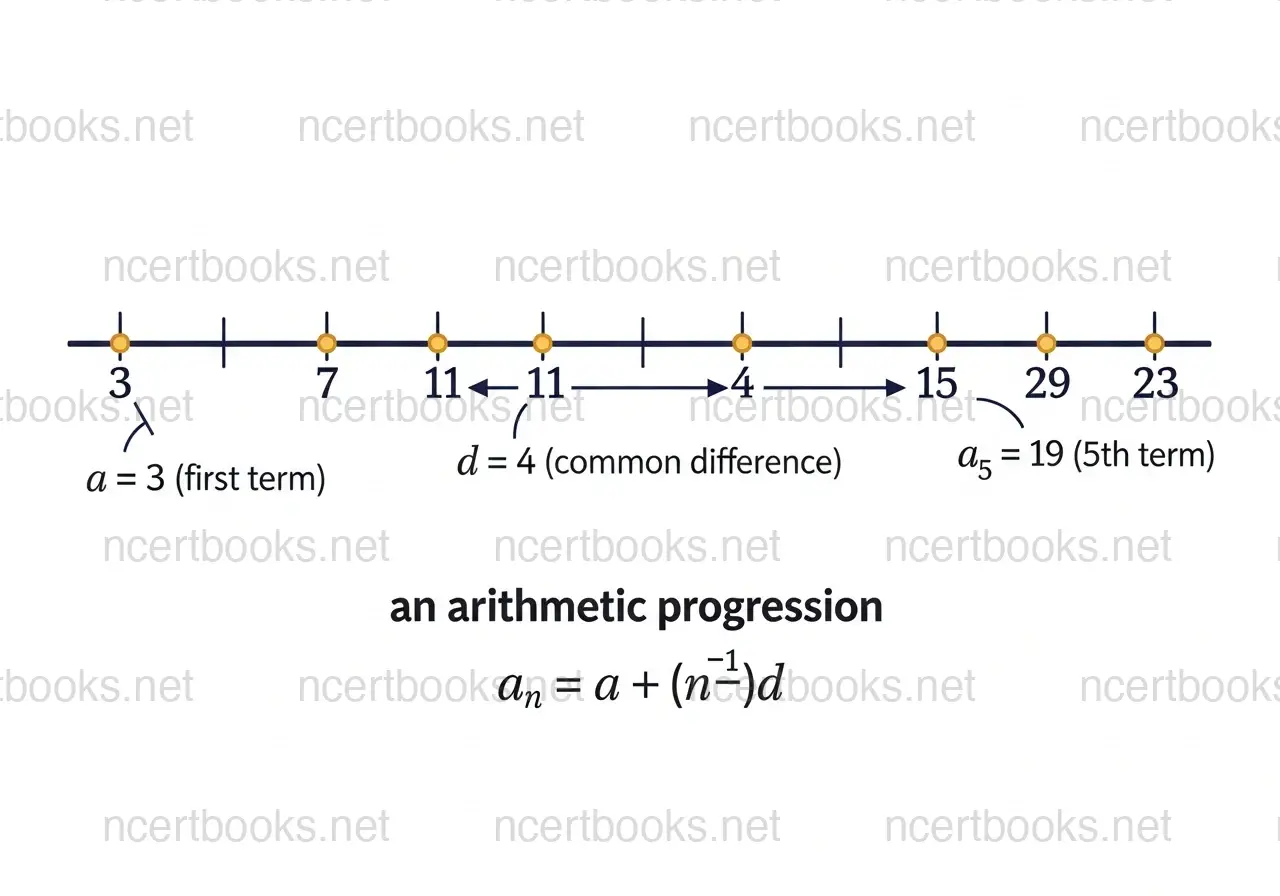
An AP with first term a, common difference d, and n terms can be written as: \( a, a+d, a+2d, \ldots, a+(n-1)d \). Adding the series forward and backward gives:
\[ S_n = \frac{n}{2}[2a + (n-1)d] \]
If the last term \( l = a + (n-1)d \) is known, the formula simplifies to:
\[ S_n = \frac{n}{2}(a + l) \]
Finding the nth Term from Sn
If the sum of first n terms \( S_n \) is given, you can find any term using:
\[ a_n = S_n – S_{n-1} \quad \text{for } n \geq 2 \]
\[ a_1 = S_1 \]
This is a very important concept tested in CBSE board exams — especially when \( S_n \) is given as a polynomial expression in n.
Real-World Meaning of AP Sum
The sum of an AP models many real-life situations: total salary over years, total distance in a race, stacking objects in rows, and penalty calculations. Recognising the AP structure in a word problem is the key skill tested in Ex 5.3.
Formula Reference Table — Arithmetic Progressions
| Formula Name | Formula | Variables Defined |
|---|---|---|
| nth Term of AP | \( a_n = a + (n-1)d \) | a = first term, d = common difference, n = term number |
| Sum of n terms (standard) | \( S_n = \frac{n}{2}[2a + (n-1)d] \) | a = first term, d = common difference, n = number of terms |
| Sum of n terms (with last term) | \( S_n = \frac{n}{2}(a + l) \) | a = first term, l = last term, n = number of terms |
| nth term from Sn | \( a_n = S_n – S_{n-1} \) | Valid for \( n \geq 2 \) |
| Common Difference | \( d = a_2 – a_1 \) | Constant difference between consecutive terms |
| Sum of first n natural numbers | \( S = \frac{n(n+1)}{2} \) | Special case of AP with a=1, d=1 |
Exercise 5.3 — Step-by-Step NCERT Solutions (All 20 Questions)
Below are complete, original solutions for all 20 questions from NCERT Class 10 Maths Chapter 5 Exercise 5.3. Every solution includes full working with the 2026-27 CBSE marking scheme in mind.
Question 1
Easy
Find the sum of the following APs: (i) 2, 7, 12,… to 10 terms. (ii) −37, −33, −29,… to 12 terms. (iii) 0.6, 1.7, 2.8,… to 100 terms. (iv) 1/15, 1/12, 1/10,… to 11 terms.
Step 1: Identify values. \( a = 2,\ d = 7 – 2 = 5,\ n = 10 \)
Step 2: Apply the sum formula:
\[ S_n = \frac{n}{2}[2a + (n-1)d] \]
\[ S_{10} = \frac{10}{2}[2(2) + (10-1)(5)] = 5[4 + 45] = 5 \times 49 = 245 \]
\( \therefore \) S₁₀ = 245
Step 1: \( a = -37,\ d = -33 – (-37) = 4,\ n = 12 \)
Step 2: Apply the formula:
\[ S_{12} = \frac{12}{2}[2(-37) + (12-1)(4)] = 6[-74 + 44] = 6 \times (-30) = -180 \]
\( \therefore \) S₁₂ = −180
Step 1: \( a = 0.6,\ d = 1.7 – 0.6 = 1.1,\ n = 100 \)
Step 2: Apply the formula:
\[ S_{100} = \frac{100}{2}[2(0.6) + (100-1)(1.1)] = 50[1.2 + 108.9] = 50 \times 110.1 = 5505 \]
\( \therefore \) S₁₀₀ = 5505
Step 1: \( a = \frac{1}{15},\ d = \frac{1}{12} – \frac{1}{15} = \frac{5-4}{60} = \frac{1}{60},\ n = 11 \)
Step 2: Apply the formula:
\[ S_{11} = \frac{11}{2}\left[2 \times \frac{1}{15} + (11-1) \times \frac{1}{60}\right] = \frac{11}{2}\left[\frac{2}{15} + \frac{10}{60}\right] \]
\[ = \frac{11}{2}\left[\frac{8}{60} + \frac{10}{60}\right] = \frac{11}{2} \times \frac{18}{60} = \frac{11}{2} \times \frac{3}{10} = \frac{33}{20} \]
\( \therefore \) S₁₁ = 33/20
Question 2
Medium
Find the sums given below: (i) 7 + 10½ + 14 + … + 84 (ii) 34 + 32 + 30 + … + 10 (iii) −5 + (−8) + (−11) + … + (−230)
Step 1: \( a = 7,\ d = 10.5 – 7 = 3.5,\ l = 84 \)
Step 2: Find n using \( a_n = a + (n-1)d \):
\[ 84 = 7 + (n-1)(3.5) \Rightarrow 77 = (n-1)(3.5) \Rightarrow n-1 = 22 \Rightarrow n = 23 \]
Step 3: Apply sum formula:
\[ S_{23} = \frac{23}{2}(7 + 84) = \frac{23}{2} \times 91 = \frac{2093}{2} = 1046.5 \]
\( \therefore \) Sum = 1046.5
Step 1: \( a = 34,\ d = 32 – 34 = -2,\ l = 10 \)
Step 2: Find n:
\[ 10 = 34 + (n-1)(-2) \Rightarrow -24 = -2(n-1) \Rightarrow n-1 = 12 \Rightarrow n = 13 \]
Step 3: Sum:
\[ S_{13} = \frac{13}{2}(34 + 10) = \frac{13}{2} \times 44 = 13 \times 22 = 286 \]
\( \therefore \) Sum = 286
Step 1: \( a = -5,\ d = -8 – (-5) = -3,\ l = -230 \)
Step 2: Find n:
\[ -230 = -5 + (n-1)(-3) \Rightarrow -225 = -3(n-1) \Rightarrow n-1 = 75 \Rightarrow n = 76 \]
Step 3: Sum:
\[ S_{76} = \frac{76}{2}(-5 + (-230)) = 38 \times (-235) = -8930 \]
\( \therefore \) Sum = −8930
Question 3
Medium
In an AP, find the required unknowns for each sub-part.
Step 1: Use \( a_n = a + (n-1)d \):
\[ 50 = 5 + (n-1)(3) \Rightarrow 45 = 3(n-1) \Rightarrow n = 16 \]
Step 2: \( S_{16} = \frac{16}{2}(5 + 50) = 8 \times 55 = 440 \)
\( \therefore \) n = 16, S₁₆ = 440
Step 1: \( a_{13} = a + 12d \Rightarrow 35 = 7 + 12d \Rightarrow d = \frac{28}{12} = \frac{7}{3} \)
Step 2: \( S_{13} = \frac{13}{2}(7 + 35) = \frac{13}{2} \times 42 = 13 \times 21 = 273 \)
\( \therefore \) d = 7/3, S₁₃ = 273
Step 1: \( a_{12} = a + 11d \Rightarrow 37 = a + 11(3) \Rightarrow a = 37 – 33 = 4 \)
Step 2: \( S_{12} = \frac{12}{2}(4 + 37) = 6 \times 41 = 246 \)
\( \therefore \) a = 4, S₁₂ = 246
Step 1: \( a_3 = a + 2d = -15 \) → equation (1)
Step 2: \( S_{10} = \frac{10}{2}[2a + 9d] = 125 \Rightarrow 2a + 9d = 25 \) → equation (2)
Step 3: From (1): \( a = -15 – 2d \). Substitute in (2): \( 2(-15 – 2d) + 9d = 25 \Rightarrow -30 + 5d = 25 \Rightarrow d = 11 \)
Step 4: \( a = -15 – 2(11) = -37 \). Then \( a_{10} = -37 + 9(11) = -37 + 99 = 62 \)
\( \therefore \) d = 11, a₁₀ = 62
Step 1: \( S_9 = \frac{9}{2}[2a + 8(5)] = 75 \Rightarrow \frac{9}{2}[2a + 40] = 75 \Rightarrow 2a + 40 = \frac{150}{9} = \frac{50}{3} \)
Why does this work? We isolate a by simplifying the bracket first.
\[ 2a = \frac{50}{3} – 40 = \frac{50 – 120}{3} = \frac{-70}{3} \Rightarrow a = \frac{-35}{3} \]
Step 2: \( a_9 = a + 8d = \frac{-35}{3} + 40 = \frac{-35 + 120}{3} = \frac{85}{3} \)
\( \therefore \) a = −35/3, a₉ = 85/3
Step 1: \( S_n = \frac{n}{2}[2(2) + (n-1)(8)] = 90 \Rightarrow \frac{n}{2}[4 + 8n – 8] = 90 \Rightarrow \frac{n}{2}[8n – 4] = 90 \)
\[ n(8n – 4) = 180 \Rightarrow 8n^2 – 4n – 180 = 0 \Rightarrow 2n^2 – n – 45 = 0 \]
Step 2: Factorise: \( (2n + 9)(n – 5) = 0 \Rightarrow n = 5 \) (taking positive value)
Step 3: \( a_5 = 2 + 4(8) = 2 + 32 = 34 \)
\( \therefore \) n = 5, a₅ = 34
Step 1: \( S_n = \frac{n}{2}(a + a_n) \Rightarrow 210 = \frac{n}{2}(8 + 62) = \frac{n}{2} \times 70 = 35n \Rightarrow n = 6 \)
Step 2: \( a_6 = a + 5d \Rightarrow 62 = 8 + 5d \Rightarrow d = \frac{54}{5} \)
\( \therefore \) n = 6, d = 54/5
Step 1: \( S_n = \frac{n}{2}(a + a_n) \Rightarrow -14 = \frac{n}{2}(a + 4) \) → equation (1)
Step 2: \( a_n = a + (n-1)d \Rightarrow 4 = a + (n-1)(2) \Rightarrow a = 4 – 2(n-1) = 6 – 2n \) → equation (2)
Step 3: Substitute (2) in (1): \( -14 = \frac{n}{2}(6 – 2n + 4) = \frac{n}{2}(10 – 2n) = n(5 – n) \)
\[ -14 = 5n – n^2 \Rightarrow n^2 – 5n – 14 = 0 \Rightarrow (n-7)(n+2) = 0 \Rightarrow n = 7 \]
Step 4: \( a = 6 – 2(7) = 6 – 14 = -8 \)
\( \therefore \) n = 7, a = −8
Step 1: \( S_8 = \frac{8}{2}[2(3) + 7d] = 192 \Rightarrow 4[6 + 7d] = 192 \Rightarrow 6 + 7d = 48 \Rightarrow d = 6 \)
\( \therefore \) d = 6
Step 1: \( S_9 = \frac{9}{2}(a + l) \Rightarrow 144 = \frac{9}{2}(a + 28) \Rightarrow a + 28 = \frac{288}{9} = 32 \Rightarrow a = 4 \)
\( \therefore \) a = 4
Question 4
Medium
How many terms of AP: 9, 17, 25, … must be taken to give a sum of 636?
Step 1: \( a = 9,\ d = 8 \). Set \( S_n = 636 \):
\[ \frac{n}{2}[2(9) + (n-1)(8)] = 636 \Rightarrow \frac{n}{2}[18 + 8n – 8] = 636 \Rightarrow \frac{n}{2}[8n + 10] = 636 \]
\[ n(4n + 5) = 636 \Rightarrow 4n^2 + 5n – 636 = 0 \]
Step 2: Discriminant: \( \Delta = 25 + 4 \times 4 \times 636 = 25 + 10176 = 10201 = 101^2 \)
\[ n = \frac{-5 + 101}{8} = \frac{96}{8} = 12 \]
\( \therefore \) n = 12 terms
Question 5
Medium
The first term of an AP is 5, the last term is 45 and the sum is 400. Find the number of terms and the common difference.
Step 1: \( a = 5,\ l = 45,\ S_n = 400 \). Use \( S_n = \frac{n}{2}(a+l) \):
\[ 400 = \frac{n}{2}(5 + 45) = 25n \Rightarrow n = 16 \]
Step 2: \( l = a + (n-1)d \Rightarrow 45 = 5 + 15d \Rightarrow d = \frac{40}{15} = \frac{8}{3} \)
\( \therefore \) n = 16, d = 8/3
Question 6
Medium
The first and last terms of an AP are 17 and 350 respectively. If the common difference is 9, how many terms are there and what is their sum?
Step 1: \( a = 17,\ l = 350,\ d = 9 \). Find n:
\[ 350 = 17 + (n-1)(9) \Rightarrow 333 = 9(n-1) \Rightarrow n-1 = 37 \Rightarrow n = 38 \]
Step 2: Sum: \( S_{38} = \frac{38}{2}(17 + 350) = 19 \times 367 = 6973 \)
\( \therefore \) n = 38, Sum = 6973
Question 7
Easy
Find the sum of first 22 terms of an AP in which d = 7 and 22nd term is 149.
Step 1: \( d = 7,\ a_{22} = 149,\ n = 22 \). Use \( S_n = \frac{n}{2}(a + a_n) \). Need a first:
\[ a_{22} = a + 21(7) = 149 \Rightarrow a = 149 – 147 = 2 \]
Step 2: \( S_{22} = \frac{22}{2}(2 + 149) = 11 \times 151 = 1661 \)
\( \therefore \) S₂₂ = 1661
Question 8
Medium
Find the sum of first 51 terms of an AP whose second and third terms are 14 and 18 respectively.
Step 1: \( a_2 = 14,\ a_3 = 18 \Rightarrow d = 18 – 14 = 4 \). Then \( a = a_2 – d = 14 – 4 = 10 \).
Step 2: \( S_{51} = \frac{51}{2}[2(10) + 50(4)] = \frac{51}{2}[20 + 200] = \frac{51}{2} \times 220 = 51 \times 110 = 5610 \)
\( \therefore \) S₅₁ = 5610
Question 9
Hard
If the sum of first 7 terms of an AP is 49 and that of 17 terms is 289, find the sum of first n terms.
Step 1: \( S_7 = \frac{7}{2}[2a + 6d] = 49 \Rightarrow 7(a + 3d) = 49 \Rightarrow a + 3d = 7 \) — (1)
Step 2: \( S_{17} = \frac{17}{2}[2a + 16d] = 289 \Rightarrow 17(a + 8d) = 289 \Rightarrow a + 8d = 17 \) — (2)
Step 3: Subtract (1) from (2): \( 5d = 10 \Rightarrow d = 2 \). Then \( a = 7 – 3(2) = 1 \).
Step 4: \( S_n = \frac{n}{2}[2(1) + (n-1)(2)] = \frac{n}{2}[2 + 2n – 2] = \frac{n}{2} \times 2n = n^2 \)
\( \therefore \) Sₙ = n²
Question 10
Medium
Show that a₁, a₂, …, aₙ form an AP where aₙ is defined as: (i) aₙ = 3 + 4n (ii) aₙ = 9 − 5n. Also find the sum of first 15 terms in each case.
Step 1: \( a_1 = 3 + 4(1) = 7,\ a_2 = 3 + 4(2) = 11,\ a_3 = 3 + 4(3) = 15 \)
Step 2: \( a_2 – a_1 = 4,\ a_3 – a_2 = 4 \). Difference is constant, so it is an AP with \( d = 4 \).
Step 3: \( S_{15} = \frac{15}{2}[2(7) + 14(4)] = \frac{15}{2}[14 + 56] = \frac{15}{2} \times 70 = 525 \)
\( \therefore \) It is an AP. S₁₅ = 525
Step 1: \( a_1 = 9 – 5 = 4,\ a_2 = 9 – 10 = -1,\ a_3 = 9 – 15 = -6 \)
Step 2: \( a_2 – a_1 = -5,\ a_3 – a_2 = -5 \). Constant difference \( d = -5 \), so it is an AP.
Step 3: \( S_{15} = \frac{15}{2}[2(4) + 14(-5)] = \frac{15}{2}[8 – 70] = \frac{15}{2} \times (-62) = -465 \)
\( \therefore \) It is an AP. S₁₅ = −465
Question 11
Hard
If the sum of the first n terms of an AP is 4n − n², what is the first term (S₁)? What is the sum of first two terms? What is the second term? Similarly, find the 3rd, the 10th and the nth terms.
Step 1: \( S_1 = 4(1) – 1^2 = 4 – 1 = 3 \). So \( a_1 = 3 \).
Step 2: \( S_2 = 4(2) – 2^2 = 8 – 4 = 4 \). So \( a_2 = S_2 – S_1 = 4 – 3 = 1 \).
Step 3: \( S_3 = 4(3) – 9 = 3 \). So \( a_3 = S_3 – S_2 = 3 – 4 = -1 \).
Step 4: \( a_{10} = S_{10} – S_9 = [4(10) – 100] – [4(9) – 81] = (40 – 100) – (36 – 81) = -60 – (-45) = -15 \)
Step 5 (nth term): For \( n \geq 2 \): \( a_n = S_n – S_{n-1} = (4n – n^2) – [4(n-1) – (n-1)^2] \)
\[ = 4n – n^2 – [4n – 4 – n^2 + 2n – 1] = 4n – n^2 – [3n – 5 – n^2] = 4n – n^2 – 3n + 5 + n^2 = n + 5 \]
Wait — let us re-check: \( a_n = 4n – n^2 – 4(n-1) + (n-1)^2 = 4n – n^2 – 4n + 4 + n^2 – 2n + 1 = 5 – 2n \)
Check: \( a_1 = 5 – 2 = 3 ✓,\ a_2 = 5 – 4 = 1 ✓,\ a_3 = 5 – 6 = -1 ✓,\ a_{10} = 5 – 20 = -15 ✓ \)
\( \therefore \) a₁ = 3, S₂ = 4, a₂ = 1, a₃ = −1, a₁₀ = −15, aₙ = 5 − 2n
Question 12
Easy
Find the sum of the first 40 positive integers divisible by 6.
Step 1: The first 40 positive integers divisible by 6 are: 6, 12, 18, …, 240. This is an AP with \( a = 6,\ d = 6,\ n = 40 \).
Step 2: \( S_{40} = \frac{40}{2}[2(6) + 39(6)] = 20[12 + 234] = 20 \times 246 = 4920 \)
\( \therefore \) Sum = 4920
Question 13
Easy
Find the sum of the first 15 multiples of 8.
Step 1: First 15 multiples of 8: 8, 16, 24, …, 120. AP with \( a = 8,\ d = 8,\ n = 15 \).
Step 2: \( S_{15} = \frac{15}{2}[2(8) + 14(8)] = \frac{15}{2}[16 + 112] = \frac{15}{2} \times 128 = 15 \times 64 = 960 \)
\( \therefore \) Sum = 960
Question 14
Easy
Find the sum of the odd numbers between 0 and 50.
Step 1: Odd numbers between 0 and 50: 1, 3, 5, …, 49. AP with \( a = 1,\ d = 2,\ l = 49 \).
Step 2: Find n: \( 49 = 1 + (n-1)(2) \Rightarrow 48 = 2(n-1) \Rightarrow n = 25 \)
Step 3: \( S_{25} = \frac{25}{2}(1 + 49) = \frac{25}{2} \times 50 = 625 \)
\( \therefore \) Sum = 625
Question 15
Medium
A contract on construction job specifies a penalty: ₹200 for the first day, ₹250 for the second day, ₹300 for the third day, etc., each succeeding day being ₹50 more. How much penalty if the contractor delayed by 30 days?
Step 1: Penalty forms an AP: \( a = 200,\ d = 50,\ n = 30 \)
Step 2: \( S_{30} = \frac{30}{2}[2(200) + 29(50)] = 15[400 + 1450] = 15 \times 1850 = 27750 \)
\( \therefore \) Total penalty = ₹27,750
Question 16
Medium
A sum of ₹700 is to be used to give seven cash prizes. If each prize is ₹20 less than its preceding prize, find the value of each prize.
Step 1: Let the first (highest) prize be ₹a. The prizes form an AP with \( d = -20,\ n = 7,\ S_7 = 700 \).
Step 2: \( S_7 = \frac{7}{2}[2a + 6(-20)] = 700 \Rightarrow \frac{7}{2}[2a – 120] = 700 \Rightarrow 7(a – 60) = 700 \Rightarrow a – 60 = 100 \Rightarrow a = 160 \)
Step 3: Prizes: ₹160, ₹140, ₹120, ₹100, ₹80, ₹60, ₹40
\( \therefore \) Prizes are ₹160, ₹140, ₹120, ₹100, ₹80, ₹60, ₹40
Question 17
Medium
Students plant trees equal to their class number. There are 3 sections per class, from Class I to Class XII. How many trees are planted in total?
Step 1: Each class plants: Class I → 1 tree/section × 3 sections = 3 trees. Class II → 2 × 3 = 6 trees. Class XII → 12 × 3 = 36 trees.
Step 2: Total trees = 3 + 6 + 9 + … + 36. This is an AP with \( a = 3,\ d = 3,\ n = 12 \).
Step 3: \( S_{12} = \frac{12}{2}[2(3) + 11(3)] = 6[6 + 33] = 6 \times 39 = 234 \)
\( \therefore \) Total trees planted = 234
Question 18
Hard
A spiral is made of 13 consecutive semicircles with radii 0.5 cm, 1.0 cm, 1.5 cm, 2.0 cm, … Find the total length. (Take π = 22/7)
Step 1: Length of a semicircle with radius r = πr. The lengths are: \( l_1 = \pi(0.5),\ l_2 = \pi(1.0),\ l_3 = \pi(1.5), \ldots \)
Step 2: This forms an AP with \( a = 0.5\pi,\ d = 0.5\pi,\ n = 13 \).
Step 3: Total length = \( S_{13} = \frac{13}{2}[2(0.5\pi) + 12(0.5\pi)] = \frac{13}{2}[\pi + 6\pi] = \frac{13}{2} \times 7\pi = \frac{91\pi}{2} \)
Step 4: Substitute \( \pi = \frac{22}{7} \): \( \frac{91}{2} \times \frac{22}{7} = \frac{91 \times 22}{14} = \frac{2002}{14} = 143 \text{ cm} \)
\( \therefore \) Total length of spiral = 143 cm
Question 19
Medium
200 logs are stacked: 20 in the bottom row, 19 in the next, 18 in the next, and so on. In how many rows are 200 logs placed and how many logs are in the top row?
Step 1: AP with \( a = 20,\ d = -1 \). Set \( S_n = 200 \):
\[ \frac{n}{2}[2(20) + (n-1)(-1)] = 200 \Rightarrow \frac{n}{2}[40 – n + 1] = 200 \Rightarrow \frac{n}{2}[41 – n] = 200 \]
\[ n(41 – n) = 400 \Rightarrow 41n – n^2 = 400 \Rightarrow n^2 – 41n + 400 = 0 \]
Step 2: Discriminant: \( \Delta = 1681 – 1600 = 81 \). So \( n = \frac{41 \pm 9}{2} \Rightarrow n = 25 \) or \( n = 16 \).
Step 3: Check n = 25: \( a_{25} = 20 + 24(-1) = -4 \) — negative, not possible. So \( n = 16 \).
Step 4: Top row: \( a_{16} = 20 + 15(-1) = 5 \) logs.
\( \therefore \) Logs are placed in 16 rows; top row has 5 logs
Question 20
Hard
In a potato race, a bucket is 5 m from the first potato, and other potatoes are 3 m apart. There are 10 potatoes. A competitor picks each potato and runs back to the bucket. What is the total distance run?
Step 1: Distance to pick the 1st potato and return = \( 2 \times 5 = 10 \) m.
Step 2: Distance for 2nd potato = \( 2 \times (5 + 3) = 16 \) m. For 3rd = \( 2 \times (5 + 6) = 22 \) m. Pattern: 10, 16, 22, …
Step 3: AP with \( a = 10,\ d = 6,\ n = 10 \).
Step 4: \( S_{10} = \frac{10}{2}[2(10) + 9(6)] = 5[20 + 54] = 5 \times 74 = 370 \) m
\( \therefore \) Total distance = 370 m
Solved Examples Beyond NCERT — Class 10 Maths Chapter 5
Extra Example 1
Medium
The sum of n terms of an AP is 3n² + 5n. Find the AP and its 20th term.
Step 1: \( a_1 = S_1 = 3(1) + 5(1) = 8 \)
Step 2: \( a_n = S_n – S_{n-1} = (3n^2 + 5n) – [3(n-1)^2 + 5(n-1)] = 6n + 2 \)
Step 3: \( d = a_2 – a_1 = 14 – 8 = 6 \). AP: 8, 14, 20, …
Step 4: \( a_{20} = 6(20) + 2 = 122 \)
\( \therefore \) AP: 8, 14, 20, … ; a₂₀ = 122
Extra Example 2
Hard
If the ratio of the sum of first m and n terms of an AP is m² : n², show that the ratio of its mth and nth terms is (2m−1) : (2n−1).
Step 1: \( \frac{S_m}{S_n} = \frac{m^2}{n^2} \Rightarrow \frac{\frac{m}{2}[2a + (m-1)d]}{\frac{n}{2}[2a + (n-1)d]} = \frac{m^2}{n^2} \)
Step 2: \( \frac{2a + (m-1)d}{2a + (n-1)d} = \frac{m}{n} \)
Step 3: Replace m with (2m−1) and n with (2n−1): \( \frac{a_m}{a_n} = \frac{a + (m-1)d}{a + (n-1)d} \). Set \( 2a + (m-1)d = \frac{m}{n}[2a + (n-1)d] \) and compare — ratio of mth to nth term = (2m−1):(2n−1). \( \square \)
\( \therefore \) Ratio of mth and nth terms = (2m−1) : (2n−1) [Proved]
Extra Example 3
Medium
Find the sum of all two-digit numbers divisible by 3.
Step 1: Two-digit multiples of 3: 12, 15, 18, …, 99. AP with \( a = 12,\ d = 3 \).
Step 2: \( 99 = 12 + (n-1)(3) \Rightarrow n = 30 \)
Step 3: \( S_{30} = \frac{30}{2}(12 + 99) = 15 \times 111 = 1665 \)
\( \therefore \) Sum = 1665
For more practice with cbse class 10 maths ncert solutions, explore our related pages on NCERT Solutions for Class 10.
Important Questions for CBSE Board Exam — Arithmetic Progressions Sum
1-Mark Questions
- What is the formula for the sum of first n terms of an AP? Ans: \( S_n = \frac{n}{2}[2a + (n-1)d] \)
- If the sum of first n terms is \( S_n = n^2 \), find the first term. Ans: \( S_1 = 1 \), so \( a_1 = 1 \).
- Find the sum of the AP: 1, 2, 3, …, 10. Ans: 55
3-Mark Questions
- The sum of first 6 terms of an AP is 42 and the ratio of 10th to 30th term is 1:3. Find the first term and common difference. Ans: a = 2, d = 5 (set up two equations from given conditions and solve simultaneously).
- How many terms of the AP 24, 21, 18, … must be taken so that their sum is 78? Ans: n = 4 or n = 13 (both valid; verify by substitution).
5-Mark Questions
- A manufacturer of TV sets produced 600 sets in the 3rd year and 700 sets in the 7th year. Assuming production increases uniformly by a fixed number each year, find the production in the 1st year, the 10th year, and the total production in the first 7 years. Ans: d = 25, a = 550, a₁₀ = 775, S₇ = 4375 sets.
Common Mistakes Students Make in Arithmetic Progressions Ex 5.3
Mistake 1: Using \( S_n = \frac{n}{2}(a + l) \) when the last term is not given, and incorrectly assuming the last term.
Why it’s wrong: This formula requires both first and last terms. If only a and d are given, use \( S_n = \frac{n}{2}[2a + (n-1)d] \).
Correct approach: Check which values are given before choosing the formula.
Mistake 2: Forgetting to reject negative values of n in quadratic equations.
Why it’s wrong: n represents number of terms and must be a positive integer. n = −2 makes no physical sense.
Correct approach: Always state “rejecting n = [negative value] as n cannot be negative.”
Mistake 3: In Q14, including 0 or 50 in “odd numbers between 0 and 50.”
Why it’s wrong: “Between” means strictly between — 0 is even anyway, but 50 is not odd. The series is 1, 3, 5, …, 49.
Correct approach: Write the first few and last few terms to confirm boundaries.
Mistake 4: In Q20 (potato race), not doubling the distance (forgetting the return journey).
Why it’s wrong: The competitor runs to the potato AND back. Each trip is 2 × distance.
Correct approach: Distance for kth potato = 2 × [5 + (k−1) × 3].
Mistake 5: Applying \( a_n = S_n – S_{n-1} \) for n = 1 (should use \( a_1 = S_1 \)).
Why it’s wrong: \( S_0 = 0 \) by convention, but the formula is defined for \( n \geq 2 \) in most textbook derivations.
Correct approach: Always find \( a_1 = S_1 \) separately, then use \( a_n = S_n – S_{n-1} \) for \( n \geq 2 \).
Exam Tips for 2026-27 — CBSE Class 10 Maths Chapter 5
- Write the formula first: In the 2026-27 CBSE marking scheme, writing the correct formula before substituting values earns 1 mark even if the final answer is wrong.
- Show all steps: For 3-mark questions, CBSE typically awards 1 mark for formula, 1 mark for correct substitution, and 1 mark for the final answer.
- Word problems: Always state what a, d, and n represent in the context of the problem. This demonstrates understanding and earns full marks.
- Quadratic equations in AP: When Sn = given value leads to a quadratic, show the discriminant calculation and reject the invalid root with a reason.
- Chapter weightage: Arithmetic Progressions is part of the Algebra unit, which carries approximately 20 marks in the 2026-27 CBSE Class 10 Maths paper. Chapter 5 alone contributes 6–8 marks.
- Last-minute revision: Memorise both sum formulas, the nth term formula, and the formula \( a_n = S_n – S_{n-1} \). These four formulas cover every question in Ex 5.3.
- NCERT exemplar: For extra practice aligned to ncert exemplar class 10 maths solutions, focus on questions where Sn is given as a polynomial and you must find the AP.