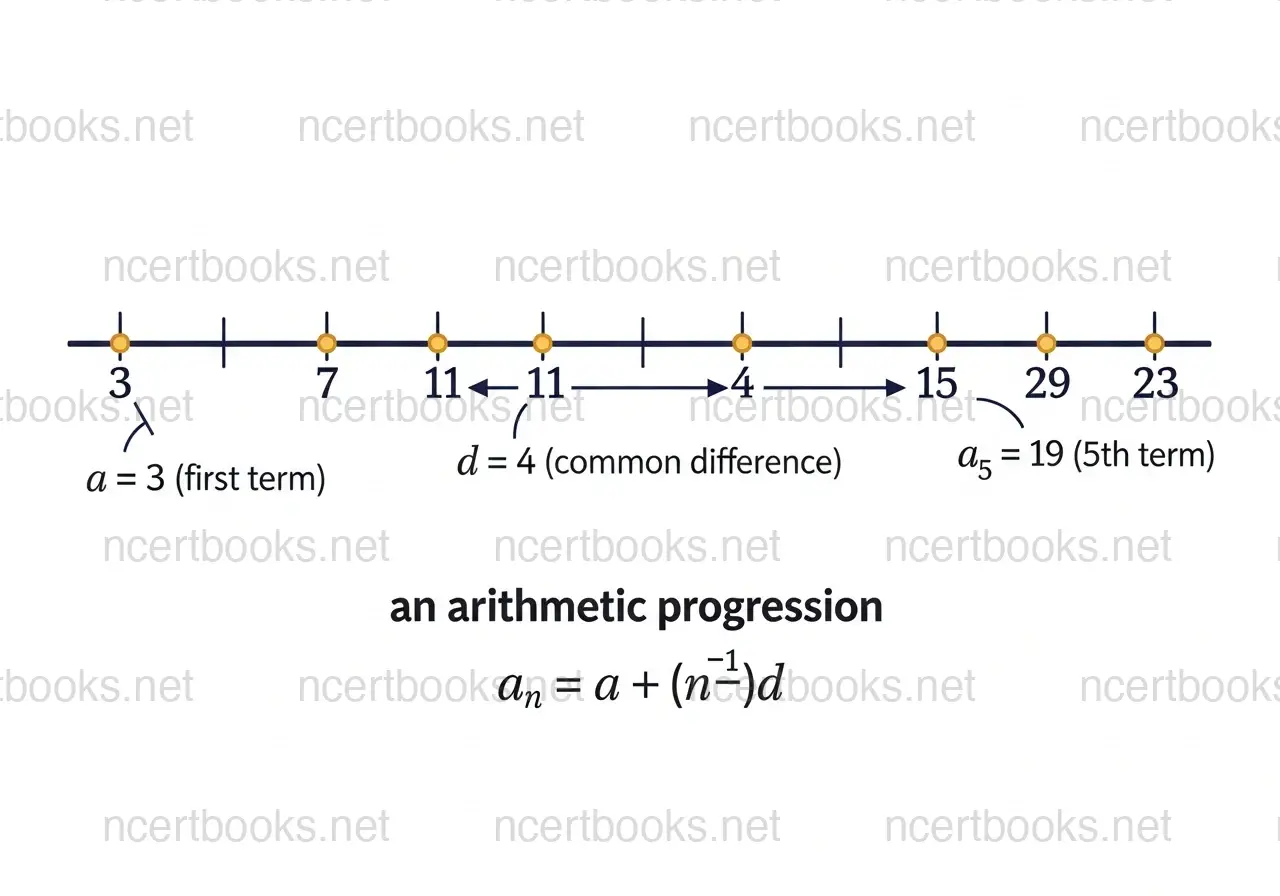
- General Term Formula: \( a_n = a + (n-1)d \) where \( a \) = first term, \( d \) = common difference, \( n \) = term number
- Common Difference: \( d = a_2 – a_1 = a_3 – a_2 \) (constant for any AP)
- Finding n: Rearrange to \( n = \frac{a_n – a}{d} + 1 \)
- Check if a value is a term: If \( n \) comes out as a positive integer, it is a term; otherwise it is not
- Difference between two terms: \( a_m – a_n = (m – n) \times d \)
- Three-digit numbers divisible by 7: 128 numbers (105 to 994)
- Exercise 5.2 has 20 questions — all based on the nth term formula
- CBSE Weightage: Arithmetic Progressions carries 5–6 marks in the Class 10 board exam
The NCERT Solutions for Class 10 Maths Chapter 5 Ex 5.2 on this page cover all 20 questions from the Arithmetic Progressions exercise, updated for the 2026-27 CBSE syllabus. You can find complete step-by-step solutions with LaTeX-rendered formulas, making it easy to follow every calculation. These solutions are part of our comprehensive NCERT Solutions for Class 10 collection. You can also download the official textbook from the NCERT official website.
Exercise 5.2 focuses entirely on the nth term formula \( a_n = a + (n-1)d \). This is one of the most tested formulas in CBSE Class 10 board exams. Browse our full NCERT Solutions library for solutions to every class and subject.
NCERT Solutions for Class 10 Maths Chapter 5 Ex 5.2 — Chapter Overview
Chapter 5 of the NCERT Class 10 Maths textbook deals with Arithmetic Progressions (AP). Exercise 5.2 specifically covers Section 5.3 — The nth Term of an AP. This is the heart of the chapter because almost every other concept (sum of terms, finding position of a term) builds on the nth term formula.
For the 2026-27 CBSE board exam, Arithmetic Progressions typically carries 5–6 marks. Questions from this exercise appear in the 2-mark and 3-mark sections of the board paper. Students who master Exercise 5.2 can confidently attempt any AP-based question in the exam.
| Detail | Information |
|---|---|
| Chapter | Chapter 5 — Arithmetic Progressions |
| Exercise | Exercise 5.2 |
| Textbook | NCERT Mathematics — Class 10 |
| Class | Class 10 (Grade 10) |
| Subject | Mathematics |
| Number of Questions | 20 |
| Key Formula | \( a_n = a + (n-1)d \) |
| Difficulty Level | Easy to Medium |
| CBSE Marks Weightage | 5–6 marks (entire chapter) |
Key Concepts and Formulas — Arithmetic Progressions
What is an Arithmetic Progression?
An Arithmetic Progression (AP) is a list of numbers in which each term is obtained by adding a fixed number to the previous term. That fixed number is called the common difference (d). For example, 2, 5, 8, 11, … is an AP with \( d = 3 \).
The nth Term Formula
The most important formula in Exercise 5.2 is:
\[ a_n = a + (n-1)d \]
Where \( a \) is the first term, \( d \) is the common difference, \( n \) is the position of the term, and \( a_n \) is the value of the nth term.
Finding the Common Difference
For any AP, \( d = a_2 – a_1 \). Always verify by checking \( a_3 – a_2 \) as well — both should give the same value.
Checking Whether a Value is a Term of an AP
Set \( a_n \) equal to the given value and solve for \( n \). If \( n \) is a positive integer, the value is a term. If \( n \) is a fraction or negative, it is not a term of the AP.
Formula Reference Table — Arithmetic Progressions
| Formula Name | Formula | Variables |
|---|---|---|
| nth Term of AP | \( a_n = a + (n-1)d \) | a = first term, d = common difference, n = term number |
| Common Difference | \( d = a_2 – a_1 \) | Any two consecutive terms |
| Finding n (term position) | \( n = \frac{a_n – a}{d} + 1 \) | When aₙ, a, d are known |
| Difference between two terms | \( a_m – a_n = (m-n) \times d \) | m, n = positions of two terms |
| Last term (l) of AP | \( l = a + (n-1)d \) | Same as nth term formula |
Exercise 5.2 Solutions — All 20 Questions Step by Step (NCERT Solutions for Class 10 Maths Chapter 5)
Question 1
Easy
Fill in the blanks in the following table, given that a is the first term, d the common difference and aₙ the nth term of the AP:
(i) \( a = 7,\ d = 3,\ n = 8 \)
\[ a_8 = 7 + (8-1) \times 3 = 7 + 21 = 28 \]
\( \therefore \) \( a_8 = 28 \)
(ii) \( a = -18,\ n = 10,\ a_{10} = 0 \). Find d.
\[ 0 = -18 + (10-1)d \implies 18 = 9d \implies d = 2 \]
\( \therefore \) \( d = 2 \)
(iii) \( d = -3,\ n = 18,\ a_{18} = -5 \). Find a.
\[ -5 = a + (18-1)(-3) = a – 51 \implies a = 46 \]
\( \therefore \) \( a = 46 \)
(iv) \( a = -18.9,\ d = 2.5,\ a_n = 3.6 \). Find n.
\[ 3.6 = -18.9 + (n-1)(2.5) \implies 22.5 = (n-1)(2.5) \implies n-1 = 9 \implies n = 10 \]
\( \therefore \) \( n = 10 \)
(v) \( a = 3.5,\ d = 0,\ n = 105 \). Find \( a_{105} \).
\[ a_{105} = 3.5 + (105-1) \times 0 = 3.5 \]
\( \therefore \) \( a_{105} = 3.5 \)
Question 2
Easy
Choose the correct choice in the following and justify:
Step 1: Identify \( a = 10 \) and \( d = 7 – 10 = -3 \).
Step 2: Apply the nth term formula:
\[ a_{30} = 10 + (30-1)(-3) = 10 + 29 \times (-3) = 10 – 87 = -77 \]
\( \therefore \) Answer: (c) −77
Step 1: \( a = -3 \), \( d = -\frac{1}{2} – (-3) = -\frac{1}{2} + 3 = \frac{5}{2} \)
Step 2:
\[ a_{11} = -3 + (11-1) \times \frac{5}{2} = -3 + 10 \times \frac{5}{2} = -3 + 25 = 22 \]
\( \therefore \) Answer: (b) 22
Question 3
Medium
In the following APs, find the missing terms:
Here \( a = 2 \), \( a_3 = 26 \). Using \( a_3 = a + 2d \):
\[ 26 = 2 + 2d \implies d = 12 \]
\[ a_2 = 2 + 12 = 14 \]
\( \therefore \) Missing term = 14
Let \( a_1 = a \). Then \( a_2 = 13 \) and \( a_4 = 3 \).
\[ a_4 = a + 3d = 3 \quad \text{and} \quad a_2 = a + d = 13 \]
Subtracting: \( 2d = 3 – 13 = -10 \implies d = -5 \)
\[ a = 13 – d = 13 – (-5) = 18 \]
\[ a_3 = 13 + (-5) = 8 \]
\( \therefore \) Missing terms: 18 and 8. AP: 18, 13, 8, 3
\( a = 5 \), \( a_4 = 9.5 \). Using \( a_4 = a + 3d \):
\[ 9.5 = 5 + 3d \implies 3d = 4.5 \implies d = 1.5 \]
\[ a_2 = 5 + 1.5 = 6.5, \quad a_3 = 6.5 + 1.5 = 8 \]
\( \therefore \) Missing terms: 6.5 and 8. AP: 5, 6.5, 8, 9.5
\( a = -4 \), \( a_6 = 6 \). Using \( a_6 = a + 5d \):
\[ 6 = -4 + 5d \implies 5d = 10 \implies d = 2 \]
\[ a_2 = -2,\ a_3 = 0,\ a_4 = 2,\ a_5 = 4 \]
\( \therefore \) AP: −4, −2, 0, 2, 4, 6
\( a_2 = 38 \), \( a_6 = -22 \). So \( a + d = 38 \) and \( a + 5d = -22 \).
Subtracting: \( 4d = -60 \implies d = -15 \)
\[ a = 38 – (-15) = 53 \]
\[ a_3 = 38 – 15 = 23,\ a_4 = 8,\ a_5 = -7 \]
\( \therefore \) AP: 53, 38, 23, 8, −7, −22
Question 4
Easy
Which term of the AP: 3, 8, 13, 18, …, is 78?
Step 1: \( a = 3 \), \( d = 8 – 3 = 5 \), \( a_n = 78 \)
Step 2: Apply the formula:
\[ 78 = 3 + (n-1) \times 5 \]
\[ 75 = (n-1) \times 5 \]
\[ n – 1 = 15 \implies n = 16 \]
\( \therefore \) 78 is the 16th term of the AP.
Question 5
Medium
Find the number of terms in each of the following APs:
Step 1: \( a = 7 \), \( d = 6 \), \( a_n = 205 \)
\[ 205 = 7 + (n-1) \times 6 \implies 198 = (n-1) \times 6 \implies n-1 = 33 \implies n = 34 \]
\( \therefore \) There are 34 terms.
Step 1: \( a = 18 \), \( d = 15.5 – 18 = -2.5 \), \( a_n = -47 \)
\[ -47 = 18 + (n-1)(-2.5) \]
\[ -65 = (n-1)(-2.5) \]
\[ n – 1 = 26 \implies n = 27 \]
\( \therefore \) There are 27 terms.
Question 6
Medium
Check whether −150 is a term of the AP: 11, 8, 5, 2, …
Step 1: \( a = 11 \), \( d = 8 – 11 = -3 \), \( a_n = -150 \)
Step 2: Solve for n:
\[ -150 = 11 + (n-1)(-3) \]
\[ -161 = (n-1)(-3) \]
\[ n – 1 = \frac{161}{3} = 53.\overline{6} \]
Step 3: Since \( n \) is not a positive integer, −150 is not a term of this AP.
\( \therefore \) −150 is NOT a term of the AP: 11, 8, 5, 2, …
Question 7
Medium
Find the 31st term of an AP whose 11th term is 38 and the 16th term is 73.
Step 1: Write the two equations:
\[ a_{11} = a + 10d = 38 \quad \text{…(1)} \]
\[ a_{16} = a + 15d = 73 \quad \text{…(2)} \]
Step 2: Subtract (1) from (2):
\[ 5d = 35 \implies d = 7 \]
Step 3: Substitute into (1):
\[ a + 70 = 38 \implies a = -32 \]
Step 4: Find the 31st term:
\[ a_{31} = -32 + 30 \times 7 = -32 + 210 = 178 \]
\( \therefore \) The 31st term is 178.
Question 8
Medium
An AP consists of 50 terms of which 3rd term is 12 and the last term is 106. Find the 29th term.
Step 1: \( a_3 = a + 2d = 12 \) …(1) and \( a_{50} = a + 49d = 106 \) …(2)
Step 2: Subtract (1) from (2):
\[ 47d = 94 \implies d = 2 \]
Step 3: From (1): \( a = 12 – 4 = 8 \)
Step 4:
\[ a_{29} = 8 + 28 \times 2 = 8 + 56 = 64 \]
\( \therefore \) The 29th term is 64.
Question 9
Medium
If the 3rd and the 9th term of an AP are 4 and −8 respectively, which term of this AP is zero?
Step 1: \( a + 2d = 4 \) …(1) and \( a + 8d = -8 \) …(2)
Step 2: Subtract (1) from (2):
\[ 6d = -12 \implies d = -2 \]
Step 3: From (1): \( a = 4 – 2(-2) = 4 + 4 = 8 \)
Step 4: Set \( a_n = 0 \):
\[ 0 = 8 + (n-1)(-2) \implies 2(n-1) = 8 \implies n-1 = 4 \implies n = 5 \]
\( \therefore \) The 5th term of the AP is zero.
Question 10
Easy
The 17th term of an AP exceeds its 10th term by 7. Find the common difference.
Step 1: Write the condition: \( a_{17} – a_{10} = 7 \)
Step 2: Use the property \( a_m – a_n = (m – n) \times d \):
\[ a_{17} – a_{10} = (17 – 10) \times d = 7d = 7 \]
\[ d = 1 \]
\( \therefore \) The common difference \( d = 1 \).
Question 11
Medium
Which term of the AP: 3, 15, 27, 39, … will be 132 more than its 54th term?
Step 1: \( a = 3 \), \( d = 12 \). Find the 54th term:
\[ a_{54} = 3 + 53 \times 12 = 3 + 636 = 639 \]
Step 2: We need \( a_n = a_{54} + 132 = 639 + 132 = 771 \).
Step 3: Solve for n:
\[ 771 = 3 + (n-1) \times 12 \implies 768 = (n-1) \times 12 \implies n-1 = 64 \implies n = 65 \]
\( \therefore \) The 65th term is 132 more than the 54th term.
Question 12
Medium
Two APs have the same common difference. The difference between their 100th terms is 100. What is the difference between their 1000th terms?
Key Concept: Let the two APs have first terms \( a \) and \( b \), and the same common difference \( d \).
Step 1: Difference between 100th terms:
\[ [a + 99d] – [b + 99d] = a – b = 100 \]
Step 2: Difference between 1000th terms:
\[ [a + 999d] – [b + 999d] = a – b = 100 \]
Why does this work? Because the \( 999d \) terms cancel out, leaving only \( a – b \), which is constant.
\( \therefore \) The difference between their 1000th terms is also 100.
Question 13
Medium
How many three-digit numbers are divisible by 7?
Step 1: The smallest three-digit number divisible by 7: \( 7 \times 15 = 105 \).
Step 2: The largest three-digit number divisible by 7: \( 7 \times 142 = 994 \).
Step 3: These form an AP: 105, 112, 119, …, 994 with \( a = 105 \), \( d = 7 \), \( a_n = 994 \).
\[ 994 = 105 + (n-1) \times 7 \implies 889 = (n-1) \times 7 \implies n-1 = 127 \implies n = 128 \]
\( \therefore \) There are 128 three-digit numbers divisible by 7.
Question 14
Medium
How many multiples of 4 lie between 10 and 250?
Step 1: First multiple of 4 greater than 10: \( 4 \times 3 = 12 \).
Step 2: Last multiple of 4 less than 250: \( 4 \times 62 = 248 \).
Step 3: AP: 12, 16, 20, …, 248 with \( a = 12 \), \( d = 4 \), \( a_n = 248 \).
\[ 248 = 12 + (n-1) \times 4 \implies 236 = (n-1) \times 4 \implies n-1 = 59 \implies n = 60 \]
\( \therefore \) There are 60 multiples of 4 between 10 and 250.
Question 15
Medium
For what value of n, the nth terms of two APs: 63, 65, 67, … and 3, 10, 17, … are equal?
Step 1: For AP1: \( a = 63 \), \( d = 2 \). nth term: \( 63 + (n-1) \times 2 = 61 + 2n \)
Step 2: For AP2: \( a = 3 \), \( d = 7 \). nth term: \( 3 + (n-1) \times 7 = -4 + 7n \)
Step 3: Set them equal:
\[ 61 + 2n = -4 + 7n \]
\[ 65 = 5n \implies n = 13 \]
\( \therefore \) The 13th terms of both APs are equal.
Question 16
Medium
Determine the AP whose 3rd term is 16 and 7th term exceeds the 5th term by 12.
Step 1: From the second condition: \( a_7 – a_5 = 12 \)
\[ (a + 6d) – (a + 4d) = 12 \implies 2d = 12 \implies d = 6 \]
Step 2: Use \( a_3 = 16 \):
\[ a + 2d = 16 \implies a + 12 = 16 \implies a = 4 \]
Step 3: The AP is: \( 4, 10, 16, 22, 28, \ldots \)
\( \therefore \) The AP is 4, 10, 16, 22, 28, …
Question 17
Medium
Find the 20th term from the last term of the AP: 3, 8, 13, …, 253.
Key Concept: The 20th term from the last is the same as the (total − 19)th term from the start. Alternatively, reverse the AP.
Method — Reverse AP: When reversed, the AP becomes 253, 248, 243, … with \( a = 253 \), \( d = -5 \).
Step 1: Find the 20th term of the reversed AP:
\[ a_{20} = 253 + (20-1)(-5) = 253 – 95 = 158 \]
\( \therefore \) The 20th term from the last is 158.
Question 18
Hard
The sum of the 4th and 8th terms of an AP is 24 and the sum of the 6th and 10th terms is 44. Find the first three terms of the AP.
Step 1: Write equations:
\[ a_4 + a_8 = (a + 3d) + (a + 7d) = 2a + 10d = 24 \implies a + 5d = 12 \quad \text{…(1)} \]
\[ a_6 + a_{10} = (a + 5d) + (a + 9d) = 2a + 14d = 44 \implies a + 7d = 22 \quad \text{…(2)} \]
Step 2: Subtract (1) from (2):
\[ 2d = 10 \implies d = 5 \]
Step 3: Substitute into (1):
\[ a + 25 = 12 \implies a = -13 \]
Step 4: First three terms:
\[ a_1 = -13,\ a_2 = -13 + 5 = -8,\ a_3 = -8 + 5 = -3 \]
\( \therefore \) The first three terms are −13, −8, −3.
Question 19
Medium
Subba Rao started work in 1995 at an annual salary of ₹5000 and received an increment of ₹200 each year. In which year did his income reach ₹7000?
Step 1: This is an AP with \( a = 5000 \), \( d = 200 \), \( a_n = 7000 \).
Step 2: Solve for n:
\[ 7000 = 5000 + (n-1) \times 200 \]
\[ 2000 = (n-1) \times 200 \]
\[ n – 1 = 10 \implies n = 11 \]
Step 3: The 11th year from 1995 is \( 1995 + 10 = 2005 \).
\( \therefore \) Subba Rao’s income reached ₹7000 in the year 2005.
Question 20
Medium
Ramkali saved ₹5 in the first week of a year and then increased her weekly saving by ₹1.75. If in the nth week, her weekly saving becomes ₹20.75, find n.
Step 1: AP with \( a = 5 \), \( d = 1.75 \), \( a_n = 20.75 \).
Step 2: Apply the formula:
\[ 20.75 = 5 + (n-1) \times 1.75 \]
\[ 15.75 = (n-1) \times 1.75 \]
\[ n – 1 = \frac{15.75}{1.75} = 9 \implies n = 10 \]
\( \therefore \) In the 10th week, Ramkali’s saving becomes ₹20.75.
Solved Examples Beyond NCERT — Arithmetic Progressions
These extra examples will strengthen your understanding of the nth term formula and help you tackle harder CBSE board questions.
Extra Example 1
Medium
The 5th term of an AP is 26 and the 10th term is 51. Find the AP.
Step 1: \( a + 4d = 26 \) …(1) and \( a + 9d = 51 \) …(2)
Step 2: Subtract: \( 5d = 25 \implies d = 5 \). Then \( a = 26 – 20 = 6 \).
AP: 6, 11, 16, 21, 26, …
Extra Example 2
Hard
How many two-digit numbers are divisible by 3?
Step 1: AP: 12, 15, 18, …, 99. \( a = 12 \), \( d = 3 \), \( a_n = 99 \).
\[ 99 = 12 + (n-1) \times 3 \implies 87 = 3(n-1) \implies n = 30 \]
There are 30 two-digit numbers divisible by 3.
Extra Example 3
Medium
If the nth term of an AP is \( 4n – 3 \), find the first term and common difference.
Step 1: \( a_1 = 4(1) – 3 = 1 \) and \( a_2 = 4(2) – 3 = 5 \).
Step 2: \( d = a_2 – a_1 = 5 – 1 = 4 \).
First term = 1, Common difference = 4. AP: 1, 5, 9, 13, …
Important Questions for CBSE Board Exam — Class 10 Maths Chapter 5
These questions are frequently asked in CBSE board exams and are based on the cbse class 10 maths ncert solutions pattern. Practise them thoroughly for 2026-27.
1-Mark Questions
Q1. What is the nth term formula for an AP?
Answer: \( a_n = a + (n-1)d \)
Q2. Find the common difference of the AP: 5, 8, 11, 14, …
Answer: \( d = 3 \)
Q3. Is 0 a term of the AP: 31, 28, 25, …?
Answer: Yes. \( 0 = 31 + (n-1)(-3) \implies n = 11\frac{1}{3} \). No — n is not an integer, so 0 is NOT a term.
3-Mark Questions
Q4. The 4th term of an AP is 11 and the 8th term is 23. Find the AP and its 15th term.
Answer: \( a + 3d = 11 \) and \( a + 7d = 23 \). Solving: \( d = 3 \), \( a = 2 \). AP: 2, 5, 8, 11, … \( a_{15} = 2 + 14 \times 3 = 44 \).
Q5. How many natural numbers between 1 and 1000 are divisible by 5?
Answer: AP: 5, 10, 15, …, 1000. \( n = \frac{1000-5}{5} + 1 = 200 \). There are 200 such numbers.
5-Mark Questions
Q6. The sum of the 5th and 7th terms of an AP is 52 and the 10th term is 46. Find the AP.
Answer: \( a_5 + a_7 = (a+4d) + (a+6d) = 2a + 10d = 52 \implies a + 5d = 26 \) …(1). \( a_{10} = a + 9d = 46 \) …(2). Subtract (1) from (2): \( 4d = 20 \implies d = 5 \). From (1): \( a = 1 \). AP: 1, 6, 11, 16, 21, …
Common Mistakes Students Make in Arithmetic Progressions
Mistake 1: Writing \( a_n = a + nd \) instead of \( a_n = a + (n-1)d \).
Why it’s wrong: The formula starts counting from the first term, so the first step is \( n-1 \), not \( n \).
Correct approach: Always use \( a_n = a + (n-1)d \). Verify with \( n = 1 \): \( a_1 = a \). ✅
Mistake 2: Confusing “between 10 and 250” with “from 10 to 250”.
Why it’s wrong: “Between” means strictly excluding 10 and 250 themselves.
Correct approach: Start from 12 (first multiple of 4 after 10) and end at 248 (last multiple before 250).
Mistake 3: Saying a value is NOT a term without checking if n is a positive integer.
Why it’s wrong: n must be both a positive integer AND greater than zero.
Correct approach: Solve for n and check: is n a positive integer? If yes → it’s a term. If no → it’s not.
Mistake 4: In year-based problems (like Q19), adding n to the starting year instead of (n−1).
Why it’s wrong: The 1st term corresponds to the starting year, so the nth term is (start year + n − 1).
Correct approach: If n = 11 and start = 1995, the year is \( 1995 + 11 – 1 = 2005 \).
Mistake 5: Not simplifying the equation before solving (e.g., not dividing \( 2a + 10d = 24 \) by 2).
Why it’s wrong: It makes the arithmetic harder and increases the chance of errors.
Correct approach: Always simplify equations early — divide by common factors.
Exam Tips for 2026-27 — CBSE Class 10 Maths Chapter 5
Use these tips to maximise your marks in the 2026-27 CBSE board exam:
- Always write the formula first: The CBSE 2026-27 marking scheme awards 1 mark for writing \( a_n = a + (n-1)d \) correctly before substituting values.
- Show substitution clearly: Write \( a_n = a + (n-1)d \), then substitute — don’t skip to the answer directly.
- Label your equations: In two-equation problems, write …(1) and …(2) and show the subtraction step. This earns method marks even if the final answer is wrong.
- Verify your answer: Substitute n back into the AP formula to confirm. This takes 10 seconds and prevents silly errors.
- Word problems: Identify a, d, and what you need to find before writing any equation. Write a one-line statement: “This is an AP with a = ___, d = ___”.
- Chapter weightage: Arithmetic Progressions typically carries 5–6 marks in the Class 10 board exam. Exercise 5.2 questions (nth term) are more commonly tested than Exercise 5.3 (sum) in 2-mark slots.
- Revision checklist: ✅ nth term formula | ✅ Finding n | ✅ Checking if a value is a term | ✅ Two-equation problems | ✅ Real-life AP word problems