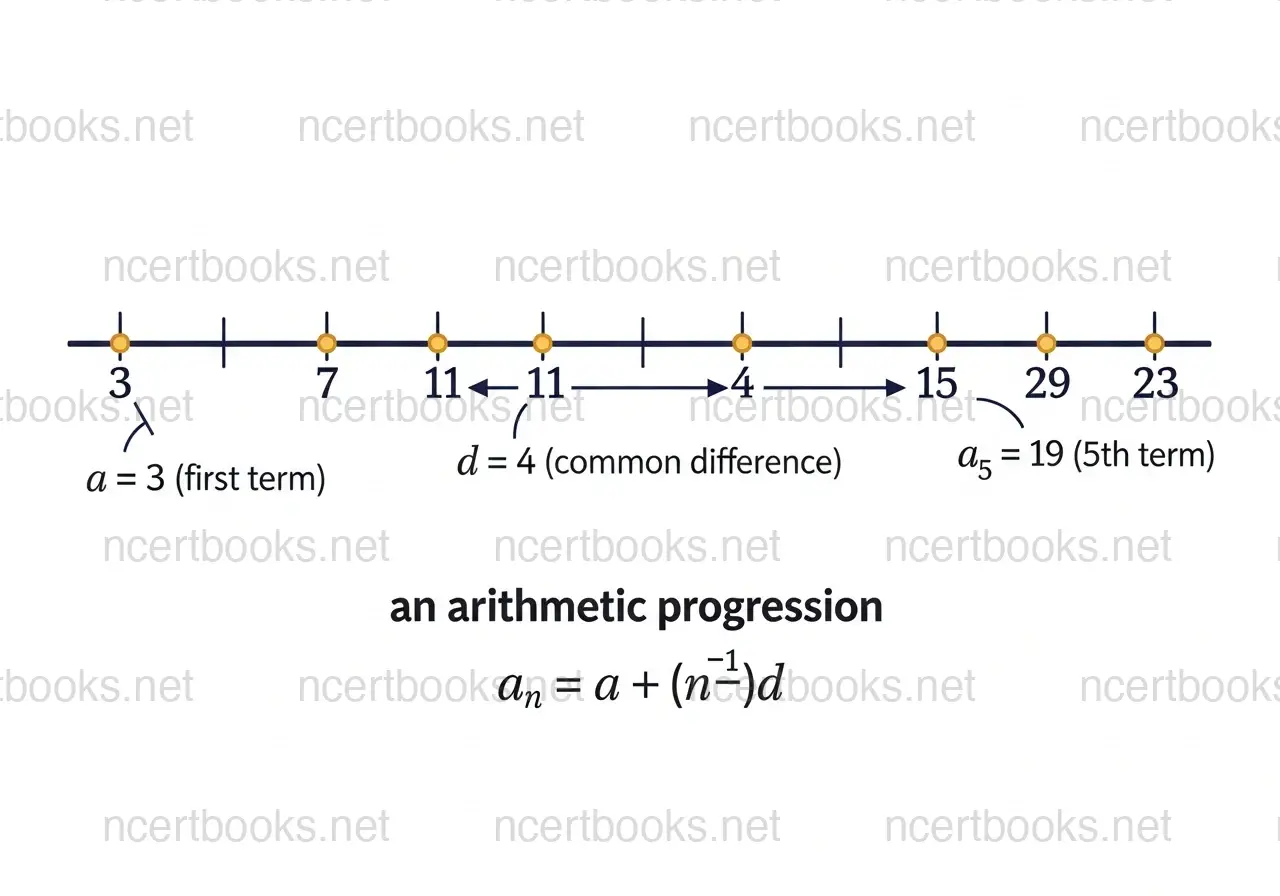
- AP Definition: A sequence where each term is obtained by adding a fixed number (common difference d) to the previous term.
- General form: \( a,\ a+d,\ a+2d,\ a+3d, \ldots \)
- Common difference: \( d = a_2 – a_1 = a_3 – a_2 \) (must be constant throughout)
- nth term formula: \( a_n = a + (n-1)d \)
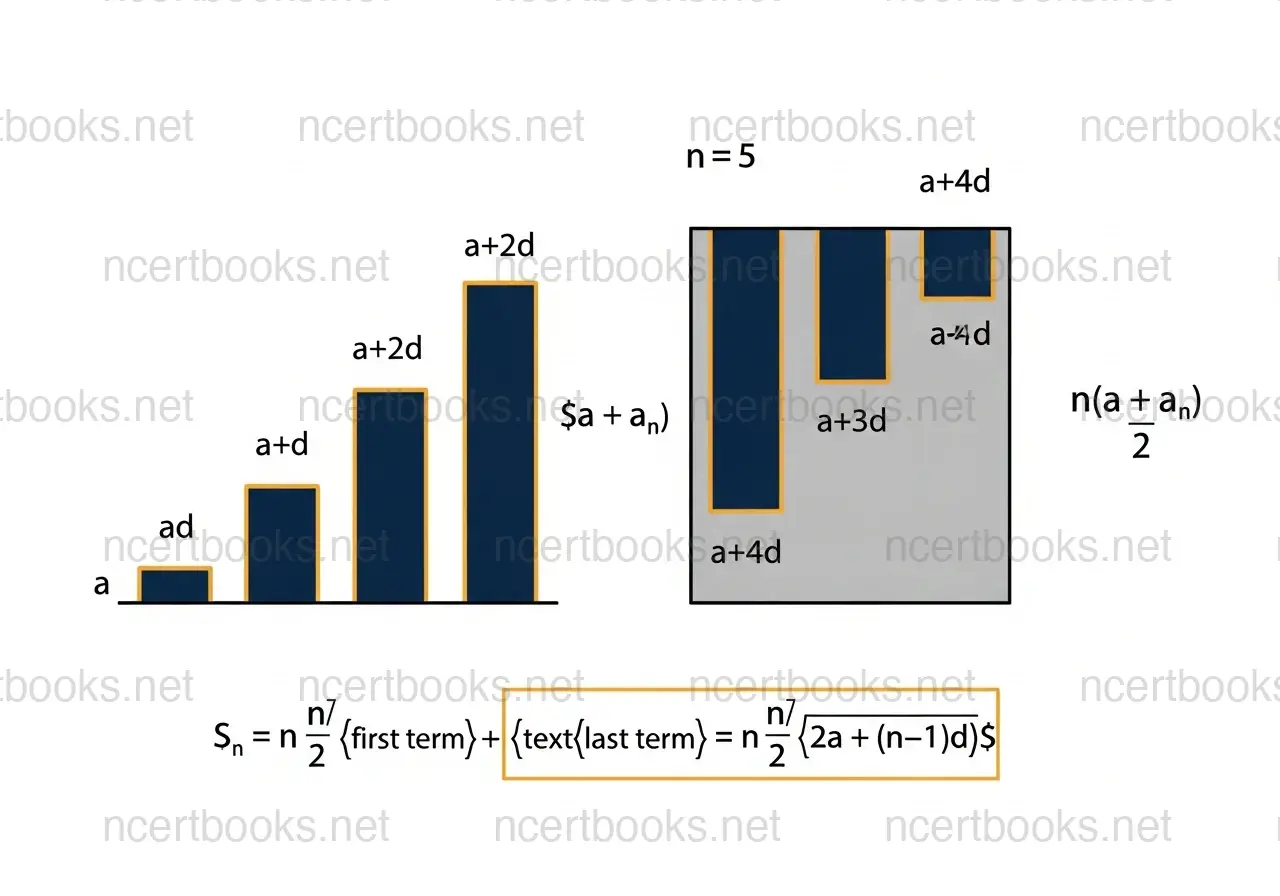
- Sum of n terms: \( S_n = \frac{n}{2}[2a + (n-1)d] \) or \( S_n = \frac{n}{2}(a + l) \)
- Compound interest ≠ AP — it forms a GP because the ratio, not the difference, is constant.
- Vacuum pump air removal ≠ AP — each step removes a fraction of remaining air, so differences are not equal.
- Exercise 5.1 focus: Identifying APs, writing terms from given a and d, finding a and d from a given AP.
These NCERT solutions for class 10 maths chapter 5 arithmetic progressions cover every question in Exercise 5.1 with complete step-by-step working, updated for the 2026-27 CBSE board exam. Whether you are checking your homework, preparing for unit tests, or revising for boards, this page gives you accurate, exam-ready answers. You can find all NCERT Solutions for Class 10 on our hub page, and the full collection of NCERT Solutions for all classes is also available. The official textbook is published by NCERT (National Council of Educational Research and Training).
Table of Contents
- Quick Revision Box
- Chapter Overview — Arithmetic Progressions Class 10
- Key Concepts and Theorems
- NCERT Solutions for Class 10 Maths Chapter 5 Exercise 5.1 — All Questions
- Formula Reference Table
- Solved Examples Beyond NCERT
- Important Questions for CBSE Board Exam
- Common Mistakes Students Make
- Exam Tips for 2026-27 CBSE Board
- Frequently Asked Questions
Chapter Overview — Arithmetic Progressions Class 10 Maths (CBSE 2026-27)
Chapter 5 of the NCERT Class 10 Maths textbook, Arithmetic Progressions, introduces one of the most important number patterns in mathematics. An arithmetic progression (AP) is a sequence of numbers where each term after the first is obtained by adding a fixed value called the common difference (d). This chapter builds directly on your understanding of number patterns from earlier classes.
For the CBSE 2026-27 board exam, this chapter carries significant weightage under the Algebra unit. Questions from this chapter appear in 1-mark (MCQ), 2-mark, 3-mark, and 5-mark sections. Exercise 5.1 specifically tests your ability to identify whether a given sequence is an AP, write terms of an AP when a and d are given, and extract a and d from a given AP.
Before studying this chapter, you should be comfortable with number sequences, linear equations, and basic algebraic expressions from Class 9. The chapter has four exercises: Ex 5.1 (basics), Ex 5.2 (nth term), Ex 5.3 (sum of n terms), and Ex 5.4 (optional). This page covers Exercise 5.1 completely.
| Detail | Information |
|---|---|
| Chapter | 5 — Arithmetic Progressions |
| Textbook | NCERT Mathematics — Class 10 |
| Exercise | Exercise 5.1 (Page 99) |
| Number of Questions | 4 Questions (with multiple sub-parts) |
| CBSE Unit | Algebra |
| Difficulty Level | Easy to Medium |
| Academic Year | 2026-27 |
Key Concepts and Theorems — Arithmetic Progressions
What is an Arithmetic Progression?
An arithmetic progression (समान्तर श्रेढ़ी) is a list of numbers in which each term is obtained by adding a fixed number to the preceding term. The fixed number is the common difference (d). It can be positive, negative, or zero. For example: 2, 5, 8, 11, … is an AP with \( a = 2 \) and \( d = 3 \).
General Form of an AP
Any AP can be written as:
\[ a,\ a+d,\ a+2d,\ a+3d,\ \ldots \]
where \( a \) is the first term and \( d \) is the common difference. A finite AP has a last term; an infinite AP continues forever.
How to Check if a Sequence is an AP
Calculate the difference between consecutive terms: \( a_2 – a_1 \), \( a_3 – a_2 \), \( a_4 – a_3 \), and so on. If all differences are equal, the sequence is an AP. This equal value is the common difference \( d \). If even one difference is different, the sequence is not an AP.
nth Term Formula
The \( n \)th term (general term) of an AP with first term \( a \) and common difference \( d \) is:
\[ a_n = a + (n-1)d \]
This formula is essential for solving most board exam questions in this chapter.
NCERT Solutions for Class 10 Maths Chapter 5 Arithmetic Progressions — Exercise 5.1
Below are complete, step-by-step solutions to all four questions in Exercise 5.1 of the NCERT Class 10 Maths textbook. These solutions match the official NCERT answer key and are updated for the 2026-27 CBSE syllabus.
Question 1
Medium
In which of the following situations, does the list of numbers involved make an arithmetic progression and why?
(i) The taxi fare after each km when the fare is ₹ 15 for the first km and ₹ 8 for each additional km.
(ii) The amount of air present in a cylinder when a vacuum pump removes \( \frac{1}{4} \) of the air remaining in the cylinder at a time.
(iii) The cost of digging a well after every meter of digging, when it costs ₹ 150 for the first meter and rises by ₹ 50 for each subsequent meter.
(iv) The amount of money in the account every year, when ₹ 10000 is deposited at compound interest at 8% per annum.
Step 1: List the fare after each km.
After 1st km: ₹ 15
After 2nd km: ₹ 15 + ₹ 8 = ₹ 23
After 3rd km: ₹ 23 + ₹ 8 = ₹ 31
After 4th km: ₹ 31 + ₹ 8 = ₹ 39
Step 2: Check the differences.
\[ 23 – 15 = 8,\quad 31 – 23 = 8,\quad 39 – 31 = 8 \]
Why does this work? Each km adds a constant ₹ 8 to the previous fare, so the difference is always the same.
\( \therefore \) Yes, this is an AP. First term \( a = 15 \), common difference \( d = 8 \).
Step 1: Let the initial amount of air be \( x \) units.
After 1st removal: \( x – \frac{x}{4} = \frac{3x}{4} \)
After 2nd removal: \( \frac{3x}{4} – \frac{1}{4} \cdot \frac{3x}{4} = \frac{3x}{4} \times \frac{3}{4} = \frac{9x}{16} \)
After 3rd removal: \( \frac{9x}{16} \times \frac{3}{4} = \frac{27x}{64} \)
Step 2: Check the differences.
\[ \frac{9x}{16} – \frac{3x}{4} = \frac{9x – 12x}{16} = \frac{-3x}{16} \]
\[ \frac{27x}{64} – \frac{9x}{16} = \frac{27x – 36x}{64} = \frac{-9x}{64} \]
Why does this work? The pump removes \( \frac{1}{4} \) of the remaining air each time, not a fixed amount. So the differences are \( \frac{-3x}{16} \) and \( \frac{-9x}{64} \), which are not equal.
\( \therefore \) No, this is NOT an AP. The differences between consecutive terms are not constant.
Step 1: List the cumulative cost after each meter.
After 1st meter: ₹ 150
After 2nd meter: ₹ 150 + ₹ 200 = ₹ 350
After 3rd meter: ₹ 350 + ₹ 250 = ₹ 600
After 4th meter: ₹ 600 + ₹ 300 = ₹ 900
Step 2: Check the differences.
\[ 350 – 150 = 200,\quad 600 – 350 = 250,\quad 900 – 600 = 300 \]
Why does this work? The cost for each successive meter increases by ₹ 50 (150, 200, 250, 300, …), so the individual costs form an AP with \( a = 150 \) and \( d = 50 \). The cumulative costs (150, 350, 600, 900) do NOT form an AP since their differences (200, 250, 300) are not constant.
\( \therefore \) Yes, the cost per meter forms an AP with \( a = 150 \) and \( d = 50 \). The sequence is: 150, 200, 250, 300, …
Step 1: Calculate the amount at the end of each year using compound interest formula \( A = P(1 + r)^n \) with \( P = 10000 \), \( r = 0.08 \).
After Year 1: \( 10000 \times 1.08 = ₹\ 10800 \)
After Year 2: \( 10000 \times (1.08)^2 = ₹\ 11664 \)
After Year 3: \( 10000 \times (1.08)^3 = ₹\ 12597.12 \)
Step 2: Check the differences.
\[ 11664 – 10800 = 864 \]
\[ 12597.12 – 11664 = 933.12 \]
Why does this work? In compound interest, interest is earned on the growing amount each year, not on the original principal alone. So the amount increases by a fixed ratio (1.08), not a fixed difference. This makes it a geometric progression, not an AP.
\( \therefore \) No, this is NOT an AP. The differences between consecutive amounts are not constant. Compound interest forms a geometric progression (GP).
Question 2
Easy
Write first four terms of the AP, when the first term \( a \) and the common difference \( d \) are given as follows:
(i) \( a = 10,\ d = 10 \)
(ii) \( a = -2,\ d = 0 \)
(iii) \( a = 4,\ d = -3 \)
(iv) \( a = -1,\ d = \frac{1}{2} \)
(v) \( a = -1.25,\ d = -0.25 \)
Key Concept: To write the first four terms of an AP, use \( a_1 = a \), \( a_2 = a + d \), \( a_3 = a + 2d \), \( a_4 = a + 3d \).
\[ a_2 = 10 + 10 = 20 \]
\[ a_3 = 10 + 2(10) = 30 \]
\[ a_4 = 10 + 3(10) = 40 \]
\( \therefore \) First four terms: 10, 20, 30, 40
\[ a_2 = -2 + 0 = -2 \]
\[ a_3 = -2 + 2(0) = -2 \]
\[ a_4 = -2 + 3(0) = -2 \]
Why does this work? When \( d = 0 \), all terms are equal. This is called a constant AP.
\( \therefore \) First four terms: −2, −2, −2, −2
\[ a_2 = 4 + (-3) = 1 \]
\[ a_3 = 4 + 2(-3) = -2 \]
\[ a_4 = 4 + 3(-3) = -5 \]
Why does this work? A negative common difference means the AP is decreasing.
\( \therefore \) First four terms: 4, 1, −2, −5
\[ a_2 = -1 + \frac{1}{2} = -\frac{1}{2} \]
\[ a_3 = -1 + 2 \times \frac{1}{2} = 0 \]
\[ a_4 = -1 + 3 \times \frac{1}{2} = \frac{1}{2} \]
\( \therefore \) First four terms: \( -1,\ -\frac{1}{2},\ 0,\ \frac{1}{2} \)
\[ a_2 = -1.25 + (-0.25) = -1.50 \]
\[ a_3 = -1.25 + 2(-0.25) = -1.75 \]
\[ a_4 = -1.25 + 3(-0.25) = -2.00 \]
\( \therefore \) First four terms: −1.25, −1.50, −1.75, −2.00
Question 3
Easy
For the following APs, write the first term and the common difference:
(i) 3, 1, −1, −3, …
(ii) −5, −1, 3, 7, …
(iii) \( \frac{1}{3},\ \frac{5}{3},\ \frac{9}{3},\ \frac{13}{3},\ \ldots \)
(iv) 0.6, 1.7, 2.8, 3.9, …
Key Concept: The first term \( a = a_1 \) (the first number in the list). The common difference \( d = a_2 – a_1 \).
\[ d = a_2 – a_1 = 1 – 3 = -2 \]
Verification: \( -1 – 1 = -2 \) and \( -3 – (-1) = -2 \). ✓
\( \therefore \) First term \( a = 3 \), Common difference \( d = -2 \)
\[ d = a_2 – a_1 = -1 – (-5) = 4 \]
Verification: \( 3 – (-1) = 4 \) and \( 7 – 3 = 4 \). ✓
\( \therefore \) First term \( a = -5 \), Common difference \( d = 4 \)
\[ d = \frac{5}{3} – \frac{1}{3} = \frac{4}{3} \]
Verification: \( \frac{9}{3} – \frac{5}{3} = \frac{4}{3} \) and \( \frac{13}{3} – \frac{9}{3} = \frac{4}{3} \). ✓
\( \therefore \) First term \( a = \frac{1}{3} \), Common difference \( d = \frac{4}{3} \)
\[ d = 1.7 – 0.6 = 1.1 \]
Verification: \( 2.8 – 1.7 = 1.1 \) and \( 3.9 – 2.8 = 1.1 \). ✓
\( \therefore \) First term \( a = 0.6 \), Common difference \( d = 1.1 \)
Question 4
Medium
Which of the following are APs? If they form an AP, find the common difference \( d \) and write three more terms.
(i) 2, 4, 8, 16, …
(ii) \( 2,\ \frac{5}{2},\ 3,\ \frac{7}{2},\ \ldots \)
(iii) −1.2, −3.2, −5.2, −7.2, …
(iv) −10, −6, −2, 2, …
(v) \( 3,\ 3+\sqrt{2},\ 3+2\sqrt{2},\ 3+3\sqrt{2},\ \ldots \)
(vi) 0.2, 0.22, 0.222, 0.2222, …
(vii) 0, −4, −8, −12, …
(viii) \( -\frac{1}{2},\ -\frac{1}{2},\ -\frac{1}{2},\ -\frac{1}{2},\ \ldots \)
(ix) 1, 3, 9, 27, …
(x) \( a,\ 2a,\ 3a,\ 4a,\ \ldots \)
(xi) \( a,\ a^2,\ a^3,\ a^4,\ \ldots \)
(xii) \( \sqrt{2},\ \sqrt{8},\ \sqrt{18},\ \sqrt{32},\ \ldots \)
(xiii) \( \sqrt{3},\ \sqrt{6},\ \sqrt{9},\ \sqrt{12},\ \ldots \)
(xiv) \( 1^2,\ 3^2,\ 5^2,\ 7^2,\ \ldots \)
(xv) \( 1^2,\ 5^2,\ 7^2,\ 7^3,\ \ldots \)
Differences are 2, 4, 8 — not equal.
\( \therefore \) Not an AP.
All differences equal \( \frac{1}{2} \). This is an AP with \( d = \frac{1}{2} \).
Next three terms:
\[ a_5 = \frac{7}{2} + \frac{1}{2} = 4,\quad a_6 = 4 + \frac{1}{2} = \frac{9}{2},\quad a_7 = \frac{9}{2} + \frac{1}{2} = 5 \]
\( \therefore \) AP with \( d = \frac{1}{2} \). Next three terms: 4, \( \frac{9}{2} \), 5
All differences equal −2. This is an AP with \( d = -2 \).
\[ a_5 = -7.2 + (-2) = -9.2,\quad a_6 = -11.2,\quad a_7 = -13.2 \]
\( \therefore \) AP with \( d = -2 \). Next three terms: −9.2, −11.2, −13.2
All differences equal 4. This is an AP with \( d = 4 \).
\[ a_5 = 2 + 4 = 6,\quad a_6 = 10,\quad a_7 = 14 \]
\( \therefore \) AP with \( d = 4 \). Next three terms: 6, 10, 14
All differences equal \( \sqrt{2} \). This is an AP.
\[ a_5 = 3+4\sqrt{2},\quad a_6 = 3+5\sqrt{2},\quad a_7 = 3+6\sqrt{2} \]
\( \therefore \) AP with \( d = \sqrt{2} \). Next three terms: \( 3+4\sqrt{2},\ 3+5\sqrt{2},\ 3+6\sqrt{2} \)
Differences are 0.02, 0.002, 0.0002 — not equal.
\( \therefore \) Not an AP.
All differences equal −4. This is an AP.
\[ a_5 = -12 + (-4) = -16,\quad a_6 = -20,\quad a_7 = -24 \]
\( \therefore \) AP with \( d = -4 \). Next three terms: −16, −20, −24
All differences equal 0. This is a constant AP.
\[ a_5 = -\frac{1}{2},\quad a_6 = -\frac{1}{2},\quad a_7 = -\frac{1}{2} \]
\( \therefore \) AP with \( d = 0 \). Next three terms: \( -\frac{1}{2},\ -\frac{1}{2},\ -\frac{1}{2} \)
Differences are 2, 6, 18 — not equal. (This is a geometric progression with ratio 3.)
\( \therefore \) Not an AP.
All differences equal \( a \). This is an AP (as long as \( a \) is a fixed number).
\[ a_5 = 5a,\quad a_6 = 6a,\quad a_7 = 7a \]
\( \therefore \) AP with \( d = a \). Next three terms: \( 5a,\ 6a,\ 7a \)
These differences are \( a(a-1) \), \( a^2(a-1) \), \( a^3(a-1) \) — not equal (unless \( a = 0 \) or \( a = 1 \)).
\( \therefore \) Not an AP (in general, for \( a \neq 0 \) and \( a \neq 1 \)).
Step 1: Simplify each term.
\[ \sqrt{2} = \sqrt{2},\quad \sqrt{8} = 2\sqrt{2},\quad \sqrt{18} = 3\sqrt{2},\quad \sqrt{32} = 4\sqrt{2} \]
Step 2: Check differences.
\[ 2\sqrt{2} – \sqrt{2} = \sqrt{2},\quad 3\sqrt{2} – 2\sqrt{2} = \sqrt{2},\quad 4\sqrt{2} – 3\sqrt{2} = \sqrt{2} \]
\[ a_5 = 5\sqrt{2} = \sqrt{50},\quad a_6 = 6\sqrt{2} = \sqrt{72},\quad a_7 = 7\sqrt{2} = \sqrt{98} \]
\( \therefore \) AP with \( d = \sqrt{2} \). Next three terms: \( \sqrt{50},\ \sqrt{72},\ \sqrt{98} \)
\[ \sqrt{9} – \sqrt{6} = 3 – \sqrt{6} \approx 0.551 \]
These differences are not equal.
\( \therefore \) Not an AP. The differences between consecutive terms are not constant.
Differences are 8, 16, 24 — not equal (they increase by 8 each time).
\( \therefore \) Not an AP.
The first two differences are 24, but the third is 294 — not equal.
\( \therefore \) Not an AP. The differences are not constant throughout.
Formula Reference Table — Arithmetic Progressions Class 10
| Formula Name | Formula | Variables Defined |
|---|---|---|
| General term (nth term) | \( a_n = a + (n-1)d \) | \( a \) = first term, \( d \) = common difference, \( n \) = term number |
| Common difference | \( d = a_{k+1} – a_k \) | Any two consecutive terms |
| Sum of first n terms | \( S_n = \frac{n}{2}[2a + (n-1)d] \) | \( a \) = first term, \( d \) = common difference |
| Sum using last term | \( S_n = \frac{n}{2}(a + l) \) | \( l \) = last term |
| Arithmetic mean | \( b = \frac{a+c}{2} \) | \( a, b, c \) are in AP |
| Sum of first n natural numbers | \( S = \frac{n(n+1)}{2} \) | \( n \) = number of terms |
You can also explore related solutions on our NCERT Solutions Class 10 hub page for all chapters.
Solved Examples Beyond NCERT — Arithmetic Progressions
Extra Example 1 — Find the 20th term of an AP
Easy
Find the 20th term of the AP: 3, 7, 11, 15, …
Step 1: Identify \( a = 3 \) and \( d = 7 – 3 = 4 \).
Step 2: Apply the nth term formula with \( n = 20 \).
\[ a_{20} = a + (20-1)d = 3 + 19 \times 4 = 3 + 76 = 79 \]
\( \therefore \) The 20th term is 79.
Extra Example 2 — Check if 301 is a term of the AP
Medium
Is 301 a term of the AP: 5, 11, 17, 23, …?
Step 1: \( a = 5,\ d = 6 \).
Step 2: Set \( a_n = 301 \) and solve for \( n \).
\[ 5 + (n-1) \times 6 = 301 \]
\[ (n-1) \times 6 = 296 \]
\[ n – 1 = \frac{296}{6} = 49.33\ldots \]
Since \( n \) is not a natural number, 301 is not a term of this AP.
\( \therefore \) 301 is NOT a term of this AP.
Extra Example 3 — How many terms of the AP: 9, 17, 25, … must be taken to give a sum of 636?
Hard
How many terms of the AP 9, 17, 25, … must be taken to give a sum of 636?
Step 1: \( a = 9,\ d = 8 \).
Step 2: Use \( S_n = \frac{n}{2}[2a + (n-1)d] = 636 \).
\[ \frac{n}{2}[18 + 8(n-1)] = 636 \]
\[ n[18 + 8n – 8] = 1272 \]
\[ n[10 + 8n] = 1272 \]
\[ 8n^2 + 10n – 1272 = 0 \]
\[ 4n^2 + 5n – 636 = 0 \]
Step 3: Use the quadratic formula or factorisation.
\[ n = \frac{-5 \pm \sqrt{25 + 4 \times 4 \times 636}}{8} = \frac{-5 \pm \sqrt{10201}}{8} = \frac{-5 \pm 101}{8} \]
Taking positive value: \( n = \frac{96}{8} = 12 \).
\( \therefore \) 12 terms must be taken.
Important Questions for CBSE Board Exam — Arithmetic Progressions
1-Mark Questions (Definition / Fill-in-the-Blank)
- Define an arithmetic progression. Give one example. [Answer: A sequence where each term is obtained by adding a fixed number (common difference) to the previous term. Example: 2, 5, 8, 11, …]
- What is the common difference of the AP: 100, 90, 80, 70, …? [Answer: d = −10]
- Find the first term of the AP whose 3rd term is 7 and common difference is 3. [Answer: a = 7 − 2(3) = 1]
3-Mark Questions
- Find the 31st term of an AP whose 11th term is 38 and 16th term is 73. [Answer: d = 7, a = −32, a₃₁ = 178]
- Which term of the AP 3, 15, 27, 39, … will be 132 more than its 54th term? [Answer: 11 more, so the 65th term]
5-Mark Questions (Long Answer)
- The sum of the 4th and 8th terms of an AP is 24 and the sum of the 6th and 10th terms is 44. Find the first three terms of the AP. Show all working. [Answer: a = −13, d = 5; first three terms: −13, −8, −3]
For more practice, see our sibling pages: NCERT Solutions Class 10 Maths Chapter 5 Exercise 5.2 and NCERT Solutions Class 10 Maths Chapter 5 Exercise 5.3.
Common Mistakes Students Make in Arithmetic Progressions
Mistake 1: Students assume that if the first two differences are equal, the sequence is an AP.
Why it’s wrong: You must check the difference between all consecutive pairs, not just the first two. See Q4(xv) above — the first two differences are equal but the third is not.
Correct approach: Check at least three consecutive differences before concluding it is an AP.
Mistake 2: Students confuse the taxi fare per km with the cumulative fare and get confused about which sequence to check.
Why it’s wrong: The question asks about the list of fares after each km (cumulative), not the fare for each km alone.
Correct approach: List the total fare after 1 km, 2 km, 3 km, … and then check if consecutive differences are equal.
Mistake 3: Students write \( d = a_1 – a_2 \) instead of \( d = a_2 – a_1 \).
Why it’s wrong: The common difference is always the later term minus the earlier term.
Correct approach: Always compute \( d = a_{n+1} – a_n \), i.e., next term minus current term.
Mistake 4: In Q4(xii), students do not simplify \( \sqrt{8} \), \( \sqrt{18} \), \( \sqrt{32} \) before checking differences.
Why it’s wrong: Without simplification, the pattern is not obvious and students incorrectly conclude it is not an AP.
Correct approach: Simplify surds first: \( \sqrt{8} = 2\sqrt{2} \), \( \sqrt{18} = 3\sqrt{2} \), \( \sqrt{32} = 4\sqrt{2} \), then check differences.
Mistake 5: Students say compound interest forms an AP because the amount increases each year.
Why it’s wrong: Increasing amounts do not automatically make an AP. The differences must be constant. In compound interest, the amount grows by a fixed ratio, not a fixed amount.
Correct approach: Calculate the actual amounts and subtract consecutive terms to verify.
Exam Tips for 2026-27 CBSE Board — Arithmetic Progressions
- Chapter weightage: Arithmetic Progressions is part of the Algebra unit, which carries approximately 20 marks in the CBSE Class 10 board exam. Expect 1–2 questions directly from this chapter.
- Always show working: In the 2026-27 CBSE marking scheme, method marks are awarded even if the final answer is wrong. Never skip steps.
- Exercise 5.1 question type: Q1 (identifying APs) is a 2-mark question in most board papers. Write the differences explicitly and state your conclusion clearly.
- Surd simplification: For sequences involving \( \sqrt{2} \), \( \sqrt{8} \), \( \sqrt{18} \), etc., always simplify to the form \( k\sqrt{2} \) first. This is a commonly tested skill.
- Revision checklist:
- ✅ Know the definition of AP and how to identify one
- ✅ Memorise the nth term formula \( a_n = a + (n-1)d \)
- ✅ Memorise both sum formulas \( S_n = \frac{n}{2}[2a + (n-1)d] \) and \( S_n = \frac{n}{2}(a+l) \)
- ✅ Practice writing AP terms from given \( a \) and \( d \) (both positive and negative \( d \))
- ✅ Know why compound interest and geometric sequences are NOT APs
- This page covers the updated 2026-27 syllabus and exam pattern. For the most current syllabus document, visit the CBSE Academic website.