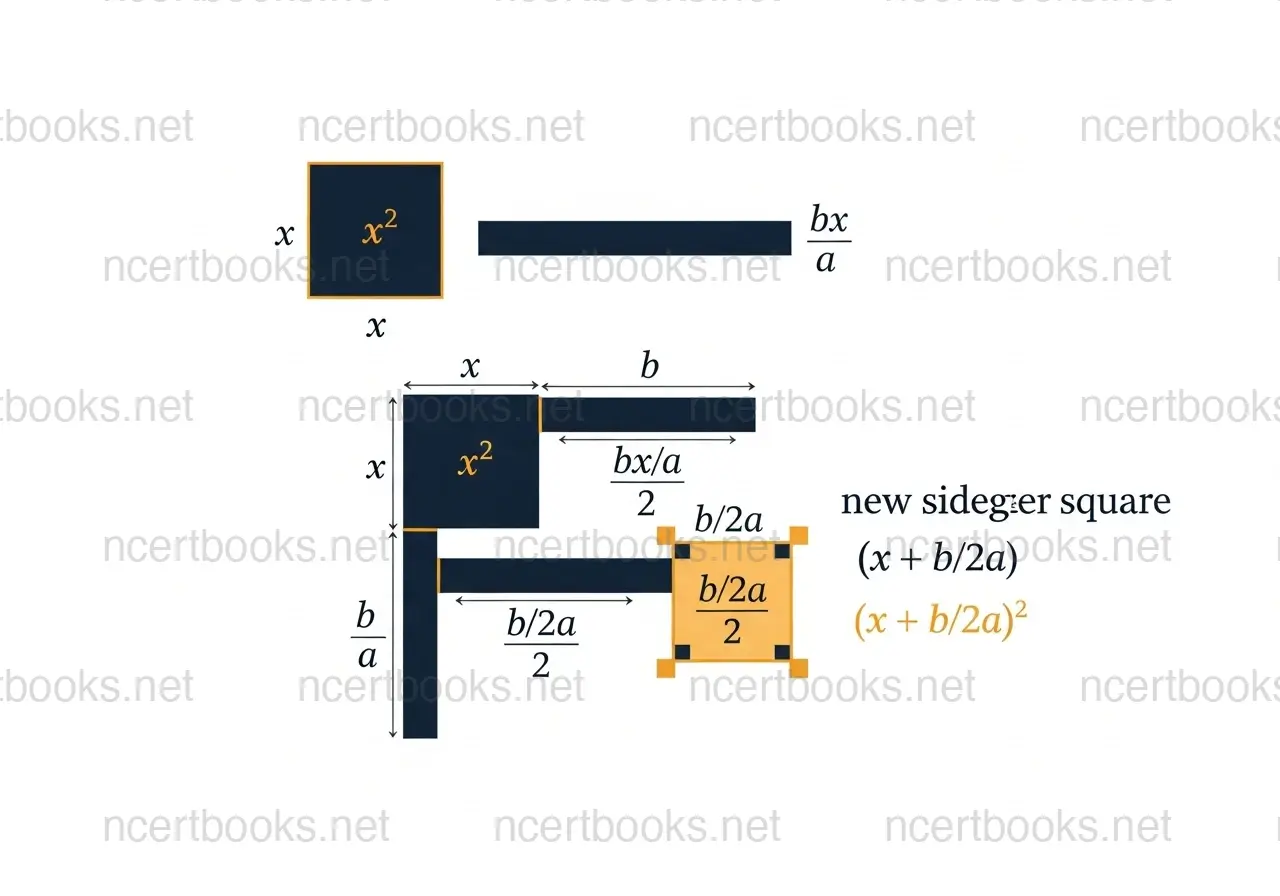
- Standard Form: A quadratic equation is written as \ ( ax^2 + bx + c = 0 \), where \ ( a \neq 0 \).
- Degree: The highest power of the variable must be exactly 2.
- Roots / Zeroes: A quadratic equation has at most two roots.
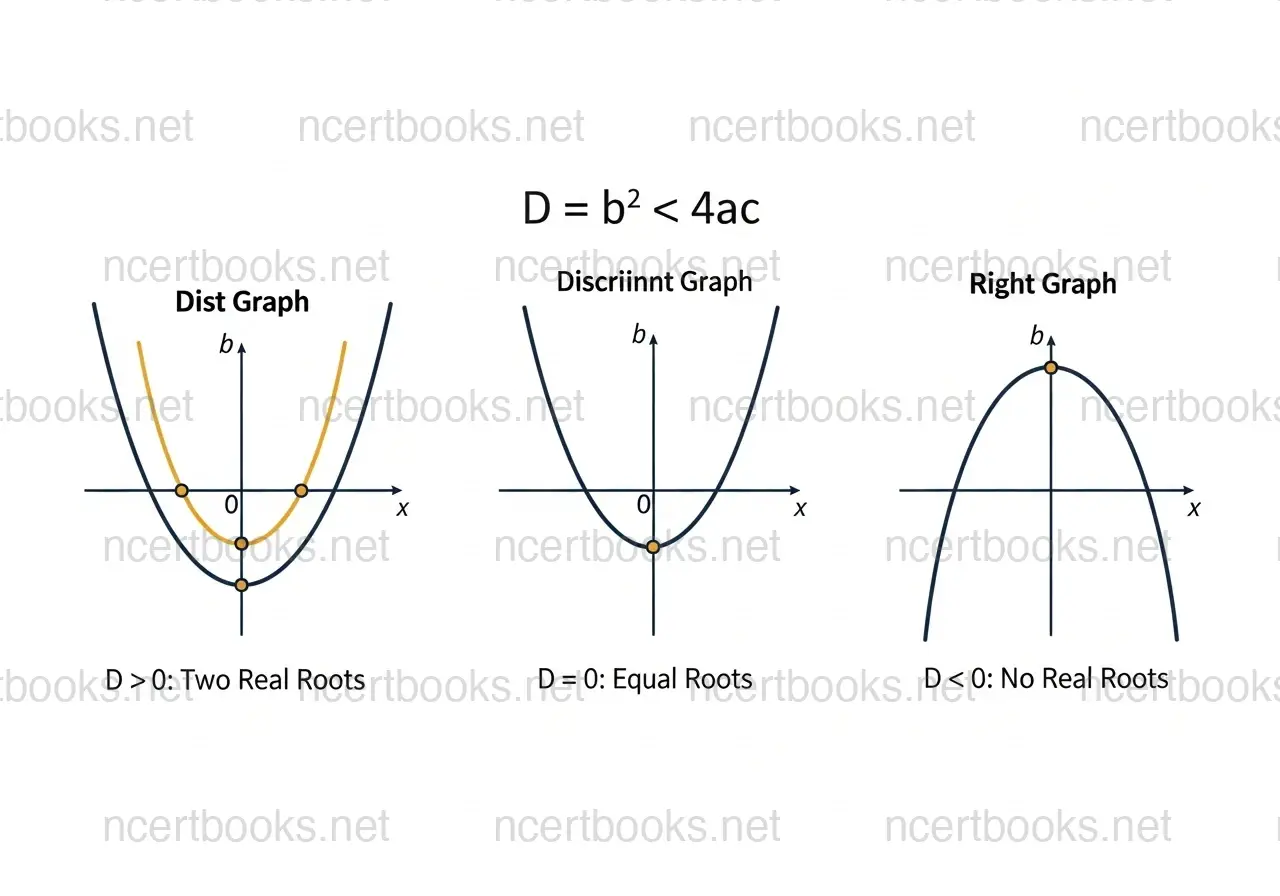
- Discriminant: \ ( D = b^2 – 4ac \). If \ ( D \geq 0 \), roots are real.
- Exercise 4.1 Focus: Identifying quadratic equations and forming them from word problems — no solving required here.
- Word Problem Strategy: Assign variable → form equation → simplify to \ ( ax^2 + bx + c = 0 \).
- Syllabus Status: Chapter 4 is fully included in the 2026-27 CBSE rationalised syllabus.
The NCERT Solutions for Class 10 Maths Chapter 4 Quadratic Equations on this page are fully updated for the 2026-27 CBSE board exam. These solutions cover Exercise 4.1 in complete detail, with step-by-step working for all 2 questions and their sub-parts. You can find all NCERT Solutions for Class 10 on our sub-hub, and the complete collection of NCERT Solutions for all classes on our main hub. The official textbook is available on the NCERT official website.
- Chapter Overview
- Key Concepts and Theorems
- Formula Reference Table
- Exercise 4.1 Solutions — Step by Step
- Question 1 — Identify Quadratic Equations
- Question 2 — Word Problems as Quadratic Equations
- Solved Examples Beyond NCERT
- Important Questions for Board Exam
- Common Mistakes Students Make
- Exam Tips for 2026-27
- Key Points to Remember
- Frequently Asked Questions
NCERT Solutions for Class 10 Maths Chapter 4 Quadratic Equations — Chapter Overview
Chapter 4 of the NCERT Class 10 Mathematics textbook (published by the NCERT) introduces Quadratic Equations — one of the most important algebra topics in secondary school mathematics. You will learn to identify quadratic equations, form them from real-life situations, and solve them using three methods: factorisation, completing the square, and the quadratic formula.
For CBSE board exams, this chapter typically carries 6–8 marks and appears in both the short-answer (2–3 mark) and long-answer (4–5 mark) sections. Word problems and the quadratic formula are the most frequently tested areas. Students who have studied Chapter 2 (Polynomials) and Chapter 3 (Linear Equations) will find the transition to quadratic equations straightforward.
| Detail | Information |
|---|---|
| Class | 10 |
| Subject | Mathematics |
| Chapter | Chapter 4 |
| Chapter Name | Quadratic Equations |
| Textbook | NCERT Mathematics (Class 10) |
| Exercise Covered | Exercise 4.1 (2 Questions, 12 Sub-parts) |
| Marks Weightage | 6–8 marks (approx.) |
| Difficulty Level | Easy to Medium |
| Academic Year | 2026-27 |
 0 D=0 D<0 for quadratic equations - NCERT Class 10 Maths Chapter 4" width="1280" height="896" loading="lazy">
Key Concepts and Theorems — Quadratic Equations
Standard Form of a Quadratic Equation
A quadratic equation (द्विघात समीकरण) in variable \ ( x \) is any equation that can be written in the form:
\[ ax^2 + bx + c = 0 \]
where \ ( a, b, c \) are real numbers and \ ( a \neq 0 \). The condition \ ( a \neq 0 \) is critical — if \ ( a = 0 \), the equation becomes linear, not quadratic.
Roots / Zeroes of a Quadratic Equation
A real number \ ( \alpha \) is a root (मूल) of \ ( ax^2 + bx + c = 0 \) if substituting \ ( x = \alpha \) satisfies the equation, i.e., \ ( a\alpha^2 + b\alpha + c = 0 \). Every quadratic equation has at most two roots.
Discriminant and Nature of Roots
The discriminant (विविक्तकर) is defined as \ ( D = b^2 – 4ac \). It tells you the nature of the roots without fully solving the equation:
- If \ ( D > 0 \): two distinct real roots
- If \ ( D = 0 \): two equal real roots
- If \ ( D < 0 \): no real roots (roots are imaginary)
How to Identify a Quadratic Equation
Expand both sides of the equation fully. Bring all terms to one side. If the resulting polynomial has degree exactly 2 (i.e., \ ( x^2 \) term is present with a non-zero coefficient), it is quadratic. If \ ( x^2 \) cancels out or the degree is 3 or more, it is not quadratic.
Formula Reference Table — Quadratic Equations
| Formula Name | Formula | Variables Defined |
|---|---|---|
| Standard Form | \ ( ax^2 + bx + c = 0 \) | \ ( a \neq 0 \); a, b, c are real numbers |
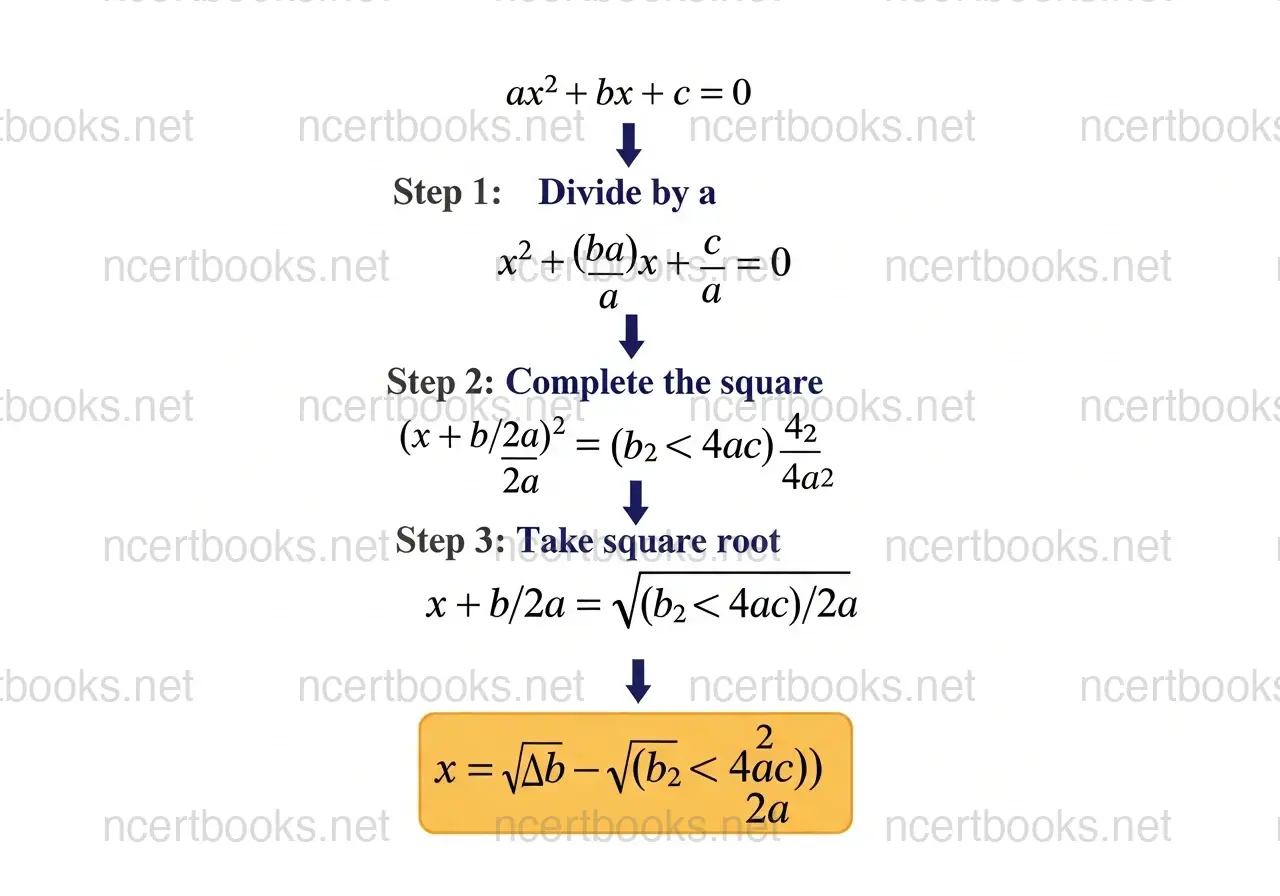
| Quadratic Formula | \ ( x = \frac{-b \pm \sqrt{b^2 – 4ac}}{2a} \) | Gives both roots directly |
| Discriminant | \ ( D = b^2 – 4ac \) | Determines nature of roots |
| Sum of Roots | \ ( \alpha + \beta = \frac{-b}{a} \) | \ ( \alpha, \beta \) are the two roots |
| Product of Roots | \ ( \alpha \cdot \beta = \frac{c}{a} \) | \ ( \alpha, \beta \) are the two roots |
Exercise 4.1 Solutions — Step by Step (2026-27)
Below are the complete NCERT Solutions for Class 10 Maths Chapter 4 Quadratic Equations Exercise 4.1. Every sub-part is solved with full working. These answers are aligned with the CBSE 2026-27 marking scheme. You can also explore related chapters in our NCERT Solutions for Class 10 section.
Question 1
Medium
Check whether the following are quadratic equations:
Step 1: Expand the left-hand side:
\[ x^2 + 2x + 1 = 2x – 6 \]
Step 2: Bring all terms to one side:
\[ x^2 + 2x + 1 – 2x + 6 = 0 \]
\[ x^2 + 7 = 0 \]
Step 3: Check the degree. The highest power of \ ( x \) is 2, and the coefficient of \ ( x^2 \) is 1 \ ( \neq 0 \).
\ ( \therefore \) Yes, this is a quadratic equation. Standard form: \ ( x^2 + 0 \cdot x + 7 = 0 \)
Step 1: Expand the right-hand side:
\[ x^2 – 2x = -6 + 2x \]
Step 2: Bring all terms to one side:
\[ x^2 – 2x – 2x + 6 = 0 \]
\[ x^2 – 4x + 6 = 0 \]
Step 3: The highest power is 2 and coefficient of \ ( x^2 \) is 1 \ ( \neq 0 \).
\ ( \therefore \) Yes, this is a quadratic equation. Standard form: \ ( x^2 – 4x + 6 = 0 \)
Step 1: Expand both sides:
\[ x^2 + x – 2x – 2 = x^2 + 3x – x – 3 \]
\[ x^2 – x – 2 = x^2 + 2x – 3 \]
Step 2: Bring all terms to one side:
\[ x^2 – x – 2 – x^2 – 2x + 3 = 0 \]
\[ -3x + 1 = 0 \]
Why does this happen? The \ ( x^2 \) terms cancel out on both sides, leaving a linear equation.
Step 3: The highest power of \ ( x \) is 1, not 2.
\ ( \therefore \) No, this is NOT a quadratic equation. It is a linear equation: \ ( -3x + 1 = 0 \)
Step 1: Expand the left-hand side:
\[ 2x^2 + x – 6x – 3 = x^2 + 5x \]
\[ 2x^2 – 5x – 3 = x^2 + 5x \]
Step 2: Bring all terms to one side:
\[ 2x^2 – 5x – 3 – x^2 – 5x = 0 \]
\[ x^2 – 10x – 3 = 0 \]
Step 3: Highest power is 2, coefficient of \ ( x^2 \) is 1 \ ( \neq 0 \).
\ ( \therefore \) Yes, this is a quadratic equation. Standard form: \ ( x^2 – 10x – 3 = 0 \)
Step 1: Expand both sides:
\[ 2x^2 – 6x – x + 3 = x^2 – x + 5x – 5 \]
\[ 2x^2 – 7x + 3 = x^2 + 4x – 5 \]
Step 2: Bring all terms to one side:
\[ 2x^2 – 7x + 3 – x^2 – 4x + 5 = 0 \]
\[ x^2 – 11x + 8 = 0 \]
\ ( \therefore \) Yes, this is a quadratic equation. Standard form: \ ( x^2 – 11x + 8 = 0 \)
Step 1: Expand the right-hand side:
\[ x^2 + 3x + 1 = x^2 – 4x + 4 \]
Step 2: Bring all terms to one side:
\[ x^2 + 3x + 1 – x^2 + 4x – 4 = 0 \]
\[ 7x – 3 = 0 \]
Why does this happen? The \ ( x^2 \) terms cancel, leaving a linear equation.
\ ( \therefore \) No, this is NOT a quadratic equation. It simplifies to a linear equation: \ ( 7x – 3 = 0 \)
Step 1: Expand the left-hand side using the identity \ ( (a+b)^3 = a^3 + 3a^2b + 3ab^2 + b^3 \):
\[ x^3 + 6x^2 + 12x + 8 = 2x^3 – 2x \]
Step 2: Bring all terms to one side:
\[ x^3 + 6x^2 + 12x + 8 – 2x^3 + 2x = 0 \]
\[ -x^3 + 6x^2 + 14x + 8 = 0 \]
Why is this not quadratic? The term \ ( -x^3 \) means the highest degree is 3, making this a cubic equation.
Step 3: Highest power is 3, not 2.
\ ( \therefore \) No, this is NOT a quadratic equation. It is a cubic equation of degree 3.
Step 1: Expand the right-hand side:
\[ (x-2)^3 = x^3 – 6x^2 + 12x – 8 \]
Step 2: Set up the equation:
\[ x^3 – 4x^2 – x + 1 = x^3 – 6x^2 + 12x – 8 \]
Step 3: Bring all terms to one side:
\[ x^3 – 4x^2 – x + 1 – x^3 + 6x^2 – 12x + 8 = 0 \]
\[ 2x^2 – 13x + 9 = 0 \]
Why does this work? The \ ( x^3 \) terms cancel, and we are left with a degree-2 polynomial.
Step 4: Highest power is 2, coefficient of \ ( x^2 \) is 2 \ ( \neq 0 \).
\ ( \therefore \) Yes, this is a quadratic equation. Standard form: \ ( 2x^2 – 13x + 9 = 0 \)
Question 2
Medium
Represent the following situations in the form of quadratic equations:
Given: Area of rectangular plot = 528 m². Length is one more than twice the breadth.
Step 1: Let the breadth of the plot be \ ( x \) metres.
Step 2: Then the length = \ ( 2x + 1 \) metres (one more than twice the breadth).
Step 3: Use the area formula: Area = Length \ ( \times \) Breadth
\[ (2x + 1) \times x = 528 \]
\[ 2x^2 + x = 528 \]
Step 4: Bring all terms to one side:
\[ 2x^2 + x – 528 = 0 \]
\ ( \therefore \) The required quadratic equation is \ ( 2x^2 + x – 528 = 0 \), where \ ( x \) is the breadth in metres.
Given: The product of two consecutive positive integers is 306.
Step 1: Let the first (smaller) integer be \ ( x \).
Step 2: Then the next consecutive integer is \ ( x + 1 \).
Step 3: Set up the product equation:
\[ x(x + 1) = 306 \]
\[ x^2 + x = 306 \]
Step 4: Bring all terms to one side:
\[ x^2 + x – 306 = 0 \]
\ ( \therefore \) The required quadratic equation is \ ( x^2 + x – 306 = 0 \), where \ ( x \) is the smaller integer.
Given: Rohan’s mother is 26 years older than Rohan. The product of their ages 3 years from now will be 360.
Step 1: Let Rohan’s present age be \ ( x \) years.
Step 2: Then his mother’s present age = \ ( x + 26 \) years.
Step 3: Three years from now: Rohan’s age = \ ( x + 3 \), Mother’s age = \ ( x + 29 \).
Step 4: Set up the product equation:
\[ (x + 3)(x + 29) = 360 \]
\[ x^2 + 29x + 3x + 87 = 360 \]
\[ x^2 + 32x + 87 = 360 \]
Step 5: Bring all terms to one side:
\[ x^2 + 32x + 87 – 360 = 0 \]
\[ x^2 + 32x – 273 = 0 \]
\ ( \therefore \) The required quadratic equation is \ ( x^2 + 32x – 273 = 0 \), where \ ( x \) is Rohan’s present age in years.
Given: A train travels 480 km at uniform speed. If speed were 8 km/h less, it would take 3 hours more.
Step 1: Let the original speed of the train be \ ( x \) km/h.
Step 2: Time at original speed = \ ( \frac{480}{x} \) hours.
Step 3: Reduced speed = \ ( (x – 8) \) km/h. Time at reduced speed = \ ( \frac{480}{x – 8} \) hours.
Step 4: The reduced-speed journey takes 3 hours more, so:
\[ \frac{480}{x – 8} – \frac{480}{x} = 3 \]
Step 5: Multiply throughout by \ ( x(x – 8) \):
\[ 480x – 480(x – 8) = 3x(x – 8) \]
\[ 480x – 480x + 3840 = 3x^2 – 24x \]
\[ 3840 = 3x^2 – 24x \]
Step 6: Divide throughout by 3 and rearrange:
\[ 1280 = x^2 – 8x \]
\[ x^2 – 8x – 1280 = 0 \]
\ ( \therefore \) The required quadratic equation is \ ( x^2 – 8x – 1280 = 0 \), where \ ( x \) is the original speed of the train in km/h.
Solved Examples Beyond NCERT — Extra Practice
These extra examples help you prepare for NCERT Exemplar Class 10 Maths solutions and higher-difficulty CBSE questions.
Extra Example 1
Easy
Is \ ( (x + 1)(x – 1) = x^2 + 3 \) a quadratic equation?
Step 1: Expand the left side: \ ( x^2 – 1 = x^2 + 3 \)
Step 2: Subtract \ ( x^2 \) from both sides: \ ( -1 = 3 \), which gives \ ( 0 = 4 \).
Why is this not quadratic? The \ ( x^2 \) terms cancel completely, leaving no variable at all — this is a contradiction, not an equation in \ ( x \).
No, this is not a quadratic equation.
Extra Example 2
Medium
A rectangular garden has a perimeter of 40 m and an area of 96 m². Form a quadratic equation in terms of its length.
Step 1: Let length = \ ( l \) metres. Perimeter = \ ( 2(l + b) = 40 \), so \ ( l + b = 20 \), giving \ ( b = 20 – l \).
Step 2: Use area: \ ( l \times b = 96 \)
\[ l(20 – l) = 96 \]
\[ 20l – l^2 = 96 \]
\[ l^2 – 20l + 96 = 0 \]
\ ( \therefore \) Quadratic equation: \ ( l^2 – 20l + 96 = 0 \)
Extra Example 3
Hard
A boat goes 30 km upstream and 44 km downstream in 10 hours. If the speed of the stream is 3 km/h, form a quadratic equation for the speed of the boat in still water.
Step 1: Let speed of boat in still water = \ ( x \) km/h.
Step 2: Upstream speed = \ ( x – 3 \) km/h; Downstream speed = \ ( x + 3 \) km/h.
Step 3: Total time = 10 hours:
\[ \frac{30}{x – 3} + \frac{44}{x + 3} = 10 \]
Step 4: Multiply through by \ ( (x-3)(x+3) \):
\[ 30(x + 3) + 44(x – 3) = 10(x^2 – 9) \]
\[ 30x + 90 + 44x – 132 = 10x^2 – 90 \]
\[ 74x – 42 = 10x^2 – 90 \]
\[ 10x^2 – 74x – 48 = 0 \]
\[ 5x^2 – 37x – 24 = 0 \]
\ ( \therefore \) Quadratic equation: \ ( 5x^2 – 37x – 24 = 0 \)
Topic-wise Important Questions for Board Exam — Quadratic Equations Class 10
1-Mark Questions (Definition / Recall)
- Define a quadratic equation. Give one example.
Answer: An equation of the form \ ( ax^2 + bx + c = 0 \), where \ ( a \neq 0 \), is called a quadratic equation. Example: \ ( 2x^2 – 3x + 1 = 0 \). - What is the degree of a quadratic equation?
Answer: The degree of a quadratic equation is 2. - How many roots can a quadratic equation have at most?
Answer: At most two roots.
3-Mark Questions (Application)
- Check whether \ ( (x + 2)^3 = 2x(x^2 – 1) \) is a quadratic equation. Show full working.
Answer: Expanding LHS: \ ( x^3 + 6x^2 + 12x + 8 \). RHS: \ ( 2x^3 – 2x \). Subtracting: \ ( -x^3 + 6x^2 + 14x + 8 = 0 \). Degree is 3, so it is NOT a quadratic equation. - The sum of two natural numbers is 8 and their product is 15. Form a quadratic equation.
Answer: Let one number be \ ( x \). Then the other is \ ( 8 – x \). Product: \ ( x(8 – x) = 15 \Rightarrow 8x – x^2 = 15 \Rightarrow x^2 – 8x + 15 = 0 \).
5-Mark Questions (Long Answer)
- A train covers a distance of 360 km at a uniform speed. Had the speed been 5 km/h more, it would have taken 1 hour less. Form a quadratic equation for the speed of the train.
Answer: Let speed = \ ( x \) km/h. Time at original speed = \ ( \frac{360}{x} \). Time at increased speed = \ ( \frac{360}{x+5} \). Difference = 1 hour: \ ( \frac{360}{x} – \frac{360}{x+5} = 1 \). Multiply by \ ( x(x+5) \): \ ( 360(x+5) – 360x = x(x+5) \Rightarrow 1800 = x^2 + 5x \Rightarrow x^2 + 5x – 1800 = 0 \). This is the required quadratic equation.
Common Mistakes Students Make in Quadratic Equations
Mistake 1: Forgetting to check whether x² cancels out
Why it’s wrong: If \ ( x^2 \) terms cancel, the equation is linear, not quadratic. Many students assume an equation is quadratic just because it has \ ( x^2 \) on both sides.
Correct approach: Always simplify fully and check the degree of the final polynomial.
Mistake 2: Not defining the variable clearly in word problems
Why it’s wrong: CBSE examiners award 1 mark specifically for defining the variable. Skipping this loses marks.
Correct approach: Always write “Let \ ( x \) = [quantity]” before forming the equation.
Mistake 3: Leaving the equation in factored form instead of standard form
Why it’s wrong: The question asks you to represent the situation as a quadratic equation in standard form \ ( ax^2 + bx + c = 0 \).
Correct approach: Always expand and collect all terms on one side.
Mistake 4: Treating \ ( (x+2)^3 \) as a quadratic expression
Why it’s wrong: Cubic expansions produce degree-3 terms that must be checked after simplification.
Correct approach: Expand completely before judging the degree.
Mistake 5: Sign errors when bringing terms to one side
Why it’s wrong: A sign error changes the entire equation and leads to the wrong standard form.
Correct approach: Write each step carefully; use brackets when subtracting entire expressions.
Exam Tips for 2026-27 CBSE Board Exams — Quadratic Equations
- Show all expansion steps: CBSE 2026-27 marking scheme awards step marks. Even if your final answer is wrong, you earn marks for correct working.
- Word problems — always define the variable: Write “Let \ ( x \) = …” as your very first line. This is worth 1 mark in most CBSE papers.
- End in standard form: Every word problem answer must conclude with \ ( ax^2 + bx + c = 0 \). Do not leave it in factored or rearranged form.
- Discriminant questions are common: Expect at least one question asking you to find the nature of roots using \ ( D = b^2 – 4ac \) — this comes from Exercise 4.4.
- Chapter weightage: Quadratic Equations typically carries 6–8 marks in CBSE Class 10 Maths board papers. It is part of the Algebra unit, which carries the highest weightage.
- Revision checklist for 2026-27: (a) Standard form identification ✓ (b) Word problem formulation ✓ (c) Factorisation method ✓ (d) Quadratic formula ✓ (e) Nature of roots using discriminant ✓
Key Points to Remember — Quadratic Equations Class 10
- A quadratic equation must have degree exactly 2 — the \ ( x^2 \) coefficient must be non-zero.
- Always expand and simplify fully before deciding whether an equation is quadratic.
- The discriminant \ ( D = b^2 – 4ac \) determines the nature of roots without solving.
- A quadratic equation has at most 2 roots — it can have 0, 1, or 2 real roots.
- In word problems, let the unknown be \ ( x \), translate conditions into algebra, and simplify to standard form.
- Exercise 4.1 only requires identification and formation of quadratic equations — no solving required.
- For the CBSE 2026-27 exam, practice all four word problems in Q2 as they are frequently repeated.
For more practice, check out our related pages: NCERT Solutions for Class 10 Maths covering all chapters, and explore the full NCERT Solutions library for all classes and subjects.
Frequently Asked Questions — Quadratic Equations Class 10 NCERT