- Chapter: 4 — Quadratic Equations | Class 10 Maths NCERT
- Exercise 4.3 Focus: Completing the Square Method & Quadratic Formula
- Quadratic Formula: \( x = \frac{-b \pm \sqrt{b^2 – 4ac}}{2a} \)
- Discriminant (D): \( D = b^2 – 4ac \) — determines nature of roots
- D > 0: Two distinct real roots | D = 0: Two equal real roots | D < 0: No real roots
- Total Questions: 11 (Q1–Q2: formula-based; Q3–Q11: word problems)
- Board Exam Weightage: Quadratic Equations carries 6–8 marks in CBSE Class 10 Maths
- Updated for: 2026-27 CBSE Rationalised Syllabus
This page reflects the latest NCERT rationalised syllabus for 2026-27. All 11 questions in Exercise 4.3 are part of the current CBSE syllabus. No questions have been removed from this exercise.
The NCERT Solutions for Class 10 Maths Chapter 4 Ex 4.3 on this page cover all 11 questions from the Quadratic Equations exercise, fully updated for the 2026-27 CBSE board exam. This exercise is the most important in Chapter 4 because it introduces two powerful methods — completing the square and the quadratic formula — that students use to solve equations that cannot be factorised easily. You can find all NCERT Solutions for Class 10 on our hub page. These solutions are also part of our complete NCERT Solutions library. For the official textbook, visit the NCERT official website.
Table of Contents
- Quick Revision Box
- Chapter Overview — Quadratic Equations Class 10
- Key Concepts: Completing the Square and Quadratic Formula
- NCERT Solutions for Class 10 Maths Chapter 4 Ex 4.3 — All Questions
- Formula Reference Table
- Solved Examples Beyond NCERT
- Important Questions for Board Exam 2026-27
- Common Mistakes Students Make
- Exam Tips for CBSE 2026-27
- Frequently Asked Questions
Chapter Overview — Quadratic Equations Class 10 Maths
Chapter 4 of the NCERT Class 10 Maths textbook (Mathematics — Textbook for Class X, published by NCERT) deals with Quadratic Equations — equations of the form \( ax^2 + bx + c = 0 \) where \( a \neq 0 \). Exercise 4.3 specifically covers two algebraic methods: completing the square and the quadratic formula. These methods work even when an equation cannot be factorised by inspection.
For CBSE board exams 2026-27, Quadratic Equations is part of the Algebra unit and typically carries 6–8 marks. Questions from this exercise appear as 2-mark, 3-mark, and 5-mark problems. Word problems (Q4–Q11) are especially popular in board papers.
Prerequisites: Students should be comfortable with factorisation (Ex 4.2), basic algebraic identities, and solving linear equations before attempting Ex 4.3.
| Detail | Information |
|---|---|
| Chapter | 4 — Quadratic Equations |
| Exercise | 4.3 |
| Textbook | NCERT Mathematics Class X |
| Class | 10 |
| Subject | Mathematics |
| Total Questions | 11 |
| Methods Covered | Completing the Square, Quadratic Formula |
| Marks Weightage | 6–8 marks (Algebra unit) |
| Difficulty Level | Medium to Hard |
| Academic Year | 2026-27 |
Key Concepts: Completing the Square and Quadratic Formula
Completing the Square Method (वर्ग पूर्ण करने की विधि)
This method converts any quadratic equation into the form \( (x + k)^2 = d \), which can then be solved by taking square roots. The steps are:
- Make the coefficient of \( x^2 \) equal to 1 (divide throughout if needed).
- Move the constant term to the right side.
- Add \( \left(\frac{\text{coefficient of } x}{2}\right)^2 \) to both sides.
- Write the left side as a perfect square.
- Take the square root of both sides and solve for \( x \).
The Quadratic Formula (द्विघात सूत्र)
For any quadratic equation \( ax^2 + bx + c = 0 \) (where \( a \neq 0 \)), the roots are given by:
\[ x = \frac{-b \pm \sqrt{b^2 – 4ac}}{2a} \]
The expression \( D = b^2 – 4ac \) is called the discriminant. It tells you about the nature of roots without actually solving the equation.
Nature of Roots Based on Discriminant
- If \( D > 0 \): Two distinct real roots
- If \( D = 0 \): Two equal real roots (also called repeated roots)
- If \( D < 0 \): No real roots exist
NCERT Solutions for Class 10 Maths Chapter 4 Ex 4.3 — All 11 Questions
Below are complete, step-by-step solutions for all 11 questions in Exercise 4.3. These solutions follow the CBSE marking scheme for 2026-27 board exams.
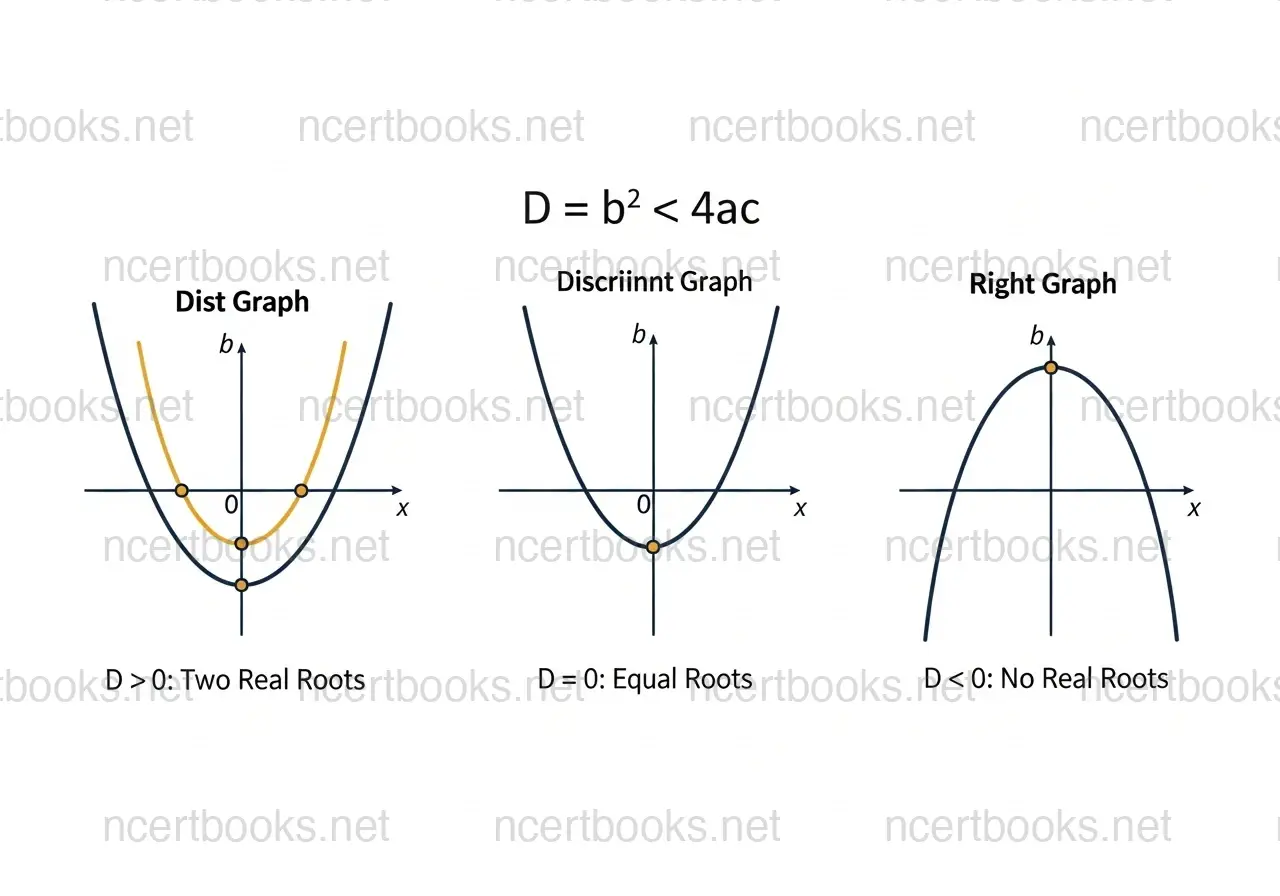 0 D=0 D<0 for quadratic equations - NCERT Class 10 Maths Chapter 4" width="1280" height="896" loading="lazy">
Question 1
Medium
Find the roots of the following quadratic equations, if they exist, by the method of completing the square: (i) \( 2x^2 – 7x + 3 = 0 \) (ii) \( 2x^2 + x – 4 = 0 \) (iii) \( 4x^2 + 4\sqrt{3}x + 3 = 0 \) (iv) \( 2x^2 + x + 4 = 0 \)
Step 1: Divide throughout by 2 to make coefficient of \( x^2 \) equal to 1:
\[ x^2 – \frac{7}{2}x + \frac{3}{2} = 0 \]
Step 2: Move the constant to the right side:
\[ x^2 – \frac{7}{2}x = -\frac{3}{2} \]
Step 3: Add \( \left(\frac{7}{4}\right)^2 = \frac{49}{16} \) to both sides:
\[ x^2 – \frac{7}{2}x + \frac{49}{16} = -\frac{3}{2} + \frac{49}{16} \]
\[ \left(x – \frac{7}{4}\right)^2 = \frac{-24 + 49}{16} = \frac{25}{16} \]
Step 4: Take the square root of both sides:
\[ x – \frac{7}{4} = \pm \frac{5}{4} \]
Step 5: Solve for \( x \):
\[ x = \frac{7}{4} + \frac{5}{4} = 3 \quad \text{or} \quad x = \frac{7}{4} – \frac{5}{4} = \frac{1}{2} \]
\( \therefore \) Roots are \( x = 3 \) and \( x = \frac{1}{2} \)
Step 1: Divide throughout by 2:
\[ x^2 + \frac{1}{2}x – 2 = 0 \]
Step 2: Move constant to right:
\[ x^2 + \frac{1}{2}x = 2 \]
Step 3: Add \( \left(\frac{1}{4}\right)^2 = \frac{1}{16} \) to both sides:
\[ \left(x + \frac{1}{4}\right)^2 = 2 + \frac{1}{16} = \frac{33}{16} \]
Step 4: Take square root:
\[ x + \frac{1}{4} = \pm \frac{\sqrt{33}}{4} \]
Step 5: Solve:
\[ x = \frac{-1 + \sqrt{33}}{4} \quad \text{or} \quad x = \frac{-1 – \sqrt{33}}{4} \]
\( \therefore \) Roots are \( x = \frac{-1 + \sqrt{33}}{4} \) and \( x = \frac{-1 – \sqrt{33}}{4} \)
Step 1: Divide throughout by 4:
\[ x^2 + \sqrt{3}x + \frac{3}{4} = 0 \]
Step 2: Move constant to right:
\[ x^2 + \sqrt{3}x = -\frac{3}{4} \]
Step 3: Add \( \left(\frac{\sqrt{3}}{2}\right)^2 = \frac{3}{4} \) to both sides:
\[ \left(x + \frac{\sqrt{3}}{2}\right)^2 = -\frac{3}{4} + \frac{3}{4} = 0 \]
Step 4: Take square root:
\[ x + \frac{\sqrt{3}}{2} = 0 \]
\[ x = -\frac{\sqrt{3}}{2} \]
Why does this work? The discriminant is zero here, so both roots are equal.
\( \therefore \) Roots are \( x = -\frac{\sqrt{3}}{2} \) and \( x = -\frac{\sqrt{3}}{2} \) (equal roots)
Step 1: Divide throughout by 2:
\[ x^2 + \frac{1}{2}x + 2 = 0 \]
Step 2: Move constant to right:
\[ x^2 + \frac{1}{2}x = -2 \]
\[ \left(x + \frac{1}{4}\right)^2 = -2 + \frac{1}{16} = \frac{-31}{16} \]
Why does this work? The right side is negative, meaning no real square root exists.
\( \therefore \) Since \( \left(x + \frac{1}{4}\right)^2 = -\frac{31}{16} < 0 \), no real roots exist for this equation.
Question 2
Medium
Find the roots of the quadratic equations by applying the quadratic formula: (i) \( 2x^2 – 7x + 3 = 0 \) (ii) \( 2x^2 – x + 4 = 0 \) (iii) \( 4x^2 – 4\sqrt{3}x + 3 = 0 \) (iv) \( 2x^2 – x + 4 = 0 \)
Step 1: Identify \( a = 2,\ b = -7,\ c = 3 \).
Step 2: Calculate discriminant:
\[ D = b^2 – 4ac = 49 – 24 = 25 \]
Step 3: Since \( D > 0 \), two distinct real roots exist. Apply formula:
\[ x = \frac{7 \pm \sqrt{25}}{4} = \frac{7 \pm 5}{4} \]
\[ x = \frac{12}{4} = 3 \quad \text{or} \quad x = \frac{2}{4} = \frac{1}{2} \]
Step 1: Identify \( a = 2,\ b = -1,\ c = 4 \).
Step 2: Calculate discriminant:
\[ D = (-1)^2 – 4(2)(4) = 1 – 32 = -31 \]
Step 3: Since \( D < 0 \), no real roots exist.
\( \therefore \) No real roots exist for \( 2x^2 – x + 4 = 0 \).
Step 1: Identify \( a = 4,\ b = -4\sqrt{3},\ c = 3 \).
Step 2: Calculate discriminant:
\[ D = (-4\sqrt{3})^2 – 4(4)(3) = 48 – 48 = 0 \]
Step 3: Since \( D = 0 \), two equal real roots:
\[ x = \frac{4\sqrt{3}}{2 \times 4} = \frac{4\sqrt{3}}{8} = \frac{\sqrt{3}}{2} \]
\( \therefore \) Roots are \( x = \frac{\sqrt{3}}{2} \) and \( x = \frac{\sqrt{3}}{2} \) (equal roots)
Note: This part is the same equation as part (ii). \( a = 2,\ b = -1,\ c = 4 \).
\[ D = 1 – 32 = -31 < 0 \]
\( \therefore \) No real roots exist.
Question 3
Medium
Find the roots of the following equations: (i) \( x – \frac{1}{x} = 3,\ x \neq 0 \) (ii) \( \frac{1}{x+4} – \frac{1}{x-7} = \frac{11}{30},\ x \neq -4, 7 \)
Step 1: Multiply throughout by \( x \):
\[ x^2 – 1 = 3x \]
\[ x^2 – 3x – 1 = 0 \]
Step 2: Apply quadratic formula with \( a = 1,\ b = -3,\ c = -1 \):
\[ D = 9 + 4 = 13 \]
\[ x = \frac{3 \pm \sqrt{13}}{2} \]
\( \therefore \) Roots are \( x = \frac{3 + \sqrt{13}}{2} \) and \( x = \frac{3 – \sqrt{13}}{2} \)
Step 1: Simplify the left side:
\[ \frac{(x-7) – (x+4)}{(x+4)(x-7)} = \frac{11}{30} \]
\[ \frac{-11}{(x+4)(x-7)} = \frac{11}{30} \]
Step 2: Cross multiply:
\[ -11 \times 30 = 11 \times (x+4)(x-7) \]
\[ -30 = (x+4)(x-7) \]
\[ x^2 – 3x – 28 = -30 \]
\[ x^2 – 3x + 2 = 0 \]
Step 3: Factorise:
\[ (x-1)(x-2) = 0 \]
\( \therefore \) Roots are \( x = 1 \) and \( x = 2 \)
Question 4
Medium
The sum of the reciprocals of Rehman’s ages (in years) 3 years ago and 5 years from now is \( \frac{1}{3} \). Find his present age.
Step 1: Let Rehman’s present age be \( x \) years. Then 3 years ago his age was \( (x-3) \) and 5 years from now it will be \( (x+5) \).
Step 2: Set up the equation:
\[ \frac{1}{x-3} + \frac{1}{x+5} = \frac{1}{3} \]
Step 3: Simplify the left side:
\[ \frac{(x+5) + (x-3)}{(x-3)(x+5)} = \frac{1}{3} \]
\[ \frac{2x+2}{(x-3)(x+5)} = \frac{1}{3} \]
Step 4: Cross multiply:
\[ 3(2x+2) = (x-3)(x+5) \]
\[ 6x + 6 = x^2 + 2x – 15 \]
\[ x^2 – 4x – 21 = 0 \]
Step 5: Factorise:
\[ (x-7)(x+3) = 0 \]
\[ x = 7 \quad \text{or} \quad x = -3 \]
Step 6: Since age cannot be negative, \( x = -3 \) is rejected.
\( \therefore \) Rehman’s present age is 7 years.
Question 5
Medium
In a class test, the sum of Shefali’s marks in Mathematics and English is 30. Had she got 2 marks more in Mathematics and 3 marks less in English, the product of their marks would have been 210. Find her marks in the two subjects.
Step 1: Let Shefali’s marks in Mathematics be \( x \). Then marks in English \( = 30 – x \).
Step 2: New Maths marks \( = x + 2 \); New English marks \( = (30 – x) – 3 = 27 – x \).
Step 3: Set up the equation for product:
\[ (x+2)(27-x) = 210 \]
\[ 27x – x^2 + 54 – 2x = 210 \]
\[ -x^2 + 25x + 54 = 210 \]
\[ x^2 – 25x + 156 = 0 \]
Step 4: Factorise:
\[ (x – 12)(x – 13) = 0 \]
\[ x = 12 \quad \text{or} \quad x = 13 \]
Step 5: Both values are valid (marks are positive and less than 30).
If \( x = 12 \): Maths = 12, English = 18. If \( x = 13 \): Maths = 13, English = 17.
\( \therefore \) Shefali’s marks are: Maths = 12 and English = 18, OR Maths = 13 and English = 17.
Question 6
Medium
The diagonal of a rectangular field is 60 metres more than the shorter side. If the longer side is 30 metres more than the shorter side, find the sides of the field.
Step 1: Let the shorter side be \( x \) metres. Then longer side \( = x + 30 \) metres and diagonal \( = x + 60 \) metres.
Step 2: Apply Pythagoras theorem:
\[ \text{diagonal}^2 = \text{shorter side}^2 + \text{longer side}^2 \]
\[ (x+60)^2 = x^2 + (x+30)^2 \]
Step 3: Expand:
\[ x^2 + 120x + 3600 = x^2 + x^2 + 60x + 900 \]
\[ x^2 + 120x + 3600 = 2x^2 + 60x + 900 \]
\[ x^2 – 60x – 2700 = 0 \]
Step 4: Factorise:
\[ (x – 90)(x + 30) = 0 \]
\[ x = 90 \quad \text{or} \quad x = -30 \]
Step 5: Since length cannot be negative, \( x = 90 \) m.
\( \therefore \) Shorter side = 90 m, Longer side = 120 m.
Question 7
Medium
The difference of squares of two numbers is 180. The square of the smaller number is 8 times the larger number. Find the two numbers.
Step 1: Let the larger number be \( x \) and the smaller number be \( y \).
Step 2: Set up equations from the given conditions:
\[ x^2 – y^2 = 180 \quad \text{…(1)} \]
\[ y^2 = 8x \quad \text{…(2)} \]
Step 3: Substitute (2) into (1):
\[ x^2 – 8x = 180 \]
\[ x^2 – 8x – 180 = 0 \]
Step 4: Factorise:
\[ (x – 18)(x + 10) = 0 \]
\[ x = 18 \quad \text{or} \quad x = -10 \]
Step 5: If \( x = 18 \): \( y^2 = 8 \times 18 = 144 \), so \( y = \pm 12 \). If \( x = -10 \): \( y^2 = -80 \), which is impossible.
\( \therefore \) The two numbers are 18 and 12, or 18 and −12.
Question 8
Hard
A train travels 360 km at a uniform speed. If the speed had been 5 km/h more, it would have taken 1 hour less for the same journey. Find the speed of the train.
Step 1: Let the speed of the train be \( x \) km/h. Time taken \( = \frac{360}{x} \) hours.
Step 2: At increased speed \( (x+5) \) km/h, time taken \( = \frac{360}{x+5} \) hours.
Step 3: Set up the equation (difference in time = 1 hour):
\[ \frac{360}{x} – \frac{360}{x+5} = 1 \]
Step 4: Simplify:
\[ 360(x+5) – 360x = x(x+5) \]
\[ 1800 = x^2 + 5x \]
\[ x^2 + 5x – 1800 = 0 \]
Step 5: Factorise:
\[ (x + 45)(x – 40) = 0 \]
\[ x = 40 \quad \text{or} \quad x = -45 \]
Step 6: Speed cannot be negative, so \( x = 40 \) km/h.
\( \therefore \) The speed of the train is 40 km/h.
Question 9
Hard
Two water taps together can fill a tank in \( 9\frac{3}{8} \) hours. The tap of larger diameter takes 10 hours less than the smaller one to fill the tank separately. Find the time in which each tap can separately fill the tank.
Step 1: Convert mixed fraction: \( 9\frac{3}{8} = \frac{75}{8} \) hours.
Step 2: Let time taken by smaller tap alone \( = x \) hours. Then time taken by larger tap \( = (x – 10) \) hours.
Step 3: Work done per hour by each tap: Smaller \( = \frac{1}{x} \), Larger \( = \frac{1}{x-10} \).
Step 4: Together they fill the tank in \( \frac{75}{8} \) hours:
\[ \frac{1}{x} + \frac{1}{x-10} = \frac{8}{75} \]
Step 5: Simplify:
\[ \frac{(x-10) + x}{x(x-10)} = \frac{8}{75} \]
\[ 75(2x – 10) = 8x(x-10) \]
\[ 150x – 750 = 8x^2 – 80x \]
\[ 8x^2 – 230x + 750 = 0 \]
\[ 4x^2 – 115x + 375 = 0 \]
Step 6: Apply quadratic formula with \( a = 4,\ b = -115,\ c = 375 \):
\[ D = 115^2 – 4 \times 4 \times 375 = 13225 – 6000 = 7225 = 85^2 \]
\[ x = \frac{115 \pm 85}{8} \]
\[ x = \frac{200}{8} = 25 \quad \text{or} \quad x = \frac{30}{8} = 3.75 \]
Step 7: If \( x = 3.75 \), then larger tap time \( = 3.75 – 10 = -6.25 \) hours, which is impossible. So \( x = 25 \).
\( \therefore \) Smaller tap fills in 25 hours; Larger tap fills in 15 hours.
Question 10
Hard
An express train takes 1 hour less than a passenger train to travel 132 km between Mysore and Bengaluru (without taking into consideration the time they stop at intermediate stations). If the average speed of the express train is 11 km/h more than that of the passenger train, find the average speed of the two trains.
Step 1: Let the speed of the passenger train be \( x \) km/h. Then speed of express train \( = (x + 11) \) km/h.
Step 2: Time taken by passenger train \( = \frac{132}{x} \) hours; by express train \( = \frac{132}{x+11} \) hours.
Step 3: Set up the equation:
\[ \frac{132}{x} – \frac{132}{x+11} = 1 \]
Step 4: Simplify:
\[ 132(x+11) – 132x = x(x+11) \]
\[ 132 \times 11 = x^2 + 11x \]
\[ 1452 = x^2 + 11x \]
\[ x^2 + 11x – 1452 = 0 \]
Step 5: Factorise:
\[ (x + 44)(x – 33) = 0 \]
\[ x = 33 \quad \text{or} \quad x = -44 \]
Step 6: Speed cannot be negative, so \( x = 33 \) km/h.
\( \therefore \) Speed of passenger train = 33 km/h; Speed of express train = 44 km/h.
Question 11
Medium
Sum of the areas of two squares is 468 m². If the difference of their perimeters is 24 m, find the sides of the two squares.
Step 1: Let the side of the larger square be \( x \) m and the smaller square be \( y \) m.
Step 2: Difference of perimeters:
\[ 4x – 4y = 24 \implies x – y = 6 \implies x = y + 6 \quad \text{…(1)} \]
Step 3: Sum of areas:
\[ x^2 + y^2 = 468 \quad \text{…(2)} \]
Step 4: Substitute (1) into (2):
\[ (y+6)^2 + y^2 = 468 \]
\[ y^2 + 12y + 36 + y^2 = 468 \]
\[ 2y^2 + 12y – 432 = 0 \]
\[ y^2 + 6y – 216 = 0 \]
Step 5: Factorise:
\[ (y + 18)(y – 12) = 0 \]
\[ y = 12 \quad \text{or} \quad y = -18 \]
Step 6: Side cannot be negative, so \( y = 12 \) m and \( x = 18 \) m.
\( \therefore \) Side of larger square = 18 m; Side of smaller square = 12 m.
Formula Reference Table — Quadratic Equations Class 10
| Formula Name | Formula | Variables |
|---|---|---|
| Standard Form | \( ax^2 + bx + c = 0 \) | \( a \neq 0 \); a, b, c are real numbers |
| Quadratic Formula | \( x = \frac{-b \pm \sqrt{b^2 – 4ac}}{2a} \) | a = coeff. of x², b = coeff. of x, c = constant |
| Discriminant | \( D = b^2 – 4ac \) | D > 0: distinct real roots; D = 0: equal roots; D < 0: no real roots |
| Sum of Roots | \( \alpha + \beta = -\frac{b}{a} \) | \( \alpha, \beta \) are roots of the equation |
| Product of Roots | \( \alpha \beta = \frac{c}{a} \) | \( \alpha, \beta \) are roots of the equation |
| Completing the Square | \( \left(x + \frac{b}{2a}\right)^2 = \frac{b^2 – 4ac}{4a^2} \) | Standard derivation of quadratic formula |
Solved Examples Beyond NCERT — Quadratic Equations
Extra Example 1
Easy
Solve \( x^2 – 5x + 6 = 0 \) using the quadratic formula.
Step 1: \( a = 1,\ b = -5,\ c = 6 \). Calculate \( D = 25 – 24 = 1 \).
\[ x = \frac{5 \pm 1}{2} \implies x = 3 \text{ or } x = 2 \]
Roots: \( x = 3 \) and \( x = 2 \)
Extra Example 2
Medium
A number is 3 less than twice another number. Their product is 104. Find the numbers.
Step 1: Let one number be \( x \). Then the other \( = 2x – 3 \).
\[ x(2x-3) = 104 \implies 2x^2 – 3x – 104 = 0 \]
Step 2: \( D = 9 + 832 = 841 = 29^2 \)
\[ x = \frac{3 \pm 29}{4} \implies x = 8 \text{ or } x = -\frac{26}{4} \]
Taking \( x = 8 \): the other number \( = 13 \).
The two numbers are 8 and 13.
Extra Example 3
Hard
A rectangular garden has area 300 m² and its perimeter is 70 m. Find the dimensions of the garden.
Step 1: Let length \( = l \) and breadth \( = b \). Then \( 2(l+b) = 70 \implies l + b = 35 \), so \( l = 35 – b \).
\[ (35-b) \cdot b = 300 \implies b^2 – 35b + 300 = 0 \]
Step 2: Factorise: \( (b-15)(b-20) = 0 \), so \( b = 15 \) or \( b = 20 \).
Dimensions: 20 m × 15 m.
Important Questions for Board Exam 2026-27 — Quadratic Equations
1-Mark Questions
- State the condition for a quadratic equation \( ax^2 + bx + c = 0 \) to have no real roots. [Answer: Discriminant \( D = b^2 – 4ac < 0 \)]
- Write the quadratic formula. [Answer: \( x = \frac{-b \pm \sqrt{b^2-4ac}}{2a} \)]
- What is the nature of roots when \( D = 0 \)? [Answer: Two equal real roots]
3-Mark Questions
- Find the roots of \( 3x^2 – 5x + 2 = 0 \) using the quadratic formula. Show all steps.
- The product of two consecutive positive integers is 306. Find the integers.
5-Mark Questions
- A motor boat whose speed is 18 km/h in still water takes 1 hour more to go 24 km upstream than to return downstream to the same spot. Find the speed of the stream. (Hint: Set up a quadratic equation using time = distance/speed.)
Common Mistakes Students Make in Quadratic Equations
Mistake 1: Students forget to divide by the coefficient of \( x^2 \) before completing the square.
Why it’s wrong: Completing the square only works directly when the coefficient of \( x^2 \) is 1.
Correct approach: Always divide the entire equation by the coefficient of \( x^2 \) as the very first step.
Mistake 2: Students write \( \sqrt{D} \) when \( D < 0 \) and try to find roots.
Why it’s wrong: A negative number has no real square root.
Correct approach: State clearly that since \( D < 0 \), no real roots exist.
Mistake 3: In word problems, students keep both roots even when one is physically impossible (e.g., negative age or speed).
Why it’s wrong: Context must be applied — CBSE deducts marks if you don’t reject the invalid root with a reason.
Correct approach: Write: “Since [age/speed/length] cannot be negative, \( x = [negative value] \) is rejected.”
Mistake 4: Students incorrectly identify \( a, b, c \) when the equation is not in standard form.
Why it’s wrong: The quadratic formula only works for \( ax^2 + bx + c = 0 \).
Correct approach: Always rearrange the equation to standard form before identifying \( a, b, c \).
Mistake 5: Students add \( \left(\frac{b}{2}\right)^2 \) instead of \( \left(\frac{b}{2a}\right)^2 \) when the coefficient of \( x^2 \) is not 1.
Why it’s wrong: The formula for completing the square changes when \( a \neq 1 \).
Correct approach: Divide first, then add \( \left(\frac{\text{new coefficient of }x}{2}\right)^2 \).
Exam Tips for CBSE 2026-27 — Chapter 4 Quadratic Equations
- ✅ Show all steps: CBSE 2026-27 marking scheme awards marks for each step, not just the final answer. Even if your final answer is wrong, step marks are given.
- ✅ State the discriminant value: When using the quadratic formula, always write \( D = b^2 – 4ac = [value] \) and state its implication before finding roots.
- ✅ Reject invalid roots explicitly: In word problems, write a sentence explaining why you reject the negative/zero root.
- ✅ Verify your answers: Substitute roots back into the original equation to confirm correctness — this takes 30 seconds and can save marks.
- ✅ Memorise the quadratic formula: It appears in multiple questions every year. Write it at the top of your answer sheet for quick reference.
- ✅ Practice converting word problems: Questions 4–11 in this exercise are the most common type in board exams. Practise setting up the equation from the problem statement — this is where most marks are lost.