⚡ Quick Revision Box — Chapter 4 Exercise 4.2
- Method used: Factorisation (splitting the middle term)
- Core principle: Zero Product Property — if \ ( A \times B = 0 \), then \( A = 0 \) or \( B = 0 \)
- Standard form: \( ax^{2} + bx + c = 0 \), where \( a \neq 0 \)
- Split middle term rule: Find two numbers whose product = \( ac \) and sum = \( b \)
- Number of questions in Ex 4.2: 6 (Q1 has 5 sub-parts)
- Chapter weightage: Quadratic Equations carries 6–8 marks in CBSE Class 10 board exams
- Key skill tested: Setting up and solving quadratic equations from word problems
- Updated for: CBSE 2026-27 rationalised syllabus
The NCERT solutions for class 10 maths chapter 4 ex 4.2 on this page cover all 6 questions from Exercise 4.2 of Chapter 4 — Quadratic Equations, updated for the 2026-27 CBSE board exam. Every solution is worked out step-by-step using the factorisation method, so you can follow each step clearly and write the same in your exam. These solutions are part of our complete NCERT Solutions for Class 10 series, and you can find all subjects covered under our NCERT Solutions hub. The NCERT official textbook is the primary reference for all solutions provided here.
Table of Contents
- Quick Revision Box
- Chapter Overview — Quadratic Equations Class 10 Maths
- Key Concepts: Factorisation Method
- NCERT Solutions for Class 10 Maths Chapter 4 Ex 4.2 — All Questions
- Formula Reference Table
- Solved Examples Beyond NCERT
- Important Questions for CBSE Board Exam
- Common Mistakes Students Make
- Exam Tips for 2026-27
- Frequently Asked Questions
Chapter Overview — Quadratic Equations Class 10 Maths (CBSE 2026-27)
Chapter 4 of the NCERT Class 10 Maths textbook deals with Quadratic Equations. A quadratic equation is any equation of the form \( ax^{2} + bx + c = 0 \) where \( a \neq 0 \). Exercise 4.2 specifically focuses on solving quadratic equations by the factorisation method, which is the most direct technique when the equation can be factored neatly.
This chapter is important for CBSE board exams because it carries questions in the 2-mark, 3-mark, and 5-mark categories. Word problems based on quadratic equations are a regular feature in board papers, and Exercise 4.2 gives you the foundation to handle all of them. You need a solid understanding of algebraic identities and linear equations (from earlier chapters) before starting this exercise.
| Detail | Information |
|---|---|
| Chapter | Chapter 4 — Quadratic Equations |
| Exercise | Exercise 4.2 |
| Textbook | NCERT Mathematics — Class 10 |
| Subject | Mathematics |
| Number of Questions | 6 (Q1 has 5 sub-parts) |
| Marks Weightage | 6–8 marks (Algebra unit) |
| Difficulty Level | Medium |
| Academic Year | 2026-27 |
Key Concepts: Factorisation Method for Quadratic Equations
What Is the Factorisation Method?
The factorisation method (also called the splitting the middle term method) rewrites the quadratic \( ax^{2} + bx + c \) as a product of two linear factors. Once you have two factors whose product is zero, you apply the zero product property to find the roots.
How to Split the Middle Term
Given \( ax^{2} + bx + c = 0 \):
- Compute the product \( a \times c \).
- Find two integers \( p \) and \( q \) such that \( p \times q = ac \) and \( p + q = b \).
- Rewrite \( bx \) as \( px + qx \) and factor by grouping.
- Apply the zero product property: set each factor to zero and solve.
Zero Product Property
If \( (x – \alpha)(x – \beta) = 0 \), then \( x = \alpha \) or \( x = \beta \). These values \( \alpha \) and \( \beta \) are called the roots (or zeros) of the quadratic equation. In Hindi, roots are called मूल (mool).
NCERT Solutions for Class 10 Maths Chapter 4 Ex 4.2 — All Questions (2026-27)
Below are complete, step-by-step solutions for all 6 questions in Exercise 4.2. Each solution follows the CBSE marking scheme pattern so you know exactly what to write in your board exam.
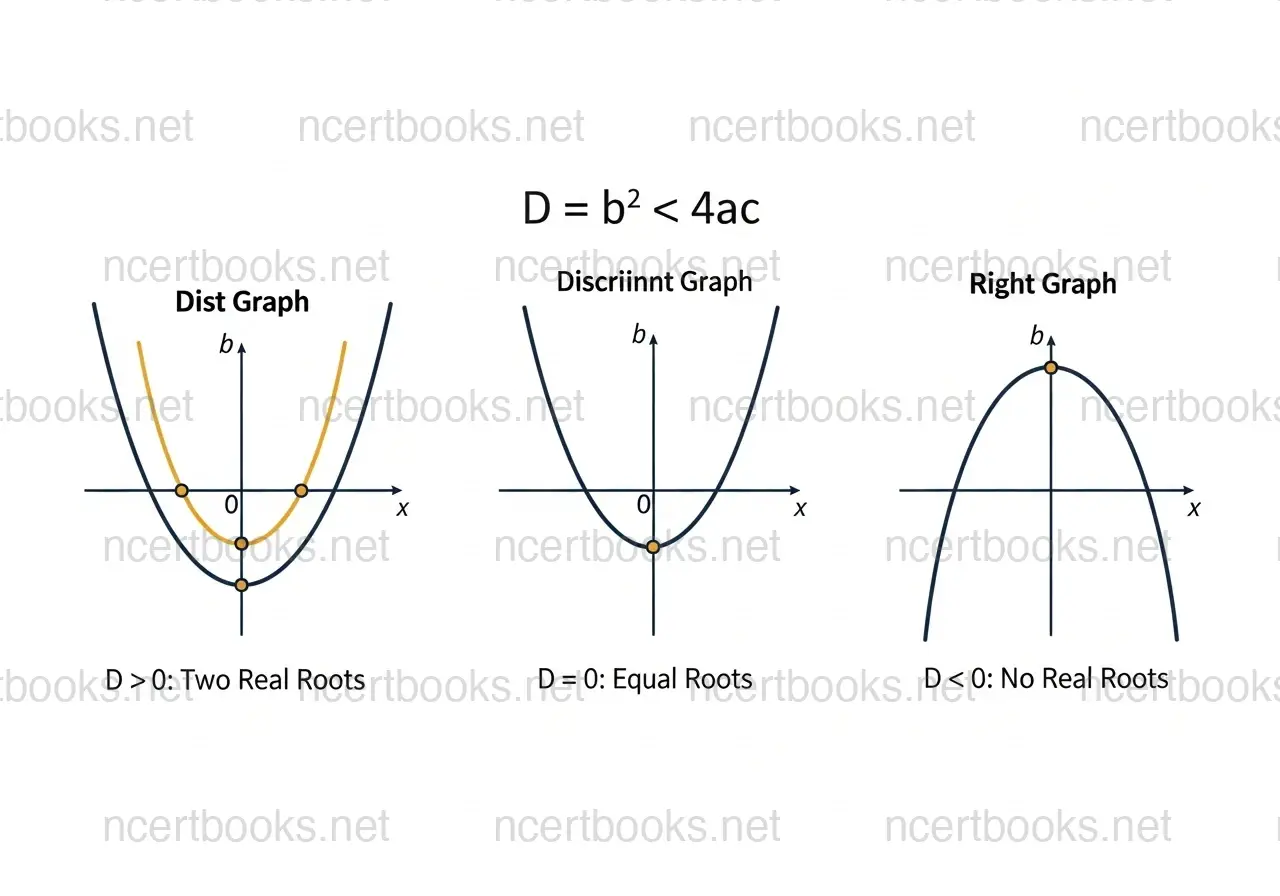 0 D=0 D<0 for quadratic equations - NCERT Class 10 Maths Chapter 4" width="1280" height="896" loading="lazy">
Question 1
Medium
Find the roots of the following quadratic equations by factorisation:
Step 1: Identify \( a = 1,\ b = -3,\ c = -10 \). Compute \( ac = 1 \times (-10) = -10 \).
Step 2: Find two numbers whose product is \( -10 \) and sum is \( -3 \). Those numbers are \( -5 \) and \( +2 \) because \( (-5) \times 2 = -10 \) and \( -5 + 2 = -3 \).
Step 3: Split the middle term:
\[ x^{2} – 5x + 2x – 10 = 0 \]
Step 4: Factor by grouping:
\[ x(x – 5) + 2(x – 5) = 0 \]
\[ (x – 5)(x + 2) = 0 \]
Step 5: Apply zero product property: \( x – 5 = 0 \) or \( x + 2 = 0 \).
\( \therefore \) The roots are \( x = 5 \) and \( x = -2 \).
Step 1: Here \( a = 2,\ b = 1,\ c = -6 \). Compute \( ac = 2 \times (-6) = -12 \).
Step 2: Find two numbers with product \( -12 \) and sum \( 1 \). Those are \( 4 \) and \( -3 \) because \( 4 \times (-3) = -12 \) and \( 4 + (-3) = 1 \).
Step 3: Split and factor:
\[ 2x^{2} + 4x – 3x – 6 = 0 \]
\[ 2x(x + 2) – 3(x + 2) = 0 \]
\[ (2x – 3)(x + 2) = 0 \]
Step 4: \( 2x – 3 = 0 \Rightarrow x = \dfrac{3}{2} \) or \( x + 2 = 0 \Rightarrow x = -2 \).
\( \therefore \) The roots are \( x = \dfrac{3}{2} \) and \( x = -2 \).
Step 1: Here \( a = \sqrt{2},\ b = 7,\ c = 5\sqrt{2} \). Compute \( ac = \sqrt{2} \times 5\sqrt{2} = 5 \times 2 = 10 \).
Step 2: Find two numbers with product \( 10 \) and sum \( 7 \). Those are \( 5 \) and \( 2 \).
Step 3: Split and factor:
\[ \sqrt{2}\,x^{2} + 5x + 2x + 5\sqrt{2} = 0 \]
\[ x(\sqrt{2}\,x + 5) + \sqrt{2}(\sqrt{2}\,x + 5) = 0 \]
\[ (\sqrt{2}\,x + 5)(x + \sqrt{2}) = 0 \]
Step 4: \( \sqrt{2}\,x + 5 = 0 \Rightarrow x = -\dfrac{5}{\sqrt{2}} = -\dfrac{5\sqrt{2}}{2} \) or \( x + \sqrt{2} = 0 \Rightarrow x = -\sqrt{2} \).
Why does this work? We multiply \( \sqrt{2} \times \sqrt{2} = 2 \) when grouping, which rationalises the surd coefficient cleanly.
\( \therefore \) The roots are \( x = -\dfrac{5\sqrt{2}}{2} \) and \( x = -\sqrt{2} \).
Step 1: Multiply throughout by 8 to clear the fraction:
\[ 16x^{2} – 8x + 1 = 0 \]
Step 2: Now \( a = 16,\ b = -8,\ c = 1 \). Compute \( ac = 16 \). Find two numbers with product \( 16 \) and sum \( -8 \): those are \( -4 \) and \( -4 \).
Step 3: Split and factor:
\[ 16x^{2} – 4x – 4x + 1 = 0 \]
\[ 4x(4x – 1) – 1(4x – 1) = 0 \]
\[ (4x – 1)(4x – 1) = 0 \]
\[ (4x – 1)^{2} = 0 \]
Step 4: \( 4x – 1 = 0 \Rightarrow x = \dfrac{1}{4} \) (repeated root).
Why does this work? When both numbers are equal, the quadratic is a perfect square and gives a repeated (equal) root.
\( \therefore \) The root is \( x = \dfrac{1}{4} \) (repeated root).
Step 1: Here \( a = 100,\ b = -20,\ c = 1 \). Compute \( ac = 100 \). Find two numbers with product \( 100 \) and sum \( -20 \): those are \( -10 \) and \( -10 \).
Step 2: Split and factor:
\[ 100x^{2} – 10x – 10x + 1 = 0 \]
\[ 10x(10x – 1) – 1(10x – 1) = 0 \]
\[ (10x – 1)(10x – 1) = 0 \]
\[ (10x – 1)^{2} = 0 \]
Step 3: \( 10x – 1 = 0 \Rightarrow x = \dfrac{1}{10} \) (repeated root).
\( \therefore \) The root is \( x = \dfrac{1}{10} \) (repeated root).
Question 2
Medium
Solve the following situations mathematically:
Step 1 — Set up the variable: Let John initially have \( x \) marbles. Then Jivanti has \( 45 – x \) marbles.
Step 2 — After losing 5 each: John has \( x – 5 \) and Jivanti has \( 40 – x \) marbles.
Step 3 — Form the equation:
\[ (x – 5)(40 – x) = 124 \]
\[ 40x – x^{2} – 200 + 5x = 124 \]
\[ -x^{2} + 45x – 200 = 124 \]
\[ -x^{2} + 45x – 324 = 0 \]
\[ x^{2} – 45x + 324 = 0 \]
Step 4 — Factorise: Find two numbers with product \( 324 \) and sum \( 45 \): those are \( 36 \) and \( 9 \).
\[ x^{2} – 36x – 9x + 324 = 0 \]
\[ x(x – 36) – 9(x – 36) = 0 \]
\[ (x – 36)(x – 9) = 0 \]
Step 5: \( x = 36 \) or \( x = 9 \).
Interpretation: If John started with 36, Jivanti started with 9. If John started with 9, Jivanti started with 36. Both are valid.
\( \therefore \) John had 36 marbles and Jivanti had 9 marbles, or John had 9 marbles and Jivanti had 36 marbles.
Step 1 — Set up the variable: Let the number of toys produced = \( x \). Then cost of each toy = \( \rupee(55 – x) \).
Step 2 — Form the equation:
\[ x(55 – x) = 750 \]
\[ 55x – x^{2} = 750 \]
\[ x^{2} – 55x + 750 = 0 \]
Step 3 — Factorise: Find two numbers with product \( 750 \) and sum \( 55 \): those are \( 25 \) and \( 30 \).
\[ x^{2} – 25x – 30x + 750 = 0 \]
\[ x(x – 25) – 30(x – 25) = 0 \]
\[ (x – 25)(x – 30) = 0 \]
Step 4: \( x = 25 \) or \( x = 30 \).
Verification: If \( x = 25 \): cost per toy = ₹30, total = ₹750 ✓. If \( x = 30 \): cost per toy = ₹25, total = ₹750 ✓.
\( \therefore \) The number of toys produced was 25 or 30.
Question 3
Easy
Find two numbers whose sum is 27 and product is 182.
Step 1 — Set up the variable: Let one number be \( x \). Then the other number is \( 27 – x \).
Step 2 — Form the equation using the product condition:
\[ x(27 – x) = 182 \]
\[ 27x – x^{2} = 182 \]
\[ x^{2} – 27x + 182 = 0 \]
Step 3 — Factorise: Find two numbers with product \( 182 \) and sum \( 27 \): those are \( 14 \) and \( 13 \).
\[ x^{2} – 14x – 13x + 182 = 0 \]
\[ x(x – 14) – 13(x – 14) = 0 \]
\[ (x – 14)(x – 13) = 0 \]
Step 4: \( x = 14 \) or \( x = 13 \).
Verification: \( 14 + 13 = 27 \) ✓ and \( 14 \times 13 = 182 \) ✓.
\( \therefore \) The two numbers are 13 and 14.
Question 4
Medium
Find two consecutive positive integers, the sum of whose squares is 365.
Step 1 — Set up the variable: Let the smaller integer be \( x \). Then the next consecutive integer is \( x + 1 \).
Step 2 — Form the equation:
\[ x^{2} + (x+1)^{2} = 365 \]
\[ x^{2} + x^{2} + 2x + 1 = 365 \]
\[ 2x^{2} + 2x + 1 = 365 \]
\[ 2x^{2} + 2x – 364 = 0 \]
\[ x^{2} + x – 182 = 0 \]
Step 3 — Factorise: Find two numbers with product \( -182 \) and sum \( 1 \): those are \( 14 \) and \( -13 \).
\[ x^{2} + 14x – 13x – 182 = 0 \]
\[ x(x + 14) – 13(x + 14) = 0 \]
\[ (x – 13)(x + 14) = 0 \]
Step 4: \( x = 13 \) or \( x = -14 \). Since the integers must be positive, \( x = 13 \).
Verification: \( 13^{2} + 14^{2} = 169 + 196 = 365 \) ✓.
\( \therefore \) The two consecutive positive integers are 13 and 14.
Question 5
Medium
The altitude of a right triangle is 7 cm less than its base. If the hypotenuse is 13 cm, find the other two sides.
Step 1 — Set up the variable: Let the base of the right triangle = \( x \) cm. Then altitude = \( (x – 7) \) cm.
Step 2 — Apply the Pythagorean theorem:
\[ \text{base}^{2} + \text{altitude}^{2} = \text{hypotenuse}^{2} \]
\[ x^{2} + (x – 7)^{2} = 13^{2} \]
\[ x^{2} + x^{2} – 14x + 49 = 169 \]
\[ 2x^{2} – 14x + 49 – 169 = 0 \]
\[ 2x^{2} – 14x – 120 = 0 \]
\[ x^{2} – 7x – 60 = 0 \]
Step 3 — Factorise: Find two numbers with product \( -60 \) and sum \( -7 \): those are \( -12 \) and \( 5 \).
\[ x^{2} – 12x + 5x – 60 = 0 \]
\[ x(x – 12) + 5(x – 12) = 0 \]
\[ (x – 12)(x + 5) = 0 \]
Step 4: \( x = 12 \) or \( x = -5 \). Since length cannot be negative, \( x = 12 \) cm.
Step 5: Altitude \( = 12 – 7 = 5 \) cm.
Verification: \( 12^{2} + 5^{2} = 144 + 25 = 169 = 13^{2} \) ✓.
\( \therefore \) The base is 12 cm and the altitude is 5 cm.
Question 6
Medium
A cottage industry produces a certain number of pottery articles in a day. The cost of production of each article (in rupees) was 3 more than twice the number of articles produced on that day. If the total cost of production was ₹90, find the number of articles produced and the cost of each article.
Step 1 — Set up the variable: Let the number of pottery articles produced = \( x \). Then cost of each article = \( \rupee(2x + 3) \).
Step 2 — Form the equation:
\[ x(2x + 3) = 90 \]
\[ 2x^{2} + 3x = 90 \]
\[ 2x^{2} + 3x – 90 = 0 \]
Step 3 — Factorise: Here \( a = 2,\ b = 3,\ c = -90 \). Compute \( ac = 2 \times (-90) = -180 \). Find two numbers with product \( -180 \) and sum \( 3 \): those are \( 15 \) and \( -12 \).
\[ 2x^{2} + 15x – 12x – 90 = 0 \]
\[ x(2x + 15) – 6(2x + 15) = 0 \]
\[ (2x + 15)(x – 6) = 0 \]
Step 4: \( 2x + 15 = 0 \Rightarrow x = -\dfrac{15}{2} \) (rejected, as number of articles cannot be negative or fractional) or \( x – 6 = 0 \Rightarrow x = 6 \).
Step 5: Number of articles = 6. Cost per article = \( 2(6) + 3 = \rupee 15 \).
Verification: \( 6 \times 15 = 90 \) ✓.
\( \therefore \) The number of pottery articles produced = 6 and the cost of each article = ₹15.
Formula Reference Table — Quadratic Equations
| Formula Name | Formula | Variables Defined |
|---|---|---|
| Standard Form | \( ax^{2} + bx + c = 0 \) | \( a, b, c \) are real numbers; \( a \neq 0 \) |
| Factorised Form | \( (x – \alpha)(x – \beta) = 0 \) | \( \alpha, \beta \) are the roots |
| Sum of Roots | \( \alpha + \beta = -\dfrac{b}{a} \) | Vieta’s formula for sum |
| Product of Roots | \( \alpha \beta = \dfrac{c}{a} \) | Vieta’s formula for product |
| Discriminant | \( D = b^{2} – 4ac \) | \( D > 0 \): two distinct real roots; \( D = 0 \): equal roots; \( D < 0 \): no real roots |
| Pythagorean Theorem | \( a^{2} + b^{2} = c^{2} \) | Used in Q5 — right triangle problems |
Solved Examples Beyond NCERT — Quadratic Equations by Factorisation
Extra Example 1
Easy
Find the roots of \( x^{2} – 5x + 6 = 0 \).
Step 1: Find two numbers with product \( 6 \) and sum \( -5 \): those are \( -2 \) and \( -3 \).
\[ (x – 2)(x – 3) = 0 \]
\( \therefore \) Roots: \( x = 2 \) and \( x = 3 \).
Extra Example 2
Medium
The sum of a number and its reciprocal is \( \dfrac{10}{3} \). Find the number.
Step 1: Let the number be \( x \). Then \( x + \dfrac{1}{x} = \dfrac{10}{3} \).
Step 2: Multiply through by \( 3x \):
\[ 3x^{2} + 3 = 10x \]
\[ 3x^{2} – 10x + 3 = 0 \]
Step 3: Factorise: product \( = 9 \), sum \( = -10 \): numbers are \( -9 \) and \( -1 \).
\[ 3x^{2} – 9x – x + 3 = 0 \]
\[ 3x(x – 3) – 1(x – 3) = 0 \]
\[ (3x – 1)(x – 3) = 0 \]
\( \therefore \) The number is \( x = 3 \) or \( x = \dfrac{1}{3} \).
Extra Example 3
Hard
A train travels 360 km at a uniform speed. If the speed had been 5 km/h more, it would have taken 1 hour less. Find the speed of the train.
Step 1: Let speed = \( x \) km/h. Time taken = \( \dfrac{360}{x} \) hours.
Step 2: At speed \( (x+5) \): time = \( \dfrac{360}{x+5} \). Condition: \( \dfrac{360}{x} – \dfrac{360}{x+5} = 1 \).
Step 3:
\[ 360(x+5) – 360x = x(x+5) \]
\[ 1800 = x^{2} + 5x \]
\[ x^{2} + 5x – 1800 = 0 \]
Step 4: Factorise: product \( -1800 \), sum \( 5 \): numbers are \( 45 \) and \( -40 \).
\[ (x + 45)(x – 40) = 0 \]
\( x = -45 \) rejected (speed cannot be negative). So \( x = 40 \) km/h.
\( \therefore \) Speed of the train = 40 km/h.
Important Questions for CBSE Board Exam — Quadratic Equations Chapter 4
1-Mark Questions
- Write the standard form of a quadratic equation. Answer: \( ax^{2} + bx + c = 0,\ a \neq 0 \).
- State the zero product property. Answer: If \( AB = 0 \), then \( A = 0 \) or \( B = 0 \).
- For \( x^{2} – 4 = 0 \), find the roots. Answer: \( x = 2 \) or \( x = -2 \).
3-Mark Questions
- Find the roots of \( 3x^{2} – 5x – 2 = 0 \) by factorisation. Answer: \( ac = -6 \); numbers: \( -6 \) and \( 1 \); factors: \( (3x + 1)(x – 2) = 0 \); roots: \( x = 2 \) and \( x = -\dfrac{1}{3} \).
- The product of two consecutive even integers is 168. Find the integers. Answer: Let integers be \( x \) and \( x+2 \); \( x(x+2) = 168 \); \( x^{2} + 2x – 168 = 0 \); \( (x+14)(x-12) = 0 \); integers are 12 and 14.
5-Mark Questions
- A rectangular park has perimeter 80 m and area 375 sq. m. Find its length and breadth. Answer: Let length = \( l \), breadth = \( b \). \( 2(l+b) = 80 \Rightarrow l + b = 40 \); \( lb = 375 \). So \( l(40-l) = 375 \); \( l^{2} – 40l + 375 = 0 \); \( (l-25)(l-15) = 0 \); length = 25 m, breadth = 15 m.
Common Mistakes Students Make in Quadratic Equations Exercise 4.2
Mistake 1: Students forget to bring all terms to one side before factorising.
Why it’s wrong: Factorisation works only when the equation equals zero (zero product property requires zero on one side).
Correct approach: Always rearrange to \( ax^{2} + bx + c = 0 \) first.
Mistake 2: Students accept negative roots for problems involving physical quantities like length, number of articles, or speed.
Why it’s wrong: Physical quantities cannot be negative; accepting such roots leads to wrong answers and loss of marks.
Correct approach: After solving, check the context and explicitly reject roots that don’t make sense. Write: “Since [quantity] cannot be negative, \( x = [negative value] \) is rejected.”
Mistake 3: Students split the middle term incorrectly — they find numbers with the correct sum but wrong product.
Why it’s wrong: Both conditions (product = \( ac \) AND sum = \( b \)) must be satisfied simultaneously.
Correct approach: Always verify: \( p \times q = ac \) and \( p + q = b \) before proceeding.
Mistake 4: In Q1(iv) and Q1(v), students do not multiply through to clear fractions first.
Why it’s wrong: Working with fractions in factorisation is error-prone and time-consuming in exams.
Correct approach: Multiply the entire equation by the LCM of denominators to get integer coefficients before factorising.
Mistake 5: Students write both roots without interpreting them in word problems.
Why it’s wrong: CBSE examiners expect you to state what each root means in context. Skipping interpretation loses marks.
Correct approach: Always conclude with a sentence like: “Therefore, the number of articles = 6 and the cost = ₹15.”
Exam Tips for 2026-27 CBSE Board — Chapter 4 Quadratic Equations
- Step-by-step working is mandatory: The CBSE 2026-27 marking scheme awards marks for each step. Even if your final answer is wrong, you earn marks for correct method.
- Word problems are high-value: Questions 2–6 of Exercise 4.2 are word problems. These appear as 3-mark or 5-mark questions in CBSE board papers. Practise setting up the equation from the problem statement.
- Rejection of roots: Always state why you reject a root in context problems. This is a separate mark in the CBSE marking scheme.
- Verification is rewarded: In many CBSE papers, the marking scheme includes a step for verification. Always substitute your roots back into the original equation.
- Chapter weightage: The Algebra unit (which includes Quadratic Equations) carries approximately 10 marks in the CBSE Class 10 board exam. Exercise 4.2 type questions account for a significant share of these marks.
- Last-minute revision checklist: (1) Know the splitting-the-middle-term method. (2) Practise all 6 questions from Ex 4.2. (3) Remember to reject invalid roots. (4) Memorise the discriminant formula for Ex 4.3. (5) Practise at least 3 word problems from previous year CBSE papers.