- Chapter: Pair of Linear Equations in Two Variables — Exercise 3.5
- Methods covered: Cross-multiplication method, Substitution method
- Unique solution condition: \( \frac{a_1}{a_2} \neq \frac{b_1}{b_2} \)
- No solution condition: \( \frac{a_1}{a_2} = \frac{b_1}{b_2} \neq \frac{c_1}{c_2} \)
- Infinitely many solutions: \( \frac{a_1}{a_2} = \frac{b_1}{b_2} = \frac{c_1}{c_2} \)
- Cross-multiplication formula: \( \frac{x}{b_1c_2 – b_2c_1} = \frac{y}{c_1a_2 – c_2a_1} = \frac{1}{a_1b_2 – a_2b_1} \)
- Total questions in Ex 3.5: 4 questions (with sub-parts)
- Board exam weightage: Linear Equations chapter carries 6–8 marks in CBSE Class 10
The NCERT Solutions for Class 10 Maths Chapter 3 Ex 3.5 on this page are fully updated for the 2026-27 CBSE board exam. Exercise 3.5 is part of Chapter 3 — Pair of Linear Equations in Two Variables — from the NCERT official textbook. This exercise focuses on determining whether a pair of linear equations has a unique solution, no solution, or infinitely many solutions, and on solving them using the cross-multiplication and substitution methods. You can find all NCERT Solutions and specifically NCERT Solutions for Class 10 on our website.
NCERT Solutions for Class 10 Maths Chapter 3 Ex 3.5 — Chapter Overview
Chapter 3 of Class 10 NCERT Maths deals with the Pair of Linear Equations in Two Variables. Exercise 3.5 specifically covers two powerful algebraic techniques: the cross-multiplication method and a combined application of the substitution method. It also tests your ability to identify whether a given system is consistent (unique or infinite solutions) or inconsistent (no solution).
For the 2026-27 CBSE board exam, this chapter typically carries 6–8 marks. Questions from this exercise appear as 2-mark, 3-mark, and 5-mark problems. Word problems (Question 4) are high-frequency in board papers. Mastering the consistency conditions and the cross-multiplication formula will help you score full marks.
Prerequisites for this exercise: understanding of linear equations in one variable, basic algebra, and the graphical interpretation of solutions (covered in earlier exercises of this chapter).
| Detail | Information |
|---|---|
| Chapter | Chapter 3 — Pair of Linear Equations in Two Variables |
| Exercise | Exercise 3.5 |
| Textbook | NCERT Mathematics Class 10 |
| Class | Class 10 |
| Subject | Mathematics |
| Marks Weightage | 6–8 marks (Chapter 3 overall) |
| Difficulty Level | Medium to Hard |
| Academic Year | 2026-27 |
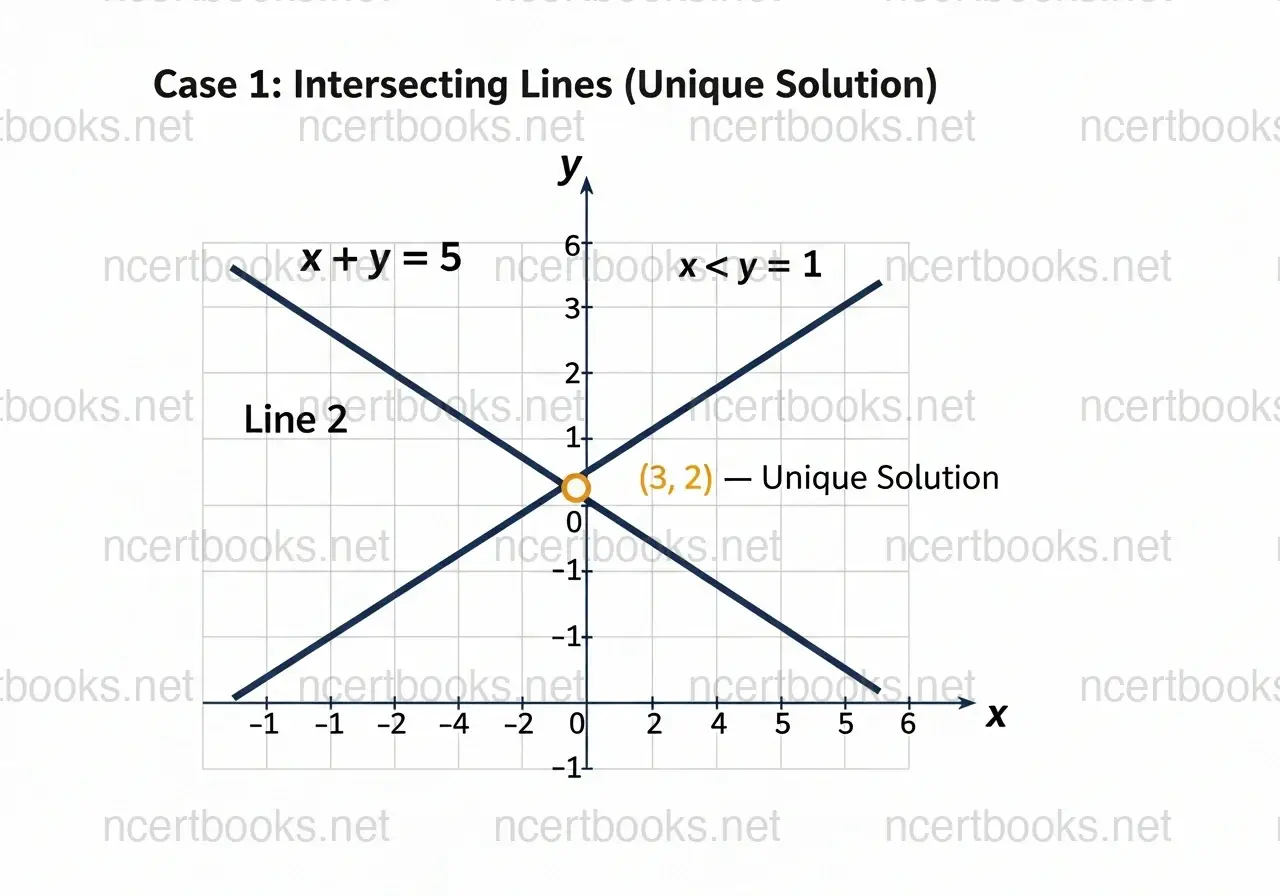
Key Concepts — Consistency Conditions and Methods
Before solving Exercise 3.5, you must know these three core concepts. They appear directly in Question 1 and Question 2.
Consistency Conditions for a Pair of Linear Equations
For the general pair \( a_1x + b_1y + c_1 = 0 \) and \( a_2x + b_2y + c_2 = 0 \):
- Unique solution (consistent): \( \frac{a_1}{a_2} \neq \frac{b_1}{b_2} \) — lines intersect at one point.
- No solution (inconsistent): \( \frac{a_1}{a_2} = \frac{b_1}{b_2} \neq \frac{c_1}{c_2} \) — lines are parallel.
- Infinitely many solutions (dependent): \( \frac{a_1}{a_2} = \frac{b_1}{b_2} = \frac{c_1}{c_2} \) — lines are coincident.
Cross-Multiplication Method
For equations \( a_1x + b_1y + c_1 = 0 \) and \( a_2x + b_2y + c_2 = 0 \), the cross-multiplication formula is:
\[ \frac{x}{b_1c_2 – b_2c_1} = \frac{y}{c_1a_2 – c_2a_1} = \frac{1}{a_1b_2 – a_2b_1} \]
This gives: \( x = \frac{b_1c_2 – b_2c_1}{a_1b_2 – a_2b_1} \) and \( y = \frac{c_1a_2 – c_2a_1}{a_1b_2 – a_2b_1} \)
Substitution Method — Quick Recap
Express one variable (say y) from one equation. Substitute this expression into the second equation to get a single-variable equation. Solve for that variable, then back-substitute to find the other.
Formula Reference Table — Class 10 Maths Chapter 3
| Formula Name | Formula | Variables Defined |
|---|---|---|
| Unique solution condition | \( \frac{a_1}{a_2} \neq \frac{b_1}{b_2} \) | \(a_1, a_2\) = x-coefficients; \(b_1, b_2\) = y-coefficients |
| No solution condition | \( \frac{a_1}{a_2} = \frac{b_1}{b_2} \neq \frac{c_1}{c_2} \) | \(c_1, c_2\) = constants |
| Infinitely many solutions | \( \frac{a_1}{a_2} = \frac{b_1}{b_2} = \frac{c_1}{c_2} \) | All coefficients proportional |
| Cross-multiplication (x) | \( x = \frac{b_1c_2 – b_2c_1}{a_1b_2 – a_2b_1} \) | Standard form: \(a_ix + b_iy + c_i = 0\) |
| Cross-multiplication (y) | \( y = \frac{c_1a_2 – c_2a_1}{a_1b_2 – a_2b_1} \) | Denominator same as for x |
Exercise 3.5 — Step-by-Step NCERT Solutions (All Questions)
Below are complete, original solutions for all 4 questions of Exercise 3.5. These ncert solutions for class 10 maths chapter 3 ex 3 5 follow the CBSE marking scheme for 2026-27. Show every step in your board exam answer to earn full marks.
Question 1 — Unique Solution, No Solution, or Infinitely Many Solutions
Question 1
Medium
Which of the following pairs of linear equations has unique solution, no solution or infinitely many solutions. In case there is a unique solution, find it by using cross-multiplication method.
Step 1: Identify coefficients. \( a_1 = 1,\ b_1 = -3,\ c_1 = -3 \) and \( a_2 = 3,\ b_2 = -9,\ c_2 = -2 \).
Step 2: Compare ratios:
\[ \frac{a_1}{a_2} = \frac{1}{3},\quad \frac{b_1}{b_2} = \frac{-3}{-9} = \frac{1}{3},\quad \frac{c_1}{c_2} = \frac{-3}{-2} = \frac{3}{2} \]
Step 3: Since \( \frac{a_1}{a_2} = \frac{b_1}{b_2} \neq \frac{c_1}{c_2} \), i.e., \( \frac{1}{3} = \frac{1}{3} \neq \frac{3}{2} \), the lines are parallel.
\( \therefore \) No solution (Inconsistent system).
Step 1: Rewrite in standard form: \( 2x + y – 5 = 0 \) and \( 3x + 2y – 8 = 0 \).
Coefficients: \( a_1 = 2,\ b_1 = 1,\ c_1 = -5 \) and \( a_2 = 3,\ b_2 = 2,\ c_2 = -8 \).
Step 2: Compare ratios:
\[ \frac{a_1}{a_2} = \frac{2}{3},\quad \frac{b_1}{b_2} = \frac{1}{2} \]
Since \( \frac{2}{3} \neq \frac{1}{2} \), the system has a unique solution.
Step 3: Apply cross-multiplication:
\[ \frac{x}{b_1c_2 – b_2c_1} = \frac{y}{c_1a_2 – c_2a_1} = \frac{1}{a_1b_2 – a_2b_1} \]
\[ \frac{x}{(1)(-8) – (2)(-5)} = \frac{y}{(-5)(3) – (-8)(2)} = \frac{1}{(2)(2) – (3)(1)} \]
\[ \frac{x}{-8 + 10} = \frac{y}{-15 + 16} = \frac{1}{4 – 3} \]
\[ \frac{x}{2} = \frac{y}{1} = \frac{1}{1} \]
Step 4: Therefore \( x = 2 \) and \( y = 1 \).
Why does this work? Cross-multiplication uses the determinant of the coefficient matrix to find both unknowns simultaneously.
Verification: \( 2(2) + 1 = 5 \) ✓ and \( 3(2) + 2(1) = 8 \) ✓
\( \therefore \) Unique solution: \( x = 2,\ y = 1 \)
Step 1: Rewrite: \( 3x – 5y – 20 = 0 \) and \( 6x – 10y – 40 = 0 \).
Coefficients: \( a_1 = 3,\ b_1 = -5,\ c_1 = -20 \) and \( a_2 = 6,\ b_2 = -10,\ c_2 = -40 \).
Step 2: Compare ratios:
\[ \frac{a_1}{a_2} = \frac{3}{6} = \frac{1}{2},\quad \frac{b_1}{b_2} = \frac{-5}{-10} = \frac{1}{2},\quad \frac{c_1}{c_2} = \frac{-20}{-40} = \frac{1}{2} \]
Step 3: Since \( \frac{a_1}{a_2} = \frac{b_1}{b_2} = \frac{c_1}{c_2} = \frac{1}{2} \), the two equations represent the same line.
\( \therefore \) Infinitely many solutions (Dependent system).
Step 1: Coefficients: \( a_1 = 1,\ b_1 = -3,\ c_1 = -7 \) and \( a_2 = 3,\ b_2 = -3,\ c_2 = -15 \).
Step 2: Compare ratios:
\[ \frac{a_1}{a_2} = \frac{1}{3},\quad \frac{b_1}{b_2} = \frac{-3}{-3} = 1 \]
Since \( \frac{1}{3} \neq 1 \), the system has a unique solution.
Step 3: Apply cross-multiplication:
\[ \frac{x}{(-3)(-15) – (-3)(-7)} = \frac{y}{(-7)(3) – (-15)(1)} = \frac{1}{(1)(-3) – (3)(-3)} \]
\[ \frac{x}{45 – 21} = \frac{y}{-21 + 15} = \frac{1}{-3 + 9} \]
\[ \frac{x}{24} = \frac{y}{-6} = \frac{1}{6} \]
Step 4: \( x = \frac{24}{6} = 4 \) and \( y = \frac{-6}{6} = -1 \).
Verification: \( 4 – 3(-1) – 7 = 4 + 3 – 7 = 0 \) ✓ and \( 3(4) – 3(-1) – 15 = 12 + 3 – 15 = 0 \) ✓
\( \therefore \) Unique solution: \( x = 4,\ y = -1 \)
Question 2 — Finding Values of a, b, and k
Question 2
Hard
\( 2x + 3y = 7 \) and \( (a – b)x + (a + b)y = 3a + b – 2 \)
Step 1: Rewrite in standard form:
Equation 1: \( 2x + 3y – 7 = 0 \), so \( a_1 = 2,\ b_1 = 3,\ c_1 = -7 \).
Equation 2: \( (a-b)x + (a+b)y – (3a+b-2) = 0 \), so \( a_2 = a-b,\ b_2 = a+b,\ c_2 = -(3a+b-2) \).
Step 2: For infinitely many solutions: \( \frac{a_1}{a_2} = \frac{b_1}{b_2} = \frac{c_1}{c_2} \)
\[ \frac{2}{a-b} = \frac{3}{a+b} = \frac{7}{3a+b-2} \]
Step 3: From the first two ratios:
\[ \frac{2}{a-b} = \frac{3}{a+b} \]
\[ 2(a+b) = 3(a-b) \]
\[ 2a + 2b = 3a – 3b \]
\[ 5b = a \quad \Rightarrow \quad a = 5b \quad \text{…(I)} \]
Step 4: From the first and third ratios:
\[ \frac{2}{a-b} = \frac{7}{3a+b-2} \]
\[ 2(3a+b-2) = 7(a-b) \]
\[ 6a + 2b – 4 = 7a – 7b \]
\[ 9b – 4 = a \quad \Rightarrow \quad a = 9b – 4 \quad \text{…(II)} \]
Step 5: Substitute (I) into (II):
\[ 5b = 9b – 4 \]
\[ 4 = 4b \]
\[ b = 1 \]
From (I): \( a = 5(1) = 5 \).
Verification: \( \frac{2}{5-1} = \frac{2}{4} = \frac{1}{2} \), \( \frac{3}{5+1} = \frac{3}{6} = \frac{1}{2} \), \( \frac{7}{15+1-2} = \frac{7}{14} = \frac{1}{2} \) ✓
\( \therefore \) \( a = 5,\ b = 1 \) gives infinitely many solutions.
\( 3x + y = 1 \) and \( (2k-1)x + (k-1)y = 2k+1 \)
Step 1: Rewrite: \( 3x + y – 1 = 0 \) and \( (2k-1)x + (k-1)y – (2k+1) = 0 \).
\( a_1 = 3,\ b_1 = 1,\ c_1 = -1 \) and \( a_2 = 2k-1,\ b_2 = k-1,\ c_2 = -(2k+1) \).
Step 2: For no solution: \( \frac{a_1}{a_2} = \frac{b_1}{b_2} \neq \frac{c_1}{c_2} \)
\[ \frac{3}{2k-1} = \frac{1}{k-1} \]
\[ 3(k-1) = 1(2k-1) \]
\[ 3k – 3 = 2k – 1 \]
\[ k = 2 \]
Step 3: Verify the inequality condition \( \frac{b_1}{b_2} \neq \frac{c_1}{c_2} \):
When \( k = 2 \): \( \frac{b_1}{b_2} = \frac{1}{2-1} = \frac{1}{1} = 1 \) and \( \frac{c_1}{c_2} = \frac{-1}{-(2\times2+1)} = \frac{-1}{-5} = \frac{1}{5} \).
Since \( 1 \neq \frac{1}{5} \), the no-solution condition is satisfied.
\( \therefore \) \( k = 2 \) gives no solution.
Question 3 — Substitution and Cross-Multiplication Methods
Question 3
Medium
Solve the following pair of linear equations by the substitution and cross-multiplication methods: \( 8x + 5y = 9,\quad 3x + 2y = 4 \)
Step 1: From Equation 2, express x in terms of y:
\[ 3x + 2y = 4 \implies x = \frac{4 – 2y}{3} \]
Step 2: Substitute into Equation 1 (\( 8x + 5y = 9 \)):
\[ 8 \times \frac{4 – 2y}{3} + 5y = 9 \]
\[ \frac{32 – 16y}{3} + 5y = 9 \]
Multiply throughout by 3:
\[ 32 – 16y + 15y = 27 \]
\[ 32 – y = 27 \]
\[ y = 5 \]
Step 3: Substitute \( y = 5 \) back:
\[ x = \frac{4 – 2(5)}{3} = \frac{4 – 10}{3} = \frac{-6}{3} = -2 \]
Verification: \( 8(-2) + 5(5) = -16 + 25 = 9 \) ✓ and \( 3(-2) + 2(5) = -6 + 10 = 4 \) ✓
\( \therefore \) By substitution: \( x = -2,\ y = 5 \)
Step 1: Rewrite in standard form: \( 8x + 5y – 9 = 0 \) and \( 3x + 2y – 4 = 0 \).
\( a_1 = 8,\ b_1 = 5,\ c_1 = -9 \) and \( a_2 = 3,\ b_2 = 2,\ c_2 = -4 \).
Step 2: Apply the cross-multiplication formula:
\[ \frac{x}{b_1c_2 – b_2c_1} = \frac{y}{c_1a_2 – c_2a_1} = \frac{1}{a_1b_2 – a_2b_1} \]
\[ \frac{x}{(5)(-4) – (2)(-9)} = \frac{y}{(-9)(3) – (-4)(8)} = \frac{1}{(8)(2) – (3)(5)} \]
\[ \frac{x}{-20 + 18} = \frac{y}{-27 + 32} = \frac{1}{16 – 15} \]
\[ \frac{x}{-2} = \frac{y}{5} = \frac{1}{1} \]
Step 3: Therefore \( x = -2 \) and \( y = 5 \).
Why does this work? Both methods give the same answer, confirming the solution is correct. Cross-multiplication is more direct for this type of equation.
\( \therefore \) By cross-multiplication: \( x = -2,\ y = 5 \)
Question 4 — Word Problems (Algebraic Method)
Question 4
Hard
Form the pair of linear equations in the following problems and find their solutions (if they exist) by any algebraic method.
A part of monthly hostel charges is fixed and the remaining depends on the number of days one has taken food in the mess. Student A takes food for 20 days and pays ₹1000. Student B takes food for 26 days and pays ₹1180. Find the fixed charges and the cost of food per day.
Step 1: Let fixed charges = ₹\(x\) and cost per day = ₹\(y\).
Step 2: Form equations:
\[ x + 20y = 1000 \quad \text{…(1)} \]
\[ x + 26y = 1180 \quad \text{…(2)} \]
Step 3: Subtract (1) from (2):
\[ 6y = 180 \implies y = 30 \]
Step 4: Substitute \( y = 30 \) in (1):
\[ x + 20(30) = 1000 \implies x = 1000 – 600 = 400 \]
Verification: \( 400 + 26(30) = 400 + 780 = 1180 \) ✓
\( \therefore \) Fixed charges = ₹400; Cost per day = ₹30.
A fraction becomes \( \frac{1}{3} \) when 1 is subtracted from the numerator and becomes \( \frac{1}{4} \) when 8 is added to its denominator. Find the fraction.
Step 1: Let the fraction be \( \frac{x}{y} \).
Step 2: Form equations from the given conditions:
\[ \frac{x – 1}{y} = \frac{1}{3} \implies 3(x – 1) = y \implies 3x – y = 3 \quad \text{…(1)} \]
\[ \frac{x}{y + 8} = \frac{1}{4} \implies 4x = y + 8 \implies 4x – y = 8 \quad \text{…(2)} \]
Step 3: Subtract (1) from (2):
\[ x = 5 \]
Step 4: Substitute \( x = 5 \) in (1):
\[ 3(5) – y = 3 \implies y = 12 \]
Verification: \( \frac{5-1}{12} = \frac{4}{12} = \frac{1}{3} \) ✓ and \( \frac{5}{12+8} = \frac{5}{20} = \frac{1}{4} \) ✓
\( \therefore \) The fraction is \( \frac{5}{12} \).
Yash scored 40 marks getting 3 marks for each right answer and losing 1 mark for each wrong answer. Had 4 marks been awarded for each correct answer and 2 marks deducted for each incorrect answer, Yash would have scored 50 marks. How many questions were there in the test?
Step 1: Let the number of right answers = \(x\) and wrong answers = \(y\).
Step 2: Form equations:
\[ 3x – y = 40 \quad \text{…(1)} \]
\[ 4x – 2y = 50 \implies 2x – y = 25 \quad \text{…(2)} \]
Step 3: Subtract (2) from (1):
\[ x = 15 \]
Step 4: Substitute \( x = 15 \) in (1):
\[ 3(15) – y = 40 \implies y = 45 – 40 = 5 \]
Step 5: Total questions = \( x + y = 15 + 5 = 20 \).
Verification: \( 4(15) – 2(5) = 60 – 10 = 50 \) ✓
\( \therefore \) Total questions in the test = 20. (Right answers = 15, Wrong answers = 5)
Places A and B are 100 km apart on a highway. One car starts from A and another from B at the same time. If they travel in the same direction, they meet in 5 hours. If they travel towards each other, they meet in 1 hour. Find the speeds of the two cars.
Step 1: Let speed of car from A = \(x\) km/h and speed of car from B = \(y\) km/h. Assume \( x > y \).
Step 2: When travelling in the same direction, the faster car covers 100 km more than the slower car in 5 hours:
\[ 5x – 5y = 100 \implies x – y = 20 \quad \text{…(1)} \]
Step 3: When travelling towards each other, combined distance = 100 km in 1 hour:
\[ x + y = 100 \quad \text{…(2)} \]
Step 4: Add (1) and (2):
\[ 2x = 120 \implies x = 60 \]
From (2): \( y = 100 – 60 = 40 \).
Verification: Same direction: \( 5(60) – 5(40) = 300 – 200 = 100 \) km ✓. Towards each other: \( 60 + 40 = 100 \) km/h, meet in \( \frac{100}{100} = 1 \) hour ✓.
\( \therefore \) Speed of car from A = 60 km/h; Speed of car from B = 40 km/h.
The area of a rectangle gets reduced by 9 square units if its length is reduced by 5 units and breadth is increased by 3 units. If we increase the length by 3 units and the breadth by 2 units, the area increases by 67 square units. Find the dimensions of the rectangle.
Step 1: Let length = \(x\) units and breadth = \(y\) units. Original area = \(xy\).
Step 2: Condition 1 — area reduces by 9:
\[ (x – 5)(y + 3) = xy – 9 \]
\[ xy + 3x – 5y – 15 = xy – 9 \]
\[ 3x – 5y = 6 \quad \text{…(1)} \]
Step 3: Condition 2 — area increases by 67:
\[ (x + 3)(y + 2) = xy + 67 \]
\[ xy + 2x + 3y + 6 = xy + 67 \]
\[ 2x + 3y = 61 \quad \text{…(2)} \]
Step 4: Multiply (1) by 3 and (2) by 5:
\[ 9x – 15y = 18 \quad \text{…(3)} \]
\[ 10x + 15y = 305 \quad \text{…(4)} \]
Add (3) and (4):
\[ 19x = 323 \implies x = 17 \]
From (2): \( 2(17) + 3y = 61 \implies 3y = 27 \implies y = 9 \).
Verification: \( (17-5)(9+3) = 12 \times 12 = 144 = 17 \times 9 – 9 = 153 – 9 = 144 \) ✓ and \( (17+3)(9+2) = 20 \times 11 = 220 = 153 + 67 = 220 \) ✓
\( \therefore \) Length = 17 units; Breadth = 9 units.
Solved Examples Beyond NCERT — Class 10 Maths Linear Equations
These extra examples help you practise the cross-multiplication and consistency conditions at a slightly higher level, as seen in CBSE sample papers.
Extra Example 1
Medium
For what value of p will the pair \( px + 3y = p – 3 \) and \( 12x + py = p \) have no solution?
Step 1: For no solution: \( \frac{p}{12} = \frac{3}{p} \neq \frac{p-3}{p} \)
\[ \frac{p}{12} = \frac{3}{p} \implies p^2 = 36 \implies p = \pm 6 \]
Step 2: Check \( p = 6 \): \( \frac{p-3}{p} = \frac{3}{6} = \frac{1}{2} \) and \( \frac{3}{p} = \frac{3}{6} = \frac{1}{2} \). This gives equal ratios — infinitely many solutions, not no solution.
Step 3: Check \( p = -6 \): \( \frac{3}{p} = \frac{3}{-6} = -\frac{1}{2} \) and \( \frac{p-3}{p} = \frac{-9}{-6} = \frac{3}{2} \). Since \( -\frac{1}{2} \neq \frac{3}{2} \), no solution condition is satisfied.
\( \therefore \) \( p = -6 \)
Extra Example 2
Easy
Solve by cross-multiplication: \( 2x + y = 35 \) and \( 3x + 4y = 65 \).
Step 1: Standard form: \( 2x + y – 35 = 0 \) and \( 3x + 4y – 65 = 0 \).
\[ \frac{x}{(1)(-65) – (4)(-35)} = \frac{y}{(-35)(3) – (-65)(2)} = \frac{1}{(2)(4) – (3)(1)} \]
\[ \frac{x}{-65 + 140} = \frac{y}{-105 + 130} = \frac{1}{8 – 3} \]
\[ \frac{x}{75} = \frac{y}{25} = \frac{1}{5} \]
Step 2: \( x = 15,\ y = 5 \).
\( \therefore \) \( x = 15,\ y = 5 \)
Topic-Wise Important Questions for Board Exam — CBSE Class 10 Maths Chapter 3
1-Mark Questions
- Write the condition for the pair \( a_1x + b_1y + c_1 = 0 \) and \( a_2x + b_2y + c_2 = 0 \) to have no solution. [Answer: \( \frac{a_1}{a_2} = \frac{b_1}{b_2} \neq \frac{c_1}{c_2} \)]
- For what value of k do the equations \( 2x + 3y = 5 \) and \( 4x + ky = 10 \) have infinitely many solutions? [Answer: k = 6]
- The pair \( x + 2y = 3 \) and \( 2x + 4y = 7 \) — consistent or inconsistent? [Answer: Inconsistent (no solution)]
3-Mark Questions
- Solve by cross-multiplication: \( 3x + 2y = 11 \) and \( 2x + 3y = 4 \). [Answer: x = 5, y = -2] — Show all ratio steps for full marks.
- For which value of k does \( kx + 2y = k – 2 \) and \( 8x + ky = k \) have no solution? [Answer: k = -4]
5-Mark Questions
- A boat goes 30 km upstream and 44 km downstream in 10 hours. It goes 40 km upstream and 55 km downstream in 13 hours. Find the speed of the boat in still water and the speed of the stream. [Answer: Boat speed = 8 km/h, Stream speed = 3 km/h] — Form two equations using distance/speed relationships, then solve by elimination or cross-multiplication.
Common Mistakes Students Make in Exercise 3.5
Mistake 1: Forgetting to convert equations to standard form \( ax + by + c = 0 \) before applying cross-multiplication.
Why it’s wrong: The cross-multiplication formula requires \( c \) to be on the left side with a negative sign. If you use \( ax + by = c \) directly, your signs will be wrong.
Correct approach: Always rewrite as \( ax + by + c = 0 \) first. For example, \( 2x + y = 5 \) becomes \( 2x + y – 5 = 0 \), so \( c_1 = -5 \).
Mistake 2: Comparing only two ratios instead of all three when checking consistency.
Why it’s wrong: For infinitely many solutions, all three ratios must be equal. For no solution, the third ratio must be different. Checking only two ratios can lead to wrong conclusions.
Correct approach: Always compute \( \frac{a_1}{a_2} \), \( \frac{b_1}{b_2} \), and \( \frac{c_1}{c_2} \) — all three.
Mistake 3: In word problems, not defining variables clearly before writing equations.
Why it’s wrong: CBSE examiners deduct marks if variables are not defined. Also, undefined variables lead to equation-formation errors.
Correct approach: Start with “Let x = … and y = …” and then write equations.
Mistake 4: Mixing up the cross-multiplication formula — writing \( b_1c_2 – b_2c_1 \) for y instead of x.
Why it’s wrong: The formula for x uses \( b_1c_2 – b_2c_1 \) in the numerator, and for y uses \( c_1a_2 – c_2a_1 \). These are different and must not be swapped.
Correct approach: Memorise the formula as a cyclic pattern: x → (b, c); y → (c, a); denominator → (a, b).
Mistake 5: Not verifying the answer after solving.
Why it’s wrong: CBSE board papers often award 1 mark specifically for verification. Skipping it wastes easy marks.
Correct approach: Always substitute your answer back into both original equations and confirm both sides are equal.
Exam Tips for 2026-27 CBSE Board — Chapter 3 Linear Equations
- Show ratio comparison: In the 2026-27 CBSE marking scheme, 1 mark is typically awarded for writing the ratio conditions (\( \frac{a_1}{a_2} \), \( \frac{b_1}{b_2} \), \( \frac{c_1}{c_2} \)) before stating the type of solution.
- Word problems: These carry the most marks in board papers. Always write: (1) variable definition, (2) both equations, (3) solution steps, (4) answer in context, (5) verification.
- Cross-multiplication memory trick: Draw an arrow diagram — write the coefficients in a 2×3 grid and cross-multiply diagonally. This visual method reduces sign errors.
- Substitution vs. cross-multiplication: When the question asks for both methods (like Q3), write them as two separate sections with clear headings. You get marks for each method independently.
- Chapter weightage: Chapter 3 (Linear Equations) is part of the Algebra unit, which carries approximately 20 marks in the Class 10 CBSE board exam 2026-27. Practise all exercises thoroughly.
- Last-minute checklist: Know the three consistency conditions by heart; practise the cross-multiplication formula 10 times; revise all 5 sub-parts of Q4; check signs carefully when computing \( c_1 \) and \( c_2 \).
For more chapter-wise solutions, visit our NCERT Solutions for Class 10 hub page.