- Chapter: 3 — Pair of Linear Equations in Two Variables
- Exercise: 3.4 (2 Questions, multiple sub-parts)
- Methods covered: Elimination Method + Substitution Method
- Elimination method key step: Multiply equations to make coefficients of one variable equal, then add/subtract to eliminate it
- Substitution method key step: Express one variable from one equation; substitute into the other
- Word problems in Q2: Fractions, Ages, Two-digit numbers, Bank notes, Library charges
- CBSE weightage: Chapter 3 carries 6–8 marks in board exams; word problems frequently appear as 3-mark or 5-mark questions
- Syllabus status: Fully included in the 2026-27 CBSE rationalised syllabus
This page reflects the latest NCERT syllabus for 2026-27. Exercise 3.4 is fully retained in the current CBSE syllabus. Any exercises removed from the current syllabus are clearly labelled “Extra Reference / State Boards” and are not required for CBSE board exams.
The NCERT Solutions for Class 10 Maths Chapter 3 Ex 3.4 on this page give you complete, step-by-step answers for all questions in Exercise 3.4 of the NCERT textbook, updated for the 2026-27 CBSE board exam. This exercise focuses on two powerful algebraic methods — the elimination method and the substitution method — for solving a pair of linear equations in two variables. You can find all other exercises under NCERT Solutions for Class 10 and the full collection under NCERT Solutions. The official NCERT textbook is also available on the NCERT official website.
Table of Contents
- Quick Revision Box
- Chapter Overview — Pair of Linear Equations in Two Variables
- Key Concepts and Methods — Elimination and Substitution
- NCERT Solutions for Class 10 Maths Chapter 3 Ex 3.4 — All Questions
- Question 1 — Elimination and Substitution Method
- Question 2 — Word Problems (Elimination Method)
- Formula Reference Table
- Solved Examples Beyond NCERT
- Important Questions for Board Exam
- Common Mistakes Students Make
- Exam Tips for CBSE 2026-27
- Frequently Asked Questions
Chapter Overview — Pair of Linear Equations in Two Variables (Class 10 Maths Chapter 3)
Chapter 3 of the NCERT Class 10 Maths textbook — Pair of Linear Equations in Two Variables — teaches you how to represent real-life situations as two equations in two unknowns and solve them systematically. Exercise 3.4 specifically covers the elimination method and the substitution method, which are the two most important algebraic techniques for the CBSE board exam.
This chapter carries approximately 6–8 marks in the CBSE Class 10 board paper. Questions from Exercise 3.4 appear as 3-mark application problems and 5-mark word problems. The cbse class 10 maths ncert solutions for this exercise are essential because word problems (fractions, ages, digit sums, money) are a favourite in board papers every year.
Before attempting Exercise 3.4, make sure you are comfortable with forming linear equations from word problems (covered in Ex 3.1 and Ex 3.2) and the graphical method (Ex 3.2). Exercise 3.4 builds directly on those foundations.
| Detail | Information |
|---|---|
| Class | 10 |
| Subject | Mathematics |
| Chapter | 3 — Pair of Linear Equations in Two Variables |
| Exercise | 3.4 |
| Textbook | NCERT Mathematics (Standard) — 2026-27 Edition |
| Number of Questions | 2 (Q1 has 4 sub-parts; Q2 has 5 sub-parts) |
| Methods | Elimination Method, Substitution Method |
| Difficulty Level | Medium to Hard |
| CBSE Marks Weightage | 6–8 marks (Chapter 3 overall) |
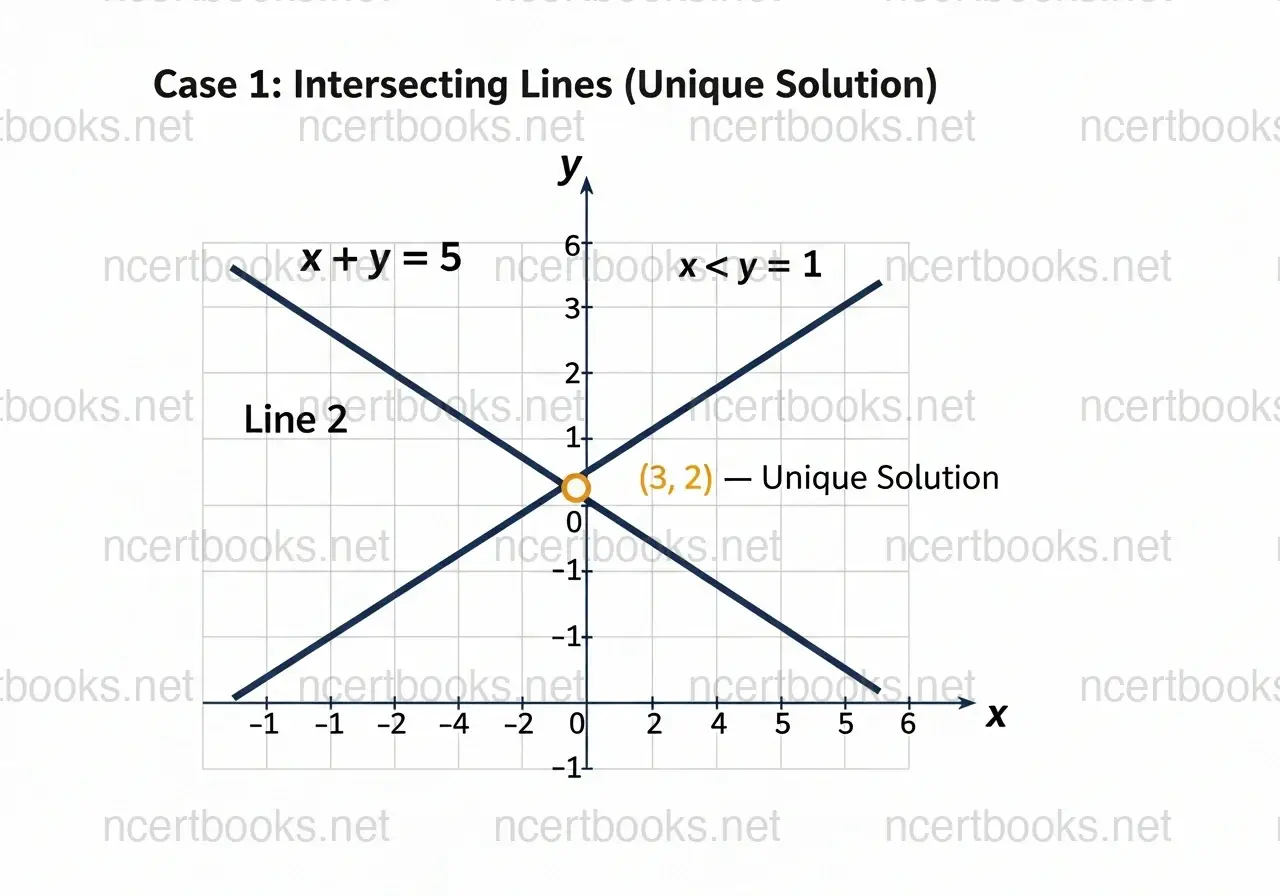
Key Concepts and Methods — Elimination and Substitution for Class 10 Maths
A pair of linear equations in two variables has the general form:
\[ a_1x + b_1y + c_1 = 0 \]
\[ a_2x + b_2y + c_2 = 0 \]
The solution is the point \((x, y)\) that satisfies both equations simultaneously.
Elimination Method — Step-by-Step
Key Concept: Make the coefficient of one variable identical in both equations, then add or subtract to eliminate it.
- Choose the variable to eliminate (pick the one easier to make equal).
- Multiply Equation 1 by the coefficient of the chosen variable in Equation 2, and multiply Equation 2 by the coefficient of the chosen variable in Equation 1.
- Add or subtract the resulting equations to eliminate that variable.
- Solve the single-variable equation obtained.
- Substitute the value back into either original equation to find the second variable.
Substitution Method — Step-by-Step
- From one equation, express one variable in terms of the other (e.g., \( x = \frac{c – b_1 y}{a_1} \)).
- Substitute this expression into the second equation.
- Solve the resulting equation in one variable.
- Substitute back to find the other variable.
- Verify your answer in both original equations.
Why learn both? The elimination method is faster when coefficients are large integers. The substitution method is cleaner when one equation already gives a simple expression for one variable. CBSE often asks you to solve using both methods in the same question.
NCERT Solutions for Class 10 Maths Chapter 3 Ex 3.4 — All Questions (2026-27)
Below are complete, original, step-by-step solutions for every question in Exercise 3.4. These ncert solutions for class 10 maths chapter 3 ex 3 4 match the official NCERT answer key and follow the CBSE marking scheme for 2026-27.
Question 1 — Solve by Elimination Method and Substitution Method
Question 1
Medium
Solve the following pairs of linear equations by the elimination method and the substitution method:
Elimination Method:
Step 1: Write the two equations:
\[ x + y = 5 \quad \text{…(1)} \]
\[ 2x – 3y = 4 \quad \text{…(2)} \]
Step 2: Multiply equation (1) by 3 to make the coefficient of \( y \) equal in magnitude:
\[ 3x + 3y = 15 \quad \text{…(3)} \]
Step 3: Add equation (2) and equation (3) to eliminate \( y \):
\[ (2x – 3y) + (3x + 3y) = 4 + 15 \]
\[ 5x = 19 \]
\[ x = \frac{19}{5} \]
Step 4: Substitute \( x = \frac{19}{5} \) into equation (1):
\[ \frac{19}{5} + y = 5 \]
\[ y = 5 – \frac{19}{5} = \frac{25 – 19}{5} = \frac{6}{5} \]
Substitution Method:
Step 1: From equation (1): \( x = 5 – y \)
Step 2: Substitute into equation (2):
\[ 2(5 – y) – 3y = 4 \]
\[ 10 – 2y – 3y = 4 \]
\[ 10 – 5y = 4 \]
\[ 5y = 6 \]
\[ y = \frac{6}{5} \]
Step 3: \( x = 5 – \frac{6}{5} = \frac{19}{5} \)
Verification: \( \frac{19}{5} + \frac{6}{5} = \frac{25}{5} = 5 \) ✓ and \( 2 \times \frac{19}{5} – 3 \times \frac{6}{5} = \frac{38-18}{5} = \frac{20}{5} = 4 \) ✓
\( \therefore \) \( x = \dfrac{19}{5} \), \( y = \dfrac{6}{5} \)
Elimination Method:
Step 1: Write the equations:
\[ 3x + 4y = 10 \quad \text{…(1)} \]
\[ 2x – 2y = 2 \quad \text{…(2)} \]
Step 2: Multiply equation (2) by 2:
\[ 4x – 4y = 4 \quad \text{…(3)} \]
Step 3: Add equations (1) and (3) to eliminate \( y \):
\[ (3x + 4y) + (4x – 4y) = 10 + 4 \]
\[ 7x = 14 \]
\[ x = 2 \]
Step 4: Substitute \( x = 2 \) into equation (2):
\[ 2(2) – 2y = 2 \]
\[ 4 – 2y = 2 \]
\[ 2y = 2 \]
\[ y = 1 \]
Substitution Method:
Step 1: From equation (2): \( 2x – 2y = 2 \Rightarrow x – y = 1 \Rightarrow x = 1 + y \)
Step 2: Substitute into equation (1):
\[ 3(1 + y) + 4y = 10 \]
\[ 3 + 3y + 4y = 10 \]
\[ 7y = 7 \]
\[ y = 1 \]
Step 3: \( x = 1 + 1 = 2 \)
Verification: \( 3(2) + 4(1) = 6 + 4 = 10 \) ✓ and \( 2(2) – 2(1) = 4 – 2 = 2 \) ✓
\( \therefore \) \( x = 2 \), \( y = 1 \)
Step 1: Rewrite in standard form:
\[ 3x – 5y = 4 \quad \text{…(1)} \]
\[ 9x – 2y = 7 \quad \text{…(2)} \]
Elimination Method:
Step 2: Multiply equation (1) by 3:
\[ 9x – 15y = 12 \quad \text{…(3)} \]
Step 3: Subtract equation (2) from equation (3):
\[ (9x – 15y) – (9x – 2y) = 12 – 7 \]
\[ -13y = 5 \]
\[ y = -\frac{5}{13} \]
Step 4: Substitute into equation (1):
\[ 3x – 5\left(-\frac{5}{13}\right) = 4 \]
\[ 3x + \frac{25}{13} = 4 \]
\[ 3x = 4 – \frac{25}{13} = \frac{52 – 25}{13} = \frac{27}{13} \]
\[ x = \frac{9}{13} \]
Substitution Method:
Step 1: From equation (1): \( x = \frac{4 + 5y}{3} \)
Step 2: Substitute into equation (2):
\[ 9 \times \frac{4 + 5y}{3} – 2y = 7 \]
\[ 3(4 + 5y) – 2y = 7 \]
\[ 12 + 15y – 2y = 7 \]
\[ 13y = -5 \]
\[ y = -\frac{5}{13} \]
Step 3: \( x = \frac{4 + 5(-\frac{5}{13})}{3} = \frac{4 – \frac{25}{13}}{3} = \frac{\frac{27}{13}}{3} = \frac{9}{13} \)
\( \therefore \) \( x = \dfrac{9}{13} \), \( y = -\dfrac{5}{13} \)
Step 1: Clear fractions. Multiply equation (1) by 6:
\[ 3x + 4y = -6 \quad \text{…(A)} \]
Multiply equation (2) by 3:
\[ 3x – y = 9 \quad \text{…(B)} \]
Elimination Method:
Step 2: Subtract equation (B) from equation (A):
\[ (3x + 4y) – (3x – y) = -6 – 9 \]
\[ 5y = -15 \]
\[ y = -3 \]
Step 3: Substitute \( y = -3 \) into equation (B):
\[ 3x – (-3) = 9 \]
\[ 3x + 3 = 9 \]
\[ 3x = 6 \]
\[ x = 2 \]
Substitution Method:
Step 1: From equation (B): \( 3x = 9 + y \Rightarrow x = \frac{9 + y}{3} \)
Step 2: Substitute into equation (A):
\[ 3 \times \frac{9 + y}{3} + 4y = -6 \]
\[ 9 + y + 4y = -6 \]
\[ 5y = -15 \]
\[ y = -3 \]
Step 3: \( x = \frac{9 + (-3)}{3} = \frac{6}{3} = 2 \)
Verification: \( \frac{2}{2} + \frac{2(-3)}{3} = 1 – 2 = -1 \) ✓ and \( 2 – \frac{-3}{3} = 2 + 1 = 3 \) ✓
\( \therefore \) \( x = 2 \), \( y = -3 \)
Question 2 — Word Problems Using Elimination Method
Question 2
Hard
Form the pair of linear equations for the following problems and find their solutions (if they exist) by the elimination method:
If we add 1 to the numerator and subtract 1 from the denominator, a fraction reduces to 1. It becomes \( \frac{1}{2} \), if we only add 1 to the denominator. What is the fraction?
Step 1: Define variables. Let the fraction be \( \frac{x}{y} \), where \( x \) = numerator and \( y \) = denominator.
Step 2: Form equations.
Condition 1: Add 1 to numerator, subtract 1 from denominator → fraction = 1:
\[ \frac{x + 1}{y – 1} = 1 \]
\[ x + 1 = y – 1 \]
\[ x – y = -2 \quad \text{…(1)} \]
Condition 2: Add 1 to denominator → fraction = \( \frac{1}{2} \):
\[ \frac{x}{y + 1} = \frac{1}{2} \]
\[ 2x = y + 1 \]
\[ 2x – y = 1 \quad \text{…(2)} \]
Step 3: Elimination. Subtract equation (1) from equation (2):
\[ (2x – y) – (x – y) = 1 – (-2) \]
\[ x = 3 \]
Step 4: Substitute \( x = 3 \) into equation (1):
\[ 3 – y = -2 \]
\[ y = 5 \]
Verification: \( \frac{3+1}{5-1} = \frac{4}{4} = 1 \) ✓ and \( \frac{3}{5+1} = \frac{3}{6} = \frac{1}{2} \) ✓
\( \therefore \) The fraction is \( \dfrac{3}{5} \).
Five years ago, Nuri was thrice as old as Sonu. Ten years later, Nuri will be twice as old as Sonu. How old are Nuri and Sonu?
Step 1: Define variables. Let Nuri’s present age = \( x \) years and Sonu’s present age = \( y \) years.
Step 2: Form equations.
Five years ago: \( x – 5 = 3(y – 5) \)
\[ x – 5 = 3y – 15 \]
\[ x – 3y = -10 \quad \text{…(1)} \]
Ten years later: \( x + 10 = 2(y + 10) \)
\[ x + 10 = 2y + 20 \]
\[ x – 2y = 10 \quad \text{…(2)} \]
\[ (x – 2y) – (x – 3y) = 10 – (-10) \]
\[ y = 20 \]
Step 4: Substitute \( y = 20 \) into equation (2):
\[ x – 2(20) = 10 \]
\[ x = 50 \]
Verification: 5 years ago: Nuri = 45, Sonu = 15. \( 45 = 3 \times 15 \) ✓. 10 years later: Nuri = 60, Sonu = 30. \( 60 = 2 \times 30 \) ✓
\( \therefore \) Nuri’s present age = 50 years, Sonu’s present age = 20 years.
The sum of the digits of a two-digit number is 9. Also, nine times this number is twice the number obtained by reversing the order of the digits. Find the number.
Step 1: Define variables. Let the tens digit = \( x \) and units digit = \( y \). The original number = \( 10x + y \). Reversed number = \( 10y + x \).
Step 2: Form equations.
Condition 1: Sum of digits = 9:
\[ x + y = 9 \quad \text{…(1)} \]
Condition 2: Nine times the number = twice the reversed number:
\[ 9(10x + y) = 2(10y + x) \]
\[ 90x + 9y = 20y + 2x \]
\[ 88x – 11y = 0 \]
\[ 8x – y = 0 \quad \text{…(2)} \]
Step 3: Elimination. Add equations (1) and (2):
\[ (x + y) + (8x – y) = 9 + 0 \]
\[ 9x = 9 \]
\[ x = 1 \]
Step 4: Substitute \( x = 1 \) into equation (1):
\[ 1 + y = 9 \]
\[ y = 8 \]
Verification: Number = 18. \( 1 + 8 = 9 \) ✓. \( 9 \times 18 = 162 \) and \( 2 \times 81 = 162 \) ✓
\( \therefore \) The two-digit number is 18.
Meena went to a bank to withdraw ₹2000. She asked the cashier to give her ₹50 and ₹100 notes only. Meena got 25 notes in all. Find how many notes of ₹50 and ₹100 she received.
Step 1: Define variables. Let the number of ₹50 notes = \( x \) and number of ₹100 notes = \( y \).
Step 2: Form equations.
Total notes = 25:
\[ x + y = 25 \quad \text{…(1)} \]
Total amount = ₹2000:
\[ 50x + 100y = 2000 \]
\[ x + 2y = 40 \quad \text{…(2)} \]
\[ (x + 2y) – (x + y) = 40 – 25 \]
\[ y = 15 \]
Step 4: Substitute \( y = 15 \) into equation (1):
\[ x + 15 = 25 \]
\[ x = 10 \]
Verification: \( 10 \times 50 + 15 \times 100 = 500 + 1500 = 2000 \) ✓ and \( 10 + 15 = 25 \) ✓
\( \therefore \) Meena received 10 notes of ₹50 and 15 notes of ₹100.
A lending library has a fixed charge for the first three days and an additional charge for each day thereafter. Saritha paid ₹27 for a book kept for seven days, while Susy paid ₹21 for the book she kept for five days. Find the fixed charge and the charge for each extra day.
Step 1: Define variables. Let the fixed charge for the first 3 days = ₹\( x \) and the charge for each extra day = ₹\( y \).
Step 2: Form equations.
Saritha kept the book for 7 days → extra days = \( 7 – 3 = 4 \) days:
\[ x + 4y = 27 \quad \text{…(1)} \]
Susy kept the book for 5 days → extra days = \( 5 – 3 = 2 \) days:
\[ x + 2y = 21 \quad \text{…(2)} \]
Step 3: Elimination. Subtract equation (2) from equation (1):
\[ (x + 4y) – (x + 2y) = 27 – 21 \]
\[ 2y = 6 \]
\[ y = 3 \]
Step 4: Substitute \( y = 3 \) into equation (2):
\[ x + 2(3) = 21 \]
\[ x + 6 = 21 \]
\[ x = 15 \]
Verification: Saritha: \( 15 + 4 \times 3 = 15 + 12 = 27 \) ✓. Susy: \( 15 + 2 \times 3 = 15 + 6 = 21 \) ✓
\( \therefore \) Fixed charge = ₹15 and charge for each extra day = ₹3.
Formula Reference Table — Linear Equations Methods
| Method / Formula | Expression (LaTeX) | When to Use |
|---|---|---|
| General form of pair | \( a_1x + b_1y + c_1 = 0 \) and \( a_2x + b_2y + c_2 = 0 \) | Always — standard form |
| Elimination — multiply factor | Multiply Eq1 by \( b_2 \), Eq2 by \( b_1 \), then subtract | When coefficients are large |
| Substitution expression | \( x = \frac{c – b_1 y}{a_1} \) | When one coefficient = 1 |
| Consistent system (unique solution) | \( \frac{a_1}{a_2} \neq \frac{b_1}{b_2} \) | Lines intersect at one point |
| Inconsistent system (no solution) | \( \frac{a_1}{a_2} = \frac{b_1}{b_2} \neq \frac{c_1}{c_2} \) | Parallel lines |
| Infinitely many solutions | \( \frac{a_1}{a_2} = \frac{b_1}{b_2} = \frac{c_1}{c_2} \) | Coincident lines |
Solved Examples Beyond NCERT — Pair of Linear Equations
These extra examples go slightly beyond the NCERT textbook to help you prepare for cbse class 10 maths ncert solutions at a higher difficulty level.
Extra Example 1
Easy
The sum of two numbers is 16 and their difference is 4. Find the numbers.
Step 1: Let the numbers be \( x \) and \( y \).
\[ x + y = 16 \quad \text{…(1)} \]
\[ x – y = 4 \quad \text{…(2)} \]
Step 2: Add (1) and (2):
\[ 2x = 20 \Rightarrow x = 10 \]
Step 3: \( y = 16 – 10 = 6 \)
\( \therefore \) The numbers are 10 and 6.
Extra Example 2
Medium
A boat travels 36 km upstream in 4 hours and 36 km downstream in 2 hours. Find the speed of the boat in still water and the speed of the stream.
Step 1: Let speed of boat in still water = \( x \) km/h and speed of stream = \( y \) km/h.
Upstream speed = \( x – y \), Downstream speed = \( x + y \).
\[ x – y = \frac{36}{4} = 9 \quad \text{…(1)} \]
\[ x + y = \frac{36}{2} = 18 \quad \text{…(2)} \]
Step 2: Add (1) and (2):
\[ 2x = 27 \Rightarrow x = 13.5 \text{ km/h} \]
Step 3: \( y = 18 – 13.5 = 4.5 \text{ km/h} \)
\( \therefore \) Speed of boat = 13.5 km/h; Speed of stream = 4.5 km/h.
Extra Example 3
Hard
A chemist has two solutions: one 30% acid and another 70% acid. How many litres of each must be mixed to get 40 litres of a 50% acid solution?
Step 1: Let \( x \) = litres of 30% solution and \( y \) = litres of 70% solution.
\[ x + y = 40 \quad \text{…(1)} \]
\[ 0.3x + 0.7y = 0.5 \times 40 = 20 \quad \text{…(2)} \]
Step 2: Multiply (2) by 10: \( 3x + 7y = 200 \)
Multiply (1) by 3: \( 3x + 3y = 120 \)
Step 3: Subtract:
\[ 4y = 80 \Rightarrow y = 20 \]
Step 4: \( x = 40 – 20 = 20 \)
\( \therefore \) 20 litres of each solution must be mixed.
Topic-wise Important Questions for Board Exam — Class 10 Maths Chapter 3
These questions are based on the pattern of CBSE board papers and are directly relevant to ncert solutions for class 10 maths chapter 3 ex 3 4 topics.
1-Mark Questions (Definition / Recall)
- Define a consistent pair of linear equations.
Answer: A pair of linear equations that has at least one solution is called consistent. - What is the condition for a pair of linear equations \( a_1x + b_1y + c_1 = 0 \) and \( a_2x + b_2y + c_2 = 0 \) to have a unique solution?
Answer: \( \frac{a_1}{a_2} \neq \frac{b_1}{b_2} \) - In the elimination method, what is the first step?
Answer: Multiply one or both equations by suitable non-zero constants so that the coefficient of one variable becomes equal in both equations.
3-Mark Questions (Application)
- Solve by elimination: \( 2x + y = 8 \) and \( x – y = 1 \).
Answer: Add both equations: \( 3x = 9 \Rightarrow x = 3 \). Then \( y = 8 – 2(3) = 2 \). Solution: \( x = 3, y = 2 \). - The perimeter of a rectangle is 44 cm. Its length is 4 cm more than its width. Find the dimensions.
Answer: Let length = \( l \), width = \( w \). Equations: \( 2(l + w) = 44 \Rightarrow l + w = 22 \) and \( l = w + 4 \). Substituting: \( 2w + 4 = 22 \Rightarrow w = 9, l = 13 \). Dimensions: 13 cm × 9 cm.
5-Mark Questions (Long Answer)
- Solve the following pair of equations by elimination method: \( \frac{x}{2} + \frac{y}{3} = 5 \) and \( x – \frac{y}{2} = 4 \). Also verify your answer.
Answer: Multiply eq1 by 6: \( 3x + 2y = 30 \). Multiply eq2 by 2: \( 2x – y = 8 \). Multiply second result by 2: \( 4x – 2y = 16 \). Add: \( 7x = 46 \Rightarrow x = \frac{46}{7} \). Then \( y = 2x – 8 = \frac{92}{7} – 8 = \frac{36}{7} \). Verification confirms both equations hold.
Common Mistakes Students Make in Class 10 Maths Chapter 3 Exercise 3.4
Mistake 1: Not multiplying ALL terms when scaling an equation.
Why it’s wrong: If you multiply only the left side and forget the right side constant, your equation becomes incorrect.
Correct approach: Always multiply every term on both sides of the equation by the same constant.
Mistake 2: Subtracting instead of adding (or vice versa) during elimination.
Why it’s wrong: If both coefficients are positive and equal, you must subtract. If they are opposite in sign, you must add. Mixing these up gives a wrong result.
Correct approach: Check the signs of the coefficients carefully before deciding to add or subtract.
Mistake 3: Not defining variables clearly in word problems.
Why it’s wrong: CBSE examiners expect you to state “Let x = …” and “Let y = …” before forming equations. Missing this step loses marks.
Correct approach: Always start word problems by writing “Let the [unknown] = x” and “Let the [unknown] = y” explicitly.
Mistake 4: Skipping verification at the end.
Why it’s wrong: CBSE marking schemes often allocate a mark for the verification step in word problems. Skipping it is an easy mark lost.
Correct approach: Always substitute your answers back into both original equations and confirm they satisfy them.
Mistake 5: Forming wrong equations from word problems (especially age problems).
Why it’s wrong: Students confuse “five years ago” (subtract 5) with “five years later” (add 5), leading to incorrect equations.
Correct approach: Re-read the problem carefully. Write the condition in words first, then translate to algebra.
Exam Tips for CBSE 2026-27 — Class 10 Maths Chapter 3 Linear Equations
- Show both methods: When a question says “solve by elimination and substitution”, CBSE expects both methods written out. Showing only one method may result in partial marks.
- Word problems carry high marks: Problems like those in Q2 of Ex 3.4 appear as 3-mark or 5-mark questions. The marks are distributed across: defining variables (1 mark), forming equations (1 mark), solving (1–2 marks), and verification (1 mark).
- Always simplify fractions: Before applying the elimination method, multiply through to clear fractions. This reduces calculation errors significantly.
- Revision checklist for Chapter 3:
- ✅ Know when to use elimination vs. substitution
- ✅ Practice forming equations from word problems (fractions, ages, digits, money)
- ✅ Remember the conditions for consistent, inconsistent, and dependent systems
- ✅ Always write variable definitions and verify your final answer
- ✅ Practise Q2(ii) and Q2(iii) type problems — they are CBSE favourites
- Chapter 3 weightage in 2026-27 CBSE board: Algebra section (which includes Chapter 3) carries approximately 20 marks total in the board paper. Mastering Exercise 3.4 helps you score in both the application and long-answer sections.
For more practice, explore the full set of NCERT Solutions for Class 10 on our website, including all chapters of Maths, Science, and Social Science.