⚡ Quick Revision Box — Chapter 3 Ex 3.2
- Chapter: 3 — Pair of Linear Equations in Two Variables | Exercise: 3.2 | Class: 10 Maths
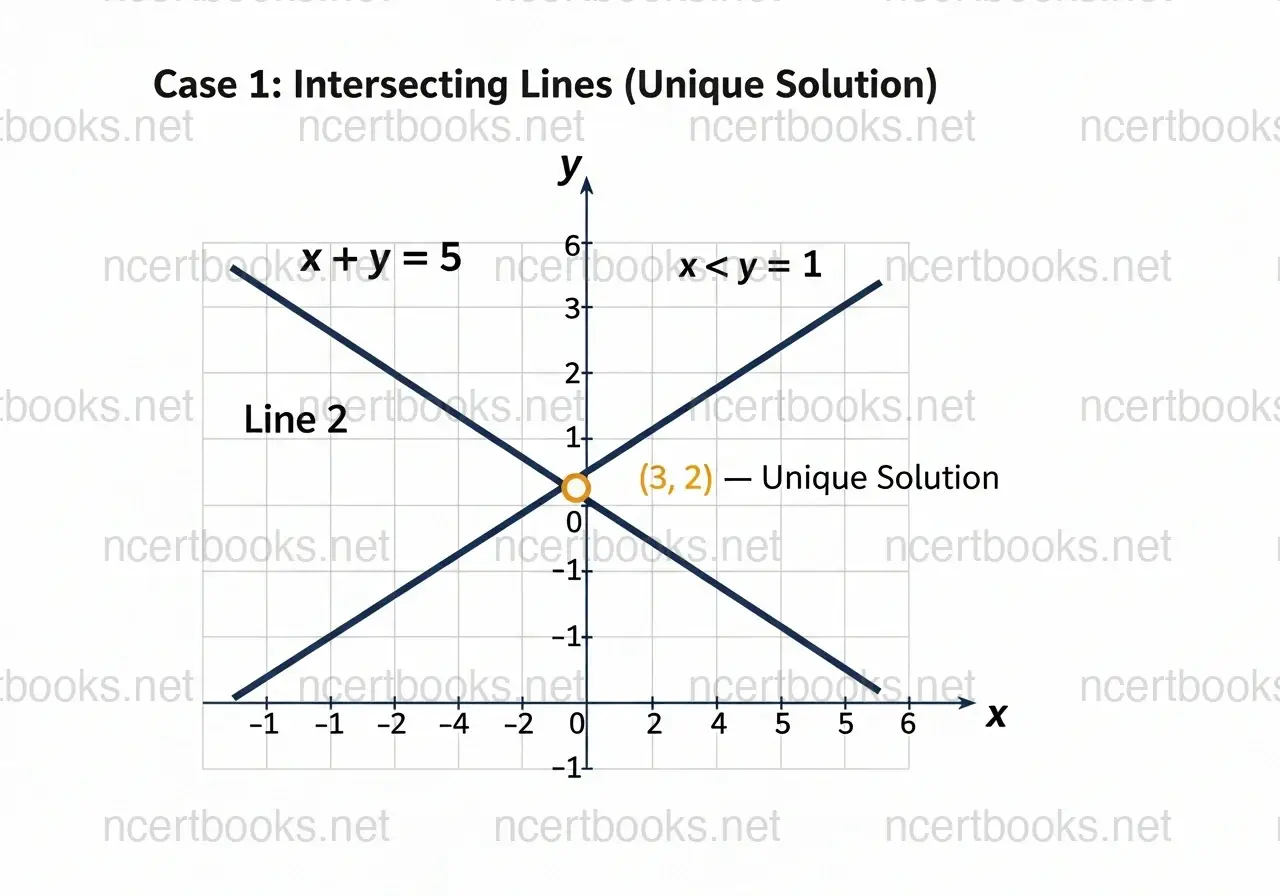
- Intersecting lines → Unique solution → Consistent pair → \( \frac{a_1}{a_2} \neq \frac{b_1}{b_2} \)
- Parallel lines → No solution → Inconsistent pair → \( \frac{a_1}{a_2} = \frac{b_1}{b_2} \neq \frac{c_1}{c_2} \)
- Coincident lines → Infinite solutions → Consistent (dependent) → \( \frac{a_1}{a_2} = \frac{b_1}{b_2} = \frac{c_1}{c_2} \)
- Graphical method: Plot at least 3 points per line, find intersection point for solution
- Word problems: Form two equations from given conditions, then solve graphically
- Algebra unit weightage: ~20 marks in CBSE Class 10 board exam 2026-27
- Total questions in Ex 3.2: 7 questions (all solved below with full working)
The NCERT Solutions for Class 10 Maths Chapter 3 Ex 3.2 on this page cover every question in Exercise 3.2 of the Pair of Linear Equations in Two Variables chapter — fully updated for the 2026-27 CBSE board exam. You will find complete step-by-step graphical solutions, ratio-comparison methods, consistency checks, and word problems. These solutions are part of our broader NCERT Solutions for Class 10 resource hub, which covers all subjects and chapters. For the official textbook, visit the NCERT official textbook portal.
Table of Contents
- Quick Revision Box
- Chapter Overview — Pair of Linear Equations in Two Variables
- Key Concepts and Theorems — Graphical Method
- NCERT Solutions for Class 10 Maths Chapter 3 Ex 3.2 — All Questions
- Formula Reference Table — Linear Equations
- Solved Examples Beyond NCERT
- Important Questions for Board Exam 2026-27
- Common Mistakes Students Make
- Exam Tips for 2026-27 CBSE Board
- Frequently Asked Questions
Chapter Overview — Pair of Linear Equations in Two Variables (Class 10 Maths, 2026-27)
Chapter 3 of the NCERT Class 10 Maths textbook deals with Pair of Linear Equations in Two Variables. Exercise 3.2 focuses specifically on the graphical method of solving such pairs — you plot both equations on a coordinate plane and identify whether they intersect, run parallel, or coincide. This is a foundational topic in the NCERT Solutions Algebra unit and is tested every year in CBSE board exams.
For the 2026-27 board exam, the Algebra unit (which includes this chapter) carries approximately 20 marks. Questions from Exercise 3.2 typically appear as 2-mark ratio-comparison problems, 3-mark graphical solution problems, and 5-mark word problems requiring graph construction. You must practise plotting accurate graphs and labelling intersection points clearly.
Prerequisites: You should be comfortable with plotting points on a Cartesian plane (Class 9 Coordinate Geometry), solving single-variable linear equations, and basic algebraic manipulation before attempting this exercise.
| Field | Details |
|---|---|
| Chapter | 3 — Pair of Linear Equations in Two Variables |
| Exercise | 3.2 |
| Textbook | NCERT Mathematics — Class 10 |
| Class | 10 |
| Subject | Mathematics |
| Marks Weightage | Part of Algebra (~20 marks in board exam) |
| Difficulty Level | Medium |
| Academic Year | 2026-27 |
Key Concepts and Theorems — Graphical Method of Solving Linear Equations
Types of Solutions for a Pair of Linear Equations
A pair of linear equations \( a_1x + b_1y + c_1 = 0 \) and \( a_2x + b_2y + c_2 = 0 \) can have three geometric relationships:
- Intersecting lines: One unique solution. The pair is consistent. Condition: \( \frac{a_1}{a_2} \neq \frac{b_1}{b_2} \)
- Parallel lines: No solution. The pair is inconsistent. Condition: \( \frac{a_1}{a_2} = \frac{b_1}{b_2} \neq \frac{c_1}{c_2} \)
- Coincident lines: Infinitely many solutions. The pair is consistent (dependent). Condition: \( \frac{a_1}{a_2} = \frac{b_1}{b_2} = \frac{c_1}{c_2} \)
Steps for the Graphical Method
- Rewrite each equation in the form \( y = mx + c \) (slope-intercept form).
- Prepare a table of at least 3 \((x, y)\) coordinate pairs for each equation.
- Plot both sets of points on the same coordinate plane and draw the lines through them.
- Observe the lines: do they intersect, run parallel, or coincide?
- If they intersect, the coordinates of the intersection point are the solution.
Consistent vs Inconsistent — Meaning in Hindi
Consistent (संगत): A pair that has at least one solution. Inconsistent (असंगत): A pair with no solution at all. These terms appear directly in CBSE board exam questions, so memorise both the English and Hindi terms.
NCERT Solutions for Class 10 Maths Chapter 3 Ex 3.2 — All 7 Questions (Step-by-Step)
Below are complete, original solutions to all 7 questions of Exercise 3.2 from the NCERT Class 10 Maths textbook. Every solution includes the method, working steps, and the final answer box. These are part of the full NCERT Solutions for Class 10 Maths series on ncertbooks.net.
Question 1
Medium
Form the pair of linear equations of the following problems and find their solutions graphically:
(i) 10 students of class X took part in a Mathematics quiz. If the number of girls is 4 more than the number of boys, find the number of boys and girls who took part in the quiz.
(ii) 5 pencils and 7 pens together cost ₹50, whereas 7 pencils and 5 pens together cost ₹46. Find the cost of one pencil and that of one pen.
Step 1 — Form the equations. Let the number of boys = \( x \) and number of girls = \( y \).
Total students: \( x + y = 10 \) …(1)
Girls are 4 more than boys: \( y – x = 4 \) …(2)
Step 2 — Prepare table for Equation (1): \( y = 10 – x \)
| \( x \) | 0 | 5 | 10 |
|---|---|---|---|
| \( y = 10 – x \) | 10 | 5 | 0 |
Step 3 — Prepare table for Equation (2): \( y = x + 4 \)
| \( x \) | 0 | 2 | 4 |
|---|---|---|---|
| \( y = x + 4 \) | 4 | 6 | 8 |
Step 4 — Plot and find intersection. Plot both lines on a graph. The two lines intersect at the point \( (3, 7) \).
Why does this work? At the intersection point, both equations are satisfied simultaneously, giving the unique solution.
\( \therefore \) Number of boys = 3, Number of girls = 7.
Verification: \( 3 + 7 = 10 \) ✓ and \( 7 – 3 = 4 \) ✓
Step 1 — Form the equations. Let cost of one pencil = \( x \) (₹) and cost of one pen = \( y \) (₹).
\( 5x + 7y = 50 \) …(1)
\( 7x + 5y = 46 \) …(2)
Step 2 — Table for Equation (1): \( y = \frac{50 – 5x}{7} \)
| \( x \) | 3 | 10 | -4 |
|---|---|---|---|
| \( y \) | 5 | 0 | 10 |
Step 3 — Table for Equation (2): \( y = \frac{46 – 7x}{5} \)
| \( x \) | 3 | 8 | -2 |
|---|---|---|---|
| \( y \) | 5 | -2 | 12 |
Step 4 — Intersection. Both tables share the point \( (3, 5) \). Plot both lines — they intersect at \( (3, 5) \).
\( \therefore \) Cost of one pencil = ₹3, Cost of one pen = ₹5.
Verification: \( 5(3) + 7(5) = 15 + 35 = 50 \) ✓ and \( 7(3) + 5(5) = 21 + 25 = 46 \) ✓
Question 2
Easy
On comparing the ratios \( \frac{a_1}{a_2} \), \( \frac{b_1}{b_2} \) and \( \frac{c_1}{c_2} \), find out whether the lines representing the following pairs of linear equations intersect at a point, are parallel or coincident:
(i) \( 5x – 4y + 8 = 0,\ 7x + 6y – 9 = 0 \)
(ii) \( 9x + 3y + 12 = 0,\ 18x + 6y + 24 = 0 \)
(iii) \( 6x – 3y + 10 = 0,\ 2x – y + 9 = 0 \)
Key Concept: Here \( a_1 = 5,\ b_1 = -4,\ c_1 = 8 \) and \( a_2 = 7,\ b_2 = 6,\ c_2 = -9 \).
\[ \frac{a_1}{a_2} = \frac{5}{7}, \quad \frac{b_1}{b_2} = \frac{-4}{6} = \frac{-2}{3} \]
Since \( \frac{5}{7} \neq \frac{-2}{3} \), we have \( \frac{a_1}{a_2} \neq \frac{b_1}{b_2} \).
\( \therefore \) The lines intersect at a point. The pair has a unique solution and is consistent.
Here \( a_1 = 9,\ b_1 = 3,\ c_1 = 12 \) and \( a_2 = 18,\ b_2 = 6,\ c_2 = 24 \).
\[ \frac{a_1}{a_2} = \frac{9}{18} = \frac{1}{2}, \quad \frac{b_1}{b_2} = \frac{3}{6} = \frac{1}{2}, \quad \frac{c_1}{c_2} = \frac{12}{24} = \frac{1}{2} \]
Since \( \frac{a_1}{a_2} = \frac{b_1}{b_2} = \frac{c_1}{c_2} = \frac{1}{2} \), all three ratios are equal.
Why does this work? Equal ratios mean the second equation is simply a scalar multiple of the first — both equations represent the same line.
\( \therefore \) The lines are coincident. The pair has infinitely many solutions and is consistent (dependent).
Here \( a_1 = 6,\ b_1 = -3,\ c_1 = 10 \) and \( a_2 = 2,\ b_2 = -1,\ c_2 = 9 \).
\[ \frac{a_1}{a_2} = \frac{6}{2} = 3, \quad \frac{b_1}{b_2} = \frac{-3}{-1} = 3, \quad \frac{c_1}{c_2} = \frac{10}{9} \]
Since \( \frac{a_1}{a_2} = \frac{b_1}{b_2} = 3 \) but \( \frac{c_1}{c_2} = \frac{10}{9} \neq 3 \).
\( \therefore \) The lines are parallel. The pair has no solution and is inconsistent.
Question 4
Medium
Which of the following pairs of linear equations are consistent/inconsistent? If consistent, obtain the solution graphically.
(i) \( x + y = 5,\ 2x + 2y = 10 \)
(ii) \( x – y = 8,\ 3x – 3y = 16 \)
(iii) \( 2x + y – 6 = 0,\ 4x – 2y – 4 = 0 \)
(iv) \( 2x – 2y – 2 = 0,\ 4x – 4y – 5 = 0 \)
Rewrite: \( a_1 = 1, b_1 = 1, c_1 = -5 \) and \( a_2 = 2, b_2 = 2, c_2 = -10 \).
\[ \frac{a_1}{a_2} = \frac{1}{2}, \quad \frac{b_1}{b_2} = \frac{1}{2}, \quad \frac{c_1}{c_2} = \frac{-5}{-10} = \frac{1}{2} \]
All three ratios are equal: \( \frac{1}{2} = \frac{1}{2} = \frac{1}{2} \). The lines are coincident.
Graphical solution: Equation (2) is simply \( 2 \times \) Equation (1), so both represent the same line. Table for \( x + y = 5 \): \((0,5), (2,3), (5,0)\). The line passes through all these points and both equations share every point on it.
\( \therefore \) Consistent (infinitely many solutions). Every point on the line \( x + y = 5 \) is a solution.
\( a_1 = 1, b_1 = -1, c_1 = -8 \) and \( a_2 = 3, b_2 = -3, c_2 = -16 \).
\[ \frac{a_1}{a_2} = \frac{1}{3}, \quad \frac{b_1}{b_2} = \frac{-1}{-3} = \frac{1}{3}, \quad \frac{c_1}{c_2} = \frac{-8}{-16} = \frac{1}{2} \]
\( \frac{a_1}{a_2} = \frac{b_1}{b_2} = \frac{1}{3} \) but \( \frac{c_1}{c_2} = \frac{1}{2} \neq \frac{1}{3} \). The lines are parallel.
\( \therefore \) Inconsistent — no solution. The lines never intersect; no graphical solution exists.
\( a_1 = 2, b_1 = 1, c_1 = -6 \) and \( a_2 = 4, b_2 = -2, c_2 = -4 \).
\[ \frac{a_1}{a_2} = \frac{2}{4} = \frac{1}{2}, \quad \frac{b_1}{b_2} = \frac{1}{-2} = -\frac{1}{2} \]
Since \( \frac{1}{2} \neq -\frac{1}{2} \), the lines intersect — the pair is consistent with a unique solution.
Graphical solution — Table for \( 2x + y = 6 \), i.e., \( y = 6 – 2x \):
| \( x \) | 0 | 2 | 3 |
|---|---|---|---|
| \( y \) | 6 | 2 | 0 |
Table for \( 4x – 2y = 4 \), i.e., \( y = 2x – 2 \):
| \( x \) | 0 | 1 | 2 |
|---|---|---|---|
| \( y \) | -2 | 0 | 2 |
Plotting both lines, they intersect at \( (2, 2) \).
\( \therefore \) Consistent — unique solution: \( x = 2, y = 2 \).
Verification: \( 2(2) + 2 – 6 = 0 \) ✓ and \( 4(2) – 2(2) – 4 = 0 \) ✓
\( a_1 = 2, b_1 = -2, c_1 = -2 \) and \( a_2 = 4, b_2 = -4, c_2 = -5 \).
\[ \frac{a_1}{a_2} = \frac{2}{4} = \frac{1}{2}, \quad \frac{b_1}{b_2} = \frac{-2}{-4} = \frac{1}{2}, \quad \frac{c_1}{c_2} = \frac{-2}{-5} = \frac{2}{5} \]
\( \frac{a_1}{a_2} = \frac{b_1}{b_2} = \frac{1}{2} \) but \( \frac{c_1}{c_2} = \frac{2}{5} \neq \frac{1}{2} \). The lines are parallel.
\( \therefore \) Inconsistent — no solution. The lines are parallel and do not intersect.
Question 5
Medium
Half the perimeter of a rectangular garden, whose length is 4 m more than its width, is 36 m. Find the dimensions of the garden graphically.
Step 1 — Define variables. Let length = \( x \) metres and width = \( y \) metres.
Step 2 — Form equations.
Half the perimeter = 36 m, so: \( x + y = 36 \) …(1)
Length is 4 m more than width: \( x – y = 4 \) …(2)
Step 3 — Table for Equation (1): \( y = 36 – x \)
| \( x \) | 0 | 20 | 36 |
|---|---|---|---|
| \( y \) | 36 | 16 | 0 |
Step 4 — Table for Equation (2): \( y = x – 4 \)
| \( x \) | 4 | 20 | 36 |
|---|---|---|---|
| \( y \) | 0 | 16 | 32 |
Step 5 — Find intersection. Plot both lines. They intersect at \( (20, 16) \).
Why does this work? The intersection point satisfies both conditions — the perimeter condition and the length-width relationship — simultaneously.
\( \therefore \) Length = 20 m, Width = 16 m.
Verification: \( 20 + 16 = 36 \) ✓ (half perimeter) and \( 20 – 16 = 4 \) ✓ (length is 4 more than width)
Question 6
Easy
Given the linear equation \( 2x + 3y – 8 = 0 \), write another linear equation in two variables such that the geometrical representation of the pair so formed is:
(i) intersecting lines
(ii) parallel lines
(iii) coincident lines
Key Concept: For the given equation, \( a_1 = 2, b_1 = 3, c_1 = -8 \). We choose a second equation \( a_2x + b_2y + c_2 = 0 \) by controlling the ratios.
Condition: \( \frac{a_1}{a_2} \neq \frac{b_1}{b_2} \)
Choose \( a_2 = 3, b_2 = 2 \): then \( \frac{2}{3} \neq \frac{3}{2} \). ✓
Example equation: \( 3x + 2y – 6 = 0 \) (any equation where \( \frac{a_1}{a_2} \neq \frac{b_1}{b_2} \) is valid)
Condition: \( \frac{a_1}{a_2} = \frac{b_1}{b_2} \neq \frac{c_1}{c_2} \)
We need \( \frac{2}{a_2} = \frac{3}{b_2} \) but \( \frac{-8}{c_2} \) must differ. Choose \( a_2 = 4, b_2 = 6 \): \( \frac{2}{4} = \frac{3}{6} = \frac{1}{2} \). Now choose \( c_2 \neq -16 \), e.g., \( c_2 = -10 \).
Example equation: \( 4x + 6y – 10 = 0 \)
Condition: \( \frac{a_1}{a_2} = \frac{b_1}{b_2} = \frac{c_1}{c_2} \)
Multiply the entire equation by any non-zero constant, say 2: \( 2(2x + 3y – 8) = 0 \)
\[ 4x + 6y – 16 = 0 \]
Check: \( \frac{2}{4} = \frac{3}{6} = \frac{-8}{-16} = \frac{1}{2} \). All ratios equal. ✓
Example equation: \( 4x + 6y – 16 = 0 \)
Question 7
Hard
Draw the graphs of the equations \( x – y + 1 = 0 \) and \( 3x + 2y – 12 = 0 \). Determine the coordinates of the vertices of the triangle formed by these lines and the x-axis, and shade the triangular region.
Step 1 — Table for Equation (1): \( x – y + 1 = 0 \), i.e., \( y = x + 1 \)
| \( x \) | 0 | 1 | -1 |
|---|---|---|---|
| \( y = x + 1 \) | 1 | 2 | 0 |
Step 2 — Table for Equation (2): \( 3x + 2y – 12 = 0 \), i.e., \( y = \frac{12 – 3x}{2} \)
| \( x \) | 0 | 2 | 4 |
|---|---|---|---|
| \( y \) | 6 | 3 | 0 |
Step 3 — Find intersection of the two lines.
From Equation (1): \( y = x + 1 \). Substitute into Equation (2):
\[ 3x + 2(x + 1) – 12 = 0 \]
\[ 3x + 2x + 2 – 12 = 0 \]
\[ 5x = 10 \implies x = 2 \]
Then \( y = 2 + 1 = 3 \). Intersection point: \( (2, 3) \).
Step 4 — Find x-intercepts (where each line meets the x-axis, i.e., \( y = 0 \)).
For Equation (1): \( x – 0 + 1 = 0 \implies x = -1 \). Point: \( (-1, 0) \).
For Equation (2): \( 3x + 0 – 12 = 0 \implies x = 4 \). Point: \( (4, 0) \).
Step 5 — Identify the three vertices of the triangle.
The triangle is formed by the two lines and the x-axis. Its three vertices are the intersection of the two lines, and the two x-intercepts.
Why does this work? Each pair of lines (or a line and the x-axis) meets at exactly one point, giving three vertices of a triangle.
\( \therefore \) Vertices of the triangle: \( A(-1, 0) \), \( B(4, 0) \), \( C(2, 3) \).
Plot these three vertices, connect them, and shade the enclosed triangular region.
Formula Reference Table — Pair of Linear Equations in Two Variables
| Condition | Ratio Comparison | Geometric Interpretation | Type of Solution | Consistency |
|---|---|---|---|---|
| Intersecting lines | \( \frac{a_1}{a_2} \neq \frac{b_1}{b_2} \) | Two lines meet at one point | Unique solution | Consistent |
| Parallel lines | \( \frac{a_1}{a_2} = \frac{b_1}{b_2} \neq \frac{c_1}{c_2} \) | Lines never meet | No solution | Inconsistent |
| Coincident lines | \( \frac{a_1}{a_2} = \frac{b_1}{b_2} = \frac{c_1}{c_2} \) | Lines overlap completely | Infinitely many solutions | Consistent (dependent) |
The standard form of a linear equation in two variables is \( ax + by + c = 0 \) where \( a, b, c \) are real numbers and \( a \neq 0 \) or \( b \neq 0 \). The slope-intercept form \( y = mx + c \) is useful when preparing tables for graphing.
Solved Examples Beyond NCERT — Graphical Method Practice
Extra Example 1 — Ratio Comparison
Easy
Check whether the pair \( 3x + 2y – 4 = 0 \) and \( 6x + 4y – 8 = 0 \) is consistent or inconsistent.
\( a_1 = 3, b_1 = 2, c_1 = -4 \) and \( a_2 = 6, b_2 = 4, c_2 = -8 \).
\[ \frac{a_1}{a_2} = \frac{3}{6} = \frac{1}{2}, \quad \frac{b_1}{b_2} = \frac{2}{4} = \frac{1}{2}, \quad \frac{c_1}{c_2} = \frac{-4}{-8} = \frac{1}{2} \]
\( \therefore \) All ratios equal \( \frac{1}{2} \). Coincident lines — consistent (infinitely many solutions).
Extra Example 2 — Word Problem
Medium
The sum of two numbers is 20 and their difference is 4. Find the numbers graphically.
Let the numbers be \( x \) and \( y \). Equations: \( x + y = 20 \) and \( x – y = 4 \).
Table for \( y = 20 – x \): \((0,20), (10,10), (20,0)\). Table for \( y = x – 4 \): \((0,-4), (4,0), (10,6)\).
Intersection: Add both equations: \( 2x = 24 \implies x = 12 \), then \( y = 8 \). Intersection point: \( (12, 8) \).
\( \therefore \) The two numbers are 12 and 8.
Extra Example 3 — Triangle Vertices
Hard
Find the vertices of the triangle formed by \( 2x + y = 6 \), \( x – y = 0 \), and the y-axis.
Intersection of the two lines: From \( x – y = 0 \): \( y = x \). Substitute: \( 2x + x = 6 \implies x = 2, y = 2 \). Point: \( (2, 2) \).
Intersection of \( 2x + y = 6 \) with y-axis (\( x = 0 \)): \( y = 6 \). Point: \( (0, 6) \).
Intersection of \( x – y = 0 \) with y-axis (\( x = 0 \)): \( y = 0 \). Point: \( (0, 0) \).
\( \therefore \) Vertices: \( (0, 0) \), \( (0, 6) \), \( (2, 2) \).
Important Questions for CBSE Board Exam 2026-27 — Chapter 3 Linear Equations
1-Mark Questions (Definition / Fill-in)
- Define a consistent pair of linear equations.
Answer: A pair of linear equations that has at least one solution (unique or infinitely many) is called a consistent pair. - What does it mean geometrically if \( \frac{a_1}{a_2} = \frac{b_1}{b_2} = \frac{c_1}{c_2} \)?
Answer: The two lines are coincident — they overlap completely and have infinitely many solutions. - State the condition for two lines to be parallel.
Answer: \( \frac{a_1}{a_2} = \frac{b_1}{b_2} \neq \frac{c_1}{c_2} \).
3-Mark Questions
- Check whether \( 2x – 3y + 5 = 0 \) and \( 4x – 6y + 10 = 0 \) are consistent. If yes, find the solution.
Answer: \( \frac{2}{4} = \frac{-3}{-6} = \frac{5}{10} = \frac{1}{2} \). All ratios equal — coincident lines. Consistent with infinitely many solutions. Every point satisfying \( 2x – 3y + 5 = 0 \) is a solution. - The difference of two numbers is 3 and their sum is 15. Form a pair of linear equations and solve graphically.
Answer: Let numbers be \( x \) and \( y \). Equations: \( x + y = 15 \) and \( x – y = 3 \). Solving: \( x = 9, y = 6 \). Intersection at \( (9, 6) \).
5-Mark Questions (Long Answer)
- Draw the graphs of \( 2x – y = 4 \) and \( x + y = -1 \). Find the vertices of the triangle formed by these lines and the y-axis.
Answer: Line 1 meets y-axis at \( (0, -4) \). Line 2 meets y-axis at \( (0, -1) \). Intersection: From \( y = 2x – 4 \) and \( y = -x – 1 \): \( 2x – 4 = -x – 1 \implies 3x = 3 \implies x = 1, y = -2 \). Vertices: \( (0, -4) \), \( (0, -1) \), \( (1, -2) \). Plot, shade the triangular region, and label all vertices.
Common Mistakes Students Make in Chapter 3 Ex 3.2
Mistake 1: Students forget to write equations in standard form \( ax + by + c = 0 \) before comparing ratios.
Why it’s wrong: If the equation is in a different form, the values of \( a, b, c \) will be incorrect, leading to wrong ratio comparisons.
Correct approach: Always rearrange both equations to \( ax + by + c = 0 \) first, then identify \( a_1, b_1, c_1, a_2, b_2, c_2 \).
Mistake 2: Students plot only 2 points per line and get an inaccurate graph.
Why it’s wrong: Two points define a line, but a third point is needed to verify you haven’t made an arithmetic error in your table.
Correct approach: Always calculate at least 3 coordinate pairs per line before plotting.
Mistake 3: Students confuse inconsistent with dependent. They write “no solution” for coincident lines.
Why it’s wrong: Coincident lines are consistent (dependent) with infinitely many solutions. Only parallel lines are inconsistent.
Correct approach: Memorise: Parallel = Inconsistent = No solution. Coincident = Consistent (dependent) = Infinite solutions.
Mistake 4: In Question 7-type problems, students find only the intersection of the two lines and miss the x-intercepts.
Why it’s wrong: The triangle has three vertices — the two x-intercepts AND the intersection point of the two lines. Missing any one loses marks.
Correct approach: Systematically find: (a) intersection of lines, (b) x-intercept of Line 1, (c) x-intercept of Line 2.
Mistake 5: Students write \( c_1/c_2 \) without checking the sign of \( c \) correctly after rearranging.
Why it’s wrong: If you move a constant to the other side, its sign changes. A sign error here changes the ratio and flips the conclusion.
Correct approach: Be careful with signs. Double-check \( c_1 \) and \( c_2 \) by substituting a known point into each equation.
Exam Tips for 2026-27 CBSE Board — Class 10 Maths Chapter 3
- Graph questions (5 marks): CBSE awards marks for the table of values (1 mark), correct plotting (1 mark), labelling the intersection point (1 mark), and the final answer with verification (2 marks). Never skip the table.
- Ratio comparison questions (2-3 marks): Write all three ratios clearly, compare them step by step, and state the conclusion in one clear sentence. Examiners look for the conclusion word — “intersecting”, “parallel”, or “coincident”.
- Word problems: Define variables, write both equations explicitly, and solve. You lose marks if you jump directly to the graph without stating the equations.
- Verification is mandatory: The CBSE marking scheme for 2026-27 rewards verification. Always substitute your answer back into both original equations.
- Shading: In triangle problems, always shade the triangular region and label all three vertices with their coordinates. An unlabelled graph loses 1 mark.
- Last-minute revision checklist:
- ✅ Know the three ratio conditions by heart (intersecting / parallel / coincident)
- ✅ Practise drawing accurate graphs on graph paper with a ruler
- ✅ Memorise: consistent = has solution, inconsistent = no solution
- ✅ Revise word problem formulation — forming the pair of equations is the hardest part
- ✅ Practise Q7-type triangle problems — they appear frequently in board exams