- Chapter: 15 — Probability | Class 10 Maths (NCERT)
- Exercise 15.2: Contains 5 questions — all based on theoretical probability
- Key Formula: \( P(E) = \frac{\text{Number of favourable outcomes}}{\text{Total number of outcomes}} \)
- Complementary Events: \( P(E) + P(\bar{E}) = 1 \)
- Sample Space (5-day week, 2 people): \( 5 \times 5 = 25 \) equally likely outcomes
- Algebraic Probability: Set up equations using P(E) expressions — used in Q3, Q4, Q5
- CBSE Weightage: Probability carries 4–5 marks in Class 10 board exams
- Academic Year: Updated for 2026-27 CBSE syllabus
The NCERT Solutions for Class 10 Maths Chapter 15 Ex 15.2 on this page cover all 5 questions from the Probability exercise, fully solved with step-by-step working — updated for the 2026-27 CBSE board exam. You can find these solutions as part of our complete NCERT Solutions for Class 10 collection. Whether you are preparing for your board exam or doing homework, these answers will help you understand exactly how to approach probability problems involving sample spaces, algebraic equations, and real-world scenarios. This exercise is part of the NCERT Solutions library at ncertbooks.net, verified against the official NCERT official textbook.
Table of Contents
- Quick Revision Box
- Chapter Overview — Probability Class 10 Chapter 15
- Key Concepts and Theorems — Theoretical Probability
- NCERT Solutions for Class 10 Maths Chapter 15 Ex 15.2 — All Questions
- Formula Reference Table
- Solved Examples Beyond NCERT
- Important Questions for CBSE Board Exam 2026-27
- Common Mistakes Students Make
- Exam Tips for CBSE 2026-27
- Key Points to Remember
- Frequently Asked Questions
Chapter Overview — Probability Class 10 Chapter 15
Chapter 15 of the NCERT Class 10 Maths textbook introduces Theoretical Probability (प्रायिकता). It builds on the experimental probability you studied in Class 9 and formalises the concept using equally likely outcomes and sample spaces. Exercise 15.2 is the second and final exercise in this chapter, and it contains 5 application-based problems that test your ability to construct sample spaces, set up algebraic probability equations, and interpret real-world scenarios.
For the CBSE 2026-27 board exam, Probability is part of the Statistics and Probability unit, which together carry around 11 marks. Questions from this chapter typically appear as 2-mark or 3-mark problems. You need to be comfortable with listing sample spaces, computing favourable outcomes, and solving equations where probability is given as a condition.
| Detail | Information |
|---|---|
| Chapter | 15 — Probability |
| Exercise | 15.2 |
| Textbook | NCERT Mathematics — Class 10 |
| Class | 10 (Secondary) |
| Subject | Mathematics |
| Number of Questions | 5 |
| CBSE Marks Weightage | 4–5 marks (Statistics & Probability unit) |
| Difficulty Level | Easy to Medium |
| Academic Year | 2026-27 |
Key Concepts and Theorems — Theoretical Probability
Theoretical Probability (सैद्धांतिक प्रायिकता) assumes that all outcomes of an experiment are equally likely. You do not need to actually perform the experiment — you calculate the probability using logic and counting.
Key Concept 1 — Probability Formula:
\[ P(E) = \frac{\text{Number of outcomes favourable to } E}{\text{Total number of equally likely outcomes}} \]
Key Concept 2 — Sample Space (नमूना समष्टि): The set of all possible outcomes of a random experiment is called the sample space. For example, if two people each choose one of 5 days, the sample space has \( 5 \times 5 = 25 \) outcomes.
Key Concept 3 — Complementary Events: If \( E \) is an event, then \( \bar{E} \) (not E) is its complement. They satisfy:
\[ P(E) + P(\bar{E}) = 1 \]
Key Concept 4 — Range of Probability: For any event \( E \):
\[ 0 \leq P(E) \leq 1 \]
Key Concept 5 — Impossible and Certain Events: \( P(\text{impossible event}) = 0 \) and \( P(\text{certain event}) = 1 \).
Key Concept 6 — Algebraic Probability Setup: In several questions, you are given a condition like “probability of A is double that of B”. You express both probabilities in terms of an unknown \( x \), set up an equation, and solve. This approach is used in Questions 3, 4, and 5 of Exercise 15.2.
NCERT Solutions for Class 10 Maths Chapter 15 Ex 15.2 — All Questions Solved
Below are the complete, step-by-step NCERT Solutions for Class 10 Maths Chapter 15 Ex 15.2. Every question is answered in full — no steps are skipped. For CBSE board exams, always show your working clearly to earn full marks.
Question 1
Medium
Two customers Shyam and Ekta are visiting a particular shop in the same week (Tuesday to Saturday). Each is equally likely to visit the shop on any day as on another day. What is the probability that both will visit the shop on (i) the same day? (ii) consecutive days? (iii) different days?
Key Concept: The week here is Tuesday to Saturday — that is 5 days. Each person independently chooses one of 5 days. The total sample space = \( 5 \times 5 = 25 \) equally likely outcomes.
Step 1 — List the sample space: Let the days be T (Tuesday), W (Wednesday), Th (Thursday), F (Friday), Sa (Saturday). Each ordered pair (Shyam’s day, Ekta’s day) is one outcome. Total outcomes = \( 5 \times 5 = 25 \).
Step 2: Favourable outcomes = both choose the same day = {(T,T), (W,W), (Th,Th), (F,F), (Sa,Sa)} = 5 outcomes.
\[ P(\text{same day}) = \frac{5}{25} = \frac{1}{5} \]
\( \therefore \) P(same day) = \( \dfrac{1}{5} \)
Step 3: Consecutive day pairs (in order): (T,W), (W,T), (W,Th), (Th,W), (Th,F), (F,Th), (F,Sa), (Sa,F) = 8 outcomes.
Why both orders? (T,W) means Shyam comes Tuesday and Ekta Wednesday. (W,T) means Shyam comes Wednesday and Ekta Tuesday. Both are consecutive-day visits, so both count.
\[ P(\text{consecutive days}) = \frac{8}{25} \]
\( \therefore \) P(consecutive days) = \( \dfrac{8}{25} \)
Step 4: Use the complementary event: different days = NOT same day.
\[ P(\text{different days}) = 1 – P(\text{same day}) = 1 – \frac{1}{5} = \frac{4}{5} \]
Verification: Favourable outcomes for different days = 25 − 5 = 20. So \( P = \frac{20}{25} = \frac{4}{5} \). ✓
\( \therefore \) P(different days) = \( \dfrac{4}{5} \)
Question 2
Medium
A die is numbered in such a way that its faces show the numbers 1, 2, 2, 3, 3, 6. It is thrown two times and the total score in two throws is noted. Complete the following table which gives a few values of the total score on the two throws. What is the probability that the total score is (i) even? (ii) 6? (iii) at least 6?
Key Concept: The die has faces: 1, 2, 2, 3, 3, 6. When thrown twice, total outcomes = \( 6 \times 6 = 36 \). Build the complete sum table to count favourable outcomes.
Step 1 — Complete the sum table: Rows = first throw, Columns = second throw.
| + | 1 | 2 | 2 | 3 | 3 | 6 |
|---|---|---|---|---|---|---|
| 1 | 2 | 3 | 3 | 4 | 4 | 7 |
| 2 | 3 | 4 | 4 | 5 | 5 | 8 |
| 2 | 3 | 4 | 4 | 5 | 5 | 8 |
| 3 | 4 | 5 | 5 | 6 | 6 | 9 |
| 3 | 4 | 5 | 5 | 6 | 6 | 9 |
| 6 | 7 | 8 | 8 | 9 | 9 | 12 |
Step 2: Total outcomes = 36.
Step 3: Even sums from the table: 2, 4, 4, 4, 4, 8, 4, 4, 8, 4, 4, 8, 6, 6, 6, 6, 12 — count all even values: 2(×1), 4(×10), 6(×4), 8(×5), 12(×1) = 1+10+4+5+1 = 18 even outcomes.
\[ P(\text{even}) = \frac{18}{36} = \frac{1}{2} \]
\( \therefore \) P(even total) = \( \dfrac{1}{2} \)
Step 4: From the table, sum = 6 appears at positions: (3,3), (3,3), (3,3), (3,3) — that is the four cells where row=3 and column=3 (two rows of 3 × two columns of 3) = 4 outcomes.
\[ P(\text{total} = 6) = \frac{4}{36} = \frac{1}{9} \]
\( \therefore \) P(total = 6) = \( \dfrac{1}{9} \)
Step 5: “At least 6” means total \( \geq 6 \). From the table, sums \( \geq 6 \): 6(×4), 7(×2), 8(×5), 9(×4), 12(×1) = 4+2+5+4+1 = 15 outcomes.
\[ P(\text{total} \geq 6) = \frac{15}{36} = \frac{5}{12} \]
\( \therefore \) P(total \( \geq \) 6) = \( \dfrac{5}{12} \)
Question 3
Easy
A bag contains 5 red balls and some blue balls. If the probability of drawing a blue ball is double that of a red ball, determine the number of blue balls in the bag.
Key Concept: Let the number of blue balls = \( x \). Total balls = \( 5 + x \). Express both probabilities and use the given condition to form an equation.
Step 1 — Define variables:
Number of red balls = 5, Number of blue balls = \( x \), Total = \( 5 + x \).
Step 2 — Write the probability expressions:
\[ P(\text{red}) = \frac{5}{5+x} \]
\[ P(\text{blue}) = \frac{x}{5+x} \]
Step 3 — Apply the given condition (P(blue) = 2 × P(red)):
\[ \frac{x}{5+x} = 2 \times \frac{5}{5+x} \]
Step 4 — Solve the equation: Multiply both sides by \( (5+x) \):
\[ x = 10 \]
Verification: With \( x = 10 \): \( P(\text{blue}) = \frac{10}{15} = \frac{2}{3} \) and \( P(\text{red}) = \frac{5}{15} = \frac{1}{3} \). Indeed \( \frac{2}{3} = 2 \times \frac{1}{3} \). ✓
\( \therefore \) Number of blue balls = 10
Question 4
Medium
A box contains 12 balls out of which \( x \) are black. If one ball is drawn at random from the box, what is the probability that it will be a black ball? If 6 more black balls are put in the box, the probability of drawing a black ball is now double of what it was before. Find \( x \).
Key Concept: This is a two-stage algebraic probability problem. First find P(black) before adding balls, then after adding 6 black balls, set the new probability equal to double the original and solve.
Step 1 — Probability before adding balls:
Total balls = 12, Black balls = \( x \).
\[ P_1(\text{black}) = \frac{x}{12} \]
Step 2 — Probability after adding 6 black balls:
New total = \( 12 + 6 = 18 \), New black balls = \( x + 6 \).
\[ P_2(\text{black}) = \frac{x+6}{18} \]
Step 3 — Apply the given condition (new probability = double the original):
\[ \frac{x+6}{18} = 2 \times \frac{x}{12} \]
Step 4 — Simplify the right side:
\[ \frac{x+6}{18} = \frac{2x}{12} = \frac{x}{6} \]
Step 5 — Cross multiply:
\[ 6(x+6) = 18x \]
\[ 6x + 36 = 18x \]
\[ 36 = 12x \]
\[ x = 3 \]
Verification: Original: \( P_1 = \frac{3}{12} = \frac{1}{4} \). After adding: \( P_2 = \frac{9}{18} = \frac{1}{2} \). Is \( \frac{1}{2} = 2 \times \frac{1}{4} \)? Yes. ✓
\( \therefore \) \( x = 3 \) (There are 3 black balls originally in the box.)
Question 5
Easy
A jar contains 24 marbles, some are green and others are blue. If a marble is drawn at random from the jar, the probability that it is green is \( \dfrac{2}{3} \). Find the number of blue marbles in the jar.
Key Concept: Total marbles are given. Use the probability of green to find the count of green marbles, then subtract from total to find blue marbles.
Step 1 — Find the number of green marbles:
Total marbles = 24. \( P(\text{green}) = \dfrac{2}{3} \).
\[ \text{Number of green marbles} = P(\text{green}) \times \text{Total} = \frac{2}{3} \times 24 = 16 \]
Step 2 — Find the number of blue marbles:
\[ \text{Number of blue marbles} = 24 – 16 = 8 \]
Verification: \( P(\text{green}) = \frac{16}{24} = \frac{2}{3} \). ✓
\( \therefore \) Number of blue marbles = 8
Formula Reference Table — Probability Class 10
| Formula Name | Formula | Variables Defined |
|---|---|---|
| Theoretical Probability | \( P(E) = \dfrac{n(E)}{n(S)} \) | \( n(E) \) = favourable outcomes, \( n(S) \) = total outcomes |
| Complementary Event | \( P(\bar{E}) = 1 – P(E) \) | \( \bar{E} \) = complement of event \( E \) |
| Range of Probability | \( 0 \leq P(E) \leq 1 \) | Always holds for any event |
| Certain Event | \( P(S) = 1 \) | \( S \) = entire sample space |
| Impossible Event | \( P(\phi) = 0 \) | \( \phi \) = empty set / impossible outcome |
| Sum of All Probabilities | \( \sum P(E_i) = 1 \) | For mutually exclusive and exhaustive events |
Solved Examples Beyond NCERT — Probability Class 10
Extra Example 1 — Cards from a Deck
Easy
A card is drawn at random from a well-shuffled deck of 52 cards. Find the probability that the card drawn is (i) a king (ii) not a king.
Step 1: There are 4 kings in a deck of 52 cards.
\[ P(\text{king}) = \frac{4}{52} = \frac{1}{13} \]
\( \therefore \) P(king) = \( \dfrac{1}{13} \)
\( \therefore \) P(not a king) = \( \dfrac{12}{13} \)
Extra Example 2 — Algebraic Probability Setup
Medium
A bag has red and white balls in ratio 3:2. If the total number of balls is 20, find the probability of drawing a white ball.
Step 1: Ratio 3:2 means red = 12, white = 8 (since \( \frac{3}{5} \times 20 = 12 \) and \( \frac{2}{5} \times 20 = 8 \)).
\[ P(\text{white}) = \frac{8}{20} = \frac{2}{5} \]
\( \therefore \) P(white) = \( \dfrac{2}{5} \)
Extra Example 3 — Two Coins Tossed
Easy
Two coins are tossed simultaneously. Find the probability of getting at least one head.
Step 1: Sample space = {HH, HT, TH, TT}. Total = 4.
Step 2: At least one head = {HH, HT, TH} = 3 outcomes.
\[ P(\text{at least one head}) = \frac{3}{4} \]
Alternative: \( P(\text{at least one head}) = 1 – P(\text{no head}) = 1 – \frac{1}{4} = \frac{3}{4} \). ✓
\( \therefore \) P(at least one head) = \( \dfrac{3}{4} \)
Important Questions for CBSE Board Exam 2026-27 — Chapter 15 Probability
1-Mark Questions
- What is the probability of an impossible event? Answer: 0
- If \( P(E) = 0.7 \), find \( P(\bar{E}) \). Answer: \( 1 – 0.7 = 0.3 \)
- A bag has 3 red and 7 blue balls. What is the probability of drawing a red ball? Answer: \( \frac{3}{10} \)
3-Mark Questions
- Q: A bag contains 3 white, 5 black, and 2 red balls. One ball is drawn at random. Find the probability that it is (i) white (ii) not black.
Answer: Total = 10. (i) \( P(\text{white}) = \frac{3}{10} \). (ii) \( P(\text{not black}) = 1 – \frac{5}{10} = \frac{1}{2} \). - Q: Cards numbered 1 to 25 are shuffled. One card is drawn. Find P(prime number).
Answer: Primes from 1–25: 2,3,5,7,11,13,17,19,23 = 9 primes. \( P = \frac{9}{25} \).
5-Mark (Long Answer) Question
Q: Two dice are thrown simultaneously. Find the probability that the sum is (i) 7 (ii) less than or equal to 4 (iii) a multiple of 3.
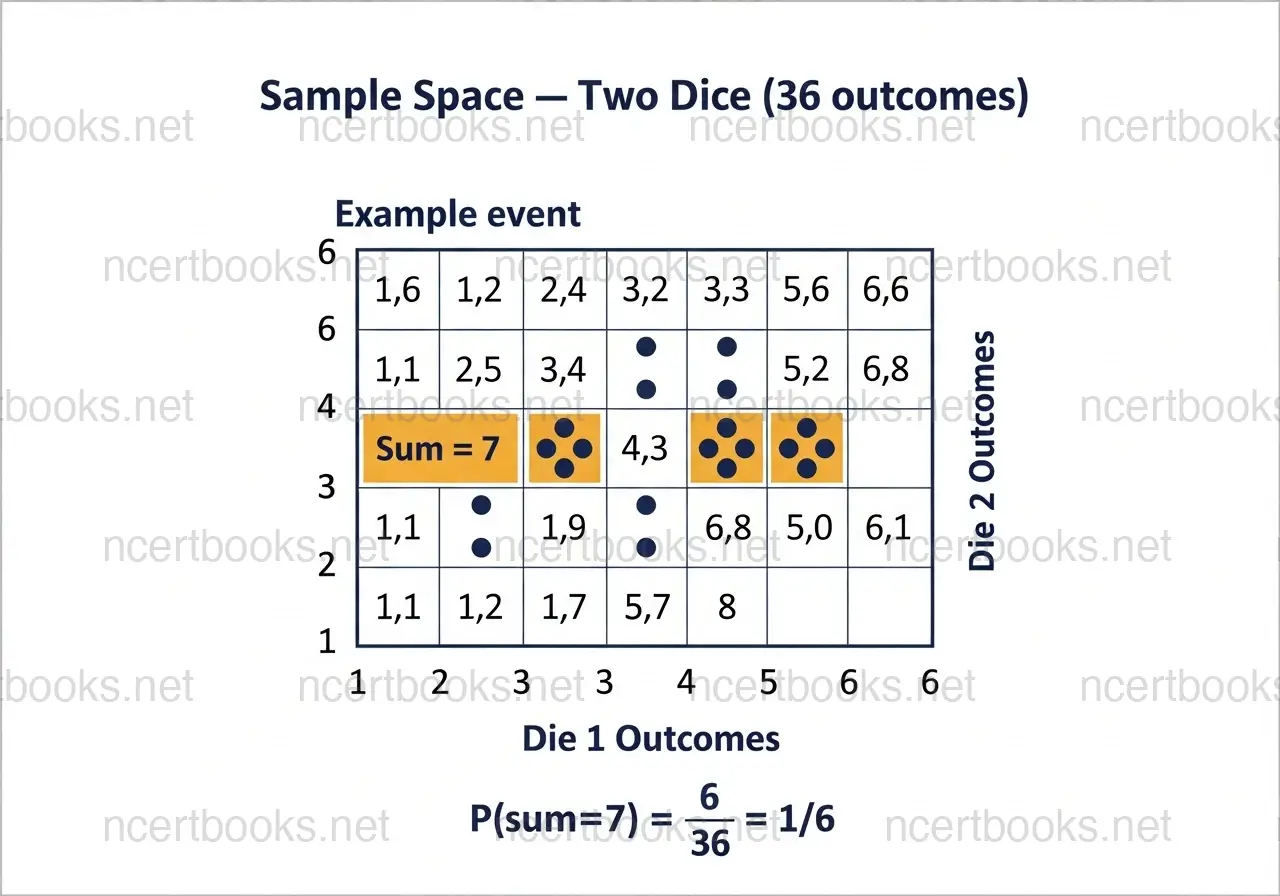
Answer: Total outcomes = 36. (i) Sum 7: {(1,6),(2,5),(3,4),(4,3),(5,2),(6,1)} = 6. \( P = \frac{6}{36} = \frac{1}{6} \). (ii) Sum \( \leq 4 \): {(1,1),(1,2),(2,1),(1,3),(3,1),(2,2)} = 6. \( P = \frac{6}{36} = \frac{1}{6} \). (iii) Multiple of 3 (3,6,9,12): 3→2, 6→5, 9→4, 12→1 = 12. \( P = \frac{12}{36} = \frac{1}{3} \).
Common Mistakes Students Make in Probability — Class 10 Maths
Mistake 1:
Wrong: Students count only one order for consecutive days — e.g., only (T,W) but not (W,T).
Why it’s wrong: Both orderings are distinct outcomes since the problem distinguishes between Shyam and Ekta.
Correct approach: Always count both (A,B) and (B,A) for consecutive pairs. Total consecutive pairs = 8, not 4.
Mistake 2:
Wrong: In Q2, students count only 5 outcomes for sum=6 (confusing with a standard die).
Why it’s wrong: This die has faces 1,2,2,3,3,6 — two faces show 3. So (3,3) appears 4 times (2×2 combinations), not 1.
Correct approach: Always use the actual face values and draw the full 6×6 table.
Mistake 3:
Wrong: In Q4, students set up the equation as \( \frac{x+6}{18} = 2 \times \frac{x+6}{12} \) (using wrong numerator for original probability).
Why it’s wrong: The original probability uses \( x \) black balls out of 12, not \( x+6 \).
Correct approach: \( P_1 = \frac{x}{12} \) and \( P_2 = \frac{x+6}{18} \). Set \( P_2 = 2P_1 \).
Mistake 4:
Wrong: Students forget to subtract green marbles from total in Q5 — they write “16 blue marbles” instead of 8.
Why it’s wrong: \( \frac{2}{3} \times 24 = 16 \) gives green marbles, not blue.
Correct approach: Blue = Total − Green = 24 − 16 = 8.
Mistake 5:
Wrong: Writing probability as a value greater than 1 (e.g., \( P = \frac{15}{12} \)).
Why it’s wrong: Probability always satisfies \( 0 \leq P(E) \leq 1 \). A value above 1 means an arithmetic error.
Correct approach: Always check your final answer is between 0 and 1.
Exam Tips for CBSE 2026-27 — Chapter 15 Probability
- Show the sample space: For any question involving two events (two people, two dice), always write the total number of outcomes explicitly. CBSE examiners award 1 mark just for correctly stating the sample space size.
- Draw the table for dice problems: In Q2-type questions, drawing the full sum table in your answer sheet earns method marks even if your final answer has a small error.
- Use complementary events: For “different days” or “not getting X” type questions, use \( P(\bar{E}) = 1 – P(E) \). It is faster and less error-prone than listing all favourable outcomes.
- Verify algebraic answers: In Q3, Q4, Q5-type questions, always substitute your value of \( x \) back to verify. CBSE 2026-27 marking scheme awards 1 mark for verification in 3-mark questions.
- Probability chapter weightage: In the CBSE 2026-27 Class 10 board exam, the Statistics and Probability unit carries approximately 11 marks. Probability alone typically contributes 4–5 marks — enough to make a difference in your final score.
- Last-minute revision checklist: (a) Know the basic formula. (b) Practice building sample spaces for 2-event experiments. (c) Revise complementary event formula. (d) Solve Q3, Q4, Q5 algebraic setups at least twice. (e) Memorise: probability is always between 0 and 1.
Key Points to Remember — Probability Exercise 15.2
- Probability of an event \( E \): \( P(E) = \frac{\text{Favourable outcomes}}{\text{Total outcomes}} \)
- For two independent choices from \( n \) options: total outcomes = \( n \times n = n^2 \)
- Complementary event: \( P(\bar{E}) = 1 – P(E) \) — use this for “not” and “different” questions
- A special die with repeated faces changes the probability distribution — always build the full outcome table
- Algebraic probability: express unknowns as \( x \), write probability fractions, form equation from given condition, solve and verify
- Range rule: \( 0 \leq P(E) \leq 1 \) always — use this as a self-check
- “At least” means \( \geq \) — count all outcomes equal to or greater than the given value
For more practice, explore our sibling pages: NCERT Solutions Class 10 Maths Chapter 15 Exercise 15.1, NCERT Solutions Class 10 Maths Chapter 14 Statistics, and NCERT Solutions Class 10 Maths Chapter 13 Surface Areas and Volumes.