- Median Formula: \( \text{Median} = l + \dfrac{\frac{n}{2} – cf}{f} \times h \)
- Median class: The class whose cumulative frequency first exceeds \( \frac{n}{2} \)
- cf = cumulative frequency of the class before the median class
- l = lower class boundary of the median class; h = class width
- Number of questions in Ex 14.3: 7 (all based on median of grouped data)
- Chapter weightage: Statistics carries significant marks in CBSE Class 10 board exams — questions appear in 2-3 mark and 5-mark sections
- Key skill tested: Constructing cumulative frequency table and applying the median formula correctly
- Academic year: Updated for 2026-27 CBSE syllabus
The NCERT Solutions for Class 10 Maths Chapter 14 Ex 14.3 on this page cover all 7 questions from the Statistics exercise on median of grouped data, fully updated for the 2026-27 CBSE board exam. You can find complete NCERT Solutions for all subjects and classes on ncertbooks.net. These solutions follow the official NCERT official textbook and are designed to help you score full marks by showing every working step clearly.
This exercise is part of NCERT Solutions for Class 10 and focuses exclusively on finding the median of grouped data using the cumulative frequency approach — one of the most frequently tested skills in CBSE board papers. Whether you are looking for cbse class 10 maths ncert solutions or step-by-step practice for your board exam, you are in the right place.
Table of Contents
- Quick Revision Box
- Chapter Overview — Statistics Class 10 Chapter 14
- Key Concepts — Median of Grouped Data
- NCERT Solutions for Class 10 Maths Chapter 14 Ex 14.3 — All 7 Questions
- Formula Reference Table — Statistics Chapter 14
- Important Questions for CBSE Board Exam 2026-27
- Common Mistakes Students Make in Statistics Ex 14.3
- Exam Tips for 2026-27 — Statistics Chapter 14
- Frequently Asked Questions
Chapter Overview — Statistics Class 10 Chapter 14
Chapter 14 Statistics in the NCERT Class 10 Maths textbook covers three measures of central tendency for grouped data: mean (माध्य), median (माध्यिका), and mode (बहुलक). Exercise 14.3 specifically deals with finding the median of grouped data using the cumulative frequency table and the standard median formula.
For the 2026-27 CBSE board exam, Statistics is a high-scoring chapter. Questions from this chapter appear as 2-3 mark short-answer questions and 5-mark long-answer questions. Students who master the median formula and can construct a cumulative frequency table accurately will find this exercise straightforward.
| Detail | Information |
|---|---|
| Chapter | Chapter 14 — Statistics |
| Exercise | Exercise 14.3 |
| Textbook | NCERT Mathematics — Class 10 |
| Class | Class 10 |
| Subject | Mathematics |
| Number of Questions | 7 |
| Topic | Median of Grouped Data |
| Difficulty Level | Medium |
| Academic Year | 2026-27 |
Key Concepts — Median of Grouped Data
Median (माध्यिका): The median is the middle value of a data set when arranged in order. For grouped data, we use the cumulative frequency table to locate the median class and then apply the formula.
Cumulative Frequency (संचयी बारंबारता): The running total of frequencies up to a given class interval. You add each class frequency to the sum of all previous frequencies.
Median Class: The class interval whose cumulative frequency first equals or exceeds \( \frac{n}{2} \), where \( n \) is the total number of observations.
The standard median formula for grouped data is:
\[ \text{Median} = l + \frac{\frac{n}{2} – cf}{f} \times h \]
Where:
- \( l \) = lower class boundary (lower limit) of the median class
- \( n \) = total frequency (sum of all frequencies)
- \( cf \) = cumulative frequency of the class preceding the median class
- \( f \) = frequency of the median class
- \( h \) = class width (class size)
Why does the formula work? It assumes that observations within each class are uniformly distributed. We interpolate within the median class to find the exact point where half the data lies below and half above.
Mode formula (for reference):
\[ \text{Mode} = l + \frac{f_1 – f_0}{2f_1 – f_0 – f_2} \times h \]
Mean formula using assumed mean method:
\[ \bar{x} = a + \frac{\sum f_i d_i}{\sum f_i} \]
NCERT Solutions for Class 10 Maths Chapter 14 Ex 14.3 — All 7 Questions
Below are complete, step-by-step solutions for all 7 questions in Exercise 14.3. These are the exact solutions for the ncert solutions for class 10 maths chapter 14 ex 14 3 that students search for before their board exams. Each solution shows the full cumulative frequency table and every working step.
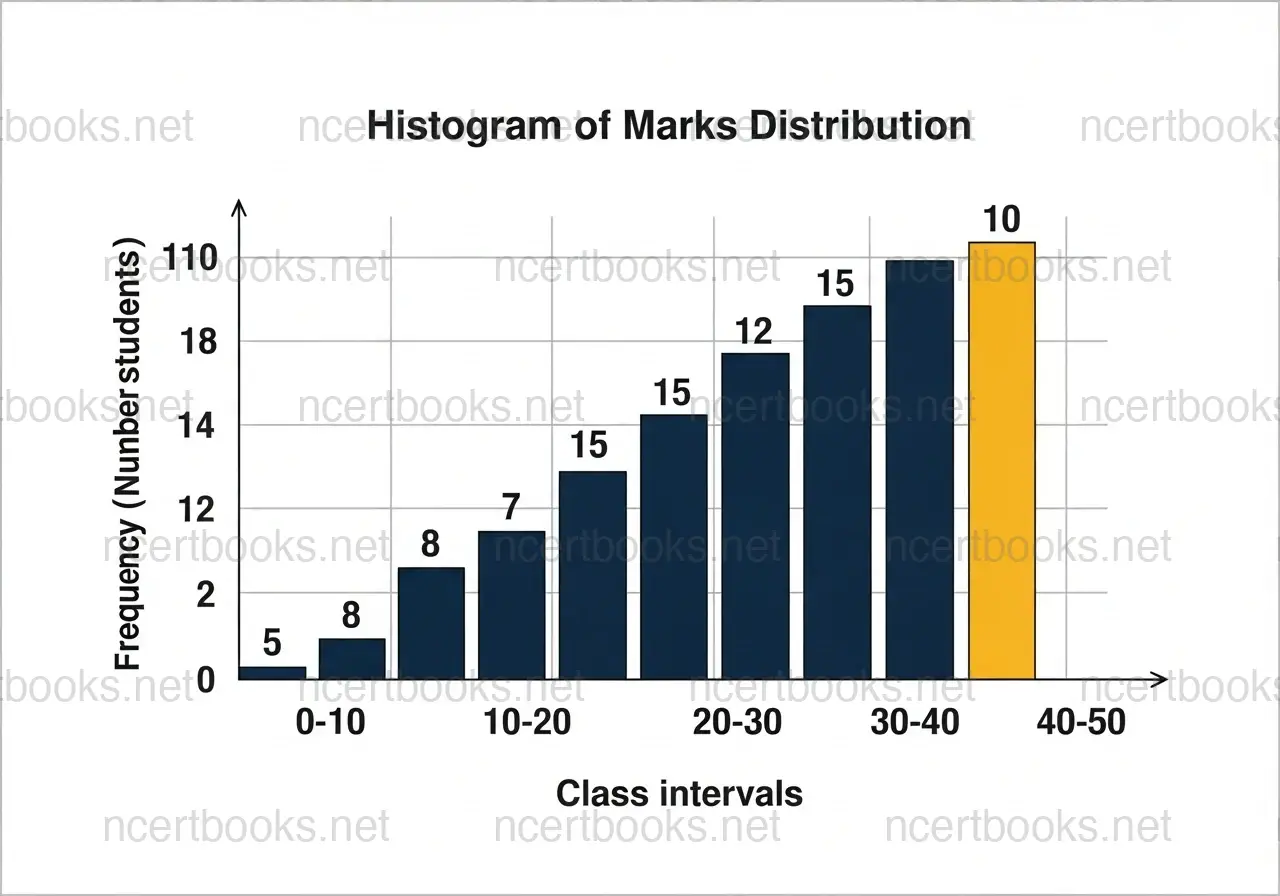
Question 1
Hard
The following frequency distribution gives the monthly consumption of electricity of 68 consumers of a locality. Find the median, mean and mode of the data and compare them.
Monthly consumption (units): 65–85, 85–105, 105–125, 125–145, 145–165, 165–185, 185–205
Number of consumers: 4, 5, 13, 20, 14, 8, 4
Step 1: Construct the cumulative frequency table and find class marks.
| Class Interval | Frequency (f) | Class Mark (x) | d = x − 135 | u = d/20 | fu | cf |
|---|---|---|---|---|---|---|
| 65–85 | 4 | 75 | −60 | −3 | −12 | 4 |
| 85–105 | 5 | 95 | −40 | −2 | −10 | 9 |
| 105–125 | 13 | 115 | −20 | −1 | −13 | 22 |
| 125–145 | 20 | 135 | 0 | 0 | 0 | 42 |
| 145–165 | 14 | 155 | 20 | 1 | 14 | 56 |
| 165–185 | 8 | 175 | 40 | 2 | 16 | 64 |
| 185–205 | 4 | 195 | 60 | 3 | 12 | 68 |
| Total | 68 | 7 |
Step 2: Find the Median.
\( n = 68 \), so \( \frac{n}{2} = 34 \). The cumulative frequency first exceeds 34 in the class 125–145.
Median class = 125–145, \( l = 125 \), \( cf = 22 \), \( f = 20 \), \( h = 20 \)
\[ \text{Median} = 125 + \frac{34 – 22}{20} \times 20 = 125 + \frac{12}{20} \times 20 = 125 + 12 = 137 \]
Step 3: Find the Mean (Step Deviation Method).
Assumed mean \( a = 135 \), \( h = 20 \), \( \sum f_i u_i = 7 \), \( \sum f_i = 68 \)
\[ \bar{x} = a + \frac{\sum f_i u_i}{\sum f_i} \times h = 135 + \frac{7}{68} \times 20 = 135 + 2.058 \approx 137.06 \]
Step 4: Find the Mode.
The modal class is 125–145 (highest frequency = 20). \( l = 125 \), \( f_1 = 20 \), \( f_0 = 13 \), \( f_2 = 14 \), \( h = 20 \)
\[ \text{Mode} = 125 + \frac{20 – 13}{2(20) – 13 – 14} \times 20 = 125 + \frac{7}{13} \times 20 = 125 + 10.77 \approx 135.76 \]
Step 5: Comparison.
Mean ≈ 137.06, Median = 137, Mode ≈ 135.76. The three measures are very close to each other, indicating the distribution is nearly symmetrical. The empirical relationship \( 3 \times \text{Median} = \text{Mode} + 2 \times \text{Mean} \) is approximately satisfied: \( 3 \times 137 = 411 \approx 135.76 + 274.12 = 409.88 \).
\( \therefore \) Median = 137 units, Mean ≈ 137.06 units, Mode ≈ 135.76 units. All three values are approximately equal, showing a nearly symmetric distribution.
Question 2
Medium
If the median of the distribution given below is 28.5, find the values of x and y.
Class interval: 0–10, 10–20, 20–30, 30–40, 40–50, 50–60
Frequency: 5, x, 20, 15, y, 5
Step 1: Set up the cumulative frequency table.
| Class Interval | Frequency | Cumulative Frequency |
|---|---|---|
| 0–10 | 5 | 5 |
| 10–20 | x | 5 + x |
| 20–30 | 20 | 25 + x |
| 30–40 | 15 | 40 + x |
| 40–50 | y | 40 + x + y |
| 50–60 | 5 | 45 + x + y |
Step 2: Use total frequency.
Total \( n = 60 \) (given, since median is 28.5 and the distribution is of 60 observations).
\[ 45 + x + y = 60 \implies x + y = 15 \quad \text{…(i)} \]
Step 3: Identify the median class.
\( \frac{n}{2} = 30 \). Median = 28.5 lies in class 20–30. So \( l = 20 \), \( cf = 5 + x \), \( f = 20 \), \( h = 10 \).
Step 4: Apply the median formula.
\[ 28.5 = 20 + \frac{30 – (5 + x)}{20} \times 10 \]
\[ 8.5 = \frac{25 – x}{20} \times 10 \]
\[ 8.5 = \frac{25 – x}{2} \]
\[ 17 = 25 – x \implies x = 8 \]
Step 5: Find y using equation (i).
\[ y = 15 – x = 15 – 8 = 7 \]
\( \therefore \) x = 8 and y = 7
Question 3
Medium
A life insurance agent found the following data for distribution of ages of 100 policy holders. Calculate the median age, if policies are given only to persons having age 18 years onwards but less than 60 years.
Age (years): Below 20, Below 25, Below 30, Below 35, Below 40, Below 45, Below 50, Below 55, Below 60
Number of policy holders: 2, 6, 24, 45, 78, 89, 92, 98, 100
Step 1: Convert the cumulative frequency table into a class-wise frequency table.
| Age (years) | Frequency (f) | Cumulative Frequency (cf) |
|---|---|---|
| 18–20 | 2 | 2 |
| 20–25 | 4 | 6 |
| 25–30 | 18 | 24 |
| 30–35 | 21 | 45 |
| 35–40 | 33 | 78 |
| 40–45 | 11 | 89 |
| 45–50 | 3 | 92 |
| 50–55 | 6 | 98 |
| 55–60 | 2 | 100 |
Step 2: Find \( \frac{n}{2} \).
\( n = 100 \), so \( \frac{n}{2} = 50 \). The cumulative frequency first exceeds 50 in the class 35–40.
Step 3: Apply the median formula.
\( l = 35 \), \( cf = 45 \), \( f = 33 \), \( h = 5 \)
\[ \text{Median} = 35 + \frac{50 – 45}{33} \times 5 = 35 + \frac{5}{33} \times 5 = 35 + \frac{25}{33} = 35 + 0.76 \approx 35.76 \]
\( \therefore \) Median age = 35.76 years
Question 4
Medium
The lengths of 40 leaves of a plant are measured correct to nearest millimetre, and the data obtained is represented in the following table. Find the median length of the leaves.
Length (mm): 118–126, 127–135, 136–144, 145–153, 154–162, 163–171, 172–180
Number of leaves: 3, 5, 9, 12, 5, 4, 2
Key Concept: The class intervals are not continuous (e.g., 118–126, 127–135). To apply the median formula, convert them to continuous class intervals by subtracting 0.5 from the lower limit and adding 0.5 to the upper limit.
Step 1: Convert to continuous class intervals and build the cumulative frequency table.
| Length (mm) — Continuous | Frequency (f) | Cumulative Frequency (cf) |
|---|---|---|
| 117.5–126.5 | 3 | 3 |
| 126.5–135.5 | 5 | 8 |
| 135.5–144.5 | 9 | 17 |
| 144.5–153.5 | 12 | 29 |
| 153.5–162.5 | 5 | 34 |
| 162.5–171.5 | 4 | 38 |
| 171.5–180.5 | 2 | 40 |
Step 2: Find the median class.
\( n = 40 \), so \( \frac{n}{2} = 20 \). The cumulative frequency first exceeds 20 in the class 144.5–153.5.
Step 3: Apply the median formula.
\( l = 144.5 \), \( cf = 17 \), \( f = 12 \), \( h = 9 \)
\[ \text{Median} = 144.5 + \frac{20 – 17}{12} \times 9 = 144.5 + \frac{3}{12} \times 9 = 144.5 + \frac{27}{12} = 144.5 + 2.25 = 146.75 \]
\( \therefore \) Median length = 146.75 mm
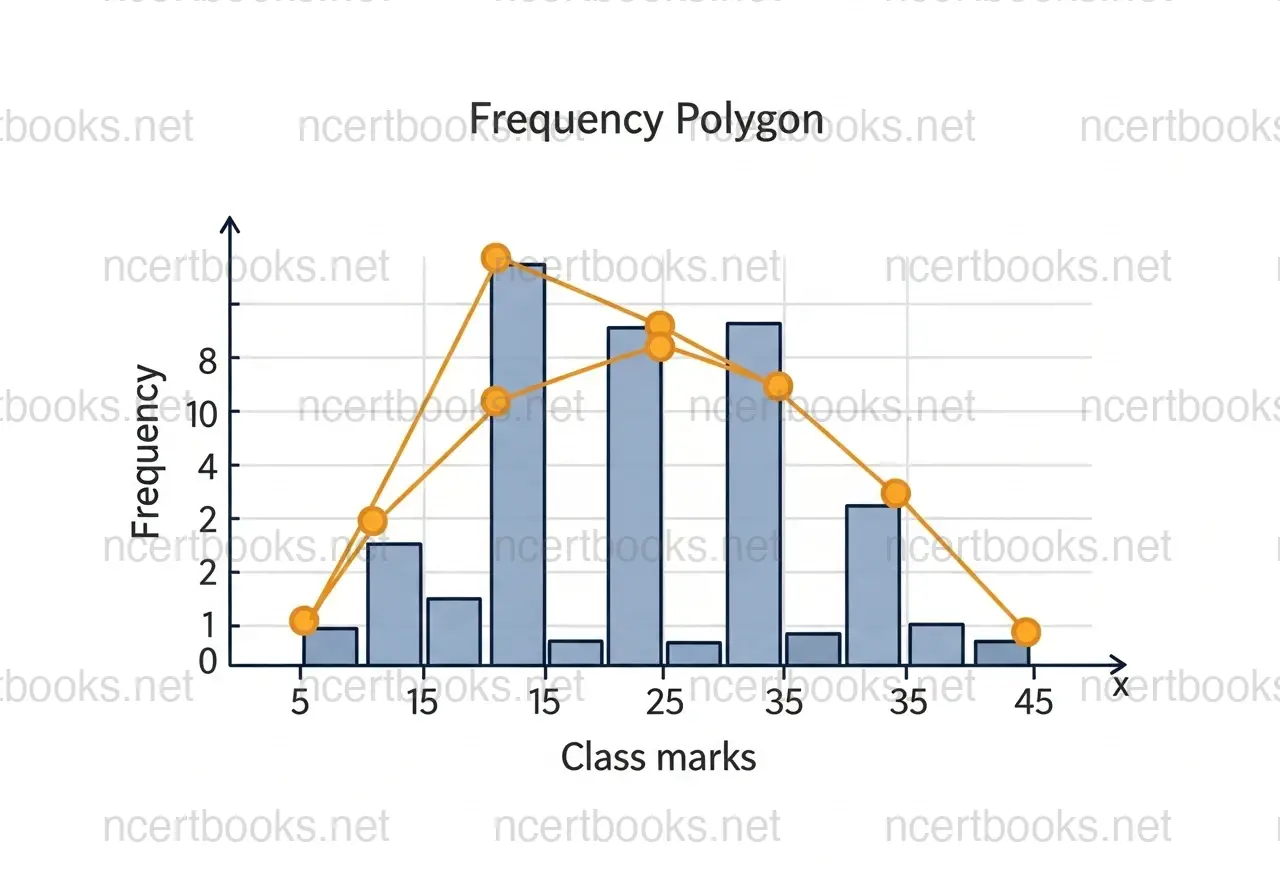
Question 5
Medium
The following table gives the distribution of the lifetime of 400 neon lamps. Find the median lifetime of a lamp.
Lifetime (in hours): 1500–2000, 2000–2500, 2500–3000, 3000–3500, 3500–4000, 4000–4500, 4500–5000
Number of lamps: 14, 56, 60, 86, 74, 62, 48
Step 1: Construct the cumulative frequency table.
| Lifetime (hours) | Frequency (f) | Cumulative Frequency (cf) |
|---|---|---|
| 1500–2000 | 14 | 14 |
| 2000–2500 | 56 | 70 |
| 2500–3000 | 60 | 130 |
| 3000–3500 | 86 | 216 |
| 3500–4000 | 74 | 290 |
| 4000–4500 | 62 | 352 |
| 4500–5000 | 48 | 400 |
Step 2: Find the median class.
\( n = 400 \), so \( \frac{n}{2} = 200 \). The cumulative frequency first exceeds 200 in the class 3000–3500.
Step 3: Apply the median formula.
\( l = 3000 \), \( cf = 130 \), \( f = 86 \), \( h = 500 \)
\[ \text{Median} = 3000 + \frac{200 – 130}{86} \times 500 = 3000 + \frac{70}{86} \times 500 = 3000 + \frac{35000}{86} = 3000 + 406.98 \approx 3406.98 \]
\( \therefore \) Median lifetime of a lamp ≈ 3406.98 hours
Question 6
Hard
100 surnames were randomly picked up from a local telephone directory and the frequency distribution of the number of letters in the English alphabet in the surnames was obtained as follows. Determine the median number of letters in the surnames. Find the mean number of letters in the surnames. Also, find the modal size of the surnames.
Number of letters: 1–4, 4–7, 7–10, 10–13, 13–16, 16–19
Number of surnames: 6, 30, 40, 16, 4, 4
Step 1: Construct the cumulative frequency table and class marks.
| Letters | Freq (f) | cf | Class Mark (x) | d = x − 8.5 | u = d/3 | fu |
|---|---|---|---|---|---|---|
| 1–4 | 6 | 6 | 2.5 | −6 | −2 | −12 |
| 4–7 | 30 | 36 | 5.5 | −3 | −1 | −30 |
| 7–10 | 40 | 76 | 8.5 | 0 | 0 | 0 |
| 10–13 | 16 | 92 | 11.5 | 3 | 1 | 16 |
| 13–16 | 4 | 96 | 14.5 | 6 | 2 | 8 |
| 16–19 | 4 | 100 | 17.5 | 9 | 3 | 12 |
| Total | 100 | −6 |
Step 2: Find the Median.
\( n = 100 \), \( \frac{n}{2} = 50 \). The cf first exceeds 50 in class 7–10.
\( l = 7 \), \( cf = 36 \), \( f = 40 \), \( h = 3 \)
\[ \text{Median} = 7 + \frac{50 – 36}{40} \times 3 = 7 + \frac{14}{40} \times 3 = 7 + \frac{42}{40} = 7 + 1.05 = 8.05 \]
Step 3: Find the Mean.
Assumed mean \( a = 8.5 \), \( h = 3 \), \( \sum f_i u_i = -6 \), \( \sum f_i = 100 \)
\[ \bar{x} = 8.5 + \frac{-6}{100} \times 3 = 8.5 – 0.18 = 8.32 \]
Step 4: Find the Mode.
Modal class = 7–10 (highest frequency = 40). \( l = 7 \), \( f_1 = 40 \), \( f_0 = 30 \), \( f_2 = 16 \), \( h = 3 \)
\[ \text{Mode} = 7 + \frac{40 – 30}{2(40) – 30 – 16} \times 3 = 7 + \frac{10}{34} \times 3 = 7 + \frac{30}{34} = 7 + 0.88 = 7.88 \]
\( \therefore \) Median = 8.05 letters, Mean = 8.32 letters, Mode = 7.88 letters.
Question 7
Medium
The distribution below gives the weight of 30 students of a class. Find the median weight of the students.
Weight (kg): 40–45, 45–50, 50–55, 55–60, 60–65, 65–70, 70–75
Number of students: 2, 3, 8, 6, 6, 3, 2
| Weight (kg) | Frequency (f) | Cumulative Frequency (cf) |
|---|---|---|
| 40–45 | 2 | 2 |
| 45–50 | 3 | 5 |
| 50–55 | 8 | 13 |
| 55–60 | 6 | 19 |
| 60–65 | 6 | 25 |
| 65–70 | 3 | 28 |
| 70–75 | 2 | 30 |
Step 2: Find the median class.
\( n = 30 \), so \( \frac{n}{2} = 15 \). The cumulative frequency first exceeds 15 in the class 55–60.
Step 3: Apply the median formula.
\( l = 55 \), \( cf = 13 \), \( f = 6 \), \( h = 5 \)
\[ \text{Median} = 55 + \frac{15 – 13}{6} \times 5 = 55 + \frac{2}{6} \times 5 = 55 + \frac{10}{6} = 55 + 1.67 = 56.67 \]
\( \therefore \) Median weight = 56.67 kg
Formula Reference Table — Statistics Chapter 14
| Formula Name | Formula | Variables Defined |
|---|---|---|
| Median of Grouped Data | \( \text{Median} = l + \dfrac{\frac{n}{2} – cf}{f} \times h \) | l = lower limit of median class, n = total freq, cf = preceding cf, f = median class freq, h = class width |
| Mode of Grouped Data | \( \text{Mode} = l + \dfrac{f_1 – f_0}{2f_1 – f_0 – f_2} \times h \) | f₁ = modal class freq, f₀ = preceding class freq, f₂ = succeeding class freq |
| Mean (Direct Method) | \( \bar{x} = \dfrac{\sum f_i x_i}{\sum f_i} \) | xᵢ = class mark, fᵢ = frequency |
| Mean (Assumed Mean) | \( \bar{x} = a + \dfrac{\sum f_i d_i}{\sum f_i} \) | a = assumed mean, dᵢ = xᵢ − a |
| Mean (Step Deviation) | \( \bar{x} = a + \dfrac{\sum f_i u_i}{\sum f_i} \times h \) | uᵢ = dᵢ/h |
| Empirical Relationship | \( 3 \times \text{Median} = \text{Mode} + 2 \times \text{Mean} \) | Approximate relationship for unimodal data |
Important Questions for CBSE Board Exam 2026-27 — Statistics Chapter 14
These questions are based on common patterns seen in CBSE board papers. Practising them will help you prepare for the 2026-27 board exam. These cover both ncert exemplar class 10 maths solutions style questions and standard board paper types.
1-Mark Questions — Statistics
- What is the formula for median of grouped data?
- Define cumulative frequency (संचयी बारंबारता).
- What is the empirical relationship between mean, median, and mode?
3-Mark Questions — Statistics
Q: The median of the following data is 525. Find the values of x and y if the total frequency is 100.
Model Answer: Set up the cumulative frequency table with unknowns x and y. Use the equation \( \sum f = 100 \) to get one equation in x and y. Then apply the median formula with the identified median class (the class containing the 50th value) to get a second equation. Solve simultaneously to find x and y. Always show both equations clearly.
5-Mark Questions — Statistics
Q: Find the mean, median, and mode of the following grouped data and verify the empirical relation.
Model Answer: Calculate all three measures using their respective formulas. For mean, use the step deviation method to simplify calculation. For median, find the median class using \( \frac{n}{2} \). For mode, identify the modal class (highest frequency). Finally, verify: \( 3 \times \text{Median} \approx \text{Mode} + 2 \times \text{Mean} \). Show all tables and working steps for full marks.
Common Mistakes Students Make in Statistics Ex 14.3
These are the most frequent errors students make when solving class 10 maths ncert solutions in hindi and English medium. Avoiding these will directly improve your board exam score.
Mistake 1: Using the upper class limit instead of the lower class limit as \( l \).
Why it’s wrong: \( l \) in the median formula is always the lower boundary of the median class.
Correct approach: Identify the median class first, then take its lower limit as \( l \).
Mistake 2: Using the cumulative frequency of the median class as \( cf \) instead of the class before it.
Why it’s wrong: \( cf \) must be the cumulative frequency preceding the median class, not of the median class itself.
Correct approach: Always take \( cf \) from the row just above the median class row in your table.
Mistake 3: Not converting discontinuous class intervals to continuous ones (as in Question 4).
Why it’s wrong: If intervals are like 118–126, 127–135, there is a gap of 1. The formula requires continuous intervals.
Correct approach: Subtract 0.5 from lower limits and add 0.5 to upper limits to make them continuous.
Mistake 4: Incorrectly identifying the median class by looking for cf = n/2 exactly, rather than the first cf that equals or exceeds n/2.
Why it’s wrong: The median class is the one whose cf first reaches or crosses n/2.
Correct approach: Scan the cf column and pick the first row where cf ≥ n/2.
Mistake 5: Forgetting to write the final answer with correct units (hours, mm, kg, years).
Why it’s wrong: CBSE examiners deduct marks for missing units in measurement-based questions.
Correct approach: Always write the unit alongside your final answer in the ncert-answer box.
Exam Tips for 2026-27 — Statistics Chapter 14 CBSE
These tips are based on the CBSE 2026-27 marking scheme and the question patterns observed in recent board papers. Use these to maximise your score in cbse class 10 maths ncert solutions based questions.
- Always draw the cumulative frequency table — examiners award 1 mark specifically for the correct cf table, even if your final answer is slightly off.
- Identify the median class clearly — write “Median class = [interval]” as a separate line before applying the formula. This earns a step mark.
- Show substitution in the formula — write \( \text{Median} = l + \frac{n/2 – cf}{f} \times h \) and then substitute values. Never skip straight to the answer.
- Chapter weightage for 2026-27: Statistics (Chapter 14) and Probability (Chapter 15) together form Unit 6, which carries significant marks in the CBSE Class 10 board paper.
- Empirical relation question: If asked to compare mean, median, and mode, always write the empirical relation \( 3 \times \text{Median} = \text{Mode} + 2 \times \text{Mean} \) and verify it numerically.
- Last-minute revision checklist: (a) Memorise the median formula; (b) Practice building cf tables quickly; (c) Know how to identify modal class and median class; (d) Remember to check for discontinuous intervals; (e) Write units in every final answer.