⚡ Quick Revision Box — Chapter 13 Ex 13.3
- Core Principle: When a solid is melted or reshaped, its volume remains constant (volume conservation).
- Sphere Volume: \( \frac{4}{3}\pi r^{3} \)
- Cylinder Volume: \( \pi r^{2} h \)
- Cone Volume: \( \frac{1}{3}\pi r^{2} h \)
- Cuboid Volume: \( l \times b \times h \)
- Slant height of cone: \( l = \sqrt{r^{2} + h^{2}} \)
- Number of coins / objects formed: \( n = \frac{\text{Volume of big solid}}{\text{Volume of one small solid}} \)
- Exercise 13.3 has 9 questions, all on conversion of solids — a high-frequency CBSE board topic.
The NCERT solutions for class 10 maths chapter 13 ex 13 3 on this page cover all 9 questions from Exercise 13.3 of Surface Areas and Volumes, updated for the 2026-27 CBSE board exam. This exercise focuses entirely on the conversion of solids — when one shape is melted, recast, or transformed into another. You can find the complete NCERT Solutions for Class 10 on our hub page, and all Maths solutions are part of our broader NCERT Solutions library. The official textbook is available on the NCERT official website.
NCERT Solutions for Class 10 Maths Chapter 13 Ex 13.3 — Chapter Overview
Chapter 13 of the NCERT Class 10 Maths textbook is Surface Areas and Volumes. Exercise 13.3 specifically deals with Section 13.4 — Conversion of Solid from One Shape to Another. This is one of the most practical sections in the entire chapter because it models real-world situations: melting metal, digging wells, filling canals, and making ice cream cones.
For the CBSE 2026-27 board exam, this chapter carries significant weightage under the Mensuration unit. Questions from Exercise 13.3 regularly appear as 3-mark and 5-mark questions. Students need a solid understanding of volume formulas for all standard solids before attempting this exercise.
| Detail | Information |
|---|---|
| Chapter | Chapter 13 — Surface Areas and Volumes |
| Textbook | NCERT Mathematics — Class 10 |
| Exercise | Exercise 13.3 |
| Section | 13.4 — Conversion of Solid from One Shape to Another |
| Number of Questions | 9 |
| Marks Weightage | Mensuration unit — typically 10–12 marks in board exam |
| Difficulty Level | Medium to Hard |
| Academic Year | 2026-27 |
Key Concepts: Conversion of Solids from One Shape to Another
Volume Conservation (आयतन संरक्षण): This is the single most important idea in Exercise 13.3. When a solid is melted and recast into a new shape, the total volume of material does not change. Only the shape changes, not the amount of material.
Setting Up the Equation: For any conversion problem, you write:
\[ \text{Volume of original solid} = \text{Volume of new solid} \]
Then substitute the appropriate formulas and solve for the unknown dimension.
Key formulas you must know:
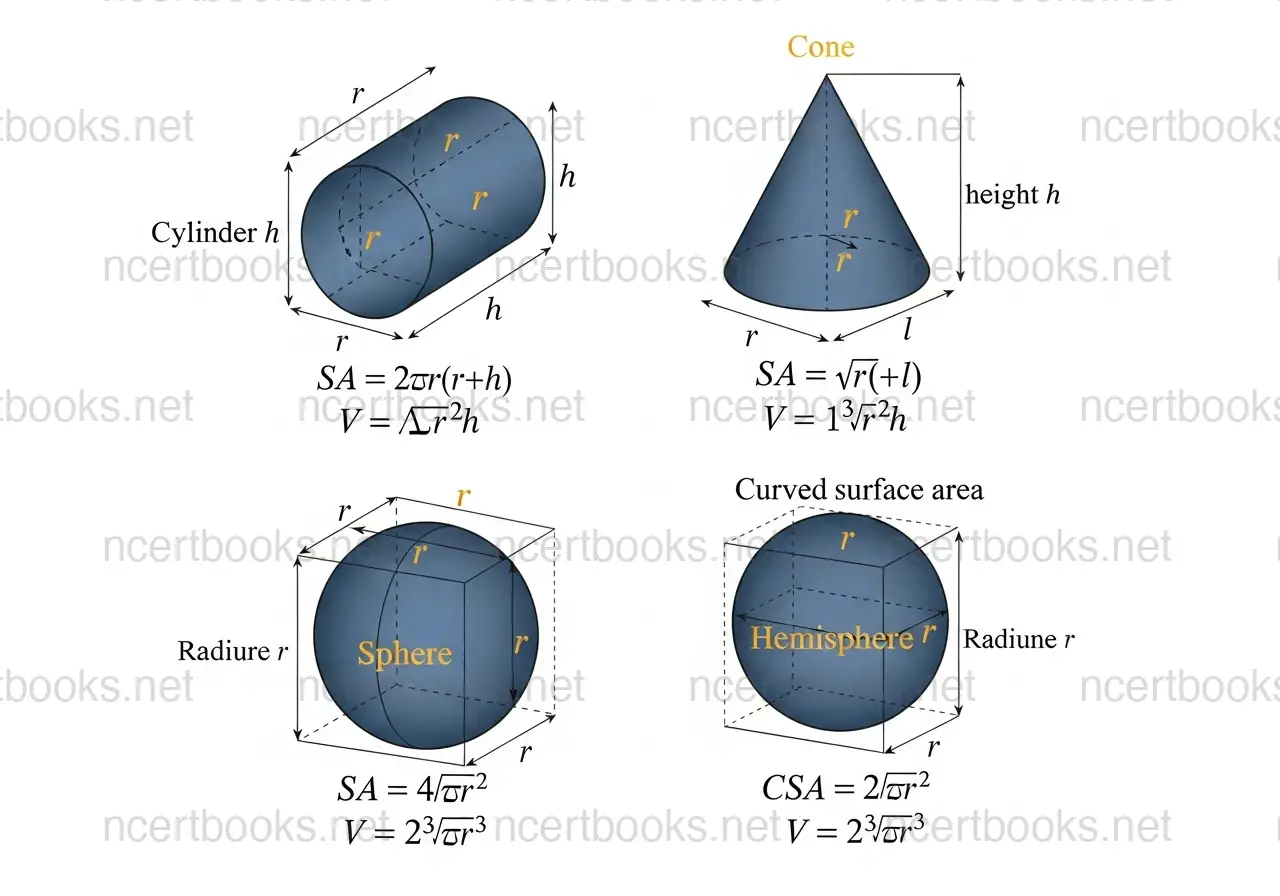
- Volume of sphere: \( V = \frac{4}{3}\pi r^{3} \)
- Volume of cylinder: \( V = \pi r^{2} h \)
- Volume of cone: \( V = \frac{1}{3}\pi r^{2} h \)
- Volume of hemisphere: \( V = \frac{2}{3}\pi r^{3} \)
- Volume of cuboid: \( V = l \times b \times h \)
- Slant height of cone: \( l = \sqrt{r^{2} + h^{2}} \)
Multiple spheres melted into one: When \( n \) spheres of radii \( r_1, r_2, \ldots, r_n \) are melted into a single sphere of radius \( R \):
\[ R^{3} = r_{1}^{3} + r_{2}^{3} + \cdots + r_{n}^{3} \]
Number of small objects from a large solid:
\[ n = \frac{\text{Volume of large solid}}{\text{Volume of one small solid}} \]
Formula Reference Table — Surface Areas and Volumes
| Solid | Volume Formula | Variables |
|---|---|---|
| Sphere | \( \frac{4}{3}\pi r^{3} \) | r = radius |
| Hemisphere | \( \frac{2}{3}\pi r^{3} \) | r = radius |
| Cylinder | \( \pi r^{2} h \) | r = base radius, h = height |
| Cone | \( \frac{1}{3}\pi r^{2} h \) | r = base radius, h = height |
| Cuboid | \( l \times b \times h \) | l = length, b = breadth, h = height |
| Cube | \( a^{3} \) | a = side length |
| Slant height (cone) | \( l = \sqrt{r^{2} + h^{2}} \) | r = radius, h = height |
Exercise 13.3 — Step-by-Step Solutions (All 9 Questions)
Below are complete, step-by-step solutions for all 9 questions in Exercise 13.3 of NCERT Class 10 Maths Chapter 13. These ncert solutions for class 10 maths chapter 13 ex 13 3 are written to match the CBSE marking scheme for 2026-27.
Question 1
Medium
A metallic sphere of radius 4.2 cm is melted and recast into the shape of a cylinder of radius 6 cm. Find the height of the cylinder.
Key Concept: Volume of sphere = Volume of cylinder (material is conserved).
Step 1: Write the volume equation.
\[ \frac{4}{3}\pi r_{\text{sphere}}^{3} = \pi r_{\text{cylinder}}^{2} h \]
Step 2: Substitute the known values. Radius of sphere \( r = 4.2 \) cm, radius of cylinder \( R = 6 \) cm.
\[ \frac{4}{3} \times \pi \times (4.2)^{3} = \pi \times (6)^{2} \times h \]
Step 3: Cancel \( \pi \) from both sides.
\[ \frac{4}{3} \times (4.2)^{3} = 36h \]
Step 4: Calculate \( (4.2)^{3} = 74.088 \).
\[ \frac{4}{3} \times 74.088 = 36h \]
\[ 98.784 = 36h \]
Step 5: Solve for \( h \).
\[ h = \frac{98.784}{36} = 2.744 \text{ cm} \]
\( \therefore \) The height of the cylinder = 2.744 cm
Question 2
Medium
Metallic spheres of radii 6 cm, 8 cm and 10 cm, respectively, are melted to form a single solid sphere. Find the radius of the resulting sphere.
Key Concept: Sum of volumes of all three spheres = Volume of resulting sphere.
Step 1: Write the volume equation.
\[ \frac{4}{3}\pi r_{1}^{3} + \frac{4}{3}\pi r_{2}^{3} + \frac{4}{3}\pi r_{3}^{3} = \frac{4}{3}\pi R^{3} \]
Step 2: Cancel \( \frac{4}{3}\pi \) from both sides.
\[ r_{1}^{3} + r_{2}^{3} + r_{3}^{3} = R^{3} \]
Step 3: Substitute \( r_1 = 6 \), \( r_2 = 8 \), \( r_3 = 10 \).
\[ 6^{3} + 8^{3} + 10^{3} = R^{3} \]
\[ 216 + 512 + 1000 = R^{3} \]
\[ 1728 = R^{3} \]
Step 4: Find the cube root.
\[ R = \sqrt[3]{1728} = 12 \text{ cm} \]
Why does this work? \( 12^3 = 12 \times 12 \times 12 = 1728 \). Verify: \( 216 + 512 + 1000 = 1728 \). ✓
\( \therefore \) The radius of the resulting sphere = 12 cm
Question 3
Medium
A 20 m deep well with diameter 7 m is dug and the earth from digging is evenly spread out to form a platform 22 m by 14 m. Find the height of the platform.
Key Concept: Volume of earth dug from well (cylinder) = Volume of platform (cuboid).
Step 1: Find the volume of earth dug. The well is cylindrical with diameter 7 m, so radius \( r = 3.5 \) m and depth \( h = 20 \) m.
\[ V_{\text{well}} = \pi r^{2} h = \frac{22}{7} \times (3.5)^{2} \times 20 \]
\[ = \frac{22}{7} \times 12.25 \times 20 = \frac{22 \times 12.25 \times 20}{7} \]
\[ = \frac{5390}{7} = 770 \text{ m}^{3} \]
Step 2: Set this equal to the volume of the platform (cuboid) with length 22 m, breadth 14 m, and unknown height \( H \).
\[ V_{\text{platform}} = 22 \times 14 \times H = 308H \]
Step 3: Equate and solve.
\[ 308H = 770 \]
\[ H = \frac{770}{308} = 2.5 \text{ m} \]
\( \therefore \) The height of the platform = 2.5 m
Question 4
Hard
A well of diameter 3 m is dug 14 m deep. The earth taken out of it has been spread evenly all around it in the shape of a circular ring of width 4 m to form an embankment. Find the height of the embankment.
Key Concept: Volume of earth from well = Volume of embankment (hollow cylinder / cylindrical ring).
Step 1: Volume of earth dug. Diameter of well = 3 m, radius \( r = 1.5 \) m, depth = 14 m.
\[ V_{\text{well}} = \pi r^{2} h = \pi \times (1.5)^{2} \times 14 = \pi \times 2.25 \times 14 = 31.5\pi \text{ m}^{3} \]
Step 2: The embankment is a hollow cylinder (ring). Inner radius = radius of well = 1.5 m. Width of ring = 4 m, so outer radius \( R = 1.5 + 4 = 5.5 \) m.
Step 3: Volume of embankment = Area of ring × height.
\[ V_{\text{embankment}} = \pi(R^{2} – r^{2}) \times H = \pi[(5.5)^{2} – (1.5)^{2}] \times H \]
\[ = \pi[30.25 – 2.25] \times H = 28\pi H \]
Step 4: Equate volumes and solve.
\[ 28\pi H = 31.5\pi \]
\[ H = \frac{31.5}{28} = \frac{9}{8} = 1.125 \text{ m} \]
\( \therefore \) The height of the embankment = 1.125 m
Question 5
Hard
A container shaped like a right circular cylinder having diameter 12 cm and height 15 cm is full of ice cream. The ice cream is to be filled into cones of height 12 cm and diameter 6 cm, having a hemispherical shape on the top. Find the number of such cones which can be filled with ice cream.
Key Concept: Each cone has two parts — a conical part and a hemispherical top. Total ice cream in cylinder = n × (volume of cone + volume of hemisphere).
Step 1: Volume of ice cream in the cylindrical container. Diameter = 12 cm, so radius \( R = 6 \) cm, height \( H = 15 \) cm.
\[ V_{\text{cylinder}} = \pi R^{2} H = \pi \times 36 \times 15 = 540\pi \text{ cm}^{3} \]
Step 2: Volume of each cone. Diameter of cone = 6 cm, so radius \( r = 3 \) cm. Height of cone = 12 cm.
\[ V_{\text{cone}} = \frac{1}{3}\pi r^{2} h = \frac{1}{3} \times \pi \times 9 \times 12 = 36\pi \text{ cm}^{3} \]
Step 3: Volume of hemispherical top. Radius = 3 cm.
\[ V_{\text{hemisphere}} = \frac{2}{3}\pi r^{3} = \frac{2}{3} \times \pi \times 27 = 18\pi \text{ cm}^{3} \]
Step 4: Total volume of one cone with hemispherical top.
\[ V_{\text{one unit}} = 36\pi + 18\pi = 54\pi \text{ cm}^{3} \]
Step 5: Find the number of cones.
\[ n = \frac{V_{\text{cylinder}}}{V_{\text{one unit}}} = \frac{540\pi}{54\pi} = 10 \]
\( \therefore \) Number of cones that can be filled = 10
Question 6
Medium
How many silver coins, 1.75 cm in diameter and of thickness 2 mm, must be melted to form a cuboid of dimensions 5.5 cm × 10 cm × 3.5 cm?
Key Concept: Each coin is a very thin cylinder. n × volume of one coin = volume of cuboid.
Step 1: Volume of the cuboid.
\[ V_{\text{cuboid}} = 5.5 \times 10 \times 3.5 = 192.5 \text{ cm}^{3} \]
Step 2: Volume of one coin. Diameter = 1.75 cm, so radius \( r = 0.875 \) cm. Thickness (height) = 2 mm = 0.2 cm.
\[ V_{\text{coin}} = \pi r^{2} h = \frac{22}{7} \times (0.875)^{2} \times 0.2 \]
\[ = \frac{22}{7} \times 0.765625 \times 0.2 \]
\[ = \frac{22}{7} \times 0.153125 = \frac{22 \times 0.153125}{7} = \frac{3.36875}{7} = 0.48125 \text{ cm}^{3} \]
Cleaner approach: Use \( r = \frac{7}{8} \) cm, \( h = \frac{1}{5} \) cm.
\[ V_{\text{coin}} = \frac{22}{7} \times \frac{49}{64} \times \frac{1}{5} = \frac{22 \times 49}{7 \times 64 \times 5} = \frac{1078}{2240} = \frac{77}{160} \text{ cm}^{3} \]
Step 3: Number of coins.
\[ n = \frac{V_{\text{cuboid}}}{V_{\text{coin}}} = \frac{192.5}{\frac{77}{160}} = \frac{192.5 \times 160}{77} = \frac{30800}{77} = 400 \]
\( \therefore \) Number of silver coins = 400
Question 7
Medium
A cylindrical bucket, 32 cm high and with radius of base 18 cm, is filled with sand. This bucket is emptied on the ground and a conical heap of sand is formed. If the height of the conical heap is 24 cm, find the radius and slant height of the heap.
Key Concept: Volume of sand in cylinder = Volume of conical heap.
Step 1: Volume of sand in bucket (cylinder). Radius \( R = 18 \) cm, height \( H = 32 \) cm.
\[ V_{\text{cylinder}} = \pi R^{2} H = \pi \times 324 \times 32 = 10368\pi \text{ cm}^{3} \]
Step 2: Volume of cone. Height \( h = 24 \) cm, radius \( r \) is unknown.
\[ V_{\text{cone}} = \frac{1}{3}\pi r^{2} h = \frac{1}{3} \times \pi \times r^{2} \times 24 = 8\pi r^{2} \]
Step 3: Equate volumes.
\[ 8\pi r^{2} = 10368\pi \]
\[ r^{2} = \frac{10368}{8} = 1296 \]
\[ r = \sqrt{1296} = 36 \text{ cm} \]
Step 4: Find the slant height.
\[ l = \sqrt{r^{2} + h^{2}} = \sqrt{(36)^{2} + (24)^{2}} = \sqrt{1296 + 576} = \sqrt{1872} \]
\[ = \sqrt{144 \times 13} = 12\sqrt{13} \approx 43.27 \text{ cm} \]
\( \therefore \) Radius of conical heap = 36 cm; Slant height = \( 12\sqrt{13} \approx 43.27 \) cm
Question 8
Hard
Water in a canal, 6 m wide and 1.5 m deep, is flowing with a speed of 10 km/h. How much area will it irrigate in 30 minutes, if 8 cm of standing water is needed?
Key Concept: Volume of water flowing through canal in 30 minutes = Volume of water needed for irrigation (area × standing water height).
Step 1: Find the length of water that flows in 30 minutes. Speed = 10 km/h = 10,000 m/h.
\[ \text{Distance in 30 min} = 10000 \times \frac{30}{60} = 5000 \text{ m} \]
Step 2: Volume of water that flows in 30 minutes. The cross-section of the canal is a rectangle: width = 6 m, depth = 1.5 m.
\[ V_{\text{water}} = 6 \times 1.5 \times 5000 = 45000 \text{ m}^{3} \]
Step 3: Standing water needed = 8 cm = 0.08 m. Let the area irrigated = \( A \) m².
\[ V_{\text{irrigation}} = A \times 0.08 \]
Step 4: Equate and solve.
\[ A \times 0.08 = 45000 \]
\[ A = \frac{45000}{0.08} = 562500 \text{ m}^{2} \]
\( \therefore \) Area irrigated = 562500 m² = 56.25 hectares
Question 9
Hard
A farmer connects a pipe of internal diameter 20 cm from a canal into a cylindrical tank in her field, which is 10 m in diameter and 2 m deep. If water flows through the pipe at the rate of 3 km/h, in how much time will the tank be filled?
Key Concept: Volume of water flowing through pipe per unit time = Volume of cylindrical tank ÷ time taken.
Step 1: Volume of the cylindrical tank. Diameter = 10 m, radius \( R = 5 \) m, depth \( H = 2 \) m.
\[ V_{\text{tank}} = \pi R^{2} H = \pi \times 25 \times 2 = 50\pi \text{ m}^{3} \]
Step 2: Volume of water flowing through pipe per hour. Pipe diameter = 20 cm = 0.2 m, so radius \( r = 0.1 \) m. Speed = 3 km/h = 3000 m/h.
\[ V_{\text{pipe per hour}} = \pi r^{2} \times \text{speed} = \pi \times (0.1)^{2} \times 3000 = \pi \times 0.01 \times 3000 = 30\pi \text{ m}^{3}/\text{h} \]
Step 3: Time to fill the tank.
\[ t = \frac{V_{\text{tank}}}{V_{\text{pipe per hour}}} = \frac{50\pi}{30\pi} = \frac{50}{30} = \frac{5}{3} \text{ hours} \]
\[ = \frac{5}{3} \times 60 = 100 \text{ minutes} \]
\( \therefore \) Time to fill the tank = \( \frac{5}{3} \) hours = 100 minutes
Solved Examples Beyond NCERT — Extra Practice
These extra examples help you master cbse class 10 maths ncert solutions concepts at a slightly higher level, preparing you for CBSE board exam 2026-27.
Extra Example 1
Medium
A solid metallic cylinder of radius 3.5 cm and height 14 cm is melted and recast into a number of small spheres of radius 1.75 cm. Find the number of spheres formed.
Step 1: Volume of cylinder.
\[ V_{\text{cyl}} = \pi \times (3.5)^{2} \times 14 = \frac{22}{7} \times 12.25 \times 14 = 539 \text{ cm}^{3} \]
Step 2: Volume of one sphere. Radius = 1.75 cm = \( \frac{7}{4} \) cm.
\[ V_{\text{sphere}} = \frac{4}{3} \times \frac{22}{7} \times \left(\frac{7}{4}\right)^{3} = \frac{4}{3} \times \frac{22}{7} \times \frac{343}{64} = \frac{4 \times 22 \times 343}{3 \times 7 \times 64} = \frac{22}{3} \text{ cm}^{3} \]
Step 3: Number of spheres.
\[ n = \frac{539}{\frac{22}{3}} = \frac{539 \times 3}{22} = \frac{1617}{22} = 73.5 \approx 73 \text{ spheres (whole number only)} \]
\( \therefore \) Number of spheres = 73 (taking the whole number as the remaining metal is not enough for a full sphere)
Extra Example 2
Hard
A hemispherical tank of radius 1.75 m is full of water. It is emptied through a pipe of diameter 7 cm at the rate of 2 m/s. How much time will it take to empty the tank?
Step 1: Volume of hemispherical tank. Radius = 1.75 m = \( \frac{7}{4} \) m.
\[ V_{\text{tank}} = \frac{2}{3}\pi r^{3} = \frac{2}{3} \times \frac{22}{7} \times \left(\frac{7}{4}\right)^{3} = \frac{2}{3} \times \frac{22}{7} \times \frac{343}{64} = \frac{11}{3} \text{ m}^{3} \approx 3.667 \text{ m}^{3} \]
Step 2: Volume of water flowing per second through pipe. Radius = 3.5 cm = 0.035 m, speed = 2 m/s.
\[ V_{\text{per sec}} = \pi \times (0.035)^{2} \times 2 = \frac{22}{7} \times 0.001225 \times 2 = 0.0077 \text{ m}^{3}/\text{s} \]
Step 3: Time = \( \frac{3.667}{0.0077} \approx 476 \) seconds \( \approx 7.93 \) minutes.
\( \therefore \) Time to empty the tank ≈ 476 seconds (about 7 minutes 56 seconds)
Topic-Wise Important Questions for CBSE Board Exam
These questions are based on the pattern seen in previous CBSE board papers and are ideal for your 2026-27 exam preparation. Practise them using the ncert solutions for class 10 maths approach — show all steps.
1-Mark Questions (Definition / Recall)
- State the principle used when a solid is melted and recast into another shape.
- Write the formula for the volume of a cone with radius \( r \) and height \( h \).
- If a sphere of radius \( r \) is melted into a cylinder of radius \( r \), what is the height of the cylinder?
3-Mark Questions (Application)
- A solid sphere of radius 6 cm is melted and recast into small spheres of radius 2 cm. Find the number of small spheres formed. [Answer: 27]
- A cone of height 24 cm and radius 6 cm is made of modelling clay. A child reshapes it in the form of a sphere. Find the radius of the sphere. [Answer: 6 cm]
5-Mark Questions (Long Answer)
- A metallic right circular cone 20 cm high and whose vertical angle is 60° is cut into two parts at the middle of its height by a plane parallel to its base. If the frustum so obtained is drawn into a wire of diameter \( \frac{1}{16} \) cm, find the length of the wire. (Hint: Use volume conservation and frustum formula.)
Common Mistakes Students Make in Exercise 13.3
Mistake 1: Forgetting to convert units before calculating.
Why it’s wrong: If diameter is in cm but speed is in km/h, mixing units gives a completely wrong answer.
Correct approach: Convert all measurements to the same unit (preferably metres or centimetres) at the very start of the solution.
Mistake 2: Using diameter instead of radius in the volume formula.
Why it’s wrong: Volume formulas use radius, not diameter. Using diameter doubles the radius, which makes \( r^2 \) or \( r^3 \) four or eight times too large.
Correct approach: Always halve the diameter to get the radius: \( r = \frac{d}{2} \).
Mistake 3: In Question 4 (embankment), using only the outer radius for the ring’s area.
Why it’s wrong: The embankment is a hollow cylinder. Its cross-sectional area is \( \pi(R^2 – r^2) \), not \( \pi R^2 \).
Correct approach: Area of ring = \( \pi(R^2 – r^2) \) where \( R \) is outer radius and \( r \) is inner radius.
Mistake 4: In Question 5 (ice cream cones), ignoring the hemispherical top.
Why it’s wrong: The problem says the cone has a hemispherical shape on top. If you only count the cone volume, you undercount the ice cream each unit holds and get a wrong (higher) number of cones.
Correct approach: Volume per unit = Volume of cone + Volume of hemisphere.
Mistake 5: Not simplifying \( \sqrt{1872} \) in Question 7 to \( 12\sqrt{13} \).
Why it’s wrong: Leaving it as \( \sqrt{1872} \) is technically correct but the NCERT answer and CBSE marking scheme expect the simplified surd form.
Correct approach: Always simplify surds: \( \sqrt{1872} = \sqrt{144 \times 13} = 12\sqrt{13} \).
Exam Tips for 2026-27 — CBSE Marking Scheme Insights
- Show the volume equation first: In every conversion problem, write “Volume of [original] = Volume of [new shape]” as your first line. This earns the concept mark even if you make a calculation error later.
- Use \( \pi = \frac{22}{7} \) when dimensions are multiples of 7: Questions 3, 4, and 6 involve 7 or 1.75 (= 7/4). Using \( \frac{22}{7} \) cancels neatly and avoids decimal errors.
- Unit conversion is a guaranteed step: In Questions 8 and 9, CBSE specifically tests whether you convert km/h to m/h and cm to m. Examiners look for this step.
- Chapter 13 carries 10–12 marks in the CBSE Class 10 board exam 2026-27 under the Mensuration unit. At least one question from Exercise 13.3 appears every year.
- Write the final answer with units: Always state the unit (cm, m, cm², m², etc.) in your final answer box. Missing units can cost you half a mark.
- Last-minute revision checklist:
- ✅ Memorise all 6 volume formulas in the table above
- ✅ Remember: slant height \( l = \sqrt{r^2 + h^2} \)
- ✅ Practice unit conversion (km/h ↔ m/min, cm ↔ m)
- ✅ For ring/embankment: area = \( \pi(R^2 – r^2) \)
- ✅ For multiple spheres: \( R^3 = r_1^3 + r_2^3 + r_3^3 \)
For more practice, explore our NCERT Solutions for Class 10 hub, which covers all subjects and chapters. You can also browse the complete NCERT Solutions library for Classes 6 to 12.