- Topic: Volume of Combination of Solids (Section 13.3 of NCERT Class 10 Maths)
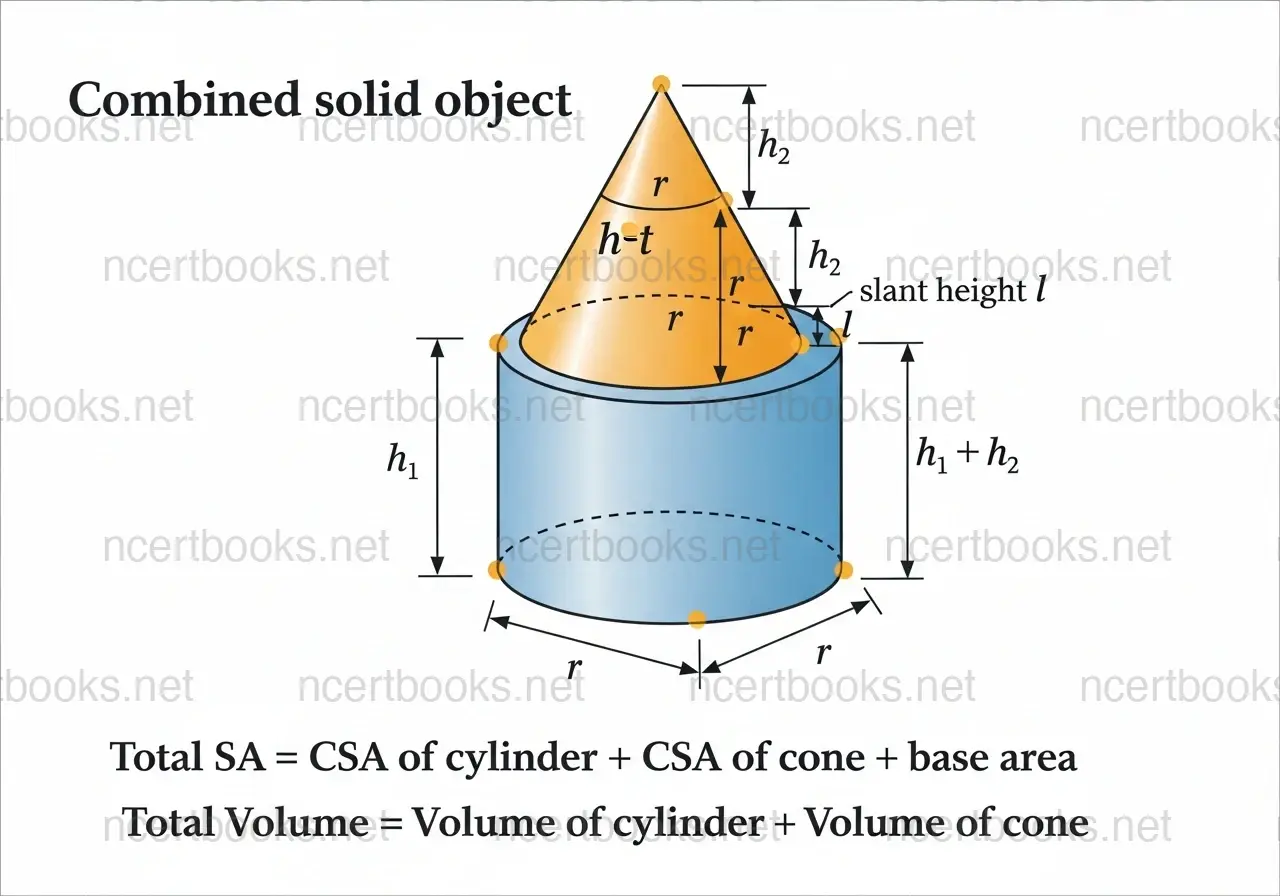
- Key Idea: Total volume = sum of volumes of individual component solids
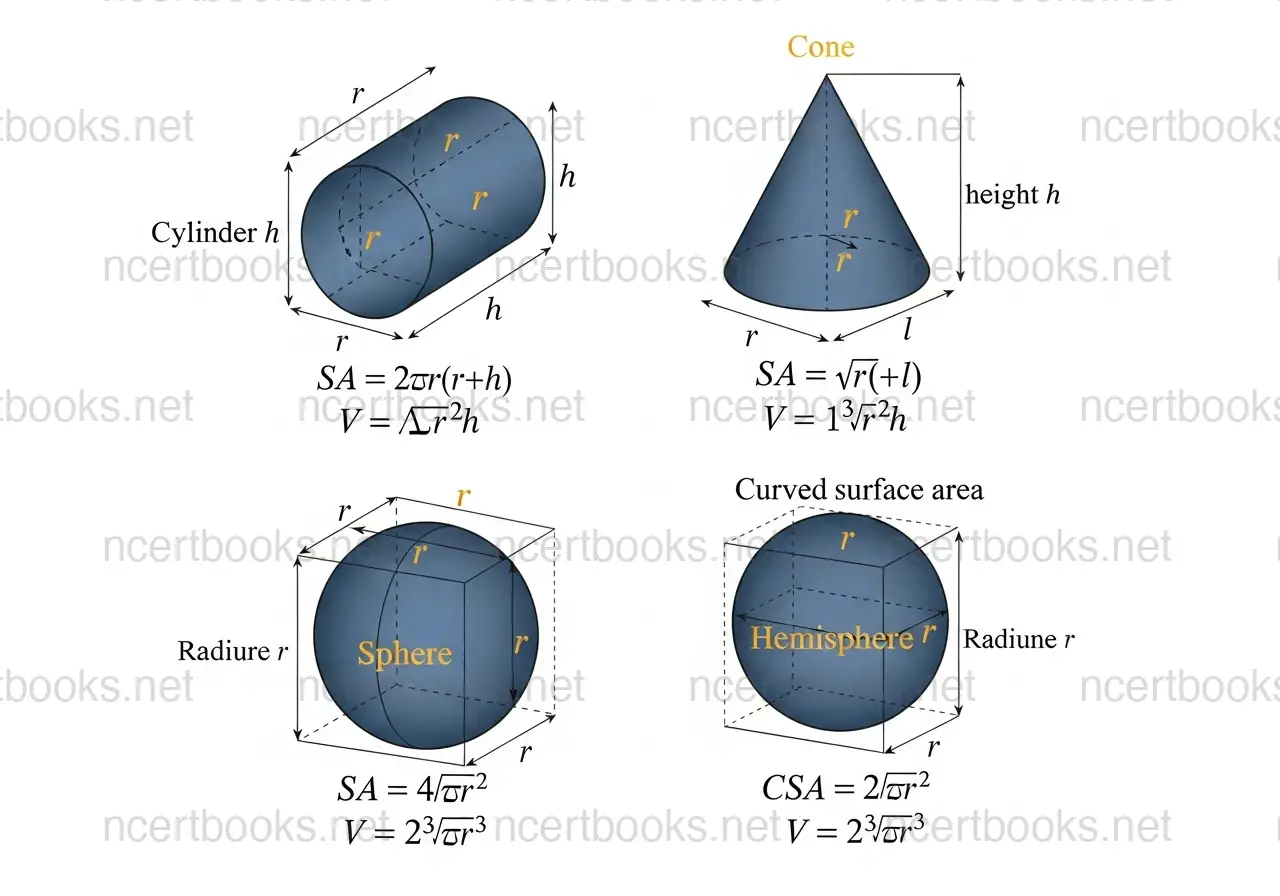
- Cone Volume: \( V = \frac{1}{3}\pi r^2 h \)
- Hemisphere Volume: \( V = \frac{2}{3}\pi r^3 \)
- Cylinder Volume: \( V = \pi r^2 h \)
- Sphere Volume: \( V = \frac{4}{3}\pi r^3 \)
- Number of Questions in Ex 13.2: 8 (all compulsory for CBSE 2026-27)
- Marks Weightage: Mensuration carries approximately 10 marks in CBSE Class 10 board exams
The NCERT Solutions for Class 10 Maths Chapter 13 Ex 13.2 cover all 8 questions on the volume of combination of solids — one of the most important topics for the 2026-27 CBSE board exam. You can find the complete NCERT Solutions for Class 10 on our platform. These step-by-step solutions follow the official NCERT official textbook and are prepared to help you score full marks in the Mensuration unit.
Exercise 13.2 builds on the surface area concepts from Exercise 13.1 and asks you to calculate volumes of real-world objects formed by combining two or more standard solids. For a complete set of NCERT Solutions across all classes and subjects, visit our main solutions hub.
Table of Contents
- Quick Revision Box
- Chapter Overview — Surface Areas and Volumes Class 10
- Key Concepts and Formulas for Exercise 13.2
- Formula Reference Table
- NCERT Solutions for Class 10 Maths Chapter 13 Ex 13.2 — All Questions
- Solved Examples Beyond NCERT
- Important Questions for Board Exam 2026-27
- Common Mistakes Students Make
- Exam Tips for 2026-27 CBSE Board
- Key Points to Remember
- Frequently Asked Questions
Chapter Overview — Surface Areas and Volumes Class 10 Maths
Chapter 13 of the NCERT Class 10 Maths textbook deals with Surface Areas and Volumes of various solid figures and their combinations. Exercise 13.2 specifically focuses on Volume of a Combination of Solids — where you find the total volume of an object made by joining two or more basic 3D shapes like cones, cylinders, hemispheres, and spheres.
This chapter is part of the Mensuration unit and carries significant marks in the CBSE Class 10 board exam. Questions from this exercise appear as 2-mark, 3-mark, and 5-mark problems. The cbse class 10 maths ncert solutions for this chapter demand careful reading of the problem to identify the component shapes correctly.
| Detail | Information |
|---|---|
| Chapter | Chapter 13 — Surface Areas and Volumes |
| Exercise | Exercise 13.2 |
| Textbook | NCERT Mathematics — Class 10 |
| Topic | Volume of a Combination of Solids |
| Number of Questions | 8 |
| Marks Weightage | ~10 marks (Mensuration unit) |
| Difficulty Level | Medium to Hard |
| Academic Year | 2026-27 |
Key Concepts and Formulas for Exercise 13.2
Before solving the questions, make sure you understand these core ideas. The central concept in Exercise 13.2 is that when two solids are combined, their total volume is the sum of their individual volumes. No volume is lost or gained when shapes are joined together (unlike surface area, where some area gets hidden).
Volume of a Combination of Solids
When a solid is formed by combining two or more solids, you simply add their volumes. For example, a toy rocket shaped like a cone on top of a cylinder has volume = Volume of cone + Volume of cylinder.
Volume by Subtraction
When a solid has depressions or hollow parts carved out, you subtract the volume of the removed part. For example, a wooden block with conical holes: Volume of wood = Volume of cuboid − (number of cones × volume of one cone).
Conversion of Solids
When a solid is melted and recast into another shape, the total volume remains the same. This principle is used in questions about lead shots, spheres recast into cylinders, etc.
Formula Reference Table — Surface Areas and Volumes Class 10
| Solid | Volume Formula | Variables |
|---|---|---|
| Cylinder | \( V = \pi r^2 h \) | r = radius, h = height |
| Cone | \( V = \frac{1}{3}\pi r^2 h \) | r = base radius, h = height |
| Sphere | \( V = \frac{4}{3}\pi r^3 \) | r = radius |
| Hemisphere | \( V = \frac{2}{3}\pi r^3 \) | r = radius |
| Cuboid | \( V = l \times b \times h \) | l = length, b = breadth, h = height |
NCERT Solutions for Class 10 Maths Chapter 13 Ex 13.2 — All Questions (2026-27)
Below are complete, step-by-step solutions to all 8 questions in Exercise 13.2. These ncert solutions for class 10 maths chapter 13 ex 13 2 are written to match the CBSE marking scheme exactly.
Question 1
Medium
A solid is in the shape of a cone standing on a hemisphere with both their radii being equal to 1 cm and the height of the cone is equal to its radius. Find the volume of the solid in terms of π.
Given: Radius of cone = Radius of hemisphere = \( r = 1 \) cm. Height of cone = \( h = r = 1 \) cm.
Step 1: Find the volume of the cone.
\[ V_{\text{cone}} = \frac{1}{3}\pi r^2 h = \frac{1}{3}\pi (1)^2(1) = \frac{\pi}{3} \text{ cm}^3 \]
Step 2: Find the volume of the hemisphere.
\[ V_{\text{hemisphere}} = \frac{2}{3}\pi r^3 = \frac{2}{3}\pi (1)^3 = \frac{2\pi}{3} \text{ cm}^3 \]
Step 3: Add both volumes to get the total volume of the solid.
\[ V_{\text{total}} = \frac{\pi}{3} + \frac{2\pi}{3} = \frac{3\pi}{3} = \pi \text{ cm}^3 \]
Why does this work? The cone sits on top of the flat face of the hemisphere. Their combined volume is simply the sum of the two individual volumes since no part overlaps in terms of space occupied.
\( \therefore \) Volume of the solid = \( \pi \) cm³
Question 2
Medium
Rachel, an engineering student, was asked to make a model shaped like a cylinder with two cones attached at its two ends by using a thin aluminium sheet. The diameter of the model is 3 cm and its length is 12 cm. If each cone has a height of 2 cm, find the volume of air contained in the model that Rachel made. (Assume the outer and inner dimensions of the model to be nearly the same.)
Given: Diameter = 3 cm, so radius \( r = 1.5 \) cm. Total length = 12 cm. Height of each cone \( h_{\text{cone}} = 2 \) cm.
Step 1: Find the height of the cylindrical part.
\[ h_{\text{cylinder}} = 12 – 2 – 2 = 8 \text{ cm} \]
Step 2: Calculate the volume of the cylinder.
\[ V_{\text{cylinder}} = \pi r^2 h = \pi (1.5)^2 (8) = \pi \times 2.25 \times 8 = 18\pi \text{ cm}^3 \]
Step 3: Calculate the volume of one cone.
\[ V_{\text{one cone}} = \frac{1}{3}\pi r^2 h = \frac{1}{3}\pi (1.5)^2 (2) = \frac{1}{3}\pi \times 2.25 \times 2 = 1.5\pi \text{ cm}^3 \]
Step 4: Volume of two cones.
\[ V_{\text{two cones}} = 2 \times 1.5\pi = 3\pi \text{ cm}^3 \]
Step 5: Total volume of the model.
\[ V_{\text{total}} = 18\pi + 3\pi = 21\pi \approx 21 \times 3.14 = 65.94 \text{ cm}^3 \approx 66 \text{ cm}^3 \]
Why does this work? The model is hollow (made of aluminium sheet), so the air volume equals the total interior volume — the cylinder plus both cones joined at each end.
\( \therefore \) Volume of air in Rachel’s model ≈ 66 cm³
Question 3
Medium
A gulab jamun contains sugar syrup up to about 30% of its volume. Find approximately how much syrup would be found in 45 gulab jamuns, each shaped like a cylinder with two hemispherical ends with length 5 cm and diameter 2.8 cm.
Given: Total length = 5 cm. Diameter = 2.8 cm, so radius \( r = 1.4 \) cm. Shape = cylinder + two hemispheres (one at each end).
Step 1: Find the height of the cylindrical part. The two hemispheres together form a complete sphere of diameter 2.8 cm, so their combined length = 2r = 2.8 cm.
\[ h_{\text{cylinder}} = 5 – 2 \times 1.4 = 5 – 2.8 = 2.2 \text{ cm} \]
Step 2: Volume of the cylindrical part.
\[ V_{\text{cylinder}} = \pi r^2 h = \pi (1.4)^2 (2.2) = \pi \times 1.96 \times 2.2 = 4.312\pi \text{ cm}^3 \]
Step 3: Volume of the two hemispherical ends (= one full sphere).
\[ V_{\text{sphere}} = \frac{4}{3}\pi r^3 = \frac{4}{3}\pi (1.4)^3 = \frac{4}{3}\pi \times 2.744 = \frac{10.976\pi}{3} \approx 3.659\pi \text{ cm}^3 \]
Step 4: Total volume of one gulab jamun.
\[ V_{\text{one}} = 4.312\pi + 3.659\pi = 7.971\pi \approx 7.971 \times 3.14 \approx 25.05 \text{ cm}^3 \]
Step 5: Total volume of 45 gulab jamuns.
\[ V_{\text{45}} = 45 \times 25.05 \approx 1127.25 \text{ cm}^3 \]
Step 6: Volume of syrup (30% of total volume).
\[ V_{\text{syrup}} = 30\% \times 1127.25 = \frac{30}{100} \times 1127.25 \approx 338.17 \text{ cm}^3 \approx 338 \text{ cm}^3 \]
Why does this work? The two hemispherical ends together make a complete sphere, which simplifies the calculation. Using \( \pi = 3.14 \) gives a practical numerical answer.
\( \therefore \) Volume of syrup in 45 gulab jamuns ≈ 338 cm³
Question 4
Medium
A pen stand made of wood is in the shape of a cuboid with four conical depressions to hold pens. The dimensions of the cuboid are 15 cm by 10 cm by 3.5 cm. The radius of each of the depressions is 0.5 cm and the depth is 1.4 cm. Find the volume of wood in the entire stand.
Given: Cuboid dimensions: \( l = 15 \) cm, \( b = 10 \) cm, \( h = 3.5 \) cm. Each conical depression: \( r = 0.5 \) cm, depth \( h_{\text{cone}} = 1.4 \) cm. Number of depressions = 4.
Step 1: Volume of the cuboid.
\[ V_{\text{cuboid}} = l \times b \times h = 15 \times 10 \times 3.5 = 525 \text{ cm}^3 \]
Step 2: Volume of one conical depression.
\[ V_{\text{one cone}} = \frac{1}{3}\pi r^2 h = \frac{1}{3} \times 3.14 \times (0.5)^2 \times 1.4 = \frac{1}{3} \times 3.14 \times 0.25 \times 1.4 \approx 0.3667 \text{ cm}^3 \]
Step 3: Volume of four conical depressions.
\[ V_{\text{4 cones}} = 4 \times 0.3667 \approx 1.4667 \approx 1.47 \text{ cm}^3 \]
Step 4: Volume of wood = Volume of cuboid − Volume of 4 cones.
\[ V_{\text{wood}} = 525 – 1.47 = 523.53 \text{ cm}^3 \]
Why does this work? The conical depressions are carved out of the wood, so we subtract their volume from the full cuboid volume.
\( \therefore \) Volume of wood in the pen stand ≈ 523.53 cm³
Question 5
Hard
A vessel is in the form of an inverted cone. Its height is 8 cm and the radius of its top, which is open, is 5 cm. It is filled with water up to the brim. When lead shots, each of which is a sphere of radius 0.5 cm are dropped into the vessel, one-fourth of the water flows out. Find the number of lead shots dropped in the vessel.
Given: Inverted cone: height \( h = 8 \) cm, radius \( r = 5 \) cm. Lead shot: sphere of radius \( r_{s} = 0.5 \) cm. One-fourth of water flows out.
Step 1: Find the total volume of the conical vessel (= volume of water initially).
\[ V_{\text{cone}} = \frac{1}{3}\pi r^2 h = \frac{1}{3}\pi (5)^2 (8) = \frac{1}{3}\pi \times 25 \times 8 = \frac{200\pi}{3} \text{ cm}^3 \]
Step 2: Find the volume of water that flows out (one-fourth of total).
\[ V_{\text{out}} = \frac{1}{4} \times \frac{200\pi}{3} = \frac{200\pi}{12} = \frac{50\pi}{3} \text{ cm}^3 \]
Step 3: Find the volume of one lead shot (sphere).
\[ V_{\text{shot}} = \frac{4}{3}\pi r_{s}^3 = \frac{4}{3}\pi (0.5)^3 = \frac{4}{3}\pi \times 0.125 = \frac{\pi}{6} \text{ cm}^3 \]
Step 4: The volume of lead shots dropped = volume of water displaced = volume of water that flowed out.
\[ n \times \frac{\pi}{6} = \frac{50\pi}{3} \]
\[ n = \frac{50\pi}{3} \times \frac{6}{\pi} = \frac{50 \times 6}{3} = \frac{300}{3} = 100 \]
Why does this work? When the lead shots are dropped into the full vessel, they displace an equal volume of water. The displaced water equals the volume of the lead shots. Since one-fourth of the water flows out, the total volume of lead shots equals one-fourth of the cone’s volume.
\( \therefore \) Number of lead shots dropped = 100
Question 6
Hard
A solid iron pole consists of a cylinder of height 220 cm and base diameter 24 cm, which is surmounted by another cylinder of height 60 cm and radius 8 cm. Find the mass of the pole, given that 1 cm³ of iron has approximately 8 g mass.
Given: Lower cylinder: height \( h_1 = 220 \) cm, diameter = 24 cm so radius \( r_1 = 12 \) cm. Upper cylinder: height \( h_2 = 60 \) cm, radius \( r_2 = 8 \) cm. Density = 8 g/cm³.
Step 1: Volume of the lower (larger) cylinder.
\[ V_1 = \pi r_1^2 h_1 = \pi (12)^2 (220) = \pi \times 144 \times 220 = 31680\pi \text{ cm}^3 \]
Step 2: Volume of the upper (smaller) cylinder.
\[ V_2 = \pi r_2^2 h_2 = \pi (8)^2 (60) = \pi \times 64 \times 60 = 3840\pi \text{ cm}^3 \]
Step 3: Total volume of the iron pole.
\[ V_{\text{total}} = 31680\pi + 3840\pi = 35520\pi \text{ cm}^3 \]
\[ V_{\text{total}} = 35520 \times 3.14 = 111532.8 \text{ cm}^3 \]
Step 4: Calculate the mass of the pole.
\[ \text{Mass} = V_{\text{total}} \times \text{density} = 111532.8 \times 8 = 892262.4 \text{ g} \]
\[ \text{Mass} \approx 892.26 \text{ kg} \]
Why does this work? The pole is a solid combination of two cylinders. The total volume is the sum of both cylinders’ volumes. Multiplying by the density of iron gives the total mass.
\( \therefore \) Mass of the iron pole ≈ 892.26 kg
Question 7
Hard
A solid consisting of a right circular cone of height 120 cm and radius 60 cm standing on a hemisphere of radius 60 cm is placed upright in a right circular cylinder full of water such that it touches the bottom. Find the volume of water left in the cylinder, if the radius of the cylinder is 60 cm and its height is 180 cm.
Given: Cone: height \( h_c = 120 \) cm, radius \( r = 60 \) cm. Hemisphere: radius \( r = 60 \) cm. Cylinder (full of water): radius \( R = 60 \) cm, height \( H = 180 \) cm.
Step 1: Volume of the cylinder (full of water initially).
\[ V_{\text{cylinder}} = \pi R^2 H = \pi (60)^2 (180) = \pi \times 3600 \times 180 = 648000\pi \text{ cm}^3 \]
Step 2: Volume of the cone part of the solid.
\[ V_{\text{cone}} = \frac{1}{3}\pi r^2 h_c = \frac{1}{3}\pi (60)^2 (120) = \frac{1}{3}\pi \times 3600 \times 120 = 144000\pi \text{ cm}^3 \]
Step 3: Volume of the hemisphere part of the solid.
\[ V_{\text{hemisphere}} = \frac{2}{3}\pi r^3 = \frac{2}{3}\pi (60)^3 = \frac{2}{3}\pi \times 216000 = 144000\pi \text{ cm}^3 \]
Step 4: Total volume of the solid placed in the cylinder.
\[ V_{\text{solid}} = V_{\text{cone}} + V_{\text{hemisphere}} = 144000\pi + 144000\pi = 288000\pi \text{ cm}^3 \]
Step 5: Volume of water left = Volume of cylinder − Volume of solid.
\[ V_{\text{water}} = 648000\pi – 288000\pi = 360000\pi \text{ cm}^3 \]
\[ V_{\text{water}} = 360000 \times 3.14 = 1130400 \text{ cm}^3 = 1.1304 \text{ m}^3 \]
Why does this work? When the solid is placed in the full cylinder, it displaces an equal volume of water. The remaining water volume = total cylinder volume − volume of the solid. Note that the solid fits perfectly: hemisphere (height = 60 cm) + cone (height = 120 cm) = 180 cm = height of cylinder.
\( \therefore \) Volume of water left in the cylinder = 1,130,400 cm³ ≈ 1.13 m³
Question 8
Hard
A spherical glass vessel has a cylindrical neck 8 cm long, 2 cm in diameter; the diameter of the spherical part is 8.5 cm. By measuring the amount of water it holds, a child finds its volume to be 345 cm³. Check whether she is correct, taking the above as the inside measurements, and π = 3.14.
Given: Cylindrical neck: length \( h = 8 \) cm, diameter = 2 cm so radius \( r_{\text{cyl}} = 1 \) cm. Spherical part: diameter = 8.5 cm so radius \( r_{\text{sph}} = 4.25 \) cm. \( \pi = 3.14 \). Child’s claim: 345 cm³.
Step 1: Volume of the cylindrical neck.
\[ V_{\text{cylinder}} = \pi r_{\text{cyl}}^2 h = 3.14 \times (1)^2 \times 8 = 3.14 \times 8 = 25.12 \text{ cm}^3 \]
Step 2: Volume of the spherical part.
\[ V_{\text{sphere}} = \frac{4}{3}\pi r_{\text{sph}}^3 = \frac{4}{3} \times 3.14 \times (4.25)^3 \]
\[ (4.25)^3 = 4.25 \times 4.25 \times 4.25 = 18.0625 \times 4.25 = 76.765625 \]
\[ V_{\text{sphere}} = \frac{4}{3} \times 3.14 \times 76.765625 = 4.1867 \times 76.765625 \approx 321.39 \text{ cm}^3 \]
Step 3: Total volume of the vessel.
\[ V_{\text{total}} = V_{\text{cylinder}} + V_{\text{sphere}} = 25.12 + 321.39 = 346.51 \text{ cm}^3 \]
Why does this work? The glass vessel is a combination of a sphere (the main body) and a cylinder (the neck). The total volume is the sum of both. We compare this calculated value with the child’s measurement of 345 cm³.
Comparison: The calculated volume ≈ 346.51 cm³, while the child measured 345 cm³. The difference is about 1.51 cm³, which is a small rounding difference due to using \( \pi = 3.14 \). The child’s answer is approximately correct but not exactly right.
\( \therefore \) Calculated volume ≈ 346.51 cm³. The child’s answer of 345 cm³ is not correct — the actual volume is approximately 346.51 cm³.
Solved Examples Beyond NCERT — Volume of Combination of Solids
These extra examples go slightly beyond the NCERT textbook and are excellent for CBSE board exam preparation. Practising these will strengthen your understanding of the ncert solutions for class 10 maths concepts in this chapter.
Extra Example 1
Medium
A toy is in the form of a cone of radius 3.5 cm mounted on a hemisphere of the same radius. The total height of the toy is 15.5 cm. Find the total volume of the toy. (Use π = 22/7)
Step 1: Radius \( r = 3.5 \) cm. Height of cone = Total height − radius of hemisphere = 15.5 − 3.5 = 12 cm.
Step 2: Volume of cone.
\[ V_{\text{cone}} = \frac{1}{3} \times \frac{22}{7} \times (3.5)^2 \times 12 = \frac{1}{3} \times \frac{22}{7} \times 12.25 \times 12 = 154 \text{ cm}^3 \]
Step 3: Volume of hemisphere.
\[ V_{\text{hemi}} = \frac{2}{3} \times \frac{22}{7} \times (3.5)^3 = \frac{2}{3} \times \frac{22}{7} \times 42.875 = 89.83 \text{ cm}^3 \]
Step 4: Total volume = 154 + 89.83 = 243.83 cm³
\( \therefore \) Total volume of toy ≈ 243.83 cm³
Extra Example 2
Medium
A medicine capsule is in the shape of a cylinder with two hemispheres stuck to each of its ends. The length of the entire capsule is 14 mm and the diameter of the capsule is 5 mm. Find its volume.
Step 1: Radius \( r = 2.5 \) mm. Two hemispheres = one sphere of diameter 5 mm. Height of cylinder = 14 − 2(2.5) = 9 mm.
Step 2: \( V_{\text{cylinder}} = \pi (2.5)^2 (9) = 56.25\pi \) mm³
Step 3: \( V_{\text{sphere}} = \frac{4}{3}\pi (2.5)^3 = \frac{4}{3}\pi \times 15.625 = \frac{62.5\pi}{3} \approx 20.833\pi \) mm³
Step 4: Total = \( (56.25 + 20.833)\pi = 77.083\pi \approx 242.13 \) mm³
\( \therefore \) Volume of capsule ≈ 242.13 mm³
Extra Example 3
Hard
How many spherical lead shots of diameter 4 cm can be made out of a solid cube of lead whose edge measures 44 cm?
Step 1: Volume of cube = \( 44^3 = 85184 \) cm³.
Step 2: Volume of one sphere (r = 2 cm) = \( \frac{4}{3}\pi (2)^3 = \frac{32\pi}{3} \approx \frac{32 \times 3.14}{3} \approx 33.49 \) cm³.
Step 3: Number of shots = \( \frac{85184}{33.49} \approx 2543 \) shots.
\( \therefore \) Number of spherical lead shots ≈ 2543
Important Questions for Board Exam 2026-27 — Class 10 Maths Chapter 13
These questions are frequently asked in CBSE board exams. Practising them will boost your confidence for the 2026-27 board exam.
1-Mark Questions
- What is the volume of a hemisphere of radius r? Answer: \( \frac{2}{3}\pi r^3 \)
- If a cone and a hemisphere have the same base radius r and the cone’s height equals r, what is the ratio of their volumes? Answer: 1:2
- A solid sphere of radius r is melted to form small spheres of radius r/2. How many small spheres are formed? Answer: 8
3-Mark Questions
- A solid is in the form of a cylinder with hemispherical ends. The total length is 19 cm and the diameter is 7 cm. Find the volume of the solid. Answer: Volume of cylinder (h=12, r=3.5) + sphere (r=3.5) = 462 + 179.67 = 641.67 cm³ (approx).
- A cone of height 24 cm and radius 6 cm is made up of modelling clay. A child reshapes it in the form of a sphere. Find the radius of the sphere. Answer: Volume of cone = \( \frac{1}{3}\pi(6)^2(24) = 288\pi \). Setting \( \frac{4}{3}\pi r^3 = 288\pi \), we get \( r^3 = 216 \), so \( r = 6 \) cm.
5-Mark Questions
- A well of diameter 3 m is dug 14 m deep. The earth taken out of it has been spread evenly all around it in the shape of a circular ring of width 4 m to form an embankment. Find the height of the embankment. Answer: Volume of earth = \( \pi(1.5)^2(14) = 31.5\pi \) m³. Embankment: outer radius = 1.5+4 = 5.5 m, inner radius = 1.5 m. Area of ring = \( \pi(5.5^2 – 1.5^2) = \pi(30.25-2.25) = 28\pi \). Height = \( \frac{31.5\pi}{28\pi} = 1.125 \) m.
Common Mistakes Students Make in Chapter 13 Exercise 13.2
These are the most frequent errors seen in CBSE board answer sheets. Avoid them to score full marks.
Mistake 1: Students use the total length of the model as the cylinder height in Question 2.
Why it’s wrong: The two cones are attached at the ends, so their heights must be subtracted from the total length to get the cylinder’s height.
Correct approach: Cylinder height = Total length − height of cone 1 − height of cone 2 = 12 − 2 − 2 = 8 cm.
Mistake 2: Students add the volume of water that flows out to the volume of lead shots instead of equating them.
Why it’s wrong: The lead shots displace water; the volume of displaced water equals the volume of lead shots, not the sum.
Correct approach: n × Volume of one lead shot = Volume of water displaced = (1/4) × Volume of cone.
Mistake 3: Students forget to convert diameter to radius before substituting in the volume formula.
Why it’s wrong: All volume formulas use radius, not diameter. Using diameter directly doubles the radius and gives a completely wrong answer.
Correct approach: Always write \( r = \frac{d}{2} \) as the first step when diameter is given.
Mistake 4: In Question 7, students forget to check that the solid height equals the cylinder height.
Why it’s wrong: If the solid is taller than the cylinder, the problem setup changes. Verifying this shows you understand the geometry.
Correct approach: Confirm: hemisphere radius + cone height = 60 + 120 = 180 cm = cylinder height. ✓
Mistake 5: Students compute the volume of two hemispheres as \( 2 \times \frac{2}{3}\pi r^3 \) but don’t simplify it to \( \frac{4}{3}\pi r^3 \) (one sphere).
Why it’s wrong: It’s not mathematically wrong, but it wastes time and risks arithmetic errors. Recognising that two hemispheres = one sphere speeds up the solution.
Correct approach: Two hemispheres of same radius = one full sphere. Use \( V = \frac{4}{3}\pi r^3 \) directly.
Exam Tips for 2026-27 CBSE Board — Chapter 13 Surface Areas and Volumes
- Show all steps: The CBSE 2026-27 marking scheme awards marks for each step — formula, substitution, simplification, and final answer. Never skip steps even if the answer is obvious.
- Write units: Always write cm³, m³, or the appropriate unit with your final answer. Missing units can cost you half a mark.
- Use π = 22/7 or 3.14: Use whichever value the question specifies. If not specified, use 22/7 for cleaner calculations with common radii.
- Identify component shapes first: Before calculating, write down the shapes that make up the solid. This helps you choose the right formulas and avoids confusion.
- Verify your answer: For mass/volume problems, check if your answer is reasonable. A 220 cm iron pole should weigh hundreds of kilograms — if you get grams, you’ve made an error.
- Practise Questions 5 and 7: These are the most frequently asked 5-mark questions from Exercise 13.2 in recent CBSE board papers. Master the displacement/subtraction approach.
Key Points to Remember — NCERT Class 10 Maths Chapter 13 Ex 13.2
- Volume of a combination of solids = sum of volumes of all component solids
- When a solid is placed in a full vessel, the volume of liquid displaced = volume of the solid
- Two hemispheres of the same radius together form one complete sphere
- For mass problems: Mass = Volume × Density
- Always convert diameter to radius before using any volume formula
- The height of the middle cylinder = total length − heights of the two end cones (or end hemispheres)
- These ncert solutions for class 10 maths are based on the NCERT Class 10 curriculum updated for 2026-27