Algebra Formula
Algebra formulas are standard rules that help you expand, factorise, and simplify expressions using variables like \(x, y, a, b\). In CBSE Maths, these formulas save time in identities, equations, polynomials, and quadratic problems. The most-used algebra formula is the square identity, which appears from middle school to board exams and competitive practice.
\[(a+b)^2 = a^2 + 2ab + b^2\]
What is Algebra?
Algebra is a branch of mathematics that uses letters (variables) to represent numbers and describes relationships between quantities. Instead of working only with specific values, algebra lets you form general rules like \(2x+3=11\) and solve for the unknown \(x\). This makes algebra powerful for real-life problems such as finding costs, ages, speed-time relations, and patterns in data.
In everyday life, algebra is used whenever you need to calculate an unknown. For example, if a shop gives a discount, you can represent the original price as \(x\) and write the final price formula. In science, algebraic expressions describe formulas like \(v=u+at\) and \(F=ma\). In mathematics, algebra formulas (identities) help you expand expressions, factorise quickly, and reduce calculations.
NCERT introduces algebraic expressions from Class 6 and builds up to Class 8–10 topics like identities, factorisation, linear equations, polynomials, and quadratic equations. In Class 11–12, algebra continues through sequences, series, and advanced manipulation. CBSE commonly tests algebra formulas in simplification, factorisation, and proof-based identity questions.
Main Algebra Formulas (Identities)
Algebra formulas are often written as identities that are true for all values of the variables.
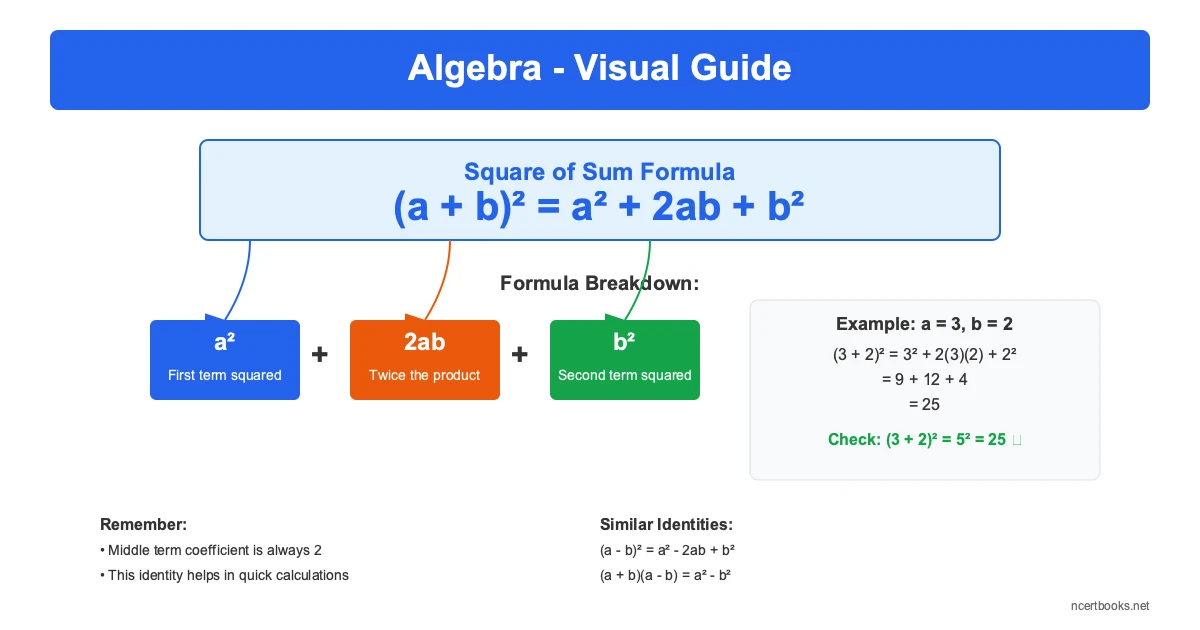
\[(a+b)^2 = a^2 + 2ab + b^2\]
- \(a, b\): variables (can be numbers, terms, or expressions)
- \((a+b)^2\): square of a binomial
- \(a^2, b^2\): squares of each term
- \(2ab\): twice the product (middle term)
Conditions / Notes:
- Algebraic identities work for all real values of \(a\) and \(b\).
- Use identities for fast expansion and factorisation.
- Keep brackets and signs correct, especially when terms contain negatives.
Important Algebra Formulas Table (CBSE)
| S.No | Name | Formula | When to Use |
|---|---|---|---|
| 1 | Square of Sum | \((a+b)^2=a^2+2ab+b^2\) | Expand \((a+b)^2\) or factorise reverse |
| 2 | Square of Difference | \((a-b)^2=a^2-2ab+b^2\) | Expand \((a-b)^2\) or factorise |
| 3 | Product of Sum and Difference | \((a+b)(a-b)=a^2-b^2\) | Difference of squares factorisation |
| 4 | Cube of Sum | \((a+b)^3=a^3+3a^2b+3ab^2+b^3\) | Expand cubes of binomials |
| 5 | Cube of Difference | \((a-b)^3=a^3-3a^2b+3ab^2-b^3\) | Expand \((a-b)^3\) or factorise |
| 6 | Sum of Cubes | \(a^3+b^3=(a+b)(a^2-ab+b^2)\) | Factorise expressions like \(x^3+8\) |
| 7 | Difference of Cubes | \(a^3-b^3=(a-b)(a^2+ab+b^2)\) | Factorise expressions like \(x^3-27\) |
| 8 | Three-variable Identity | \((a+b+c)^2=a^2+b^2+c^2+2ab+2bc+2ca\) | Expand \((a+b+c)^2\) |
| 9 | Quadratic Formula | \(x=\frac{-b\pm\sqrt{b^2-4ac}}{2a}\) | Solve \(ax^2+bx+c=0\) |
| 10 | Factor Theorem (Basic) | If \(p(\alpha)=0\), then \((x-\alpha)\) is a factor | Polynomials (Class 9–10+) |
| 11 | Remainder Theorem | Remainder on division by \((x-a)\) is \(p(a)\) | Polynomial division questions |
| 12 | Discriminant | \(D=b^2-4ac\) | Nature of roots of quadratic equation |
Algebra Formula Variants (with Examples)
1) Expansion Formulas (Square Identities)
Square identities help you expand quickly without multiplying term-by-term.
\[(a+b)^2=a^2+2ab+b^2\]
Example: \((x+5)^2=x^2+10x+25\).
2) Difference of Squares (Fast Factorisation)
Used to factorise expressions like \(x^2-49\).
\[(a+b)(a-b)=a^2-b^2\]
Example: \(x^2-49=(x+7)(x-7)\).
3) Cube Identities
Cube formulas are used in expansion and in factorisation of cubic expressions.
\[(a+b)^3=a^3+3a^2b+3ab^2+b^3\]
Example: \((x+2)^3=x^3+6x^2+12x+8\).
4) Sum/Difference of Cubes (Factorisation)
These are common in Class 9–10 algebra and higher-level polynomial questions.
\[a^3+b^3=(a+b)(a^2-ab+b^2)\]
Example: \(x^3+8=(x+2)(x^2-2x+4)\).
5) Quadratic Equation Formulas
Used to solve quadratic equations and analyze roots.
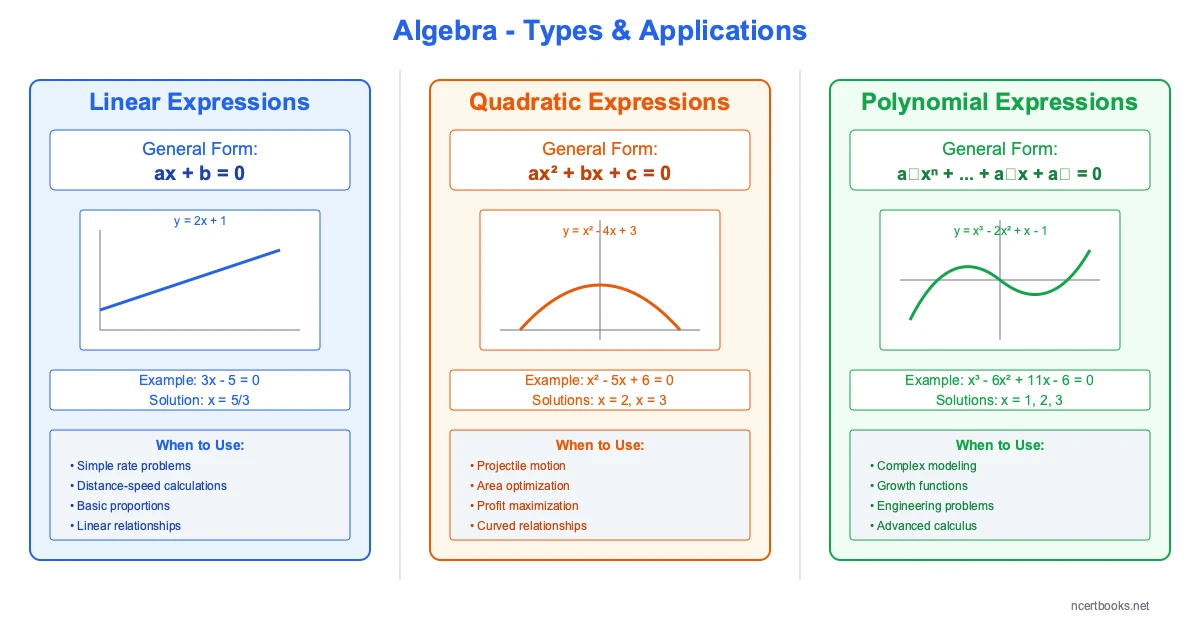
\[x=\frac{-b\pm\sqrt{b^2-4ac}}{2a}\]
Example: Solve \(x^2-5x+6=0\Rightarrow x=2,3\) (using factorisation or quadratic formula).
Derivation of a Key Algebra Formula
Let’s derive \((a+b)^2\) using basic multiplication.
Start with \((a+b)^2=(a+b)(a+b)\).
Multiply using distributive law: \((a+b)(a+b)=a(a+b)+b(a+b)\).
Expand each part: \(a(a+b)=a^2+ab\) and \(b(a+b)=ab+b^2\).
Add the results: \(a^2+ab+ab+b^2\).
Combine like terms: \(ab+ab=2ab\).
Therefore,
\[(a+b)^2=a^2+2ab+b^2\]
How to Use Algebra Formulas (Step-by-Step)
- Identify the pattern: check if expression matches a known identity (square, cube, difference of squares, etc.).
- Select the correct formula: choose \((a+b)^2\), \((a-b)^2\), \(a^2-b^2\), etc.
- Assign terms: clearly write what is \(a\) and what is \(b\) (or \(a,b,c\)).
- Substitute and expand/factor: replace \(a\), \(b\) into the formula.
- Simplify: combine like terms and arrange in standard form.
Quick Tip: When signs are confusing, rewrite \((a-b)\) as \((a+(-b))\). Then apply the “square of sum” idea carefully.
CBSE Class-wise Algebra (NCERT Reference)
Algebra starts early in NCERT and becomes a major scoring area from Class 8 onward. Here is a class-wise map for CBSE students.
Class 6 (NCERT Maths: Algebra Introduction)
- Focus: variables, simple expressions, forming expressions from statements.
- Example: “Add 5 to \(x\)” → \(x+5\).
Class 7–8 (NCERT Maths: Expressions, Identities, Linear Equations)
- Focus: simplification, basic identities, solving linear equations.
- Use: apply identities to expand and factorise.
Class 9 (NCERT Maths: Polynomials & Factorisation)
- Focus: identities, factor theorem basics, polynomial operations.
- Typical CBSE: factorisation using \(a^2-b^2\), \((a\pm b)^2\).
Class 10 (NCERT Maths: Quadratic Equations & Polynomials)
- Focus: quadratic equations, discriminant idea, factorisation methods.
- Formula: \(x=\frac{-b\pm\sqrt{b^2-4ac}}{2a}\), \(D=b^2-4ac\).
Class 11–12 (NCERT Maths: Advanced Algebra)
- Focus: sequences and series, complex numbers, higher manipulation.
- Skill: strong base of identities improves speed.
Download Free PDF: Algebra Formulas PDF (Class 6–12, CBSE)
Solved Examples on Algebra Formulas
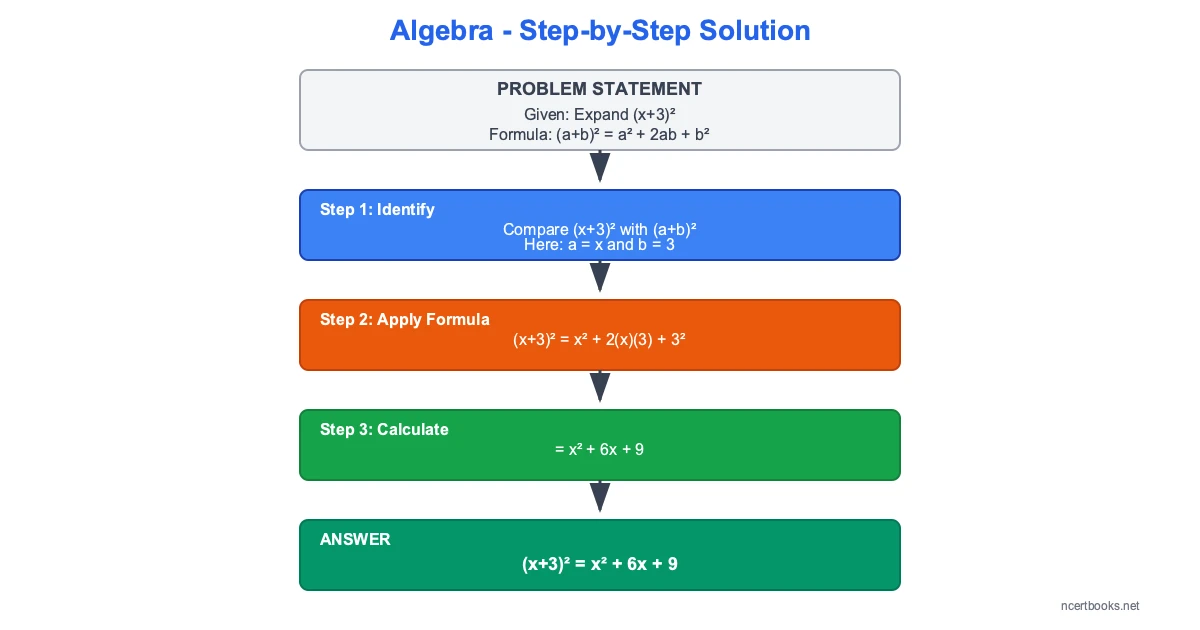
Example 1 (Easy): Expand Using \((a+b)^2\)
Given: Expand \((x+3)^2\).
Formula: \((a+b)^2=a^2+2ab+b^2\)
Steps: Take \(a=x\), \(b=3\). Then \((x+3)^2=x^2+2(x)(3)+3^2=x^2+6x+9\).
Answer: \(x^2+6x+9\)
Example 2 (Medium): Factorise Using Difference of Squares
Given: Factorise \(9y^2-16\).
Formula: \(a^2-b^2=(a+b)(a-b)\)
Steps: \(9y^2=(3y)^2\), \(16=4^2\). So \(9y^2-16=(3y+4)(3y-4)\).
Answer: \((3y+4)(3y-4)\)
Example 3 (Hard): Expand a Cube
Given: Expand \((2x-1)^3\).
Formula: \((a-b)^3=a^3-3a^2b+3ab^2-b^3\)
Steps: Take \(a=2x\), \(b=1\).
- \(a^3=(2x)^3=8x^3\)
- \(-3a^2b=-3(4x^2)(1)=-12x^2\)
- \(+3ab^2=3(2x)(1)=6x\)
- \(-b^3=-1\)
So \((2x-1)^3=8x^3-12x^2+6x-1\).
Answer: \(8x^3-12x^2+6x-1\)
Example 4 (Board Style): Solve a Quadratic Using Quadratic Formula
Given: Solve \(2x^2+3x-2=0\).
Formula: \(x=\frac{-b\pm\sqrt{b^2-4ac}}{2a}\)
Steps: \(a=2,\; b=3,\; c=-2\).
- \(D=b^2-4ac=3^2-4(2)(-2)=9+16=25\)
- \(x=\frac{-3\pm\sqrt{25}}{4}=\frac{-3\pm 5}{4}\)
- \(x=\frac{2}{4}=\frac{1}{2}\) or \(x=\frac{-8}{4}=-2\)
Answer: \(x=\frac{1}{2}\) and \(x=-2\)
Practice Problems on Algebra Formulas
Attempt these problems and check answers after solving.
- Expand \((x+7)^2\).
- Factorise \(a^2-25\).
- Expand \((3y-2)^2\).
- Factorise \(x^3+27\).
- Expand \((x+2)(x-2)\).
- Solve \(x^2-7x+12=0\).
- Find the discriminant of \(3x^2-4x+1=0\) and state the nature of roots.
- Simplify \((a+b+c)^2\).
Answers (Open to Check)
1) \(x^2+14x+49\)
2) \((a+5)(a-5)\)
3) \(9y^2-12y+4\)
4) \(x^3+27=(x+3)(x^2-3x+9)\)
5) \(x^2-4\)
6) \((x-3)(x-4)=0\Rightarrow x=3,4\)
7) \(D=b^2-4ac=(-4)^2-4(3)(1)=16-12=4\Rightarrow\) roots are real and distinct
8) \(a^2+b^2+c^2+2ab+2bc+2ca\)
Tips, Speed Tricks & Common Mistakes (Algebra)
Speed Trick
- Spot the pattern first: Before expanding, check if expression matches a standard identity like \((a+b)^2\) or \(a^2-b^2\). This saves time compared to full multiplication.
3 Common Mistakes
- ❌ Wrong middle term in square identity. ✓ \((a+b)^2\) has \(+2ab\), and \((a-b)^2\) has \(-2ab\).
- ❌ Forgetting brackets with negatives. ✓ Treat \((x-3)^2\) as \((x+(-3))^2\) and apply identity carefully.
- ❌ Using \(a^3+b^3\) formula for \(a^3-b^3\). ✓ Remember: plus uses \((a+b)(a^2-ab+b^2)\), minus uses \((a-b)(a^2+ab+b^2)\).
Classroom Tip
Maintain an “identity notebook” where you write each identity and one example for expansion and one example for factorisation. Revise it before exams to avoid sign errors.
Related Formula Topics
| S.No | Related Topic | Why Related | Link |
|---|---|---|---|
| 1 | Quadratic Formula | Used to solve quadratic equations in algebra. | /formulas/quadratic-formula/ |
| 2 | Factorisation Formula | Uses identities to factor expressions quickly. | /formulas/factorisation-formula/ |
| 3 | Polynomial Formula | Algebraic manipulation of polynomials. | /formulas/polynomial-formula/ |
| 4 | Discriminant Formula | Finds nature of roots of quadratic equations. | /formulas/discriminant-formula/ |
| 5 | Linear Equation Formula | Solving equations with one or two variables. | /formulas/linear-equation-formula/ |
| 6 | Exponents Laws | Used in simplifying algebraic expressions. | /formulas/exponents-laws-formula/ |
| 7 | Logarithm Formula | Advanced algebra simplification in Class 11–12. | /formulas/logarithm-formula/ |
| 8 | Arithmetic Progression Formula | Uses algebra to find \(n\)th term and sum. | /formulas/arithmetic-progression-formula/ |
Frequently Asked Questions on Algebra Formula
Algebra formulas are standard identities and rules used to expand, factorise, and simplify expressions with variables, such as \((a+b)^2=a^2+2ab+b^2\).
Square identities \((a+b)^2\) and \((a-b)^2\), and difference of squares \(a^2-b^2\) are among the most important for CBSE.
An identity is true for all values (like \((a+b)^2=a^2+2ab+b^2\)), while an equation is true only for specific values and needs solving (like \(2x+3=7\)).
Remember the middle term is negative: \((a-b)^2=a^2-2ab+b^2\). Treat \((a-b)\) as \((a+(-b))\) to avoid errors.
\(a^2-b^2=(a+b)(a-b)\). It is used for fast factorisation.
For \(ax^2+bx+c=0\), the solutions are \(x=\frac{-b\pm\sqrt{b^2-4ac}}{2a}\).
Discriminant is \(D=b^2-4ac\). It tells the nature of roots: \(D>0\) real distinct, \(D=0\) real equal, \(D<0\) non-real.
They appear from Class 6 onwards and are heavily used in Class 8–10 (identities, factorisation, polynomials, quadratic equations) and further in Class 11–12.
You can derive some formulas by multiplication, but memorizing key identities improves speed and accuracy, especially in board exams.
Make a one-page formula sheet and practice 2–3 problems for each identity. Regular revision reduces mistakes and improves speed.